
Quick Answer
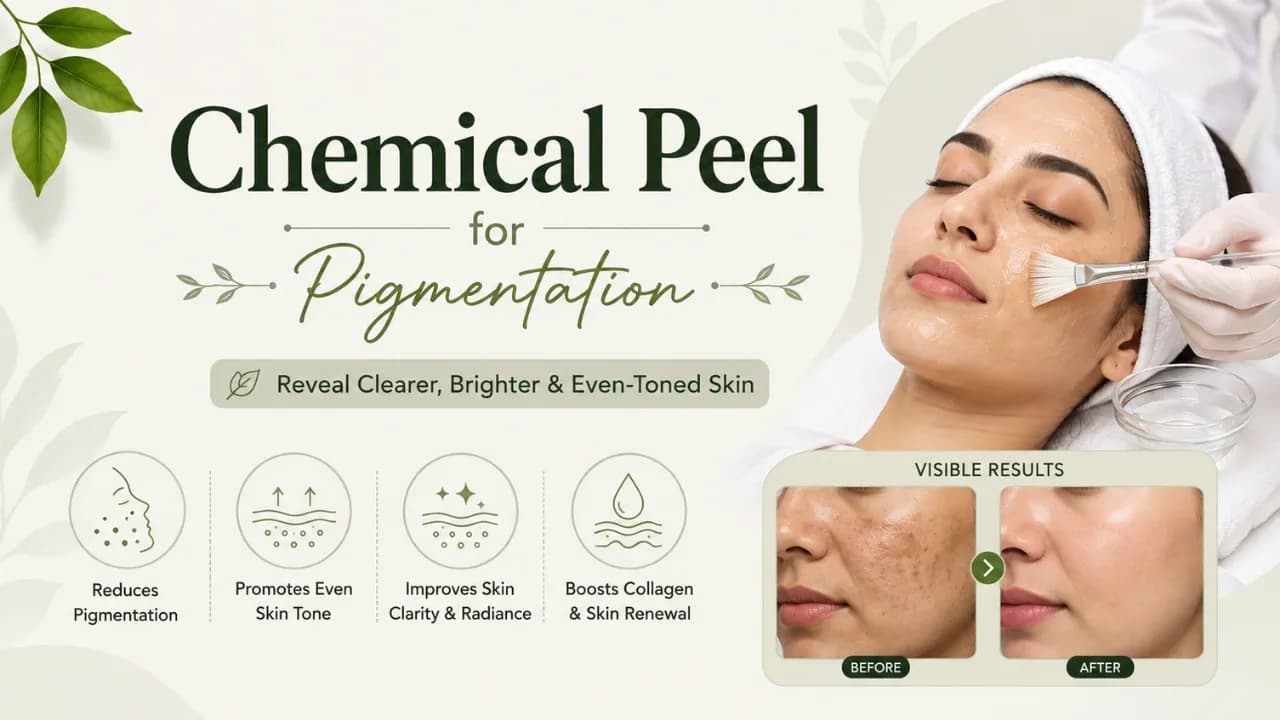
A structured course of 4-6 professionally administered chemical peels can reduce visible dark spots by 40-60% within 3-6 months, based on peer-reviewed clinical trial data. A single session produces some brightening, but lasting pigmentation reduction requires a full treatment course matched to your skin tone and pigmentation type. Chemical peels reduce pigmentation by removing melanin-loaded cells and slowing melanin production; they do not bleach the skin.
What Is a Chemical Peel for Pigmentation?
A chemical peel for pigmentation is a clinical skin treatment in which an acid solution is applied to the skin surface to exfoliate the outermost layers and reduce visible discolouration caused by excess melanin. When the treated skin peels away over 3-7 days, newer, more evenly pigmented skin replaces it.
Pigmentation problems occur when melanocytes, the pigment-producing cells, overproduce melanin in localised areas. Chemical peels target this excess melanin at the surface and in the deeper epidermal layers, depending on peel depth and formulation.
Key terms used throughout this guide:
- Hyperpigmentation: Darkening of skin patches due to excess melanin deposit
- Post-inflammatory hyperpigmentation (PIH): Dark spots left after acne, injury, or inflammation
- Melasma: Hormonally triggered pigmentation, often on the cheeks and forehead
- Solar lentigines: Sun spots caused by cumulative UV exposure
- Superficial / medium / deep peel: Classification by the number of skin layers targeted
- Melanin index: A measurable score used in clinical trials to quantify pigmentation severity
- Tyrosinase: The enzyme that triggers melanin overproduction; a key target for many peel acids
Chemical peels are one of the most evidence-backed in-clinic procedures for reducing surface and mid-layer hyperpigmentation across most skin types, provided the correct peel depth and acid type are selected. Correct acid selection for your Fitzpatrick skin type is one of the most important factors in both safety and outcome.
What Are the Key Benefits of a Chemical Peel for Pigmentation?
Chemical peels for pigmentation deliver both immediate and cumulative benefits when used as part of a structured skin treatment plan.
For readers comparing options for persistent marks, this guide to chemical peel for dark spots explains when peel-based treatment may be considered.
Short-term benefits (within 4 weeks):
- Visible reduction in surface dark spots, superficial peels can lighten epidermal melanin deposits within 2-4 weeks of a single session
- Smoother skin texture, acid exfoliation removes dead, keratinised cells that make pigmentation appear more pronounced
- Brighter overall complexion, increased cell turnover produces a more uniform skin tone in most patients
Long-term benefits (3-6 months):
- Significant reduction in melasma and PIH, studies suggest medium-depth peels can reduce melanin index scores by 40-60% over a course of 4-6 sessions
- Reduced recurrence of acne-related dark spots, peels containing salicylic acid also address the comedonal activity that causes PIH
- Collagen stimulation, medium and deep peels promote dermal remodelling, which may improve overall skin quality alongside pigmentation reduction
- Results can persist 6-12 months with proper sun protection and periodic follow-up peels
Who benefits most from chemical peels for pigmentation:
- Individuals with post-acne dark marks
- Those with sun damage and solar lentigines (age spots)
- Patients with mild to moderate melasma
- Anyone with uneven skin tone from past inflammation
Patients with Fitzpatrick skin types I-IV typically see the most predictable outcomes. Darker skin tones (types V-VI) can benefit but require lower-strength peels and careful monitoring to avoid post-peel PIH.
Chemical Peel for Dark Spots: How Peels Target Different Types of Discolouration
Not all dark spots are the same — and the peel that works for one type can worsen another. Understanding which category your dark spots fall into is the first step toward choosing the right treatment. Learn more about dark spots.
The three most common dark spot categories treated by peels:
- Post-inflammatory hyperpigmentation (PIH): Dark marks left after acne, a cut, or skin trauma. These sit primarily in the epidermis and respond well to superficial peels — salicylic acid (20–30%) for oily, acne-prone skin; mandelic acid for sensitive or darker tones.
- Solar lentigines (sun spots / age spots): Flat, well-defined brown patches from cumulative UV exposure. Glycolic acid (30–50%) has the strongest evidence base here. Medium-depth TCA peels are used for stubborn solar lentigines that don't respond to superficial treatment.
- Melasma-related dark patches: Diffuse, blotchy discolouration driven by hormonal signals, typically on the cheeks, upper lip, and forehead. Peels alone are insufficient — melasma requires combination therapy (peel + topical + sun protection).
Does a Chemical Peel Remove Dark Spots Permanently?
No — chemical peels reduce and fade dark spots rather than eliminating them permanently. PIH and sun spots can resolve with a full treatment course and consistent sun protection. Melasma is chronic and will return without ongoing management, because the hormonal trigger that causes it is not removed by the peel itself.
Citable one-liner: A chemical peel removes melanin-loaded cells from the skin surface; it does not switch off the signal that caused those cells to overproduce melanin in the first place.
How Many Sessions Does It Take to See Results on Dark Spots?
For mild PIH and surface sun spots: visible improvement after 2–3 sessions of superficial peels (spaced 2–4 weeks apart). For moderate melasma or deeper pigmentation: 4–6 sessions of medium-depth peels are typically required before MASI scores improve significantly, based on the clinical trial data reviewed in the melasma section below.
What Are the Types of Chemical Peels for Pigmentation?
Chemical peels for pigmentation are classified by depth, superficial, medium, or deep, and by the active acid used. The right choice depends on your pigmentation type, its severity, and your skin tone. Learn more about chemical peel treatment.
A broader overview of chemical peel treatment can help you understand how peel strength and acid type are selected.
Superficial Peels
Superficial peels penetrate only the outer epidermis. They are the most commonly used peel type for pigmentation in Indian skin tones and are safe for first-time patients.
- Common acids: Glycolic acid (20-35%), salicylic acid (20-30%), lactic acid (50%), mandelic acid (20-40%)
- Best for: Mild PIH, surface sun spots, early melasma, general uneven tone
- Downtime: Minimal, mild redness and flaking for 2-4 days
- Sessions needed: Typically 4-6 sessions, spaced 2-4 weeks apart
Medium-Depth Peels
Medium peels reach into the papillary dermis, making them effective for more stubborn pigmentation that has penetrated below the epidermis.
- Common acids: TCA (trichloroacetic acid) 20-35%, Jessner's solution
- Best for: Moderate melasma, deep acne scars with PIH, solar lentigines
- Downtime: 5-7 days of visible peeling and redness
- Sessions needed: 1-3 sessions, spaced 6-8 weeks apart
Deep Peels
Deep peels reach the mid-reticular dermis and are rarely used purely for pigmentation. They are typically reserved for severe cases under strict medical supervision.
- Common acids: Phenol, high-concentration TCA (>50%)
- Best for: Severe photoageing, deep pigmentation unresponsive to other treatments
- Downtime: 10-14 days; requires medical aftercare
- Sessions needed: Usually a single session
Comparison Table: Types of Chemical Peels for Pigmentation
| Peel Type | Depth | Best Pigmentation Use | Downtime | Sessions |
|---|---|---|---|---|
| Superficial (Glycolic, Salicylic, Mandelic) | Epidermis | Mild PIH, surface sun spots | 2–4 days | 4–6 |
| Medium (TCA 20–35%, Jessner's) | Papillary dermis | Melasma, moderate PIH | 5–7 days | 1–3 |
| Deep (Phenol, TCA >50%) | Mid-reticular dermis | Severe photoageing | 10–14 days | 1 |
Starting with superficial, lower-concentration peels on darker skin tones can reduce the risk of post-peel PIH, a known complication of aggressive treatment on Fitzpatrick types V and VI.
How Does a Chemical Peel for Pigmentation Work?
A chemical peel for pigmentation works by applying an acid solution that temporarily lowers the skin's pH, breaking down the protein bonds that hold dead and pigmented epidermal cells together. This triggers controlled exfoliation and activates the skin's natural repair processes. Learn more about chemical peel process day by day.
You can also review the chemical peel process day by day to understand what happens during application and recovery.
Step-by-step mechanism:
- Acid application: The dermatologist applies the chosen acid solution to clean, degreased skin. The acid immediately begins disrupting corneocyte adhesion, the molecular "glue" between skin cells.
- Controlled inflammation: The acid induces a mild, controlled inflammatory response. This signals the skin to accelerate cell turnover; the average 28-day cycle is shortened significantly.
- Melanin disruption: As the treated epidermis lifts and sheds over 3-7 days, the melanin pigment stored within those cells is physically removed from the skin.
- Inhibition of melanin overproduction: Some acids, particularly glycolic acid and mandelic acid, also interfere with the tyrosinase enzyme pathway, reducing future melanin synthesis at the cellular level.
- Regeneration: Fresher, more evenly pigmented keratinocytes migrate to the surface, producing a visibly clearer skin tone.
Why the mechanism works for different pigmentation types:
Surface-level pigmentation, such as sun spots and mild PIH, responds well to superficial peels because the excess melanin is confined to the stratum granulosum and stratum spinosum. Deeper pigmentation, as in melasma, requires medium-depth peels to reach melanocytes in the basal layer. This distinction between epidermal and deeper pigmentation guides how peel depth is matched to pigmentation type.
How to Prepare for a Chemical Peel and What to Do After: A Step-by-Step Guide
How you prepare for a chemical peel directly affects both the result and your risk of complications — particularly post-peel PIH, which is the most common adverse outcome in Indian skin tones. For a broader breakdown of possible reactions and recovery concerns, see chemical peel side effects.
Before Your Peel: Preparation Steps
- 1\. Prime your skin with retinol or AHAs for 2–4 weeks before the peel. Pre-conditioning the skin with low-concentration retinol (0.025–0.05%) or glycolic acid (5–10%) thins the stratum corneum and produces more even acid penetration. A 2018 study in Dermatologic Surgery found that primed skin showed 28% deeper peel penetration than unprimed skin at the same acid concentration.
- Stop retinoids 3–5 days before your appointment. Active retinoids thin the skin barrier immediately before treatment, which increases the risk of over-penetration and irritation. Your dermatologist will confirm the precise window.
- Avoid waxing, threading, or laser on the treatment area for 7–10 days prior. Any active skin trauma creates areas of compromised barrier that will absorb acid unevenly and may scar.
- Confirm your SPF routine is in place. You should already be applying broad-spectrum SPF 50 every morning before starting a peel series. Unprotected sun exposure in the 4 weeks before a peel significantly increases PIH risk post-treatment.
- Disclose all medications. Topical steroids, oral contraceptives, and isotretinoin all affect how your skin responds to acid. Your dermatologist needs this information to select the right peel strength.
On the Day of Your Peel
- Arrive with clean, makeup-free skin
- The dermatologist will degrease the skin with acetone or alcohol before applying the acid — this step ensures even penetration
- You will feel a mild tingling or burning sensation during application (normal); sustained stinging or significant pain should be reported immediately
- The peel is neutralised or removed after a set time depending on your skin's response
- Application to the full face typically takes 10–15 minutes; the total appointment is 30–45 minutes
After Your Peel: Days 1–7 Aftercare
- 1\. Do not wash your face for the first 4–6 hours after the peel — this allows the acid to complete its work without premature neutralisation.
- Use a gentle, fragrance-free cleanser only — no exfoliating acids, scrubs, or active ingredients for the first 7 days post-peel.
- Apply a bland, occlusive moisturiser (such as petroleum jelly or a ceramide cream) to support barrier recovery during visible peeling (days 3–5).
- Do not pick or peel the skin manually. Pulling away flaking skin before it naturally detaches increases the risk of PIH and scarring — particularly in Fitzpatrick types IV–VI.
- SPF 50 every morning without exception. Every peel removes the sun-protective dead skin layer. UV exposure on day 2 or 3 post-peel directly causes the melanin overproduction the peel was designed to reduce.
Common Mistakes That Reduce Results or Cause Complications
- Using vitamin C or niacinamide serum within 48 hours post-peel — active brightening ingredients on newly exfoliated skin cause irritation, not enhancement
- Getting a peel too frequently — waiting less than 2 weeks between superficial peels does not accelerate results; it compromises the barrier and increases PIH risk
- Skipping the maintenance phase — a single peel is rarely sufficient; skipping sessions 2–4 of a planned 6-session course produces a partial result and is a common reason treatment appears to 'not work'
Is a Chemical Peel Good for Melasma? What the Evidence Shows
Chemical peels are effective for melasma, but they are not the first line of treatment and are not sufficient on their own.
Why Melasma Is Harder to Treat Than Other Pigmentation
Melasma is driven by hormonal signals — oestrogen, progesterone, and sometimes thyroid hormones — that continuously stimulate melanocyte overactivity, particularly in response to UV exposure. Unlike PIH, which often resolves once the skin heals, melasma recurs because the underlying hormonal trigger is not removed by a peel.
This is the fundamental limitation of peels for melasma: they reduce visible pigmentation during treatment, but without ongoing management of the hormonal and UV triggers, recurrence is expected.
The Practical Protocol for Melasma
Based on the available evidence, dermatologists typically structure melasma peel treatment as follows:
- Pre-peel priming (4 weeks): Topical hydroquinone (2–4%) or kojic acid cream applied daily to reduce baseline melanin activity before the first peel
- Peel course (8–16 weeks): 4–6 sessions of salicylic-mandelic or glycolic acid peels, spaced 2–4 weeks apart
- Post-peel maintenance: Daily topical depigmentation agent (hydroquinone, azelaic acid, or kojic acid) resumed from day 10 post-peel, combined with SPF 50 every morning
- Long-term management: Addressing hormonal triggers where possible (e.g., discussing OCP alternatives with a gynaecologist if oral contraceptives are the suspected trigger)
Patients with melasma who do not use SPF 50 consistently between sessions should not expect a peel course to produce lasting results — UV exposure between sessions directly counteracts the peel's mechanism.
Chemical Peel for Pigmentation vs Other Treatments: Honest Comparison
Chemical peels are not always the best first-line treatment for pigmentation. Depending on the type and depth of your discolouration, other modalities may produce faster results, carry lower risk, or work better as a combination approach.
Citable one-liner: Chemical peels are the most cost-effective in-clinic option for mild-to-moderate pigmentation across most skin types; laser-based treatments outperform peels for deep, localised pigmentation but carry higher PIH risk in darker skin tones.
| Factor | Chemical Peel | Laser Toning | Topical Depigmentation | Microneedling |
|---|---|---|---|---|
| Best pigmentation | PIH, solar lentigines, mild-moderate melasma | Deep melasma, stubborn solar lentigines | Early PIH, mild uneven tone | PIH with texture concerns |
| Downtime | 2–7 days | 1–2 days | None | 1–3 days |
| PIH risk in darker skin | Moderate if mismatched | Moderate-to-high | Low | Low |
When a Chemical Peel Beats Alternatives
- PIH after acne: Salicylic acid peels address both the residual dark mark and the active comedonal activity causing new breakouts — something topicals and laser don't address simultaneously
- Cost-effective first course: A 4–6 session superficial peel course costs significantly less than an equivalent laser course for comparable initial results on mild-moderate pigmentation
- Combination with topicals: Peels accelerate topical penetration; combining a peel course with hydroquinone or kojic acid topicals produces results neither achieves alone
When to Choose Laser Over Peels
- Deep, well-defined solar lentigines that have not responded to 2–3 peel sessions
- Patients with Fitzpatrick type V–VI considering a medium or deep peel — PIH risk from aggressive acids may outweigh the benefit; laser toning with a skilled operator offers more controlled energy delivery
- Melasma that has recurred after a full peel course — persistent hormonally driven melasma often requires a combination of laser toning + topicals + hormonal management rather than repeat peeling
Cosmelan, Dermamelan, and MelanoPro: Specialist Peels for Stubborn Pigmentation
Standard glycolic or TCA peels are not the only clinical option for pigmentation. A category of multi-ingredient depigmentation systems — sometimes called combination peels or mask-based peels — has become the standard of care for recalcitrant melasma and deep pigmentation in many dermatology clinics.
Citable one-liner: Cosmelan, Dermamelan, and MelanoPro are combination depigmentation systems that pair an in-clinic application with a daily at-home maintenance phase — making them fundamentally different from single-session acid peels.
Cosmelan Peel
Cosmelan is a professional depigmentation system developed by Mesoestetic. The in-clinic mask contains a combination of kojic acid, phytic acid, arbutin, and retinol. It is applied in the clinic and left on for 6–10 hours, then removed at home. A maintenance cream is used daily for 3–6 months afterward.
- Best for: Moderate-to-severe melasma, post-acne PIH resistant to standard peels, widespread uneven tone
- Expected reduction: A 2020 study in the Journal of Cosmetic Dermatology reported a mean MASI score reduction of 73% at 6 months with the Cosmelan protocol, compared to 46% for standard TCA peels in the same study
- Downtime: 3–5 days of redness and visible peeling after the initial mask
- Cost (India, approximate): ₹15,000–₹35,000 for the initial session plus maintenance kit
Dermamelan Peel
Dermamelan (by Mesoestetic, marketed separately from Cosmelan) uses a similar multi-acid mask system with a higher concentration of azelaic acid and a stronger maintenance phase. It is typically reserved for more severe pigmentation.
- Best for: Severe melasma, hormonal pigmentation unresponsive to standard protocols
- Key difference from Cosmelan: Higher azelaic acid concentration; slightly more intensive initial reaction; intended for stubborn cases
- Cost (India, approximate): ₹20,000–₹45,000 for the full protocol
MelanoPro Peel (Dermalogica)
MelanoPro is a professional-grade peel system by Dermalogica combining retinol, lactic acid, and kojic acid in a layered application protocol. It is performed exclusively by trained skin therapists.
- Best for: Mild-to-moderate PIH, surface sun spots, general brightening
- Advantage: Less downtime than Cosmelan (1–2 days); suitable for patients who cannot take extended downtime
- Cost (India, approximate): ₹4,000–₹10,000 per session
Cosmelan vs Dermamelan vs Standard TCA: Quick Comparison
| Factor | Cosmelan | Dermamelan | TCA 20–35% |
|---|---|---|---|
| Active ingredients | Kojic, phytic, arbutin, retinol | Azelaic, kojic, phytic | Trichloroacetic acid |
| Best pigmentation | Moderate-severe melasma, PIH | Severe melasma | Moderate PIH, solar lentigines |
| Maintenance | 3–6 months daily cream | 3–6 months | SPF |
| Downtime | 3–5 days | 5–7 days | 5–7 days |
Who should consider a specialist depigmentation system: If standard superficial or medium-depth peels have produced limited results after a full course, or if your pigmentation is melasma-driven and has been present for more than one year, a Cosmelan or Dermamelan protocol is worth discussing with your dermatologist. These systems are not appropriate for at-home use.
What Results to Expect from a Chemical Peel for Pigmentation: A Month-by-Month Timeline
Results from a chemical peel course are gradual and cumulative — not dramatic after one session. Here is what most patients experience over a standard 4–6 session superficial peel course.
Citable one-liner: The majority of visible pigmentation reduction from a chemical peel course appears between weeks 8 and 16 — not in the first two weeks.
Week 1–2: Surface Brightening, Temporary Redness
After the first session, most patients see a mild brightening of the overall complexion as superficial dead cells shed over days 3–5. Individual dark spots may appear slightly lighter but this is primarily from the removal of surface keratinised cells, not from reduction in melanin production. Some patients notice temporary redness that resolves within 48–72 hours.
Week 4–8 (Sessions 2–3): Visible Reduction in Surface PIH
By the second or third session, post-acne dark spots and surface sun spots typically show a measurable reduction in colour intensity. The melanin index, a quantitative measure used in clinical studies, usually shows a 15–25% reduction at this stage for superficial PIH. Patients with melasma will see some improvement but rarely significant clearing at this stage.
Week 10–16 (Sessions 4–6): Significant Pigmentation Reduction
This is the window where the most meaningful results appear. Clinical trials on 4–6 session peel courses (glycolic 30–50% or mandelic 20–40%) report melanin index reductions of 40–60% in patients with mild-to-moderate PIH and solar lentigines. Skin tone appears more uniform; individual dark patches are visibly smaller and lighter.
Month 4–6: Maintenance and Durability
Results can persist for 6–12 months with consistent broad-spectrum SPF 50 use and avoidance of triggering factors (for melasma: sun, hormonal fluctuations; for PIH: active acne management). Without sun protection, pigmentation typically returns to baseline within 3–4 months — because UV exposure restimulates the melanocytes that the peel temporarily quieted.
Realistic Expectations: Who Sees the Best Results?
- Best responders: Fitzpatrick types I–IV with post-acne PIH or solar lentigines — 40–60% MASI reduction over a full course is a realistic expectation
- Moderate responders: Mild-to-moderate melasma on types I–IV with combination therapy (topical + peel + SPF) — 50–70% reduction possible but recurrence is common
- Partial responders: Fitzpatrick types V–VI with any pigmentation type — results are possible but require lower-concentration peels, longer courses, and very close monitoring to avoid post-peel PIH worsening the situation
Factors That Reduce Results
- Inconsistent SPF use between sessions (the single most common reason a peel course underperforms)
- Sessions spaced too close together (under 2 weeks for superficial, under 6 weeks for medium-depth)
- Hormonal triggers not addressed (melasma driven by oral contraceptives will recur after peeling if OCP is continued)
- Fitzpatrick skin type mismatch with peel concentration (using glycolic 50% on type V skin)
Frequently Asked Questions: Chemical Peel for Pigmentation
Q: How many sessions of chemical peel do I need to see a noticeable difference in pigmentation?
For mild PIH and sun spots, visible improvement often appears after 2–3 superficial peel sessions. Moderate melasma or deeper pigmentation usually needs 4–6 sessions.
Q: Can a chemical peel make pigmentation worse?
Yes. An overly strong or unsuitable peel can trigger post-inflammatory hyperpigmentation, especially in darker skin tones. Correct acid selection, aftercare, and SPF 50 reduce this risk.
Q: Is a chemical peel or laser better for pigmentation in Indian skin tones?
For mild-to-moderate pigmentation, superficial peels are often a safer first option. Deeper or stubborn pigmentation may respond better to laser, but treatment choice should be based on skin tone and pigmentation depth.
Q: Can I use a chemical peel if I am on hydroquinone or other topical depigmentation creams?
Yes, but timing matters. Depigmentation creams may need to be paused before treatment and restarted only after peeling settles. Follow the protocol given by your dermatologist.
Q: How is a cosmelan peel different from a regular glycolic or TCA peel for melasma?
Cosmelan is a multi-ingredient depigmentation system with an extended maintenance phase, while glycolic and TCA peels mainly work through controlled acid exfoliation.
Medical Disclaimer : Information from Kibo Hair Clinics is for educational purposes only. It does not replace diagnosis, trichoscopy, blood test interpretation, prescription treatment, procedure advice, or side-effect counselling from a qualified dermatologist or hair restoration doctor.