
Hair Transplant Graft Calculator
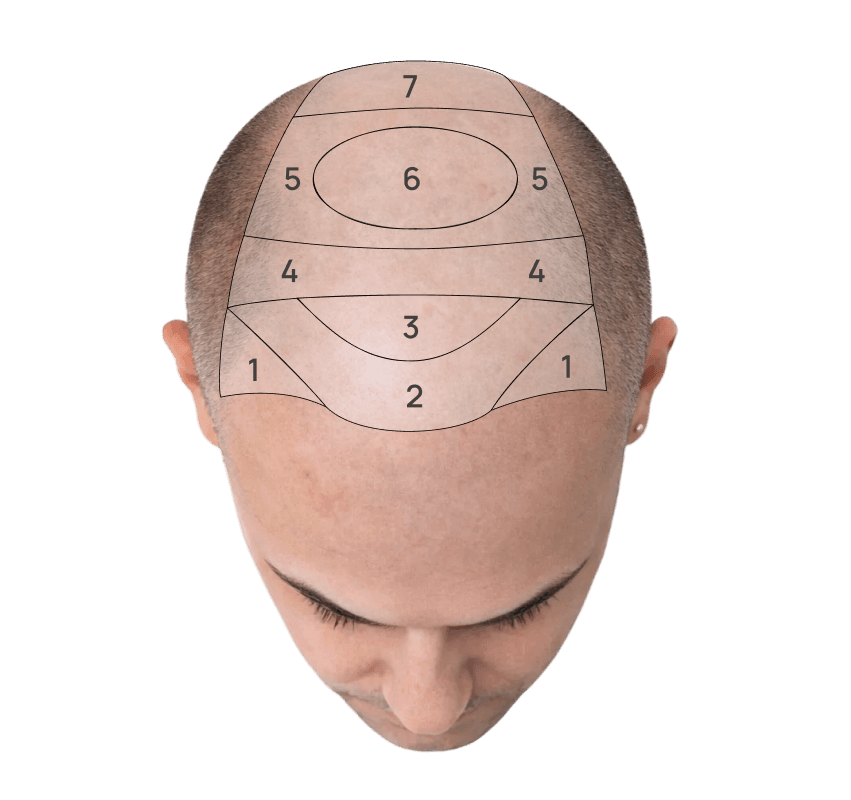
Click on the zones that represent your areas of hair loss
Click on the zones that represent your areas of hair loss

Understanding Hair
Grafts and Hair
Transplant Planning
Every hair transplant is different. The number of grafts you need depends on where you have lost hair, how dense your donor area is, and what kind of coverage will look natural on your scalp. This is why hair transplants are planned around graft numbers rather than fixed packages.
A graft is a naturally occurring unit of hair follicles. Each graft usually contains between one and four hairs. During a transplant, these grafts are taken from the donor area (usually the back and sides of the head) and placed into thinning or balding areas.
Your total graft requirement is what determines how much coverage can be created and how your final hairline and density will look.

Every hair transplant is different. The number of grafts you need depends on where you have lost hair, how dense your donor area is, and what kind of coverage will look natural on your scalp. This is why hair transplants are planned around graft numbers rather than fixed packages.
A graft is a naturally occurring unit of hair follicles. Each graft usually contains between one and four hairs. During a transplant, these grafts are taken from the donor area (usually the back and sides of the head) and placed into thinning or balding areas.
Your total graft requirement is what determines how much coverage can be created and how your final hairline and density will look.
What "Cost Per Graft"
Actually Reflects
When clinics talk about hair transplant cost per graft, they are not just referring to the hair itself. Each graft must be carefully extracted, stored, and implanted in a way that allows it to survive and grow in its new location.
This involves:
- Identifying healthy follicles in the donor area
- Extracting them without damaging the root
- Preserving them under controlled conditions
- Implanting them at the correct angle, depth, and direction
Every graft is handled individually, which is why surgical skill and clinic standards directly affect both results and cost.

When clinics talk about hair transplant cost per graft, they are not just referring to the hair itself. Each graft must be carefully extracted, stored, and implanted in a way that allows it to survive and grow in its new location.
This involves:
- Identifying healthy follicles in the donor area
- Extracting them without damaging the root
- Preserving them under controlled conditions
- Implanting them at the correct angle, depth, and direction
Every graft is handled individually, which is why surgical skill and clinic standards directly affect both results and cost.
What Affects How Many Grafts You May Need
Two people with similar looking hair loss can still need very different numbers of grafts. This is because graft requirement depends on multiple personal factors.
Some of the main ones include:
Extent and pattern of hair loss
Areas of thinning or higher Norwood grades require more grafts for balanced coverage.
Hair thickness and texture
Coarse or wavy hair gives more visual volume per graft, while fine hair may need more grafts for the same appearance of density.
Scalp size
A larger scalp area or tight skin can affect how many grafts can be safely placed.
Donor hair density
A strong donor area allows for better extraction without thinning the back or sides.
This is why a calculator can only provide an estimate. A clinical scalp examination is always needed for accuracy.
Two people with similar looking hair loss can still need very different numbers of grafts. This is because graft requirement depends on multiple personal factors.
Some of the main ones include:
Areas of thinning or higher Norwood grades require more grafts for balanced coverage.
Coarse or wavy hair gives more visual volume per graft, while fine hair may need more grafts for the same appearance of density.
A larger scalp area or tight skin can affect how many grafts can be safely placed.
A strong donor area allows for better extraction without thinning the back or sides.
This is why a calculator can only provide an estimate. A clinical scalp examination is always needed for accuracy.
How the Kibo Hair Graft Calculator Helps
The Kibo Hair Graft Calculator is designed to give you a practical starting point. By selecting the areas of hair loss on your scalp, you can see an approximate graft range based on typical patterns of thinning.
This helps you:

Visualise how much work may be required

Understand how coverage is built using grafts

Arrive at your consultation with more clarity
It does not replace a medical evaluation, but it makes the consultation more informed and focused.
The Kibo Hair Graft Calculator is designed to give you a practical starting point. By selecting the areas of hair loss on your scalp, you can see an approximate graft range based on typical patterns of thinning.
This helps you:
Visualise how much work may be required
Understand how coverage is built using grafts
Arrive at your consultation with more clarity
It does not replace a medical evaluation, but it makes the consultation more informed and focused.
How Hair Transplants Are Planned at
Kibo Clinics, Khar
At Kibo Clinics in Khar, Mumbai, grafts are not treated as numbers. Each graft is considered a living unit that needs to survive and grow for the result to look natural.
During your consultation, the surgeon will examine:
Your donor area strength

The quality of your existing hair

Pattern and stability of hair loss

Your scalp and hairline structure

Based on this, they determine how many grafts are needed and how they should be placed to achieve a result that looks balanced now and in the future.
The aim is not maximum grafts, but the right grafts in the right places.
At Kibo Clinics in Khar, Mumbai, grafts are not treated as numbers. Each graft is considered a living unit that needs to survive and grow for the result to look natural.
During your consultation, the surgeon will examine:
Your donor area strength
The quality of your existing hair
Pattern and stability of hair loss
Your scalp and hairline structure
Based on this, they determine how many grafts are needed and how they should be placed to achieve a result that looks balanced now and in the future.
The aim is not maximum grafts, but the right grafts in the right places.
Why an In-Person Consultation Matters
The calculator gives you an estimate. The consultation gives you the plan.
How hair transplant is planned at Kibo Clinics
- Your realistic graft range
- Which technique (FUE, DHI, etc.) suits your scalp
- How density will be distributed
- What kind of outcome you can expect
This allows you to make a decision based on medical assessment rather than guesswork.
The calculator gives you an estimate. The consultation gives you the plan.
At Kibo Clinics, the doctor will explain:
- Your realistic graft range
- Which technique (FUE, DHI, etc.) suits your scalp
- How density will be distributed
- What kind of outcome you can expect
This allows you to make a decision based on medical assessment rather than guesswork.