
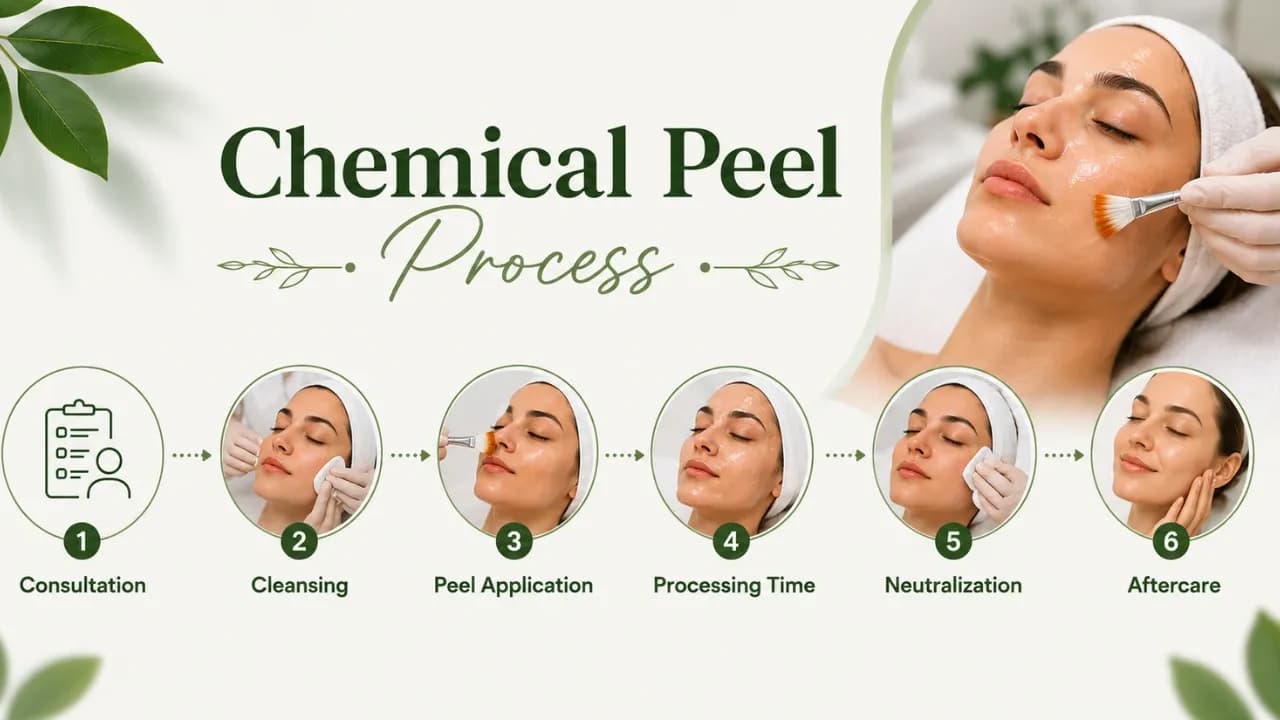
Quick Answer
The chemical peel process follows a predictable recovery sequence: day 1 commonly brings redness and tightness, days 2–3 bring dryness or bronzing, and days 3–5 are often the active peeling phase. Fresh skin becomes visible over roughly days 6–10. The supplied draft states that superficial peels generally recover in 3–5 days and medium-depth peels in 7–10 days, while collagen remodelling and longer-term improvements can continue for several months.
The chemical peel process day by day follows a predictable sequence: Day 1 brings redness and tightness, Days 2–3 see early dryness and bronzing, Days 3–5 are the active peeling phase, and by Days 6–10 fresh skin is revealed beneath. The full process takes 7–10 days for a medium-depth peel and 3–5 days for a superficial peel. Results such as smoother texture, reduced pigmentation, and improved tone continue developing for up to 3–6 months as collagen remodelling progresses.
Most people research chemical peels for the results, but it is the recovery that catches them unprepared. Understanding what is happening to your skin each day removes the anxiety, prevents the most common aftercare mistakes, and ultimately determines how well your results hold. This guide walks through the complete process from application to full skin renewal.
What Is a Chemical Peel and What Does the Day-by-Day Process Look Like?
A chemical peel is a skin treatment in which a chemical solution — typically containing glycolic acid, salicylic acid, lactic acid, trichloroacetic acid (TCA), or mandelic acid — is applied to the skin to remove the outermost damaged layers. The skin then heals from deeper layers upward, producing a newer, smoother, and more evenly toned surface.
The chemical peel process day by day refers to the sequential skin changes that occur after the peel is applied. Each day marks a distinct phase: initial redness (because the acid triggers an inflammatory response), progressive peeling (because the disrupted cells begin separating from the surface), sensitivity (because the new skin is exposed), and finally, skin renewal as the fresh epidermis matures.
Key Terms to Know
- Superficial peel: — targets the outer epidermis (stratum corneum to lower epidermis); recovery 3–5 days
- Medium peel: — reaches the upper dermis (papillary dermis); recovery 7–10 days
- Deep peel: — penetrates to the mid-dermis (reticular dermis); recovery 14–21 days
- Desquamation: — the medical term for the peeling and shedding of skin cells during recovery
- TCA frosting: — the visible white coating that appears during TCA application, confirming the acid has reached the intended depth
- Fitzpatrick scale: — a 6-point classification of skin tone used to assess peel risk and select appropriate acid types
Chemical Peel Stages: The 4 Phases Every Peel Goes Through
Every chemical peel — regardless of acid type or depth — moves through the same four biological stages. Understanding this sequence is what allows you to distinguish normal recovery from a warning sign.
1\. Inflammatory phase (Day 0–2): The acid triggers a controlled inflammatory response. Blood flow to the skin increases because the body recognises cellular disruption and sends repair signals. This is why redness and warmth appear immediately after application — not damage, but the start of repair.
2\. Desquamation phase (Days 2–7): Desquamation is the medical term for the visible peeling and shedding of dead skin cells. The acid has already done its work; what you see peeling is the result of protein disruption that occurred beneath the surface on Day 0. This phase lasts 3–5 days for superficial peels and 5–7 days for medium-depth peels.
3\. Re-epithelialisation phase (Days 5–14): Keratinocytes — the cells that form the skin's outer barrier — migrate upward from deeper layers to cover the exposed dermis. This is the phase where the skin looks pink and feels tight. It means the new epidermis is forming.
4\. Remodelling phase (Weeks 2–24): Fibroblasts in the dermis produce new collagen and elastin. This phase is invisible to the naked eye for weeks, but it is the reason chemical peel results continue improving for up to 3–6 months after the peel date.
Chemical peel results appear in two waves — visible renewal within 7–10 days, and deeper collagen remodelling that continues for up to 6 months.
Key Terms to Know
- Superficial peel: targets the outer epidermis; recovery 3–5 days
- Medium peel: reaches the upper dermis; recovery 7–10 days
- Deep peel: penetrates the mid-dermis; recovery 14–21 days
- Desquamation: is the medical term for the peeling and shedding of skin cells
How Does the Chemical Peel Process Work? The Complete Mechanism
A chemical peel works because the acid solution disrupts the bonds holding damaged and dead skin cells together — which is why the skin does not peel immediately on the day of application, but 2–5 days later.
Here is the causal chain:
1\. Acid application (Day 0): The chemical solution is applied evenly to cleansed skin. The acid penetrates to a depth determined by its concentration and type. This is why a higher percentage TCA causes deeper damage — and longer recovery — than a lower one.
2\. Protein disruption (Day 0, within minutes): The acid denatures structural proteins in the epidermal cells, breaking down the integrity of the outer skin layers. This happens beneath the surface before any visible change occurs — which is why the skin looks relatively normal immediately after treatment.
3\. Inflammatory response (Day 0–2): The skin triggers a mild inflammatory response, increasing blood flow to the area and sending repair signals to fibroblasts and keratinocytes. This is the biological cause of the redness and warmth you feel on day 1.
4\. Cell separation (Days 2–5): The damaged cells begin separating from the surface because the protein bonds holding them in place have been broken. This process is gradual, which is why peeling peaks around day 3–5, not day 1.
5\. Regeneration (Days 5–14): Keratinocytes migrate upward from the basal layer to form a fresh epidermal surface. Fibroblasts in the dermis begin producing new collagen — the biological reason skin looks progressively firmer and smoother in the weeks following a peel.
6\. Remodelling (Weeks 2–24): New collagen matures and organises. This phase is invisible externally, but it is why results from a medium-depth peel continue improving for up to 6 months after the treatment date.
Peeling begins 2–5 days after a chemical peel because the acid disrupts protein bonds beneath the skin surface on day 0, and the damaged cells need 2–5 days to fully separate and shed.
How Can You Support — Not Rush — Recovery?
Recovery can be optimised, not accelerated. Applying a fragrance-free, barrier-repair moisturiser (containing ceramides, glycerin, or petrolatum) twice daily keeps the skin hydrated, which can reduce peeling duration by 1–2 days by preventing the skin from drying and cracking before it is ready to shed naturally. Avoiding sun exposure, not picking peeling skin, and staying off retinoids and exfoliants for at least 7–10 days post-peel are the most consistently evidence-supported recovery strategies.
Chemical Peel Process Day by Day: What Happens Each Day
Here is what typically occurs at each stage across the most common medium-depth peel. Superficial peel timelines are compressed by approximately half.
Chemical Peel Aftercare Day by Day: What to Do at Each Stage of Recovery
Recovery determines results. The chemical peel does the structural work in the first 30 minutes of application. Everything after that — the smoothness, the tone correction, the collagen quality — depends on how you care for the skin during each day of healing.
Day 0 (Treatment Day)
- Do: Apply the fragrance-free barrier cream your clinician provides immediately after the peel. Keep it on.
- Do not: Wash your face for the first 4–6 hours unless specifically instructed.
- Do not: Apply any other product — no serum, no toner, no SPF spray (only mineral SPF if going outdoors).
- Why this matters: The skin barrier is temporarily compromised. Any product with an active ingredient (vitamin C, niacinamide, fragrance) will penetrate much deeper than intended and increase irritation risk.
Days 1–2
- Do: Cleanse once daily with a non-foaming, pH-neutral cleanser using lukewarm water and your fingertips only.
- Do: Apply a thick, bland moisturiser (look for ingredients: ceramides, glycerin, petrolatum) 2–3 times daily.
- Do: Sleep on a clean pillowcase elevated slightly (an extra pillow reduces overnight swelling).
- Do not: Use hot water on your face. Heat increases inflammation and can extend redness duration by days.
- Do not: Wear makeup. Foundation introduces bacteria to a compromised skin barrier.
Days 3–5 (Active Peeling Phase)
This is the most critical window. Manual peeling — pulling away sheets of skin — is the single most common cause of post-peel scarring and pigmentation.
- Do: Moisturise every 4–6 hours during peak shedding (day 5). Keeping the skin hydrated reduces the tightness sensation that drives the urge to pull.
- Do: Apply a thin layer of Vaseline or petrolatum to areas of tightest peeling (lips, chin, corners of nose) if your clinician approves.
- Do not: Pull, pick, scratch, or rub peeling skin. Even dead-seeming skin is still attached to the fresh dermis beneath.
- Do not: Exercise with high intensity. Sweating introduces salt and bacteria to open skin.
Days 6–10 (New Skin Phase)
- Do: Begin daily SPF 50 application — mineral SPF (zinc oxide or titanium dioxide) is preferred because chemical UV filters can irritate healing skin.
- Do: Reintroduce a gentle, hydrating serum (hyaluronic acid only — no actives yet).
- Do not: Introduce retinol, vitamin C, AHAs, BHAs, or any exfoliant until day 10 minimum, and only if skin is fully healed.
- Do not: Book a facial, wax, threading, or any other skin treatment within 2 weeks of your peel.
Week 2 and Beyond
- Do: Gradually reintroduce your active skincare routine, starting with the mildest active first.
- Do: Book your follow-up appointment so your clinician can assess healing and recommend timing for your next peel session.
- SPF is now your most important product.: New skin has no built-up melanin protection. A single unprotected sun exposure during weeks 1–4 can undo pigmentation correction results entirely.
| Day Range | Must Do | Must Avoid |
|---|---|---|
| Day 0 | Barrier cream only | Active products, hot water |
| Days 1–2 | Gentle cleanse, thick moisturiser | Makeup, hot showers |
| Days 3–5 | Moisturise every 4–6 hrs | Picking, intense exercise |
| Days 6–10 | SPF 50 daily, hyaluronic acid | Retinol, AHAs, BHAs, exfoliants |
| Week 2+ | Gradual reintroduction of actives | Facial treatments, waxing |
Day 1: Redness and Tightness
The skin appears red, feels tight, and may look sunburned. Some patients experience mild swelling, particularly around the eyes and cheeks. This is a normal inflammatory response. No peeling occurs yet. Avoid washing with anything other than a gentle, non-foaming cleanser.
Day 2–3: Increased Sensitivity and Early Peeling Begins
The skin begins to feel dry and may appear darker or bronzed in patches, a sign that the outer layers are preparing to shed. Very fine surface peeling may begin around the corners of the mouth, nose, and chin, which are thinner-skin areas. Sensitivity to touch increases. Continue moisturising; avoid makeup if possible.
Day 3–4: Active Peeling Phase
This is the most visually significant period. Larger sheets or patches of skin begin to peel, particularly across the cheeks, forehead, and jaw. The skin underneath may look pink and raw. Do not pull or peel skin manually, as premature removal increases scarring risk significantly, according to dermatology guidelines.
Day 5: Peak Shedding
Day 5 is typically the most intense peeling day for medium-depth peels. The face may look uneven, with some areas fully peeled, others still shedding. Applying a thick, bland moisturiser every 4–6 hours significantly reduces discomfort. Most patients report that the skin feels itchy at this stage; antihistamines may be recommended by a physician.
Day 6–7: Peeling Slows, New Skin Visible
By day 6–7, peeling slows considerably. Areas that have finished peeling reveal fresh, pink, smooth skin underneath. The overall complexion may look uneven while remaining patches continue to shed. Sun protection becomes critical at this stage because new skin has no melanin protection built up yet and burns easily.
Week 2: Results Start Showing
By day 10–14, the majority of peeling is complete for superficial and medium peels. The skin appears brighter, smoother, and more even in tone. Mild redness or pinkness may persist for an additional 2–4 weeks. Full collagen remodelling results, including improved firmness and reduced fine lines, continue developing over 1–3 months.
Prerequisites Before Starting a Chemical Peel
- Consult a qualified dermatologist or licensed aesthetician
- Discontinue retinoids and exfoliants 5–7 days prior
- Avoid sun exposure for at least 2 weeks before the peel
- Inform your provider of any cold sore history (antiviral prophylaxis may be needed)
- Complete a patch test if recommended
Common Mistakes to Avoid
- Picking or peeling skin manually
- Applying active ingredients (vitamin C, retinol, AHAs) during recovery
- Skipping SPF 30+ daily during and after healing
- Using hot water on the face
- Missing follow-up appointments
Key Benefits of a Chemical Peel: What You Actually Gain
Chemical peels deliver measurable benefits when performed correctly and supported by proper aftercare.
Short-Term Benefits (Days 7–30)
- Smoother skin texture within 7–10 days of peeling completion
- Reduction in surface dullness and uneven tone
- Decreased appearance of clogged pores and mild acne lesions
- Brighter, more radiant complexion
Long-Term Benefits (Months 1–6)
- chemical peel for pigmentation can help reduce hyperpigmentation. Studies show medium-depth peels reduce melasma severity by 40–60% after 3 sessions
- Improved fine lines and wrinkle depth through collagen stimulation
- Diminished acne scarring, particularly post-inflammatory hyperpigmentation. For recovery risks and complications, see chemical peel side effects
- Firmer skin texture due to new collagen matrix formation
Who Benefits Most from a Chemical Peel
- Individuals with mild-to-moderate hyperpigmentation or sun damage
- People with acne-prone or congestion-prone skin
- Those with early signs of ageing (fine lines, texture changes)
- Patients with uneven skin tone seeking a non-invasive correction
Clinical Note
Patients with consistent post-peel sun protection achieve significantly better long-term results than those who skip SPF. SPF 30+ applied daily is the single most protective aftercare step available.
Chemical Peel Results: What to Expect and When
| Timeframe | What to Expect |
|---|---|
| Days 1–3 | Redness, tightness, minimal peeling |
| Days 3–7 | Active peeling, sensitivity, uneven appearance |
| Week 2 | Peeling complete, fresh skin visible, mild pink tone |
| Month 1 | Smoother texture, improved tone, reduced breakouts |
| Month 3 | Collagen remodelling visible; fine lines softer |
| Month 6 | Maximum pigmentation correction and firmness |
What Does the Research Say About Chemical Peel Results?
The clinical evidence for chemical peels is well-established, particularly for pigmentation and acne scarring. Here is what the most frequently cited research shows.
Melasma and hyperpigmentation: A 2019 study published in the Journal of the American Academy of Dermatology found that a series of three medium-depth TCA peels at 25% reduced Melasma Area and Severity Index (MASI) scores by 44% on average over 12 weeks. Patients with consistent post-peel SPF 50 use showed significantly better maintenance of results at the 6-month follow-up than those without.
Acne and post-inflammatory hyperpigmentation (PIH): A clinical review in the Journal of Cutaneous and Aesthetic Surgery (2015) concluded that 20–30% salicylic acid peels reduced inflammatory acne lesion counts by an average of 47–75% after a series of four peels spaced 4 weeks apart. The same review noted that salicylic acid peels carry a significantly lower risk of PIH in darker skin tones (Fitzpatrick IV–VI) compared to glycolic acid at equivalent concentrations.
Fine lines and collagen remodelling: Research published in the Dermatologic Surgery journal demonstrated that medium-depth TCA peels produced measurable new collagen deposition at 30 and 90 days post-treatment, with collagen density continuing to increase at 6 months. This explains why chemical peel patients often report that their skin looks progressively better for months after the procedure.
Key takeaways from the evidence:
- Results for pigmentation are best maintained with consistent daily SPF 50+ use
- A series of peels produces superior outcomes to a single session for most concerns
- Salicylic acid peels are the evidence-backed choice for acne-prone skin across skin tones
- Collagen remodelling from medium-depth peels continues improving outcomes for up to 6 months
Factors That Affect Results
- Peel depth: : Deeper peels produce more dramatic results but require longer recovery
- Skin type: : Darker skin tones (Fitzpatrick IV–VI) carry a higher risk of post-inflammatory hyperpigmentation and require adjusted protocols
- Aftercare compliance: : Consistent SPF use and moisturisation are the single biggest controllable factors in outcome quality
- Number of sessions: : Most dermatologists recommend a series of 3–6 superficial peels, or 1–2 medium peels, for optimal results
- Pre-existing skin conditions: : Active rosacea, eczema, or open wounds contraindicate peeling
How Long Does It Take to Look Normal After a Chemical Peel?
Most patients look presentable (with minimal visible peeling) by day 7–10 after a medium peel, and by day 3–5 after a superficial peel. Full redness resolution may take 2–4 additional weeks.
Chemical Peel vs. Alternative Skin Treatments: An Honest Comparison
| Treatment | Downtime | Depth of Effect | Best For | Sessions Needed |
|---|---|---|---|---|
| Superficial Chemical Peel | 3–5 days | Epidermis | Mild texture, dullness | 3–6 per year |
| Medium Chemical Peel (TCA) | 7–10 days | Upper dermis | Pigmentation, fine lines | 1–2 per year |
| Microdermabrasion | 0–1 days | Stratum corneum | Very mild texture | 6–12 per year |
| face laser treatment cost | 10–21 days | Dermis | Deep wrinkles, scars | 1–3 per year |
| Dermapen Microneedling | 2–4 days | Full dermis | Scars, collagen loss | 3–6 per year |
Chemical Peel Cost in India: What to Expect and What Affects the Price
Chemical peel pricing in India varies significantly based on three factors: the depth of the peel, the acid type and concentration, and the clinic's location and expertise. Here is a realistic range to help you plan.
| Peel Type | Typical Cost (India) | Sessions Recommended | What's Included |
|---|---|---|---|
| Superficial peel (glycolic/salicylic) | ₹1,500–₹4,000/session | 4–6 per year | Application, neutralisation, post-peel cream |
| Medium-depth peel (TCA 20–35%) | ₹4,000–₹12,000/session | 1–2 per year | Consultation, application, aftercare kit |
| Deep peel (phenol) | ₹15,000–₹40,000+ | Once or rarely twice | Medical monitoring, sedation, full aftercare |
What drives the price higher:
- Higher acid concentration (TCA 35% vs TCA 20%)
- Dermatologist-performed vs aesthetician-performed
- Tier 1 metro city clinics vs Tier 2 city
- Inclusion of an aftercare kit or follow-up consultation
- Specialised formulations (sequential peels, combination peels)
Is a chemical peel worth the cost?
For mild-to-moderate pigmentation, acne, and texture concerns, a course of superficial to medium-depth peels typically costs less than equivalent laser or microneedling courses while producing comparable results for the right candidate. The most important investment is in the post-peel aftercare: SPF 50 used daily for 3–6 months after each peel protects the results you have paid for.
If your concern is more advanced — significant scarring, deep lines, or severe pigmentation — a dermatologist consultation will help determine whether a chemical peel alone is sufficient or whether it should be part of a combination approach. At Kibo Clinics, a pre-treatment consultation includes a personalised assessment of your skin type, concern depth, and which peel formulation is appropriate — before any treatment is recommended.
Which Is Best for Your Situation?
- For mild pigmentation and glow: superficial peel or microdermabrasion
- For moderate sun damage and fine lines: medium TCA peel
- For deep wrinkles or significant scarring: laser resurfacing or deep peel (with a dermatologist)
- For active acne management: salicylic acid superficial peels
- For collagen and scar remodelling: derma roller for face may complement peels when professionally planned.
Important Note
Combining peels with laser or microneedling too close together significantly increases complication risk. Always follow professional guidance before combining treatment modalities.
Is a Chemical Peel Right for You? Ideal Candidates vs. Not Ideal
| Ideal For | Not Ideal For |
|---|---|
| Fitzpatrick skin types I–III | Active skin infections or open wounds |
| Mild-to-moderate hyperpigmentation | Pregnant or breastfeeding individuals |
| Fine lines and uneven texture | History of keloid scarring |
| Acne-prone, congestion-prone skin | Very dark skin tones without expert supervision |
| People who can take 7–14 days downtime | Individuals currently on isotretinoin |
| Those committed to SPF daily | People unwilling to avoid sun exposure post-treatment |
Chemical Peel Best Practices: Expert Tips for Better Results
- Always consult a licensed professional first.: Self-applying peels without guidance significantly increases risk of burns and scarring, especially with TCA concentrations above 15%.
- Prepare your skin 2–4 weeks in advance.: Using retinoids and brightening agents before the peel can enhance penetration and results, but stop 5–7 days before treatment.
- Never skip SPF 30+ post-peel.: New skin is 4–5 times more susceptible to UV damage. Daily SPF application is the single most protective aftercare step.
- Moisturise frequently and generously.: Keeping the skin barrier hydrated reduces peeling severity and duration.
- Stay off active ingredients during recovery.: Retinol, AHAs, BHAs, and vitamin C should be avoided for a minimum of 7 days post-peel.
- Schedule peels in autumn or winter.: Reduced sun exposure during recovery months lowers hyperpigmentation risk.
- Attend follow-up appointments.: Your provider can assess healing and flag complications (such as unusual redness or infection signs) early.
Additional Mistakes to Avoid
- Applying rubbing alcohol or astringents to peeling skin
- Re-introducing actives too early (before skin has fully healed)
- Using hot showers or saunas within the first 7 days
- Skipping patch tests before a first peel
Glycolic, Salicylic, TCA, and Phenol Peels Day by Day: How Recovery Differs by Acid Type
The acid type changes the recovery timeline significantly. Salicylic acid peels heal faster because salicylic acid is oil-soluble and stays primarily in the pore canal. Glycolic acid penetrates more broadly into the epidermis. TCA penetrates into the upper dermis, which is why its recovery takes longer. Phenol penetrates deepest and requires the most extensive aftercare.
| Acid Type | Peel Depth | Peeling Starts | Peak Shedding | Recovery Complete | Best For |
|---|---|---|---|---|---|
| Glycolic acid (AHA) | Superficial | Day 2–3 | Day 3–4 | Day 4–5 | Dullness, mild texture, fine lines |
| Salicylic acid (BHA) | Superficial | Day 2–3 | Day 2–3 | Day 3–4 | Active acne, oily skin, blackheads |
| Lactic acid (AHA) | Superficial | Day 3 | Day 3–4 | Day 4–5 | Sensitive skin, mild pigmentation |
| Mandelic acid | Superficial | Day 3 | Day 4 | Day 5 | Darker skin tones, pigmentation |
| TCA 15–35% | Medium | Day 3–4 | Day 5 | Day 7–10 | Pigmentation, fine lines, sun damage |
| TCA 35–50% | Medium-deep | Day 4 | Day 5–6 | Day 10–14 | Moderate scarring, deep pigmentation |
| Phenol (Baker-Gordon) | Deep | Day 2–3 | Day 5–7 | Day 14–21 | Deep wrinkles, severe sun damage |
Salicylic Acid Peel Day by Day
Salicylic acid peels are the fastest-healing acid peels because salicylic acid is a beta-hydroxy acid (BHA). Unlike alpha-hydroxy acids, it is oil-soluble, which means it penetrates inside the pore rather than across the skin surface broadly.
- Day 0 (treatment): Mild tingling and redness during application. Skin may look slightly flushed for 2–4 hours.
- Day 1: Redness subsides. Skin may feel dry and slightly tight.
- Day 2: Fine, dry peeling begins around the nose, mouth, and chin — areas where skin moves most.
- Day 2–3: Peak shedding. The skin sheds in fine flakes, not large sheets (unlike TCA). Avoid picking.
- Day 3–4: Peeling slows. New skin is visible and clear.
- Day 4–5: Recovery complete. Skin looks brighter, pores appear smaller.
Glycolic Acid Peel Day by Day
Glycolic acid has the smallest molecular size of all AHAs. This means it penetrates deeper per application than lactic or mandelic acid, which is why glycolic peels at higher concentrations (50–70%) can approach the depth of a light TCA peel.
- Day 0: Stinging during application; neutralised by the clinician after 1–5 minutes. Mild redness.
- Day 1: Skin feels tight and dry. Redness fades to a slight flush.
- Day 2–3: Subtle surface peeling begins. Skin may look dull or slightly blotchy as outer layers prepare to shed.
- Day 3–4: Peak peeling — finer and more diffuse than TCA shedding.
- Day 4–5: Fresh skin visible. Texture improvement is immediately noticeable.
TCA Peel Day by Day (Medium-Depth)
TCA (trichloroacetic acid) at 20–35% is the most commonly performed medium-depth peel in clinical settings. The visible 'frosting' that appears during application — a white-grey coating on the skin — is a clinical endpoint indicator that confirms the acid has reached the upper dermis.
- Day 0: TCA frosting visible during application. Skin feels hot. Redness and minor swelling begin.
- Day 1: Swelling peaks, particularly around the eyes. Skin is red and feels tight.
- Day 2–3: Skin darkens to a bronze or brown tone. No active peeling yet — the outer layers are still intact.
- Day 3–5: Active peeling begins. Large sheets of skin separate, especially across the cheeks, forehead, and jaw.
- Day 5: Peak shedding. Skin looks uneven — some areas fully peeled, others still shedding.
- Day 6–7: Peeling slows. Fresh pink skin visible beneath.
- Day 7–10: Recovery complete for most patients. Redness may persist 2–4 weeks.
Phenol Peel Day by Day (Deep Peel)
Phenol peels (Baker-Gordon formula) are deep peels performed exclusively under medical supervision. They require cardiac monitoring during application because phenol is absorbed systemically. Recovery is significantly more involved.
- Days 0–2: Significant swelling, redness, and crusting. Wound-care dressings may be applied.
- Days 3–7: Intense peeling and crusting. Skin weeps before forming a new surface.
- Days 7–14: New epidermis forms. Skin appears pink-red.
- Days 14–21: Recovery complete. Redness may persist for months.
- Months 1–6: Progressive lightening and smoothing as collagen remodels.
Frequently Asked Questions
Q: When exactly does peeling start after a chemical peel?
Peeling usually starts around day 2–3 after a superficial peel and day 3–4 after a medium-depth TCA peel. The exact timing varies with peel type, concentration, and skin response.
Q: How long after a chemical peel can I wear makeup?
Wait until acute redness and peeling have settled. This may be around day 3 for a superficial peel and day 7–10 for a medium peel; follow your clinician’s instructions.
Q: Is it normal for salicylic acid peels to cause less visible peeling than glycolic acid peels?
Yes. Salicylic acid peels often cause finer, less dramatic flaking than glycolic peels because salicylic acid primarily works within oily pores.
Q: Can a chemical peel make pigmentation or dark spots worse?
Yes. Post-inflammatory hyperpigmentation can occur, particularly with inappropriate peel depth, sun exposure, or darker skin tones. Professional peel selection and strict sun protection reduce the risk.
Q: How long does a chemical peel take to fully heal?
Visible peeling usually resolves in 3–5 days after superficial peels and 7–10 days after medium peels. Deeper barrier recovery and redness can take longer.
Q: What should I do if my skin has not started peeling by day 5?
Do not try to force peeling. Some superficial peels cause very little visible shedding. Contact your clinician if you had a medium peel and see no expected skin change by day 5.
Q: Can I have a chemical peel if I have a darker skin tone?
Yes, but peel type and strength should be selected carefully because darker skin tones have a higher risk of post-inflammatory hyperpigmentation. Professional supervision is important.
Q: References
- Journal of the American Academy of Dermatology (2019) — TCA peel and melasma findings cited in the supplied draft; specific figures should be clinically verified before publication.
- Journal of Cutaneous and Aesthetic Surgery (2015) — salicylic acid peel, acne, and post-inflammatory hyperpigmentation review cited in the supplied draft.
- Dermatologic Surgery — collagen-remodelling findings after medium-depth TCA peels cited in the supplied draft; exact study details should be verified before publication.
Medical Disclaimer : Information from Kibo Hair Clinics is for educational purposes only. It does not replace diagnosis, trichoscopy, blood test interpretation, prescription treatment, procedure advice, or side-effect counselling from a qualified dermatologist or hair restoration doctor.