
Quick Answer
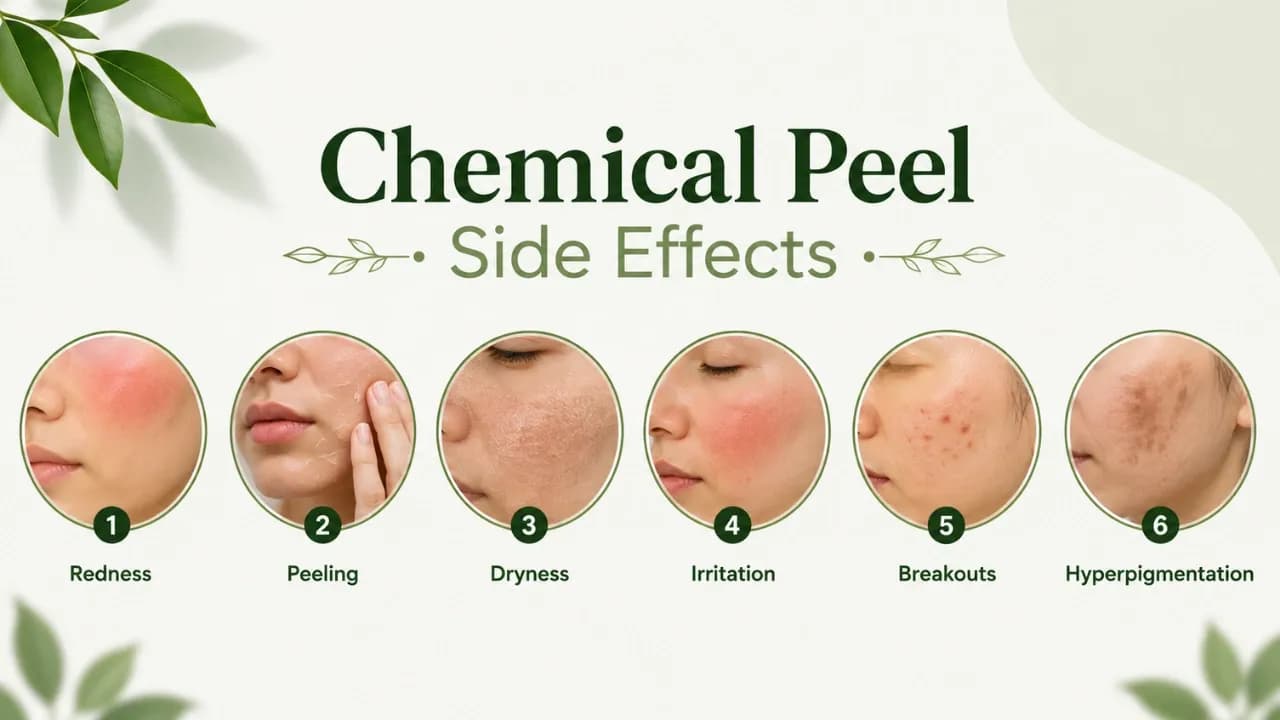
Most chemical peel side effects are mild and temporary when the peel is correctly matched to your skin type. The most common reactions are redness, dryness, tightness, and light flaking, which usually resolve within 3–7 days after a superficial peel. Medium and deep peels carry greater risks, including prolonged peeling, post-inflammatory hyperpigmentation, infection, scarring, and pigmentation changes, so peel depth, skin tone, preparation, and aftercare are important safety factors.
Most chemical peel side effects are mild, temporary, and predictable when the right peel is chosen for your skin type. The most common reactions are redness, dryness, and light flaking. These resolve within 3-7 days for superficial peels.
Serious complications, scarring, permanent pigmentation changes, infection, are uncommon and almost always preventable with correct peel selection, skin preparation, and post-treatment care.
Chemical peel side effects range from mild redness and flaking to uncommon but serious outcomes such as post-inflammatory hyperpigmentation (PIH) or scarring with medium and deep peels. Risk is directly determined by peel depth, skin tone, and how closely post-treatment protocols are followed.
What Are Chemical Peel Side Effects?
Chemical peel side effects are the skin reactions that occur after a chemical solution, typically glycolic acid, trichloroacetic acid (TCA), or phenol, is applied to the face, neck, or hands to exfoliate the outer skin layers. These reactions range from mild and temporary (redness, flaking) to moderate or severe (blistering, scarring, hyperpigmentation), depending on the type of peel used and individual skin characteristics.
Key terms used in this guide:
- Superficial peel: Uses mild acids (e.g., glycolic acid 20-30%) to exfoliate the outermost skin layer (epidermis)
- Medium peel: Penetrates into the upper dermis using TCA at 35-50%
- Deep peel: Uses phenol to reach the mid-dermis; highest risk, longest recovery
- Post-inflammatory hyperpigmentation (PIH): Darkening of skin after inflammation; a common chemical peel side effect in people with medium to dark skin tones
Chemical peels work by deliberately injuring the skin to a controlled depth. The body responds by triggering an inflammatory repair process, this is what causes redness, swelling, and peeling. The deeper the peel, the more intense the inflammatory response and the longer the recovery period.
Understanding these mechanisms helps set realistic expectations before treatment and explains why aftercare is not optional.
What Are the Most Common Side Effects of a Chemical Peel?
The most common chemical peel side effects are mild to moderate and typically resolve within 1-2 weeks for superficial peels.
Common side effects by peel depth:
- Superficial peels: Redness (erythema), mild flaking, dryness, temporary tightness, usually resolves in 3-7 days
- Medium peels: Significant swelling, crusting, peeling lasting 7-14 days, increased sun sensitivity
- Deep peels: Severe redness, blistering, oozing, extended peeling lasting 2-3 weeks, risk of permanent skin lightening
Less common but serious side effects:
- Post-inflammatory hyperpigmentation (PIH), more prevalent in Fitzpatrick skin types IV-VI
- Hypopigmentation (permanent skin lightening), especially with phenol peels
- Bacterial, viral, or fungal infection, if wound care is inadequate
- Scarring, rare but possible with deep peels or improper aftercare
- Reactivation of herpes simplex virus (cold sores), in susceptible individuals
- Allergic contact dermatitis, from peel solution ingredients
The incidence of serious complications drops significantly when patients follow pre-treatment and post-treatment protocols provided by a licensed dermatologist. Patient selection and aftercare compliance are the two biggest controllable variables in outcome quality.
Is a Glycolic Acid Peel Safe? Side Effects, Skin Types & What to Expect
A glycolic acid peel is one of the safest superficial peel options available — and its side effects are among the mildest of any chemical peel type.
What glycolic peels typically cause:
- Mild to moderate stinging during application, lasting 3-7 minutes
- Redness (erythema) that resolves within 24-48 hours in most patients
- Mild dryness and light flaking beginning 2-3 days post-treatment
- Temporary skin tightness for 1-3 days
- Increased sensitivity to sunlight for 7-14 days
What glycolic peels do not typically cause:
- Blistering or oozing (these are signs of over-application or incorrect concentration)
- Permanent pigmentation changes (rare at standard concentrations of 20-35%)
- Scarring
Research numbers: A PubMed-indexed study found that glycolic acid peels at 20-35% produced erythema resolving in under 7 days in over 90% of participants, with no serious adverse events recorded in a 12-month repeated-use protocol.
How Does Glycolic Acid Concentration Change the Risk?
Concentration is the primary variable. At 20-30%, a glycolic peel exfoliates the outermost layer of the epidermis only. At 50-70%, used only in clinical settings, penetration reaches deeper into the epidermis and the risk profile increases proportionally.
Concentration vs. side effect risk (glycolic acid):
| Concentration | Depth Reached | Typical Side Effects | Recovery |
|---|---|---|---|
| 20–30% | Stratum corneum | Mild redness, minimal flaking | 1–3 days |
| 35–50% | Full epidermis | Redness, moderate flaking, dryness | 3–5 days |
| 50–70% (clinic only) | Epidermis + upper papillary dermis | Significant erythema, peeling, PIH risk in types IV–VI | 5–10 days |
Is a Glycolic Peel Safe for Dark Skin?
At 20-35%, glycolic peels are generally safe for Fitzpatrick types IV-VI when performed by an experienced clinician who uses proper priming and monitoring protocols. The PIH risk rises sharply above 50% concentration or when priming is skipped. A series of 4-6 low-strength sessions is the recommended approach for darker skin tones — not a single aggressive session.
Clinical note: Salicylic acid peels (20-30%) are often preferred over glycolic acid for individuals with active acne on darker skin tones because salicylic acid has inherent anti-inflammatory properties that lower post-peel PIH risk.
How Does a Chemical Peel Work, and Why Do Side Effects Occur?
Chemical peel side effects occur because of the controlled chemical injury the procedure induces on skin tissue. Understanding the mechanism clarifies why each side effect happens, and why aftercare is not optional.
- Application: The acid lowers the skin's pH, breaking down the proteins that hold dead skin cells together.
- Controlled injury: The acid penetrates to a specific depth depending on its concentration and contact time, deliberately damaging the epidermis (superficial) or dermis (medium/deep).
- Inflammatory response: Damaged cells release inflammatory signals. Blood flow increases, causing redness and swelling, the primary early side effects.
- Cell death and peeling: The damaged outer layers die and shed. This peeling phase typically begins 2-3 days after the procedure.
- Regeneration: New skin cells migrate upward from the basal layer. Collagen production increases in response to the injury, this is what produces the skin-smoothing benefit.
- Risk window: During steps 3-5, the skin barrier is compromised, making it vulnerable to UV damage, infection, and PIH. This is why post-peel care protocols are non-negotiable.
The mechanism is predictable: the deeper the acid penetrates, the more significant the inflammatory phase, and the higher the risk of prolonged or serious side effects if aftercare is not followed precisely.
What Are the Benefits of Chemical Peels, and Do They Outweigh the Risks?
Whether the benefits outweigh the risks depends on peel depth, skin type, and adherence to aftercare.
Before choosing a peel plan, compare chemical peel treatment cost across different peel depths and session schedules.
Short-term benefits (visible within 1-4 weeks):
- Smoother skin texture after dead cell shedding
- Reduced appearance of superficial hyperpigmentation
- Improved skin tone uniformity
- Mild reduction in pore visibility
Long-term benefits (visible after 1-3 months):
- Reduction in fine lines and wrinkles, studies suggest medium TCA peels can reduce fine lines by up to 75% in suitable candidates
- Improved acne scarring appearance
- Increased collagen density in the treated dermis
- Long-term reduction in actinic keratoses with appropriate peels
Who benefits most vs. who carries higher risk:
- Benefits most: Adults with Fitzpatrick types I-III, patients with acne scars or sun damage, and those committed to strict post-peel SPF use
- Higher risk: Darker skin tones (types IV-VI) without specialised protocols, patients with active infections or recent isotretinoin use, and pregnant or breastfeeding individuals
For persistent dark patches or uneven tone, a dermatologist may recommend a chemical peel for pigmentation as part of a safer, staged treatment plan. Chemical peels offer a cost-effective middle ground between topical treatments and more invasive laser procedures. If comparing budgets, see face laser treatment cost. Risks are substantially reduced with proper patient selection and aftercare.
How to Prepare for a Chemical Peel to Minimise Side Effects
Proper preparation is one of the most effective ways to reduce chemical peel side effects. The following protocol is based on standard dermatological guidelines.
Prerequisites before starting:
- Consult a board-certified dermatologist to assess skin type, Fitzpatrick classification, and peel suitability
- Disclose all medications, especially retinoids, antibiotics, and hormonal contraceptives
- Discontinue retinoids (tretinoin, retinol) 5-7 days before the procedure
- Stop exfoliating acids (AHAs, BHAs) at least 3-5 days before the peel
- If you have a history of cold sores, ask about prophylactic antiviral medication
Step-by-step preparation protocol:
- 4-6 weeks before: Begin skin priming with a prescribed low-strength retinoid and broad-spectrum SPF 50+ daily to strengthen the skin barrier and reduce PIH risk.
- 1 week before: Stop active skincare ingredients, retinoids, acids, and vitamin C serums.
- 48 hours before: Avoid waxing, shaving, or other facial treatments in the peel area.
- Day of procedure: Arrive with clean, dry skin, no moisturisers, sunscreen, or makeup.
- Immediately after: Follow the dermatologist's prescribed aftercare kit, typically a gentle cleanser, barrier repair moisturiser, and petroleum-based occlusive if recommended.
- Days 1-14: Apply SPF 50+ every morning without exception, even indoors near windows.
Common mistakes to avoid:
- Picking or peeling skin manually, the leading cause of scarring post-peel
- Skipping sun protection, which dramatically increases PIH risk
- Using active skincare ingredients before the skin has fully healed (typically 2-4 weeks for medium peels)
- Getting a peel within 6 months of stopping isotretinoin (Accutane)
What Does the Research Say About Chemical Peel Side Effects?
Clinical evidence provides important context for understanding the frequency and severity of chemical peel side effects.
- A study in the Journal of Cosmetic Dermatology found that post-inflammatory hyperpigmentation occurred in approximately 30-40% of patients with Fitzpatrick type IV-VI skin after medium-depth TCA peels when adequate pre-treatment priming was not used.
- Research published on PubMed found that superficial glycolic acid peels (20-35%) produced minimal adverse effects, with erythema resolving in under 7 days in over 90% of participants.
- A phenol peel study reported permanent hypopigmentation in up to 20% of deep peel patients, highlighting why phenol peels require highly selective candidacy criteria.
- Studies suggest prophylactic antiviral therapy reduces herpes simplex reactivation rates after medium and deep peels from approximately 2-7% to under 1% in at-risk patients.
- A 2019 review in Dermatologic Surgery found that repeated glycolic acid peels over 12 months produced measurable increases in dermal collagen without adverse structural changes.
- A study in the Journal of Clinical and Aesthetic Dermatology (2020) found that pre-treatment priming reduced PIH incidence by approximately 50% in darker-skinned patients undergoing TCA peels.
Limitations of current research:
- Most trials involve small sample sizes and follow-up periods under 6 months
- Studies often exclude darker skin tones, limiting generalisability
- Standardisation of peel concentrations and application techniques varies between trials
Chemical Peel Types Compared: Side Effects by Peel Depth
Different types of chemical peels carry different side effect profiles. The right choice depends on skin concern, skin tone, and tolerance for downtime.
| Feature | Superficial Peel | Medium Peel | Deep Peel |
|---|---|---|---|
| Common acids | Glycolic, salicylic, lactic | TCA 35–50% | Phenol |
| Skin layers reached | Epidermis only | Epidermis + upper dermis | Mid-dermis |
| Downtime | 3–7 days | 7–14 days | 2–3 weeks |
| Main side effects | Redness, dryness, mild flaking | Swelling, crusting, peeling | Severe redness, blistering, oozing |
| Pigmentation risk | Low | Moderate; higher in IV–VI | High; permanent hypopigmentation possible |
| Scarring risk | Very low | Low–moderate | Moderate–high without proper care |
| Infection risk | Very low | Low | Moderate |
| Best for | Mild acne, dull skin, mild pigmentation | Sun damage, moderate acne scars, fine lines | Deep wrinkles, severe sun damage |
| Suitable skin tones | All types with guidance | I–III; IV–VI with priming | I–II only |
| Anaesthesia | No | Topical only | Sedation often required |
For Indian and darker skin tones: For individuals with medium to dark skin tones, a series of 4-6 superficial peels typically delivers safer outcomes than a single medium or deep peel. The risk of PIH is significantly higher with aggressive single sessions on unprepared darker skin. Kibo Skin's dermatology team recommends a conservative, series-based approach for Fitzpatrick types IV-VI.
How Painful Is a Chemical Peel? What Does It Actually Feel Like?
Most superficial chemical peels cause a mild to moderate stinging or tingling sensation, comparable to a mild sunburn, lasting 5-10 minutes during application. Pain is not the dominant experience for most patients.
Sensation by peel depth:
How to Prevent and Treat Hyperpigmentation After a Chemical Peel
Post-inflammatory hyperpigmentation (PIH) is the most common serious side effect of chemical peels in patients with Fitzpatrick skin types IV-VI. It is also one of the most preventable.
PIH occurs because melanocytes — the cells that produce skin pigment — are stimulated by the inflammatory response that all chemical peels trigger. In darker skin tones, this melanocyte response is more pronounced, producing visible darkening in treated areas.
Who is at highest risk for PIH after a chemical peel:
- Fitzpatrick skin types IV, V, and VI
- Patients who skip pre-treatment priming (retinoid + SPF protocol)
- Medium or deep peel recipients who do not use SPF 50+ consistently post-treatment
- Patients who pick or scratch peeling skin
- Patients with a history of PIH from previous skin trauma
Preventing PIH before your peel:
1\. Prime the skin for 4-6 weeks using a low-strength retinoid (0.025-0.05% tretinoin) and daily SPF 50+ — this is the single most evidence-backed preventive step. 2. Use a depigmenting agent if prescribed — topical hydroquinone (2-4%) or azelaic acid (15-20%) as part of a pre-treatment protocol reduces baseline melanocyte activity. 3. Choose the right peel depth — for Fitzpatrick types IV-VI, superficial peels (20-35% glycolic or 20-30% salicylic) carry substantially lower PIH risk than medium-depth TCA peels.
Research-backed reduction in PIH risk: A 2020 study in the Journal of Clinical and Aesthetic Dermatology found that pre-treatment priming reduced PIH incidence by approximately 50% in darker-skinned patients undergoing TCA peels.
Treating PIH if it occurs after your peel:
| Treatment | How It Works | Time to See Effect |
|---|---|---|
| Topical hydroquinone 2–4% | Inhibits melanin production | 6–12 weeks |
| Azelaic acid 15–20% | Reduces abnormal melanocyte activity | 6–8 weeks |
| Niacinamide 10% | Reduces melanosome transfer | 8–12 weeks |
| Sunscreen SPF 50+ | Prevents further UV-triggered darkening | Immediate prevention |
| Superficial glycolic peel series | Gradually exfoliates pigmented cells | 4–6 sessions over 3 months |
The most important rule: Do not use any depigmenting agent, retinoid, or active acid on peeling skin. Wait until full re-epithelialisation — typically 7-14 days for superficial peels, 14-21 days for medium peels — before reintroducing any active ingredient.
Clinical note: PIH is not a permanent outcome. With correct sun protection and targeted treatment, most cases resolve within 3-6 months. Consistent SPF 50+ use is non-negotiable throughout the treatment period.
Day-by-Day Recovery Timeline: What to Expect After a Chemical Peel
Recovery varies by peel depth. For a dedicated recovery guide, see chemical peel process day by day. The day-by-day breakdown below sets accurate expectations so you do not mistake a normal healing response for a complication — or dismiss a real complication as normal.
Superficial Peel (Glycolic, Salicylic, Lactic — 20-35%)
| Day | What You Will See | What to Do | What to Avoid |
|---|---|---|---|
| Day 0 | Redness, mild warmth, slight tightness | Gentle cleanser, bland moisturiser, no makeup | Sun exposure, gym, hot showers |
| Day 1–2 | Continued redness, dry/tight skin | SPF 50+ and barrier moisturiser | Retinoids, acids, vitamin C |
| Day 2–3 | Light flaking begins | Do not pick; touch gently only | Scrubs, washcloths, excessive touching |
| Day 3–5 | Flaking peaks then resolves | Hydrating serum under moisturiser may be used | AHAs, BHAs, retinol |
| Day 5–7 | Smoother skin, redness settling | Resume a gentle routine | Aggressive actives for 14 days total |
Medium Peel (TCA 35-50%)
| Day | What You Will See | What to Do | What to Avoid |
|---|---|---|---|
| Day 0–1 | Significant redness, swelling, warmth | Cool compresses; prescribed barrier cream | Sun, touching, makeup |
| Day 2–3 | Bronzing/darkening; swelling peaks | Continue barrier cream; SPF 50+ if outdoors | Picking or pulling skin |
| Day 3–5 | Peeling often begins in sheets | Keep skin moisturised; do not assist peeling | Actives, retinoids, exfoliants |
| Day 5–10 | Peeling resolves; new skin pink/sensitive | Gentle cleanser, barrier moisturiser, SPF 50+ | Unprotected UV exposure |
| Day 10–14 | Pink tone fades; texture improves | Reintroduce gentle actives only with clearance | Aggressive procedures for at least 6 weeks |
Deep Peel (Phenol)
Recovery for phenol peels is significantly longer and should be managed in close coordination with your treating clinician. Expect significant redness and oozing in the first 5-7 days, active peeling from days 5-14, and residual pinkness for 6-8 weeks. Full recovery to baseline skin tone can take 3-6 months.
Why Does Skin Sometimes Feel Oily After a Chemical Peel?
Some patients report oilier skin in weeks 2-4 after a superficial peel. This is a normal skin compensation response. The peel temporarily disrupts sebum production signals; the skin overcompensates briefly before normalising. This resolves without intervention within 3-4 weeks.
Why Does Skin Sometimes Feel Persistently Dry After a Chemical Peel?
Persistent dryness beyond day 7 (for superficial peels) indicates the skin barrier needs additional support. Increase application frequency of a ceramide-based moisturiser. If dryness persists beyond 14 days with flaking, consult your clinician — barrier disruption may require prescription emollient therapy.
Are Chemical Peels Safe? Who Should and Should Not Get One
Chemical peels are safe for most adults when the right peel is matched to the right skin type and performed by a qualified dermatologist or licensed clinician. The word 'safe' here means: the anticipated side effects are predictable, manageable, and temporary — not that there are zero risks.
The single most important safety variable: Patient selection. A glycolic acid peel that is completely safe for a patient with Fitzpatrick type II skin can cause significant PIH in a Fitzpatrick type V patient if the clinician does not adjust depth, concentration, and pre-treatment protocol accordingly.
Who Is an Ideal Candidate for a Chemical Peel?
| Ideal For | Not Ideal For / Requires Extra Caution |
|---|---|
| Fitzpatrick I–III with acne, dullness, or mild sun damage | Fitzpatrick IV–VI without darker-skin expertise |
| Stable skin with no active infection/open wounds | Active pustules, cysts, or open lesions |
| Committed to SPF 50+ | Unable to avoid sun exposure after treatment |
| Not currently/recently on isotretinoin | Current/recent isotretinoin use |
| Non-pregnant, non-breastfeeding adults | Pregnant or breastfeeding individuals |
| No keloid history | Known keloid/hypertrophic scarring |
| No frequent cold sores or protected with antivirals | Unprotected frequent herpes reactivation |
| Realistic expectations | Expecting single-session transformation |
What Makes a Chemical Peel Unsafe?
A chemical peel becomes unsafe when any of the following occur:
1\. Wrong depth for the skin type — a phenol peel on Fitzpatrick type V skin without specialist priming is a high-risk combination. 2. Incorrect aftercare — skipping SPF after a medium peel on darker skin is the most common cause of preventable PIH. 3. Unqualified application — at-home peels above 15-20% concentration, or clinic application by untrained staff, significantly raise complication risk. 4. Undisclosed medications — retinoids, antibiotics, and photosensitising drugs interact with peel chemistry. Full medication disclosure before the procedure is mandatory. 5. Too frequent treatment — repeating superficial peels more often than every 3-4 weeks prevents adequate barrier recovery between sessions.
Chemical Peels vs. Alternatives: How Do They Compare?
Chemical peels are one of several evidence-based skin resurfacing options. Whether they are the right choice depends on your concern, skin tone, downtime tolerance, and budget. Here is how they compare to the most common alternatives.
Side-by-Side Comparison: Chemical Peels vs. Alternatives
| Treatment | How It Works | Side Effects | Downtime | Best For | Risk for Dark Skin |
|---|---|---|---|---|---|
| Superficial chemical peel | Acid exfoliates outer epidermis | Redness, mild flaking | 3–7 days | Dullness, mild acne, early pigmentation | Low with proper priming |
| Medium TCA peel | Acid reaches upper dermis | Swelling, crusting, peeling | 7–14 days | Sun damage, moderate acne scars, fine lines | Moderate–high without specialist protocols |
| PRX-T33 | TCA 33% + H₂O₂ | Mild redness, tightness | 1–2 days | Dermal stimulation with minimal peeling | Lower than standard TCA |
| Laser resurfacing | Controlled laser ablation/remodelling | Redness, swelling, peeling | 7–21 days | Deep wrinkles, severe scars | High without specialist settings |
| Microdermabrasion | Mechanical surface exfoliation | Mild redness, tightness | 0–1 day | Mild texture improvement | Very low |
| Microneedling | Micro-injuries stimulate collagen | Redness, pinpoint bleeding, swelling | 2–4 days | Acne scars, laxity | Low–moderate |
When Chemical Peels Win Over Alternatives
- For pigmentation and uneven skin tone: Superficial peels outperform microdermabrasion because they reach the melanin-producing layer more effectively.
- For acne and oily skin: Salicylic acid peels have an advantage over glycolic and most alternatives because salicylic acid is lipid-soluble — it penetrates sebaceous follicles directly.
- For cost efficiency over multiple sessions: Superficial chemical peels are typically more cost-effective than laser resurfacing for the same improvement in mild-to-moderate concerns.
When Alternatives Win Over Chemical Peels
- For patients with no downtime tolerance: PRX-T33 or microneedling offer collagen stimulation without visible peeling.
- For deep structural scars: Fractional CO₂ laser typically delivers deeper collagen remodelling than even medium TCA peels.
- For patients with very dark skin (Fitzpatrick V-VI) and significant scars: A combination of microneedling radiofrequency plus superficial salicylic peels is often safer than medium TCA peels.
Frequently Asked Questions
Q: How long do chemical peel side effects last?
Superficial peel side effects usually settle within 3–7 days. Medium peels generally take 7–14 days, while deep peels can cause visible effects for 2–3 weeks and residual redness for longer.
Q: Can I get a chemical peel if I have sensitive skin?
Yes, but the peel and concentration should be selected for sensitive skin. Lower-strength glycolic or mandelic peels are commonly gentler options, and a patch test may be appropriate.
Q: Is it normal to break out after a chemical peel?
A mild breakout can occur during the first 1–2 weeks as follicles temporarily become congested. Severe, painful, widespread, or fever-associated breakouts should be assessed by your clinician.
Q: Can a chemical peel make pigmentation permanently worse?
Permanent worsening is uncommon. PIH is more likely in darker skin tones but is usually temporary when managed with appropriate treatment and strict sun protection.
Q: How many sessions does it take before chemical peel side effects outweigh the benefits?
There is no fixed session at which risks outweigh benefits. Superficial peels are commonly performed as 4–6 sessions spaced 3–4 weeks apart, with your clinician reassessing the response each time.
Q: What should I do if I experience an unusual reaction after a chemical peel?
Contact your treating clinician for worsening swelling, unexpected blisters, infection signs, fever, or white patches. Do not pick the skin or try to treat a severe reaction yourself.
Q: Is a chemical peel safe to use during summer or in high-UV climates like India?
Yes, but high UV exposure increases PIH risk. In summer or high-UV climates, strict SPF 50+ use and sun avoidance during recovery are especially important.
Q: Are there side effects specific to the Relife Definisse peel or similar branded peels?
PRX-T33-type peels generally cause less visible peeling than standard TCA peels. Mild redness and temporary tightness can still occur, and standard TCA contraindications remain relevant.
References
- Journal of Cosmetic Dermatology — chemical-peel PIH findings cited in the supplied draft.
- PubMed-indexed glycolic acid peel research — superficial-peel adverse effects cited in the supplied draft.
- Dermatologic Surgery (2019) — repeated glycolic acid peel and dermal collagen findings cited in the supplied draft.
- Journal of Clinical and Aesthetic Dermatology (2020) — pre-treatment priming and PIH findings cited in the supplied draft.
Medical Disclaimer : Information from Kibo Hair Clinics is for educational purposes only. It does not replace diagnosis, trichoscopy, blood test interpretation, prescription treatment, procedure advice, or side-effect counselling from a qualified dermatologist or hair restoration doctor.