
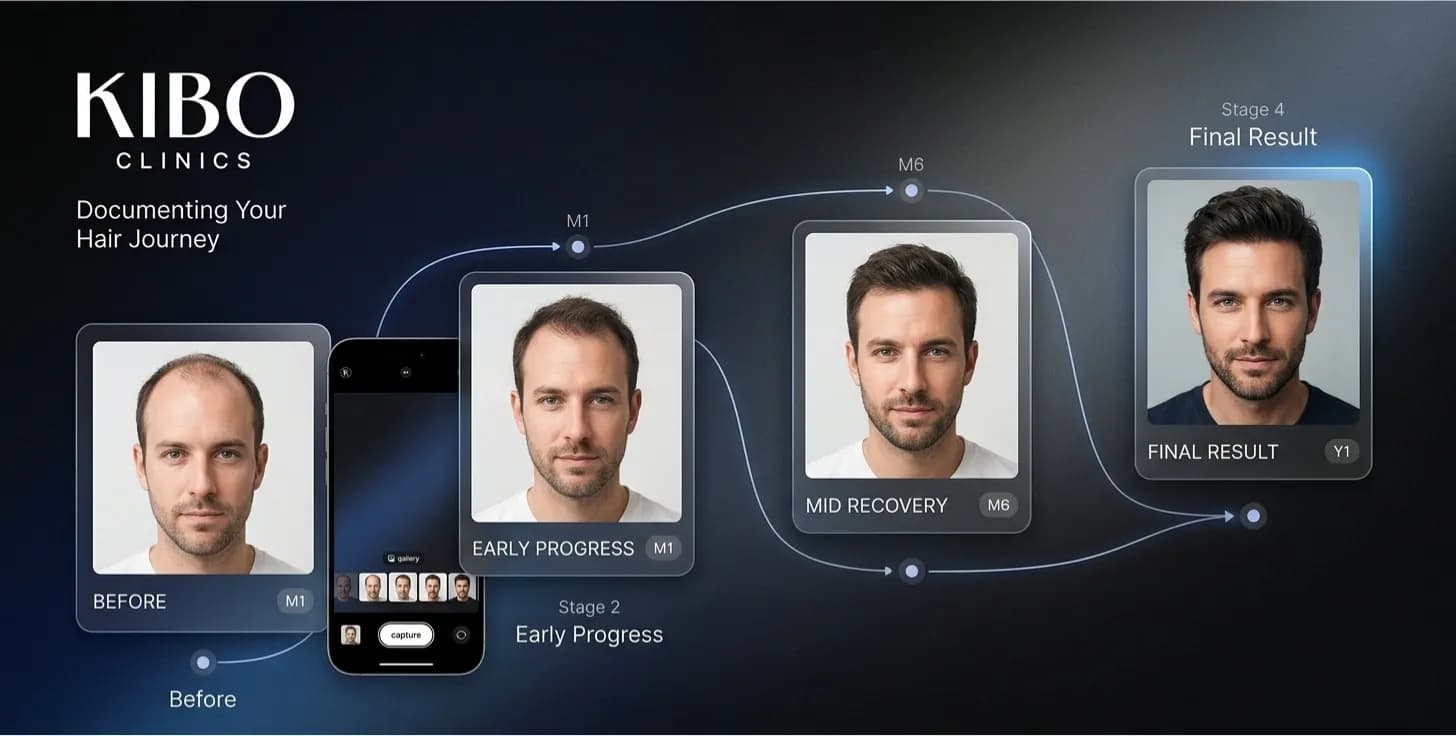
Why Documenting Your Hair Journey Builds Realistic Expectations
What You Need to Know
Documenting your hair restoration journey through regular photos and notes transforms the recovery experience from anxious waiting into informed progress tracking. Monthly visual records help you recognize subtle changes that mirror vision misses, validate your treatment timeline, and prevent the emotional rollercoaster that comes from relying on memory alone. This practice is especially valuable during the first 12 months after FUE hair transplant when growth happens in stages that can feel frustratingly slow without objective evidence.
The Photography That Changed Everything
Rajesh still remembers the moment he almost gave up on his hair restoration journey. Six months after his procedure, he stood in front of the bathroom mirror convinced nothing had changed. The reflection showed the same sparse crown, the same receding temples. He felt defeated.
Then his wife reminded him about the photos. Reluctantly, Rajesh opened the folder on his phone where he had been taking monthly pictures, a habit his surgeon at Kibo Clinics had strongly encouraged. He scrolled back to month one, then month two, then three. The progression was undeniable. What felt like no change in the mirror showed clear improvement in the timeline of images. New hair was growing, density was increasing, and the transformation was real. He just could not see it without the documented proof.
That folder of photos did not just show hair growth. It saved Rajesh from unnecessary anxiety and kept him committed to his recovery protocol. This is the power of documentation.
Ready to start your hair restoration journey?
Why Your Brain Cannot Track Gradual Change
The human brain is excellent at detecting sudden changes but remarkably poor at recognizing slow, incremental progress. This is a well-documented cognitive limitation called change blindness. You see your scalp every single day, sometimes multiple times. Your brain adapts to each tiny shift and recalibrates what it considers "normal." After a few weeks, you lose the baseline reference point entirely.
Hair grows approximately half an inch per month. Transplanted follicles shed initially, then regrow at this natural pace. The difference between month three and month four might be a few millimeters of length across thousands of grafts. Your daily mirror check cannot register this. But a photo comparison makes it obvious. The camera captures objective reality without the bias of memory or expectation.
This cognitive gap explains why so many patients experience the ugly duckling phase with unnecessary distress. Between months two and five, the scalp can look patchy as new hair emerges at different rates. Without documentation, this phase feels eternal and discouraging. With monthly photos, patients can see that the patchy appearance is temporary and the density is steadily improving. Understanding the hair transplant results timeline helps set proper expectations from the start.
The First 48 Hours: When Documentation Matters Most
Most people think documentation starts after surgery. It actually needs to begin before the procedure even happens. The most valuable comparison is not month six versus month seven. It is month six versus day zero.
Proper documentation protocol starts with comprehensive baseline photos taken from multiple angles: front view, both side profiles, top view, and crown close-ups. These should be taken in consistent lighting, ideally natural daylight near a window. Use the same location, same distance from the camera, and same hair position for every subsequent photo session.
Immediately after surgery, take another set of photos showing the recipient area with fresh grafts. This might feel uncomfortable given the redness and swelling, but these images become crucial reference points. They show the starting density, the planned hairline design, and the coverage area. When you question whether growth is happening months later, these day-one photos provide the answer.
During the first week, daily photos help track the normal healing process. Redness fades, scabs form and shed, and swelling resolves. Patients who document this phase develop confidence in the recovery process. They can see that the dramatic initial appearance is temporary and that their scalp is healing properly according to the expected timeline outlined in their procedure plan.
Monthly Milestones: The Photo Schedule That Works
After the first week, daily photos become unnecessary and potentially anxiety-inducing. The changes are too subtle to register on a day-to-day basis. Monthly documentation provides the optimal balance between tracking progress and allowing enough time for visible change.
Set a recurring calendar reminder for the same date each month. Pick a date that is easy to remember, like the first day of the month or the anniversary of your procedure. Consistency in timing matters because hair grows in cycles, and you want to compare equivalent points in those cycles.
Each monthly session should include the same six standard angles: straight-on frontal view with hair combed back, frontal view with hair in normal styling, left profile, right profile, top-down crown view, and a close-up of the hairline. Use the same room, same lighting conditions, and same camera distance. Place a mark on the floor where you stand to ensure identical positioning.
Take the photos before washing your hair when it is in its natural state. Wet hair photographs poorly and can make density appear thinner than reality. Similarly, avoid taking photos immediately after styling with products, as this can create false impressions of increased volume.
Track your progress with expert guidance
Beyond Photos: The Power of Written Notes
Visual documentation is essential, but written notes add context that photos alone cannot capture. A simple journal entry alongside each monthly photo session creates a comprehensive record of your experience.
Record practical observations: How does your scalp feel? Is there any residual numbness? Have you noticed any shedding this month? Are you experiencing any discomfort? These subjective experiences matter but are easy to forget. Six months later, you will not remember whether the tingling sensation you are currently feeling is normal or new. Your notes will tell you that you experienced similar sensations during month three that resolved on their own.
Document your hair care routine and any changes to it. Note when you started using specific products, when you switched shampoos, when you began or stopped supplements. If you notice a change in hair quality or growth rate, these notes help identify potential causes. Perhaps the shedding you are worried about coincided with starting a new medication or increased stress at work. The written record reveals patterns that memory cannot.
Track adherence to post-procedure protocols. Did you miss any doses of prescribed medications this month? Were you consistent with PRP therapy sessions? Did you protect your scalp from sun exposure? Honest documentation of protocol compliance helps your medical team provide better guidance and helps you understand which behaviors correlate with better outcomes.
The Comparison That Actually Matters
One of the biggest mistakes in hair journey documentation is comparing yourself to other patients. Social media is full of dramatic before and after transformations, often cherry-picked best cases or edited for impact. These comparisons breed dissatisfaction and unrealistic expectations.
Your only meaningful comparison is your own baseline. Month six should be compared to day zero, not to someone else's month six result. Hair restoration outcomes depend on dozens of individual factors: your original hair characteristics, the extent of loss according to the Norwood scale, the number of grafts transplanted, your age, your general health, and how your unique biology responds to the procedure.
When you document your hair journey properly, you create your personal roadmap. You can see your specific growth curve, understand your individual timeline, and celebrate your unique progress. This personalized perspective eliminates the anxiety that comes from generic comparisons.
If you must look at other patient results for reference, use them only to understand the range of normal timelines, not as a standard you need to match. One patient might see significant density by month four while another does not achieve similar density until month eight. Both outcomes can be completely normal and successful.
Digital Tools and Organization Strategies
Proper documentation requires more than just taking photos. You need a system for organizing, comparing, and accessing your visual record over time. A cluttered photo roll makes documentation useless.
Create a dedicated folder in your phone or cloud storage labeled with your procedure date. Within that main folder, create subfolders for each month. Some patients find it helpful to create an even more detailed structure with separate folders for different angles: frontal, profile, crown, and close-ups.
Many patients benefit from photo comparison apps that allow side-by-side viewing of images from different time points. These apps often include features like grid overlays to ensure consistent positioning and annotation tools to highlight areas of particular interest. Some even offer automated before-and-after slideshows that dramatically illustrate progress over time.
Back up your documentation regularly. Hair journey photos represent irreplaceable evidence of your transformation. Use cloud storage services to ensure you do not lose months of records to a lost phone or computer failure. Many patients maintain their photo archives for years after their procedure as a permanent record of their restoration journey.
When Documentation Reveals Concerns
While documentation usually provides reassurance, sometimes it reveals legitimate concerns that require medical attention. This is actually one of the most valuable aspects of systematic tracking. Problems are easier to address when caught early.
If your monthly photos show unexpected changes like sudden increased shedding beyond normal cyclical loss, areas of inflammation that persist rather than resolve, or growth patterns that deviate significantly from your surgeon's predictions, these documented observations enable more effective medical consultations.
Bring your photo timeline to follow-up appointments. Instead of trying to describe changes from memory, you can show your medical team exactly what has happened over time. This visual record often reveals details that physical examination alone might miss and allows for more accurate assessment of your progress.
Remember that some variation in growth timeline is completely normal. Not all grafts activate simultaneously. Temporary shedding phases can occur even many months post-procedure. Your documentation helps distinguish between normal variation and potential issues that need intervention.
Expert monitoring throughout your journey
The Psychological Benefits of Objective Evidence
Hair restoration is as much an emotional journey as a physical one. Anxiety, impatience, and doubt are normal psychological responses during the waiting period. Documentation serves as a powerful tool for managing these emotions.
When doubt creeps in, your photo archive provides concrete evidence that progress is happening. You can look at month-over-month comparisons and see undeniable improvement. This visual proof counteracts the negative internal dialogue that can undermine confidence during slower growth periods.
Documentation also helps manage the impatience that plagues most hair restoration patients. Seeing incremental progress makes the waiting more tolerable. Instead of fixating on the gap between your current state and your final goal, you can appreciate how far you have already come. This shift in perspective reduces stress and improves the overall experience.
For many patients, the documentation process itself provides a sense of control and active participation. During recovery, you cannot make hair grow faster, but you can track it systematically. This agency helps reduce the helpless feeling that often accompanies waiting for results.
Celebrating the Small Wins
Major transformations happen through thousands of small improvements. Documentation makes these incremental victories visible and worth celebrating. When you can see that your hairline has gained two millimeters of coverage, or that the crown density has increased by an estimated 20 percent, these measurable achievements deserve recognition.
Build celebration milestones into your documentation practice. When you reach three months post-procedure, create a before-and-now comparison image. At six months, make a more dramatic side-by-side showcase. At one year, compile all your monthly hair photos into a transformation video that shows your complete journey.
These celebratory reviews serve multiple purposes. They acknowledge your patience and commitment to the process. They provide motivation during later stages when progress might plateau temporarily. And they create shareable content if you choose to help others by sharing your experience, though privacy concerns should always guide these decisions.
Learning from the Documentation Process
Systematic documentation often reveals insights beyond simple progress tracking. Patterns emerge that can inform future hair care decisions and maintenance strategies.
You might notice that your hair responds particularly well to certain styling techniques and less well to others. You might observe that specific products enhance appearance while others seem to flatten volume. These observations, documented over months, become valuable data for optimizing your hair care routine long after the active growth phase ends.
Some patients discover through their photo records that they carry tension in their scalp differently than they realized. Certain areas might show more consistent growth while others lag, potentially indicating circulation differences or styling habits that create stress on specific zones. Understanding these patterns enables targeted protective measures, like the strategies covered in protective styling approaches.
Documentation also teaches patience and perspective. Looking back at early photos reminds you of moments when you felt discouraged but kept going anyway. This retrospective view builds resilience and appreciation for the transformation process itself, not just the final result.
When Documentation Becomes Obsession
While systematic tracking is valuable, there is a line between helpful documentation and unhealthy obsession. Some patients fall into the trap of taking daily photos, analyzing every millimeter, and spiraling into anxiety over normal variations.
If you find yourself taking photos more than once a week, examining images under magnification for hours, or experiencing significant distress based on perceived day-to-day changes, you have crossed from productive documentation into counterproductive fixation. Hair growth requires months to become visible. Daily examination reveals only randomness and feeds anxiety.
Set clear boundaries around your documentation practice. Once a month is sufficient for most patients. If you feel the urge to take photos more frequently, redirect that energy into other aspects of self-care that actually support hair health: proper nutrition, stress management, adequate sleep, and gentle hair care practices.
Remember that the goal of documentation is to reduce anxiety and build realistic expectations, not to create a new source of stress. If your photo practice is making you more anxious rather than more confident, it is time to reassess the approach.
Sharing Your Journey: Privacy Considerations
Many patients feel inspired to share their documented transformation with others considering hair restoration. This can be incredibly valuable for prospective patients seeking realistic examples, but privacy implications deserve careful thought.
Before sharing photos publicly, consider the permanence of online content and your comfort with that permanence. Photos shared on social media or forums can resurface years later in unexpected contexts. Some patients choose to share anonymously or crop images to exclude identifying features while still showing hair progress.
If you do share your journey, focus on providing useful information rather than seeking validation. Explain your documentation system, describe your timeline honestly including difficult phases, and emphasize that your results represent one individual experience among many possible outcomes. The value of shared journeys lies in authentic representation, not in presenting an unrealistically smooth or rapid transformation.
Be prepared for unsolicited comments and questions. Online communities can be supportive, but they can also harbor critics or people promoting alternative treatments. Maintain boundaries around what you are willing to discuss and remember that your journey documentation serves your needs first.
Why Kibo Clinics Emphasizes Documentation
At Kibo Clinics, we do not just recommend documentation as an optional practice. We consider it an essential component of successful hair restoration. Our patient care protocol includes structured guidance on proper photo documentation from the initial consultation through the final result evaluation.
During your consultation, we explain the complete timeline you can expect with Sapphire FUE or other recommended procedures. We show you documented examples from previous patients at similar stages to establish realistic benchmarks. This evidence-based approach to expectation-setting prevents the disappointment that comes from uninformed assumptions.
We provide each patient with specific documentation guidelines including recommended photo angles, timing, and lighting conditions. At follow-up appointments, we review your photo timeline together. This collaborative analysis ensures you understand what the images reveal and provides professional assessment of your progress relative to predicted timelines.
Our approach recognizes that hair restoration is a partnership between medical expertise and patient commitment. Documentation bridges the gap between clinical monitoring and daily patient experience. It transforms the recovery period from passive waiting into active, informed participation in your own transformation.
We also use aggregated documentation data to continuously refine our predictions and protocols. When we tell you what to expect during month four, that prediction is based on hundreds of documented patient journeys that preceded yours. Your systematic documentation contributes to this evolving knowledge base that helps future patients set even more accurate expectations.
The Long View: Documentation Beyond Year One
Most formal documentation protocols end at the twelve-month mark when hair transplant results are considered mature. However, the practice of periodic documentation remains valuable indefinitely for understanding long-term hair health patterns.
Consider continuing semi-annual or annual photo documentation using the same standardized approach. These extended records help you monitor the longevity of your restoration, detect any gradual thinning in native hair areas that might benefit from maintenance treatments like GFC therapy, and track the ongoing health of your transplanted hair.
Long-term documentation becomes especially valuable if you undergo additional procedures or treatments. Having a complete visual history from your first procedure through any subsequent work provides comprehensive context for treatment planning and outcome assessment.
Some patients find that the documentation habit developed during hair restoration extends beneficially into other health areas. The discipline of systematic tracking, the patience to wait for gradual changes, and the satisfaction of objective progress measurement can apply to fitness goals, nutritional changes, or other long-term health initiatives.
Frequently Asked Questions
How soon after hair transplant should I start taking documentation photos?
Take comprehensive baseline photos before your procedure, then again immediately after surgery showing the recipient area with fresh grafts. Continue with weekly photos during the first month to track initial healing, then switch to monthly documentation thereafter.
What lighting works best for hair progress photos?
Natural daylight near a window provides the most consistent and flattering lighting for hair documentation. Avoid direct overhead lighting which creates harsh shadows, and avoid yellow-tinted indoor lights which distort color. Always use the same lighting conditions for every photo session.
Should I style my hair before documentation photos?
Take photos with clean, dry, unstyled hair in its natural state. This provides the most accurate representation of actual density and growth. You can take additional styled photos for personal records, but the primary documentation should show natural hair.
Is it normal to see no visible change in monthly photos during certain periods?
Yes, growth happens in stages with some months showing dramatic progress and others appearing static. The most common plateau is between months two and four when many grafts are in the resting phase before active growth begins. Continued monthly documentation will eventually show the progress that is happening beneath the surface.
How can I ensure consistent photo angles across months?
Use physical markers like a piece of tape on the floor to show where you stand, and a mark on the wall at your eye level to ensure consistent camera height. Some patients find it helpful to have the same person take the photos each month using the same phone or camera at the same zoom level.
Disclaimer
This content provides educational information about documenting hair restoration journeys and does not constitute medical advice. Individual outcomes vary based on many factors including original hair characteristics, extent of loss, procedure type, and adherence to post-procedure protocols. Consult board-certified hair restoration specialists for personalized assessment and guidance.
Hair Transplant
FUE Hair Transplant | Sapphire FUE | Bio FUE | Direct Hair Transplant | Corrective Transplant
Hair Regrowth
PRP Therapy | GFC Therapy | Mesotherapy | Microneedling
Must Read
Complete Hair Transplant Guide | FUE Complete Guide | Procedure Steps | Results Timeline | Norwood Scale
Relevant Blogs
Hair Myths Busted | Protective Hairstyles | Hair Breakage Guide | DHT Blockers Guide | Hair Transplant Cost India
Medical Disclaimer : Information from Kibo Hair Clinics is for educational purposes only. It does not replace diagnosis, trichoscopy, blood test interpretation, prescription treatment, procedure advice, or side-effect counselling from a qualified dermatologist or hair restoration doctor.