
Why Men Lose Hair? Male Pattern Baldness Explained
Published on Fri Apr 17 2026
What is Male Pattern Baldness?
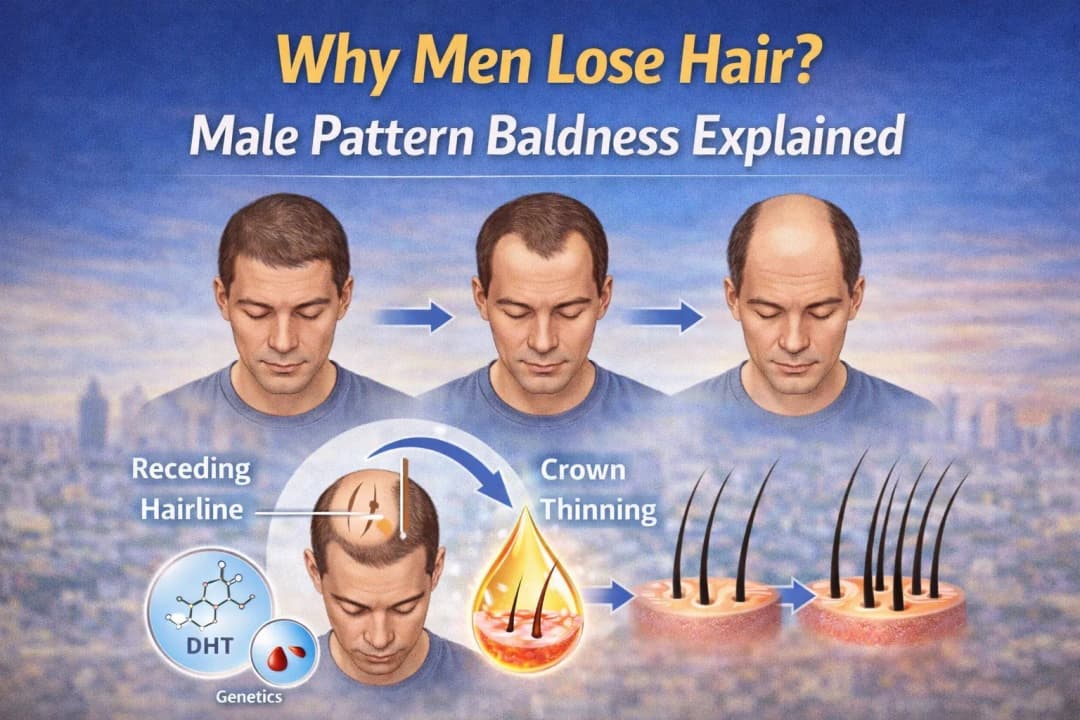
Male pattern baldness is a common type of hair loss in men. It usually begins in the 30s but can start as early as the teenage years. It leads to continuous hair fall without natural regrowth.
Hair loss is most visible around the temples and crown, often leading to a receding hairline and thinning hair. The condition develops gradually over time if left untreated.
How Common is Male Pattern Baldness?
Male pattern baldness, also known as androgenetic alopecia, is very common worldwide. The likelihood increases with age and is strongly linked to genetics, accounting for nearly 80% of cases.
Hair loss patterns may vary depending on age and ethnicity.
Symptoms and Causes
Causes
Male pattern baldness is mainly caused by genetics and hormones. The hormone dihydrotestosterone (DHT), derived from testosterone, shrinks hair follicles and prevents regrowth.
- Genetics (family history)
- Age-related changes
- Lifestyle and diet factors
- Ethnicity variations
Symptoms
- Finer, thinner hair
- Receding hairline
- Hair loss at the crown
- Thinning around temples
- Patchy or circular bald spots
Stages of Male Pattern Baldness
The progression is measured using the Hamilton-Norwood Scale:
| Stage | Description |
|---|---|
| Stage 1 | No visible hair loss |
| Stage 2 | Slight recession near temples |
| Stage 3 | M-shaped hairline, temple hair loss |
| Stage 4 | Receding hairline with crown bald spot |
| Stage 5 | Hairline and crown bald area connect |
| Stage 6 | Significant hair loss at crown and temples |
| Stage 7 | Only thin hair remains on sides |
Diagnosis
Diagnosis is based on hair loss pattern and medical history. Tests may include:
- Dermatoscopy
- Skin biopsy
- Blood tests
- Hair pull test
- Light microscopy
Treatment Options
Medications
Minoxidil
Topical minoxidil (2% or 5%) helps reduce hair loss and promote regrowth. It must be applied daily, with results visible in 6–12 months.
- Side effects: itching, dandruff, redness
Finasteride
Oral finasteride reduces DHT levels and slows hair loss. Results may appear in 6 months.
- Side effects: reduced libido, erectile issues, breast tenderness, depression
Medical and Surgical Options
Hair Transplant
A permanent solution where hair follicles are transplanted to bald areas, providing natural results.
Non-Surgical Treatments
- PRP (Platelet-Rich Plasma)
- Laser therapy
Prevention Tips
- Follow a balanced diet
- Avoid junk food
- Maintain fitness
- Get proper sleep
Living with Male Pattern Baldness
Psychological Impact
Hair loss can cause stress, anxiety, and confidence issues.
Concealment Options
- Hairstyles
- Wigs or extensions
Realistic Outlook
Male pattern baldness can be managed with treatments, but expectations should remain realistic. Early treatment offers better results.
FAQs
Does male pattern baldness run in families?
Yes, it is largely genetic.
Is it contagious?
No, it is not contagious.
Does it worsen over time?
Yes, it gradually progresses with age.
When should I see a doctor?
- Excessive hair fall
- Receding hairline
- Crown thinning
- Family history
Can it be reversed?
It can be slowed or partially reversed with treatments like minoxidil, finasteride, PRP, or hair transplant.
Do hair transplants work?
Yes, they provide natural and permanent results.
When will PRP show results?
Results are usually visible within 4–6 months.
Sources:
https://www.ncbi.nlm.nih.gov/books/NBK278957/
https://www.aad.org/public/diseases/hair-loss/treatment/male-pattern-hair-loss-treatment
https://www.healthdirect.gov.au/male-pattern-baldness
https://www.pennmedicine.org/conditions/male-pattern-baldness