
What Is An IV Hair Booster And How Does It Revive Hair Growth?
Published on Mon Apr 13 2026
IV Hair Booster Explained: Breaking Down the Basics
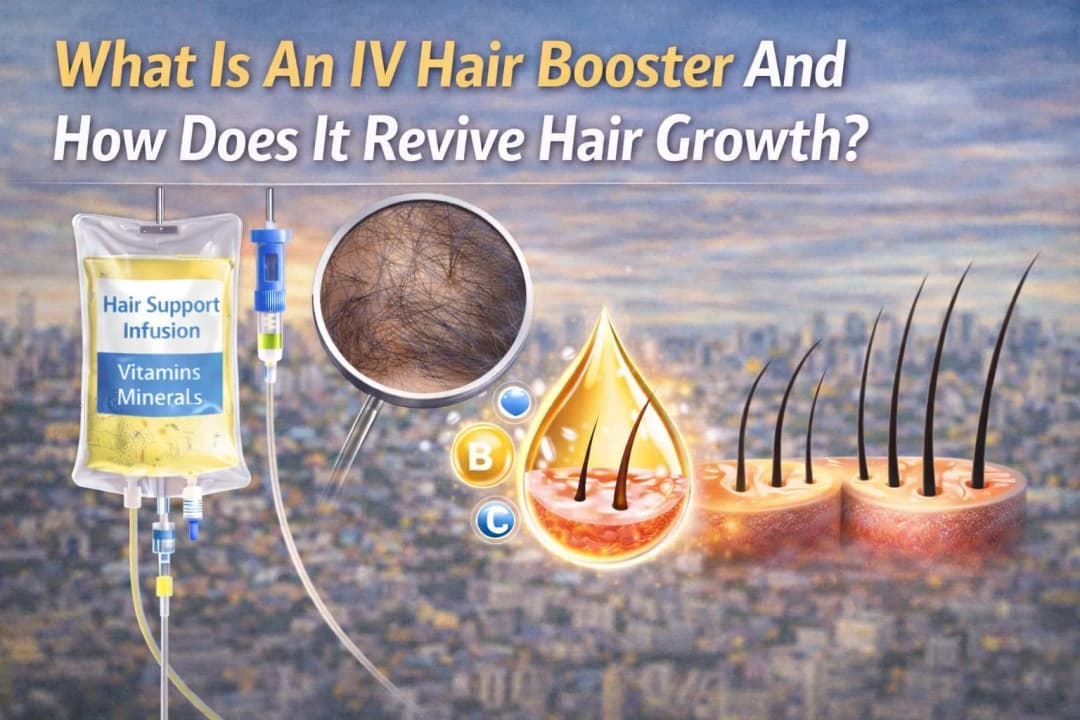
IV hair booster treatment is a method where a blend of vitamins, minerals, amino acids, and antioxidants is delivered directly into the bloodstream through an IV drip. Unlike oral supplements or topical serums, this method bypasses digestion and allows faster absorption.
The procedure is simple and usually takes 30–60 minutes, with no downtime, making it a convenient option for patients.
Common Nutrients Used
- Biotin & B-Complex Vitamins: Support keratin production and regulate hair growth cycles.
- Vitamin C: Improves scalp blood flow and protects against oxidative damage.
- Zinc & Magnesium: Help reduce deficiency-related hair loss.
- Amino Acids (Lysine, Arginine): Aid keratin and collagen production.
Why Delivery Method Matters
IV therapy bypasses the digestive system, ensuring nutrients reach the bloodstream directly. This is especially useful for people with absorption issues such as IBS or poor metabolism.
How IV Therapy Works for Hair
- Direct Nutrient Delivery: Nutrients reach hair follicles quickly via blood circulation.
- Keratin Production: Boosts hair thickness and strength.
- Improved Blood Flow: Enhances oxygen and nutrient supply to follicles.
- Reduced Damage: Fights free radicals and inflammation.
- Cellular Energy Boost: Supports stronger hair growth from roots.
Benefits of IV Hair Booster
- Reduced hair fall within weeks
- Stronger and faster hair growth
- Improved thickness and density
- Better resistance to breakage
- Supports recovery after PRP or transplant
Who Should Consider This Treatment
- People with nutrient deficiencies
- Stress or illness-induced hair loss
- Early-stage non-genetic hair thinning
- Patients combining treatments like PRP or transplant
When It May Not Work Alone
- Genetic pattern baldness
- Long-term inactive follicles
- Hormonal or medical conditions
What Happens During a Session
Pre-Consultation
Assessment of hair loss causes and medical history.
Procedure
- IV line inserted (usually arm)
- Nutrient solution infused for 30–60 minutes
Post-Treatment
No downtime; resume daily routine immediately.
Treatment Flow
- Consultation: 15–20 minutes
- Preparation: Custom formula
- IV Session: 30–60 minutes
- Monitoring: 10 minutes
Frequency of Treatment
- 4–6 sessions initially
- Weekly or bi-weekly sessions
- Maintenance every 4–8 weeks if needed
Results Timeline
- Weeks 1–2: Internal improvement
- Weeks 3–4: Reduced shedding
- Weeks 4–6: Improved hair quality
- 6+ Weeks: Increased density and strength
Safety and Risks
- Mild: redness, pain, dizziness
- Rare: infection, allergy, vein irritation
Always consult a qualified medical professional before treatment.
Comparison with Other Treatments
Vs Oral Supplements
Better absorption but higher cost.
Vs PRP
PRP regenerates follicles; IV therapy provides nutrients. Best used together.
Vs Hair Transplant
Transplant restores hair; IV therapy supports existing follicles.
Cost in India
- ₹5,000 – ₹15,000 per session
- ₹25,000 – ₹75,000 for full course
Is It Worth It?
IV hair booster works best for deficiency-related or stress-induced hair loss. It should be part of a broader treatment plan based on proper diagnosis.
Frequently Asked Questions
Can it be combined with other treatments?
Yes, with PRP, transplants, and topical treatments.
Does it work without deficiencies?
Sometimes, especially in cases of poor nutrient absorption.
Are there additional benefits?
Yes, improved skin health and energy levels.
Is vitamin overload possible?
Yes, which is why medical supervision is essential.
Can both men and women undergo this treatment?
Yes, but protocols differ based on cause of hair loss.
Is regular treatment required?
Depends on cause; some may need maintenance sessions.
How is the formula customised?
Based on medical history, symptoms, and blood test results.
Sources
- National Institutes of Health – Office of Dietary Supplements. Biotin: Fact Sheet for Health Professionals. U.S. Department of Health & Human Services. https://ods.od.nih.gov/factsheets/Biotin-HealthProfessional/
- National Institutes of Health – Office of Dietary Supplements. Vitamin D: Fact Sheet for Health Professionals. U.S. Department of Health & Human Services. https://ods.od.nih.gov/factsheets/VitaminD-HealthProfessional/
- National Institutes of Health – Office of Dietary Supplements. Zinc: Fact Sheet for Health Professionals. U.S. Department of Health & Human Services. https://ods.od.nih.gov/factsheets/Zinc-HealthProfessional/
- National Institutes of Health – Office of Dietary Supplements. Iron: Fact Sheet for Health Professionals. U.S. Department of Health & Human Services. https://ods.od.nih.gov/factsheets/Iron-HealthProfessional/
- Bistas KG, Tadi P. Biotin. StatPearls [Internet]. Treasure Island, FL: StatPearls Publishing. Updated July 3, 2023. National Center for Biotechnology Information, U.S. National Library of Medicine. https://www.ncbi.nlm.nih.gov/books/NBK554493/
- Wang R, et al. Micronutrients and Androgenetic Alopecia: A Systematic Review. Mol Nutr Food Res. 2024 Nov;68(22):e2400652. PubMed, U.S. National Library of Medicine. https://pubmed.ncbi.nlm.nih.gov/39440586/
- Yelich A, et al. Biotin for Hair Loss: Teasing Out the Evidence. J Clin Aesthet Dermatol. 2024 Aug;17(8):56–61. PubMed Central, U.S. National Library of Medicine. https://pmc.ncbi.nlm.nih.gov/articles/PMC11324195/