
The Impact of Humidity on Hair Texture and Breakage
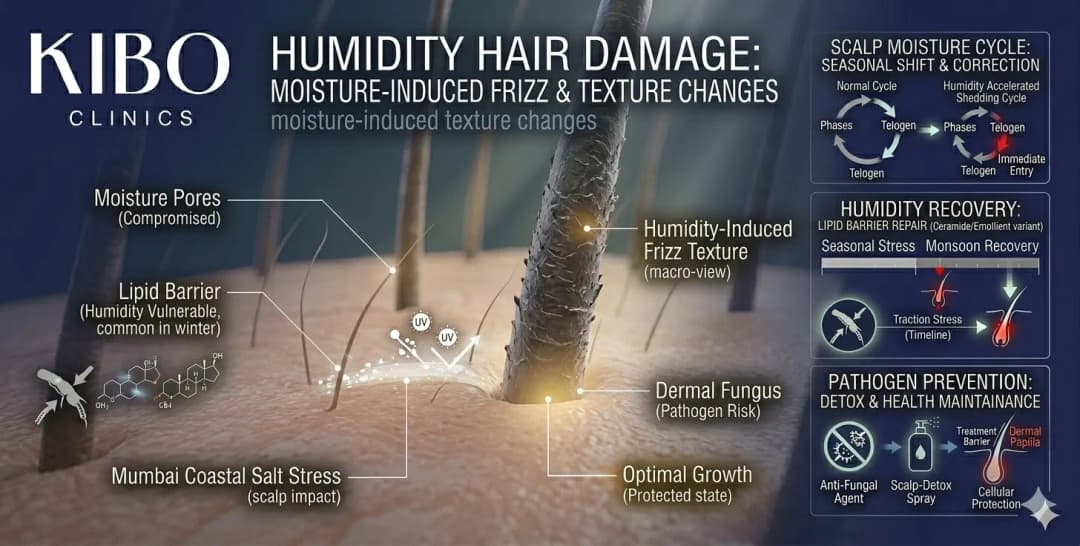
Published on Mon Apr 20 2026
Sunita moved from Pune to Mumbai for work and noticed something within her first monsoon season. "My hair completely changed," she said. "It was frizzy in a way it had never been before, and by the end of the day it looked nothing like when I started the morning. I started thinking something was wrong with my hair." Nothing was wrong with her hair. Everything was wrong with the humidity.
If you've ever stepped outside on a humid day and watched your carefully styled hair transform within minutes, you already know that humidity and hair have a complicated relationship. But understanding exactly what humidity does to hair — and why some hair types are far more affected than others — opens the door to genuinely effective strategies rather than the endless cycle of products that promise to fix frizz and rarely deliver. Here is the complete picture.
What Humidity Actually Is — and Why Hair Cares
Humidity refers to the amount of water vapour present in the air. Relative humidity — the figure you see in weather forecasts — expresses this as a percentage of the maximum amount of moisture the air could hold at a given temperature. Mumbai during the monsoon regularly reaches 85–95% relative humidity. At these levels, the air is nearly saturated with water vapour, and anything exposed to it — including your hair — is subject to significant moisture exchange.
Hair is not inert. It is a hygroscopic material, meaning it actively absorbs and releases moisture from and into the surrounding environment in response to changes in humidity. When the air around your hair contains more moisture than your hair itself holds, water molecules move from the air into the hair shaft. When the air is drier than your hair, moisture moves outward. This constant exchange is the source of most humidity-related hair problems — and understanding it is the key to addressing them.
The Structure of a Hair Strand: Why It Matters
To understand what humidity does to hair, you need a basic picture of what a hair strand actually is. Each strand of hair has three layers:
- The medulla: The innermost core, present in thicker hairs and largely irrelevant to humidity effects.
- The cortex: The thick middle layer that makes up the bulk of the hair shaft. The cortex contains keratin protein chains and a type of bond called disulphide bonds that determine the hair's natural shape — straight, wavy, or curly. It also contains melanin (the pigment that gives hair its colour). The cortex is where humidity does most of its structural work.
- The cuticle: The outermost layer — a series of overlapping, scale-like cells arranged like roof tiles or fish scales around the cortex. The cuticle's job is to protect the cortex and regulate moisture exchange. When the cuticle lies flat and smooth, it does this job well. When it is raised, damaged, or disrupted, moisture enters and exits the cortex far more freely and unpredictably.
The condition of the cuticle is the single most important structural factor in how a hair strand responds to humidity. Healthy, intact cuticles are far better at resisting humidity-driven changes than damaged or compromised ones — which is why hair care practices that damage the cuticle (heat styling, chemical processing, rough handling) directly increase humidity sensitivity.
What Humidity Does to Hair: The Science
Hydrogen Bond Disruption and Frizz
Inside the hair cortex, keratin proteins are held in their shape by multiple types of chemical bonds. Among the most relevant to humidity are hydrogen bonds — relatively weak bonds that form between water molecules and the proteins in the cortex. These hydrogen bonds are part of what gives hair its shape on any given day.
When humidity is high and water molecules penetrate the hair shaft through raised or damaged cuticles, they disrupt existing hydrogen bonds and form new ones in their place. These new hydrogen bonds form between the keratin proteins and the water molecules rather than between the proteins themselves — and because this happens unevenly and unpredictably across different strands, the result is uncontrolled swelling, expansion, and shape change. This is the biological mechanism of frizz.
In straight hair, the result is puffiness and volume loss. In wavy hair, defined waves lose their pattern and become irregular. In curly or coily hair, the curl pattern can tighten, loosen, or become unpredictable depending on the individual strand's porosity and structure. In all hair types, the visible result — the hair behaving differently than it was styled to behave — is the hydrogen bond disruption playing out strand by strand across the entire head.
Hair Swelling and Hygral Fatigue
When hair absorbs significant moisture, the individual hair shaft actually swells — increasing in diameter as the cortex expands. When humidity drops (inside an air-conditioned space, for example), the hair contracts again as moisture leaves. This cycle of swelling and contracting, repeated frequently, is called hygral fatigue.
Hygral fatigue is a form of cumulative mechanical stress on the hair shaft. Each expansion and contraction cycle puts physical strain on the cuticle and cortex. Over time, this leads to weakening of the hair shaft, increased porosity (as the cuticle becomes increasingly disrupted), and ultimately breakage — particularly at the most fragile points of each strand. For people living in consistently humid climates or experiencing repeated wet-dry cycles, hygral fatigue is a genuine and significant cause of long-term hair damage and breakage.
The Porosity Connection
Hair porosity refers to how readily the hair shaft absorbs and releases moisture — determined largely by the condition of the cuticle. It is one of the most important concepts in understanding humidity's effect on your specific hair.
| Porosity Type | Cuticle State | Moisture Behaviour | Humidity Response |
|---|---|---|---|
| Low porosity | Tightly closed, flat cuticle scales | Resists absorbing moisture; takes long to wet; retains moisture once inside | Relatively humidity-resistant initially; can still be affected in very high humidity conditions; product build-up common |
| Medium / Normal porosity | Slightly raised cuticle; balanced | Absorbs and retains moisture well; responds predictably to products | Moderate humidity sensitivity; generally manageable with appropriate products |
| High porosity | Raised, damaged, or missing cuticle scales; gaps present | Absorbs moisture very quickly; loses it just as fast; prone to frizz and dryness | Highly humidity-sensitive; absorbs atmospheric moisture rapidly causing frizz and swelling; most susceptible to hygral fatigue |
High porosity hair — which can be either naturally occurring or acquired through heat damage, chemical processing, or mechanical damage — is by far the most vulnerable to humidity-related frizz and breakage. If your hair is colour-treated, frequently heat-styled, chemically straightened or permed, or has been subjected to rough handling over time, it is very likely to have elevated porosity and therefore greater humidity sensitivity than its natural state.
Why Some Hair Types Are More Affected Than Others
Not all hair responds to humidity equally — and the reasons go beyond porosity alone. Hair texture, curl pattern, thickness, and chemical history all play roles.
Curly and Coily Hair
Curly and coily hair textures are inherently more humidity-sensitive than straight hair for several structural reasons. The curved shape of curly hair strands means the cuticle naturally sits less flat than it does on straight hair — creating more points of entry for moisture. The natural oils produced by the scalp also travel less efficiently down a curved strand than a straight one, meaning the lengths and ends of curly hair are often naturally drier and more porous. When humid air then adds atmospheric moisture unevenly across these already variable strands, the result is unpredictable curl pattern changes, frizz, and loss of definition.
Coily and tightly curled hair textures common among South Asian women — particularly those with wavy-to-curly hair types — are often also finer in diameter than straight-haired counterparts, making each individual strand more vulnerable to the structural stresses of hygral fatigue.
Chemically Processed Hair
Chemical straightening, relaxing, keratin treatments, colouring, bleaching, and perming all alter the structure of the hair cortex and cuticle in ways that increase porosity. Chemically straightened or relaxed hair has had its disulphide bonds broken and reformed — a process that fundamentally changes how the cortex responds to moisture. In high humidity, chemically processed hair often "reverts" — absorbing atmospheric moisture that causes it to return to or approximate its natural curl pattern, undoing the straightening effect. This reversion is the hydrogen bonds reforming under the influence of humidity, and it's essentially irreversible once it occurs without re-processing.
Fine Hair
Fine hair has a smaller diameter and proportionally less cortex relative to its surface area — meaning it is more quickly saturated by atmospheric moisture. Fine hair also tends to lose its style more quickly in humidity, becoming limp and flat rather than frizzy in the way thicker hair does. The mechanisms are related but the visible outcome differs — fine hair in humidity often loses volume and definition rather than gaining it.
Thick and Coarse Hair
Thick, coarse hair has more cortex and is generally more structurally resistant to humidity penetration — but when moisture does enter, the effect can be dramatic precisely because there is so much cortex to expand. Very thick hair in high humidity can become heavy, voluminous, and difficult to manage, with significant expansion in both diameter and volume.
Humidity and Breakage: The Direct Connection
Frizz is the most visible consequence of humidity — but breakage is the most damaging. The two are connected, and understanding that connection helps explain why humidity-related damage is cumulative rather than immediately obvious.
When hair is in a humid environment, it swells as moisture enters. When it moves to a drier environment — an air-conditioned office, a car, an indoor space — it contracts again. This repeated mechanical cycle, as discussed, is hygral fatigue. But breakage from humidity is also worsened by what happens when people try to manage frizzy, humidity-affected hair:
- Brushing and combing swollen hair: Hair that has absorbed significant moisture is in an expanded, weakened state. Running a brush or comb through swollen, tangled hair applies force to strands that are already under structural stress — snapping them far more easily than dry or well-conditioned hair would snap.
- Heat styling to counteract humidity: The instinctive response to humidity frizz is often to reach for a straightener or blow dryer. This applies high heat to already-stressed hair, rapidly removing the moisture that swelled the shaft, causing the cortex to contract abruptly. This rapid thermal contraction, repeated regularly, is a major source of cuticle damage — which increases porosity, which increases humidity sensitivity, which leads to more frizz, more heat styling, and a self-reinforcing cycle of damage.
- Tight hairstyles on swollen hair: Tying swollen, humidity-affected hair tightly creates tension at points of existing weakness. Elastic bands on hair that is already fragile from humidity cycling causes breakage at the ponytail or hair tie line — a common pattern of breakage in humid climates.
The Mumbai and Indian Monsoon Context
For readers in Mumbai and other high-humidity Indian cities, humidity is not a seasonal inconvenience — it is a near year-round reality, with the monsoon period bringing it to its most extreme. Understanding how to manage hair in this specific climate context matters more than generic frizz advice.
Mumbai's relative humidity averages above 70% for much of the year and reaches 90–95% during the June to September monsoon. During this period, the hair is also exposed to additional stressors: rainwater (which can be acidic and mineral-laden), increased sweat from heat and physical activity, more frequent washing to manage scalp oiliness in the heat, and the temperature differential between outdoor humidity and indoor air conditioning — which subjects hair to repeated humidity cycling multiple times per day.
Chennai, Kolkata, Kochi, and coastal cities across India face similar or even more extreme humidity profiles. Even cities like Bangalore and Hyderabad, traditionally more moderate in climate, experience significant humidity during and around the monsoon season. Hair care strategies designed for these environments need to account for sustained, high-level humidity rather than occasional humid days.
Effective Strategies for Managing Humidity-Affected Hair
With the science established, the practical question is what actually works. The most effective strategies address the problem at its root — the cuticle — rather than trying to fight humidity after it has already penetrated the hair shaft.
1. Prioritise Cuticle Health Above Everything Else
A healthy, smooth cuticle is the most effective barrier against humidity. Everything that damages the cuticle — excessive heat, chemical processing, rough towel-drying, mechanical friction — increases humidity sensitivity. Conversely, everything that supports cuticle health and closure reduces it. This means:
- Reducing heat styling frequency and always using a heat protectant when heat is used
- Using cool or lukewarm water to rinse hair — hot water raises the cuticle and keeps it open
- Finishing washes with a cool rinse to encourage cuticle closure
- Patting rather than rubbing hair dry — rough towel friction physically lifts and breaks cuticle scales
- Using microfibre towels or cotton t-shirts rather than regular towels for drying, which reduces friction significantly
- Detangling gently with a wide-tooth comb on conditioned, wet hair, starting from the ends upward
2. Understand What Your Hair Actually Needs: Moisture vs. Protein
High-porosity hair in humid climates has a counterintuitive problem. Despite being surrounded by moisture and absorbing it readily from the air, it actually struggles to retain moisture internally — it absorbs and releases too freely, without stability. The solution is not just adding more moisture (which can worsen hygral fatigue) but building internal structure with protein treatments that partially fill the gaps in the damaged cuticle and cortex.
Low-porosity hair, on the other hand, tends to be protein-sensitive — too much protein makes it stiff and prone to breakage. For low-porosity hair in humidity, lightweight moisture-focused products that don't overwhelm the already-resistant cuticle work better.
Understanding your own hair's porosity — and therefore whether it needs more protein, more moisture, or a balance of both — is foundational to choosing products that actually help rather than products that make the situation worse.
3. Product Layering for Humidity Resistance
The most effective product approach for humid climates follows a layering logic — building from lightest to heaviest, with each layer serving a specific function:
| Layer | Product Type | Function | Best For |
|---|---|---|---|
| 1st — Leave-in conditioner | Lightweight cream or liquid leave-in | Provides baseline moisture and slip; begins cuticle smoothing | All hair types; use lighter formulas for fine hair |
| 2nd — Anti-humectant or humectant (depending on climate) | Serum, gel, or cream with targeted ingredients | Controls moisture exchange between hair and atmosphere | In high humidity: anti-humectants preferred; in low humidity: humectants draw in beneficial moisture |
| 3rd — Styling product | Gel, mousse, or cream styler | Defines style and provides hold to resist humidity-driven shape change | Curly and wavy hair benefit most from gel for cast formation |
| 4th — Sealant (optional) | Light oil or silicone serum | Creates a physical barrier on the cuticle surface to slow moisture entry | High porosity hair; use sparingly on fine hair to avoid weighing down |
4. Humectants — Friend or Foe in High Humidity?
Humectants are ingredients that attract and hold moisture — glycerin, hyaluronic acid, aloe vera, and honey are common examples found in hair products. They are widely used and genuinely beneficial in moderate humidity conditions, where they draw moisture from the air into the hair shaft.
In very high humidity — above approximately 70% relative humidity — humectants become problematic. In a near-saturated atmosphere, humectants draw in too much moisture too quickly, causing the hair shaft to swell excessively and producing the very frizz and swelling they're meant to prevent. During Mumbai's monsoon or any other period of very high ambient humidity, products with glycerin or other humectants high on the ingredient list can actively worsen frizz. Anti-humectant products — which create a barrier that slows moisture absorption rather than encouraging it — are more appropriate in these conditions.
The practical implication is that your product wardrobe may need to adjust seasonally. What works well for your hair in October may produce very different results in July — not because the product changed, but because the atmospheric humidity has.
5. Oils for Sealing and Protection
Oils play a specific and useful role in humidity management — not as moisturisers (oils do not moisturise hair; they seal it) but as cuticle-smoothing sealants that slow the rate of moisture exchange between the hair shaft and the atmosphere.
Different oils have different molecular sizes and therefore different abilities to penetrate the hair shaft versus sit on the surface:
- Coconut oil: Small molecular structure that allows it to penetrate the cortex; reduces protein loss from the hair shaft; particularly effective as a pre-wash treatment applied before shampooing to reduce the amount of moisture absorbed during washing (and the subsequent hygral fatigue). Used as a sealant, it is effective but can be heavy on fine hair.
- Argan oil: Lightweight; sits primarily on the cuticle surface; excellent for smoothing and adding shine without significant weight. Well-suited to fine and medium-thickness hair in humid conditions.
- Jojoba oil: Technically a liquid wax; very similar in composition to the scalp's natural sebum; absorbs readily without leaving residue; good for all hair types.
- Castor oil: Very heavy and thick; forms a strong physical barrier on the hair shaft; useful for very coarse or high-porosity hair as a sealant but can cause build-up on fine or low-porosity hair.
- Almond and grapeseed oils: Lightweight options that seal without significant weight; good for fine hair that needs a light sealant layer.
In the context of humidity, applying a small amount of a lightweight oil to damp hair as a sealant — after leave-in conditioner and before drying — can meaningfully slow the rate of atmospheric moisture absorption and reduce frizz throughout the day.
6. Drying Methods Matter Enormously
How you dry your hair after washing is one of the most significant and underappreciated determinants of how it behaves in humidity for the rest of the day.
- Diffusing: Using a diffuser attachment on a low-heat, low-speed setting distributes air more gently and evenly than direct blow-drying, reducing the mechanical disruption of the cuticle while still encouraging the hair to dry in its natural pattern. For curly and wavy hair types, diffusing is significantly better than direct blow-drying for preserving curl definition and reducing humidity-induced frizz throughout the day.
- Air drying: Leaving hair to air dry is the most cuticle-friendly option — but in high humidity, air-drying takes longer, during which the hair is in an extended state of moisture absorption from both the wash water and the atmosphere. Plopping — wrapping wet hair in a microfibre towel or t-shirt in a specific way to absorb excess water without disturbing curl pattern — can reduce air-drying time and product disruption for curly and wavy types.
- Blow-drying on high heat: The fastest option but the most damaging to the cuticle when done repeatedly — and on a day-to-day basis in a humid climate, the damage accumulates quickly. If blow-drying, using a heat protectant, keeping the dryer moving, and finishing with a cool shot to encourage cuticle closure all reduce the damage.
7. Protective Hairstyles for High-Humidity Days
On days of extreme humidity — peak monsoon, coastal weather, or any conditions where managing your hair loose feels like a losing battle — protective styles that tuck the hair away and reduce its surface area exposure to the atmosphere are a practical and legitimate strategy.
- Loose buns and French twists contain the hair without tight elastic tension
- Braids and plaits protect the lengths while managing the hair into a defined shape that humidity affects less visibly
- Braid-outs and twist-outs — styling curly or wavy hair in braids or twists while damp and allowing it to dry, then releasing — can provide a more defined, humidity-resistant texture than letting the hair air dry loose
- Updos with gentle pins or clips rather than tight elastics protect the hairline and lengths
Ingredients to Seek Out and Ingredients to Avoid in Humid Climates
| Category | Ingredients | Effect in High Humidity | Verdict |
|---|---|---|---|
| Humectants | Glycerin, sorbitol, honey, propylene glycol, aloe vera | Draw excess moisture into shaft in high humidity causing swelling and frizz | Use with caution in >70% humidity; beneficial in moderate or low humidity |
| Anti-humectants / sealants | Dimethicone, cyclomethicone, beeswax, shea butter, mineral oil | Create barrier on cuticle that slows atmospheric moisture absorption | Beneficial in high humidity; can cause build-up with overuse |
| Film-forming polymers | PVP, acrylates copolymer (found in gels and mousses) | Form a flexible film around strands that resists humidity penetration; provide hold | Excellent for humidity resistance; core of effective anti-frizz gels |
| Proteins | Hydrolysed keratin, silk, wheat, rice protein | Temporarily fill gaps in damaged cuticle; reduce porosity and moisture uptake | Beneficial for high-porosity hair; overuse on low-porosity hair causes stiffness |
| Lightweight oils | Argan oil, jojoba oil, grapeseed oil, almond oil | Smooth cuticle; provide light sealing without excessive weight | Good for most hair types as finishing sealant |
| Heavy butters and waxes | Shea butter, mango butter, lanolin, heavy waxes | Strong sealing but can weigh down fine or low-porosity hair; attract dust in heat | Best for thick, high-porosity or coily hair; avoid on fine or low-porosity hair |
| Sulphates (in shampoo) | Sodium lauryl sulphate, sodium laureth sulphate | Strip natural oils and raise cuticle; increase porosity over time with frequent use | Use infrequently or switch to sulphate-free alternatives; particularly important in high-humidity climates |
Seasonal Hair Care: Adjusting Your Routine Through the Year
For people in Indian cities, a genuinely effective hair care approach involves adjusting the routine seasonally rather than using the same products and techniques year-round. What works in winter — when ambient humidity is lower and the hair needs more moisture-drawing humectants — is often counterproductive during the monsoon, when the air is already saturated and humectants work against you.
A practical seasonal framework looks like this:
- Monsoon (June–September): Minimise humectants; prioritise anti-humectants and film-forming polymers; seal with lightweight oils; protective styles on high-humidity days; wash more frequently if scalp becomes oily in heat and humidity; avoid heat styling where possible to prevent cycling damage.
- Post-monsoon and autumn (October–November): Gradually reintroduce humectant-containing products as humidity drops; focus on repair and protein treatments to address any hygral fatigue damage accumulated during monsoon; continue protective styling habits.
- Winter (December–February): In drier conditions, humectants are beneficial — glycerin-containing products help draw moisture into the hair. Focus shifts to preventing dryness rather than blocking humidity. Deep conditioning treatments more important.
- Summer pre-monsoon (March–May): Heat increases scalp oiliness and sweat exposure; may need to wash more frequently; begin transitioning back toward anti-humectant formulations as humidity begins to climb; UV protection for hair (leave-in conditioners with UV filters or wearing a hat) is important as sun intensity peaks.
When Humidity-Related Damage Becomes a Hair Loss Concern
For most people, humidity-related hair problems are a texture and manageability issue rather than a hair loss concern. However, chronic hygral fatigue and the breakage cycle it creates — particularly when combined with heat styling damage, chemical processing, and tight hairstyles — can produce significant visible thinning over time through repeated breakage rather than follicle-level loss.
The distinction matters: breakage-related thinning (where hairs are snapping along the shaft rather than falling from the root) is addressed by reducing the mechanical and chemical stressors causing it — and hair length and apparent density can recover as breakage stops and existing hairs grow out. Follicle-level hair loss, driven by hormones, genetics, or scalp conditions, requires a different approach entirely.
If you're noticing thinning that seems to go beyond what hair care changes can address — or if shedding at the root (hairs falling with the small white bulb attached) rather than breakage is the dominant pattern — a professional scalp evaluation is a sensible step.
Why Kibo Clinics
At Kibo Clinics, we understand that hair health doesn't exist in isolation from the environment — and for patients across Mumbai and India's humid coastal cities, climate is a very real factor in scalp and hair condition. Whether you're managing texture and breakage from humidity, dealing with scalp conditions worsened by monsoon conditions, or trying to understand whether what you're experiencing is environmental damage or something that requires clinical treatment, a proper evaluation gives you a clear and actionable picture.
Our scalp assessments look at the full picture — not just what's happening at the follicle level but the overall health and condition of the hair shaft and scalp environment. If you're concerned about humidity-related damage, breakage, or thinning that hasn't responded to changes in your hair care routine, we're here to help you understand what's actually happening and what to do about it.
Disclaimer: This blog is for informational purposes only. Consult qualified healthcare providers for personalised medical advice.