
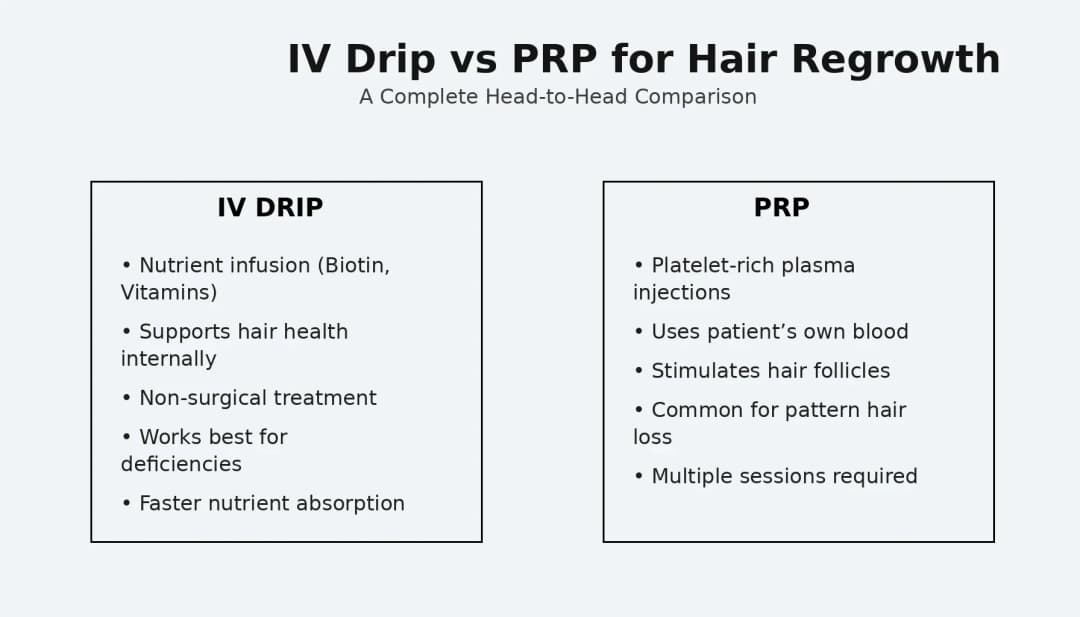
IV Drip vs PRP for Hair Regrowth: A Complete Head-to-Head Comparison
Published on Mon Apr 06 2026
IV Hair Booster Drip vs PRP Therapy: Which Hair Loss Treatment Is Better?
You have done the research. You have seen IV Hair Booster Drips and PRP Therapy both listed as treatments for hair fall, and now you are wondering: are they the same thing? Which one actually works? And which one is right for you?
It is a fair question, and one we hear often at Kibo Clinics. Both treatments are doctor-recommended and both support hair health. But they are not interchangeable. They work through entirely different mechanisms, target different causes of hair fall, and suit different patient profiles.
This guide explains the difference between IV therapy and PRP for hair fall so you know what to expect before your consultation.
What Are These Two Treatments?
Both IV drips and PRP are clinic-based hair treatments recommended by doctors, but they work very differently.
PRP (Platelet-Rich Plasma) therapy works locally at the level of your hair follicle. Your doctor draws blood, concentrates the growth factors, and injects them into your scalp to stimulate follicles directly.
An IV Hair Booster Drip works differently. It delivers vitamins, minerals, and antioxidants directly into your bloodstream, bypassing the digestive system. This allows your body to absorb almost 100% of the nutrients.
Both treatments aim to improve hair health, but they take different approaches to reach that goal.
How PRP Therapy Works
Your doctor draws around 20 ml of blood from your arm. The blood is placed in a centrifuge that spins it at high speed to separate the components. The resulting platelet-rich plasma contains a higher concentration of growth factors.
This plasma is injected into thinning areas of the scalp. A typical session lasts between 60 and 90 minutes.
Growth factors like PDGF, VEGF, and TGF-beta stimulate stem cells in hair follicles, improve blood circulation, and reactivate dormant follicles.
PRP works best when follicles are still alive. It cannot regrow hair where follicles are permanently lost.
Benefits of PRP
- Reactivates dormant hair follicles
- Increases hair density and thickness
- Slows hair fall
- Improves scalp blood circulation
- Uses your own blood
- Supports hair transplant recovery
- Results usually visible from month 3
- Clinically researched treatment
How IV Hair Booster Drips Work
When you take oral supplements, your body absorbs only around 30 to 50 percent of the nutrients. The rest may be lost during digestion.
An IV Hair Booster Drip delivers nutrients directly into your bloodstream, allowing near-complete absorption.
At Kibo Clinics, the Hair Booster Drip contains a combination of nutrients important for hair growth.
| Nutrient | Role in Hair Health |
|---|---|
| Biotin (Vitamin B7) | Supports keratin production and hair structure |
| Zinc | Helps regulate follicle function and repair tissues |
| Glutathione | Acts as an antioxidant to reduce oxidative stress |
| B-Complex Vitamins | Support oxygen delivery to the scalp |
| Vitamin C | Helps collagen production and improves iron absorption |
| Amino Acids | Provide building blocks for keratin |
| Calcium and Potassium | Support cellular signaling in follicles |
Benefits of IV Hair Drips
- High nutrient absorption through IV delivery
- Corrects nutritional deficiencies
- Reduces hair fall caused by poor nutrition
- Improves hair strength and texture
- Protects follicles from oxidative stress
- Supports scalp circulation
- Enhances results of PRP or hair transplant
- No scalp injections required
IV Hair Booster Drip vs PRP Therapy
| Factor | IV Hair Booster Drip | PRP Therapy |
|---|---|---|
| How it works | Nutrients delivered through bloodstream | Platelets injected directly into scalp |
| Best for | Nutritional deficiency and diffuse thinning | Pattern baldness and androgenetic alopecia |
| Session time | 30–45 minutes | 60–90 minutes |
| Comfort | Painless IV drip | Minor injections with numbing cream |
| Sessions needed | 4–6 sessions initially | 3–4 sessions spaced weeks apart |
| Results timeline | Reduced shedding after several sessions | Visible regrowth within 3–6 months |
| Evidence | Biological rationale with limited trials | Multiple clinical studies available |
| Standalone treatment | Often used as supportive therapy | Can work as standalone treatment |
Which Treatment Is Right for You?
Hair loss can occur due to genetics, hormones, nutritional deficiencies, stress, or scalp inflammation. The right treatment depends on the underlying cause.
PRP may be suitable if you:
- Have androgenetic alopecia
- Notice pattern hair loss such as thinning crown
- Want a clinically researched treatment
- Are preparing for or recovering from hair transplant
IV Hair Booster Drip may be suitable if you:
- Have nutrient deficiencies such as biotin or zinc
- Experience diffuse hair thinning
- Notice brittle hair or slow growth
- Prefer treatments without scalp injections
- Want to enhance PRP results
Combining IV Therapy and PRP
Combining IV Hair Booster therapy with PRP often produces better outcomes than using either treatment alone.
IV therapy improves your body's nutritional status and helps follicles respond better to PRP treatment.
This combination is also commonly recommended after hair transplant procedures to support graft survival and reduce shedding.
At Kibo Clinics, your doctor evaluates your scalp condition and blood tests before recommending the right treatment plan.
Frequently Asked Questions
Does IV drip increase hair growth?
IV drips improve hair growth indirectly by correcting nutritional deficiencies that contribute to hair fall.
Can PRP be done every three months?
Yes. After an initial treatment series, maintenance sessions may be recommended every 3 to 6 months.
What are the big three treatments for hair regrowth?
Minoxidil, Finasteride, and Ketoconazole are commonly referred to as the “Big 3” treatments for hair loss.
Does PRP stop hair fall permanently?
PRP helps slow hair fall and improve density, but maintenance treatments are required because underlying causes such as androgenetic alopecia continue over time.