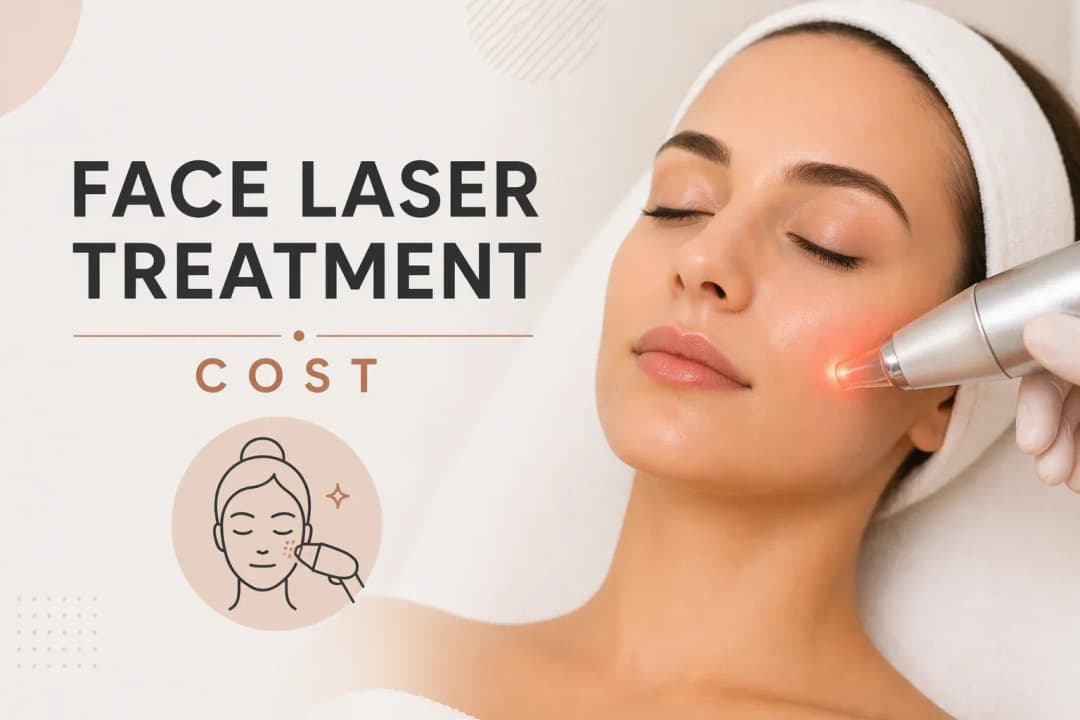
Face Laser Treatment Cost in India: Prices by Laser Type
Published on Mon Jul 20 2026
Quick Answer:
Face laser treatment in India costs between ₹1,500 and ₹25,000 per session. A full treatment course of 3-8 sessions typically totals ₹10,000 to ₹1,20,000. The laser type, skin concern, and city are the three variables that drive this range.
What Is Face Laser Treatment?
Face laser treatment is a clinical skin procedure that uses concentrated beams of light energy to target specific skin concerns, including acne scars, pigmentation, melasma, fine lines, and facial hair removal. The laser energy is absorbed by a target tissue , melanin, haemoglobin, or water , triggering controlled thermal injury that stimulates the skin's natural repair process.
Face laser treatment is not a single procedure. It is a category of treatments, each designed for a different skin concern and depth of penetration. Three broad types exist:
- Ablative laser: Removes the outer skin layer; highest efficacy, requires 5-10 days of downtime
- Non-ablative laser: Works beneath the surface without removing skin; minimal downtime, more gradual results
- Fractional laser: Treats a fraction of skin per session; balances efficacy and recovery time
A common mistake is choosing a laser based only on price before confirming that it is appropriate for the skin concern and skin type.
Face Laser Treatment Cost in India: Full Pricing Breakdown
Face laser treatment cost in India ranges from ₹1,500 to ₹25,000 per session. This range reflects differences in laser technology, clinic tier, dermatologist experience, and geographic location.
City-Wise Cost Per Session (Estimated)
| City | Entry-Level | Mid-Range | Premium Clinic |
|---|---|---|---|
| Mumbai | ₹3,000 | ₹8,000-₹15,000 | ₹20,000-₹25,000 |
| Delhi | ₹2,500 | ₹7,000-₹14,000 | ₹18,000-₹25,000 |
| Bengaluru | ₹2,500 | ₹6,000-₹12,000 | ₹15,000-₹22,000 |
| Hyderabad | ₹2,000 | ₹5,000-₹10,000 | ₹14,000-₹20,000 |
| Chennai | ₹2,000 | ₹5,000-₹10,000 | ₹12,000-₹18,000 |
| Pune | ₹1,500 | ₹4,500-₹9,000 | ₹12,000-₹18,000 |
| Smaller cities | ₹1,500 | ₹3,000-₹7,000 | ₹10,000-₹15,000 |
Mumbai and Delhi clinics typically charge 20-30% more than smaller cities for equivalent procedures.
Cost by Laser Treatment Type (Per Session)
| Laser Treatment Type | Cost Range (India) | Sessions Typically Needed |
|---|---|---|
| Laser toning / skin brightening | ₹1,500-₹5,000 | 4-8 |
| CO2 fractional resurfacing | ₹8,000-₹25,000 | 3-5 |
| Q-switched Nd:YAG (pigmentation) | ₹2,000-₹8,000 | 4-6 |
| Laser hair removal (face) | ₹1,500-₹6,000 | 6-8 |
| Erbium laser resurfacing | ₹6,000-₹20,000 | 2-4 |
| Pulsed dye laser (redness/rosacea) | ₹5,000-₹15,000 | 3-5 |
Is Face Laser Treatment Covered by Insurance in India?
Face laser treatment for cosmetic concerns , pigmentation, acne scars, anti-aging , is generally not covered by health insurance in India. If the procedure is medically indicated for a specific dermatological condition, partial coverage may be possible. Always confirm with your insurer before booking.
Does the Quoted Price Include Aftercare?
In most clinics, the session price does not include aftercare products. Sunscreen, healing creams, and prescribed serums are typically billed separately and may add ₹500-₹2,000 per treatment cycle. Request a fully itemised written quote before starting treatment.
Total Course Cost of Face Laser Treatment in India: What You Will Actually Spend
Per-session prices tell only half the story. The table below shows the realistic total spend per skin concern at mid-range certified dermatology clinics in Tier 1 Indian cities.
| Skin Concern | Laser Used | Sessions Needed | Per Session (Mid-Range) | Estimated Total Cost |
|---|---|---|---|---|
| Acne scars (moderate) | CO2 Fractional | 3-5 | ₹10,000-₹18,000 | ₹30,000-₹90,000 |
| Melasma / pigmentation | Q-switched Nd:YAG | 4-8 | ₹3,000-₹6,000 | ₹12,000-₹48,000 |
| Dark spots / sunspots | Q-switched Nd:YAG | 3-5 | ₹3,000-₹6,000 | ₹9,000-₹30,000 |
| Fine lines / anti-aging | Fractional CO2 / Erbium | 3-4 | ₹8,000-₹15,000 | ₹24,000-₹60,000 |
| Facial hair removal | Diode / Nd:YAG | 6-8 | ₹2,000-₹5,000 | ₹12,000-₹40,000 |
| Skin toning / brightening | Nd:YAG laser toning | 4-6 | ₹2,500-₹5,000 | ₹10,000-₹30,000 |
| Rosacea / redness | Pulsed dye laser | 3-5 | ₹5,000-₹12,000 | ₹15,000-₹60,000 |
Budget clinics may quote 30-40% lower. Premium clinics in South Mumbai or South Delhi may quote 40-60% higher.
What Is Typically NOT Included in a Quoted Session Price
- Pre-treatment topical anaesthetic cream: ₹200-₹500
- Post-treatment medicated sunscreen or healing serum: ₹500-₹2,000 per cycle
- First-visit consultation fee: ₹500-₹1,500
- Follow-up review appointments
- Pre-treatment prescription medications (hydroquinone, retinoids) where required
A clinic that cannot provide a written, itemised quote covering the full course , not just a per-session figure , is a red flag.
On EMI and financing: Several certified clinics in India now offer no-cost EMI for laser packages above ₹15,000. Ask your clinic directly before assuming you must pay upfront.
How Face Laser Treatment Works: The Step-by-Step Mechanism
Face laser treatment works because specific wavelengths of light are absorbed by target chromophores in the skin , melanin for pigmentation, haemoglobin for redness, and water for resurfacing. This selective absorption creates controlled thermal injury, activating the skin's healing response.
- Consultation and skin analysis: A dermatologist assesses your Fitzpatrick skin type, skin concern, and required treatment depth. This determines laser type and energy settings.
- Pre-treatment preparation: The face is cleansed and a topical anaesthetic cream is applied 30-45 minutes before the session.
- Laser application: The handpiece delivers pulses of laser energy to the target area. Each pulse lasts milliseconds. Session duration ranges from 15 to 45 minutes depending on the area.
- Immediate skin response: The skin may appear red, mildly swollen, or warm. This typically resolves within 24-72 hours for non-ablative treatments and 5-10 days for ablative procedures.
- Collagen remodelling phase: Over 4-12 weeks, the skin produces new collagen and elastin. This is when visible improvement in texture, tone, and scarring becomes apparent.
- Follow-up sessions: Most concerns require multiple sessions spaced 3-6 weeks apart for cumulative results.
Why Multiple Sessions Are Needed
A single session targets only a percentage of the affected cells. Spacing sessions allows the skin to heal fully between treatments and ensures consistent depth of penetration without overexposure.
Types of Face Laser Treatments: Which One Is Right for You?
Matching the laser type to the specific skin concern is more important than choosing based on cost. The following classification explains how different laser categories are generally matched to common skin concerns.
Ablative Lasers (CO2, Erbium)
Ablative lasers remove the outer skin layer. They are the most effective option for deep acne scars, pronounced wrinkles, and textural irregularities. CO2 lasers penetrate deepest and require 5-10 days of downtime. Erbium lasers are gentler with 3-5 days of recovery.
- Cost per session: ₹6,000-₹25,000
- Choose if: You have moderate-to-deep acne scars or significant sun damage and can accommodate downtime
Non-Ablative Lasers (Nd:YAG, Diode)
Non-ablative lasers work beneath the skin surface without removing the outer layer. They stimulate collagen production with minimal downtime of 24-48 hours of redness. Results are more gradual and typically require more sessions.
- Cost per session: ₹2,000-₹8,000
- Choose if: You have pigmentation, early signs of ageing, or redness and need a low-downtime option
Fractional Lasers (Fraxel, CO2 Fractional)
Fractional lasers treat a fraction of the skin per session, leaving surrounding tissue intact for faster healing. They offer a balance between efficacy and recovery time, typically 3-5 days.
- Cost per session: ₹5,000-₹20,000
- Choose if: You want meaningful results with manageable downtime
Q-Switched Lasers
Q-switched lasers deliver energy in extremely short pulses of nanoseconds, making them highly effective for melanin-based concerns such as melasma, sunspots, and post-acne dark marks.
- Cost per session: ₹2,000-₹8,000
- Choose if: You have pigmentation, melasma, or post-acne dark marks
Laser Type Comparison Table
| Laser Type | Best For | Downtime | Cost/Session | Sessions Needed |
|---|---|---|---|---|
| CO2 (ablative) | Deep scars, wrinkles | 5-10 days | ₹8,000-₹25,000 | 3-5 |
| Erbium (ablative) | Moderate scars, texture | 3-5 days | ₹6,000-₹20,000 | 2-4 |
| Nd:YAG (non-ablative) | Pigmentation, toning | Minimal | ₹2,000-₹8,000 | 4-8 |
| Fractional CO2 | Scars + anti-aging | 3-5 days | ₹5,000-₹20,000 | 3-5 |
| Q-switched | Melasma, dark spots | Minimal | ₹2,000-₹8,000 | 4-6 |
| Diode / IPL | Hair removal, redness | Minimal | ₹1,500-₹6,000 | 6-8 |
Q-Switched Nd:YAG Laser Toning Cost Per Session in India
Q-switched Nd:YAG laser toning is one of the most widely available and cost-effective face laser treatments in India. A single session typically costs ₹2,000-₹6,000 at a certified dermatology clinic. Sessions in Mumbai and Delhi sit at the higher end (₹4,000-₹8,000); smaller cities at the lower end (₹1,500-₹4,000).
Most patients need 4-8 sessions spaced 3-4 weeks apart, bringing the total course cost to approximately ₹8,000-₹48,000 depending on location and pigmentation severity.
The Q-switched Nd:YAG laser is effective for melasma, sunspots, post-acne dark marks, and general skin toning. It is among the safest lasers for Indian skin tones (Fitzpatrick III-V) because its 1064 nm wavelength has lower melanin absorption than shorter-wavelength lasers, reducing the risk of post-inflammatory hyperpigmentation.
A 2021 study in the Journal of Cosmetic Dermatology found that low-fluence Q-switched Nd:YAG at 1064 nm improved melasma severity scores (MASI) by an average of 41% after 6 sessions in Fitzpatrick skin types IV-V, with a post-inflammatory hyperpigmentation rate of less than 8% when the correct protocol was followed.
Fraxel Laser Cost in India
Fraxel is a brand name for fractional laser technology. In India, a single Fraxel session costs approximately ₹8,000-₹22,000, depending on the treatment area, the specific Fraxel model, and clinic location.
- Fraxel Re:pair (ablative CO2 fractional): ₹15,000-₹25,000 per session; requires 5-10 days of downtime; produces the most significant resurfacing
- Fraxel Re:store (non-ablative fractional 1550 nm): ₹8,000-₹15,000 per session; gentler with 3-5 days of downtime
Most patients undergoing Fraxel for acne scars or anti-ageing require 3-5 sessions, bringing the total course cost to ₹25,000-₹1,10,000.
Not all Indian clinics carry genuine Fraxel equipment. Some use the Fraxel name generically for any fractional laser. Confirm the specific device brand and model before booking.
Best Face Laser Treatment by Skin Concern: A Dermatologist-Aligned Guide
Cost matters, but choosing the wrong laser for your skin concern wastes both money and recovery time. The following guidance summarises how laser options are generally matched to common skin concerns in Indian patients.
Which Laser Is Best for Acne Scars?
CO2 fractional laser is the clinical gold standard for moderate-to-deep acne scars. A 2022 meta-analysis in Lasers in Surgery and Medicine found that fractional CO2 laser reduced scar severity by 50-75% after 3-5 sessions in 78% of patients. For Fitzpatrick IV-VI skin, a conservative energy protocol is essential to prevent post-inflammatory hyperpigmentation. Erbium fractional laser is a gentler alternative for shallower scars.
- Best option: CO2 fractional or Erbium fractional
- Estimated total cost: ₹30,000-₹90,000
Which Laser Is Best for Melasma?
Melasma is one of the most difficult skin conditions to treat with laser. Q-switched Nd:YAG at low fluence , the laser toning protocol , is the most commonly recommended option for Indian skin. It reduces melanin gradually without triggering a rebound hyperpigmentation response. Aggressive ablative lasers are generally avoided for melasma in darker skin tones.
- Best option: Q-switched Nd:YAG (low fluence, multi-session protocol)
- Estimated total cost: ₹12,000-₹40,000
Which Laser Is Best for Dark Spots and Sunspots?
Q-switched Nd:YAG and picosecond lasers may be used for selected dark spots and sun-induced pigmentation. The appropriate device and energy setting depend on the depth of pigment, skin tone, and risk of post-inflammatory hyperpigmentation.
- Common options: Q-switched Nd:YAG or picosecond laser
- Estimated total cost: ₹9,000-₹40,000
Which Laser Is Best for Facial Hair Removal?
Diode and long-pulsed Nd:YAG lasers are commonly used for facial hair reduction. Long-pulsed Nd:YAG is often considered for deeper skin tones because it has lower melanin absorption at the skin surface. Multiple sessions are needed because laser works best on hair in the active growth phase.
- Common options: Diode or long-pulsed Nd:YAG
- Estimated total cost: ₹12,000-₹40,000
Which Laser Is Best for Fine Lines and Texture?
Fractional CO2, Erbium, and selected non-ablative fractional lasers may be used to improve texture and early signs of ageing. More aggressive resurfacing may produce greater improvement but also requires longer recovery.
- Common options: Fractional CO2, Erbium, or non-ablative fractional laser
- Estimated total cost: ₹24,000-₹80,000
What Factors Affect Face Laser Treatment Cost?
- Laser technology: Advanced fractional and picosecond platforms generally cost more than basic toning devices.
- Treatment area: Full-face treatment costs more than targeting a few spots or a smaller zone.
- Number of sessions: Pigmentation, scars, and hair reduction usually require a planned series rather than one session.
- Dermatologist experience: Clinics with experienced dermatologists and higher clinical oversight may charge more.
- City and clinic location: Metro cities and premium commercial areas usually have higher operating costs.
- Aftercare: Sunscreen, healing creams, prescriptions, and follow-up reviews can increase the overall spend.
- Combination treatment: Some concerns require laser plus chemical peels, microneedling, or topical therapy.
Benefits of Face Laser Treatment
- Targets specific concerns such as scars, pigmentation, redness, texture, or unwanted hair
- Allows treatment depth and energy to be adjusted for the concern
- Can stimulate collagen remodelling in resurfacing procedures
- May offer more visible improvement than topical care for selected concerns
- Can be combined with other dermatologist-guided treatments when appropriate
Results vary depending on diagnosis, device, settings, skin tone, and adherence to aftercare.
When comparing resurfacing options, reviewing the complete chemical peel cost in India can help you understand how peel pricing differs from laser packages.
Possible Side Effects and Risks
Temporary redness, warmth, swelling, dryness, and mild crusting can occur after laser treatment. Ablative procedures usually involve more downtime than non-ablative procedures.
When comparing procedures, it is also useful to understand common chemical peel side effects because both lasers and peels can trigger irritation or pigmentation when poorly selected.
- Post-inflammatory hyperpigmentation
- Temporary darkening or lightening of treated skin
- Prolonged redness or swelling
- Acne flare or milia
- Infection if aftercare is not followed
- Scarring, particularly with unsuitable settings or poor technique
People with deeper skin tones may have a higher risk of pigment changes, making device selection and conservative energy settings especially important.
Who Should Avoid or Postpone Face Laser Treatment?
- People with active skin infection, open wounds, or uncontrolled acne in the treatment area
- Those with recent tanning or sunburn
- People using photosensitising medicines unless cleared by a doctor
- Those with a history of keloid scarring, depending on the procedure
- Pregnant individuals when treatment is purely cosmetic
- People with unrealistic expectations about one-session results
How to Prepare for Face Laser Treatment
- Avoid tanning and prolonged sun exposure for at least two weeks before treatment
- Use broad-spectrum sunscreen daily
- Stop strong exfoliating acids or retinoids only when advised by the treating dermatologist
- Disclose medicines, previous procedures, cold sores, and pigmentation history
- Do not wax or thread the area before hair-removal laser if the clinic advises shaving instead
- Ask for a patch test when appropriate, particularly for deeper skin tones
Face Laser Treatment Aftercare
- Use a gentle cleanser and moisturiser
- Apply broad-spectrum SPF 30-50 and reapply when outdoors
- Avoid scrubs, retinoids, and strong acids until the skin has recovered
- Do not pick crusts or peeling skin
- Avoid steam, sauna, intense exercise, and excessive heat for the advised period
- Follow the clinic's instructions for healing creams or prescribed medicines
Face Laser Treatment vs Chemical Peel
| Factor | Laser Treatment | Chemical Peel |
|---|---|---|
| Best suited for | Selected scars, deeper pigmentation, redness, texture, and hair reduction | Surface pigmentation, dullness, acne, and uneven tone |
| Cost per session | Usually higher | Usually lower |
| Downtime | Minimal to 10 days, depending on laser | Minimal to about 7 days, depending on peel strength |
| Sessions | Usually multiple | Usually multiple |
| Key consideration | Device and wavelength must suit the skin concern and tone | Acid type and strength must suit the skin concern and sensitivity |
How to Choose a Safe Laser Clinic
- Confirm that a qualified dermatologist evaluates your skin before treatment
- Ask for the exact laser name, wavelength, and purpose
- Request an itemised estimate for the complete course
- Ask about expected downtime and pigment-change risk for your skin tone
- Check whether follow-up reviews and aftercare are included
- Avoid clinics promising permanent results or complete correction in one session
Final Thoughts
Face laser treatment cost in India can vary widely because the term includes several different procedures. A low session price does not necessarily mean a low total cost, especially when multiple sittings, aftercare, and combination treatments are required.
Recovery principles overlap with chemical peel aftercare in areas such as sun protection, barrier repair, and avoiding strong actives until healing is complete.
A detailed guide to chemical peel treatment can help clarify peel types, indications, downtime, and expected results.
For lower-downtime maintenance and temporary brightness, a medifacial treatment may also be discussed as a separate option.
For acne scars and texture, patients may also compare laser resurfacing with microneedling treatment in Mumbai before choosing a procedure.
The safest way to estimate your budget is to first confirm the diagnosis, suitable laser type, number of sessions, expected downtime, and complete package cost. For a personalised assessment, book a consultation with Kibo Skin Clinic.
Frequently Asked Questions
Q1. What is the average face laser treatment cost in India?
Face laser treatment generally costs ₹1,500-₹25,000 per session, depending on the laser type, skin concern, city, clinic, and treatment area.
Q2. How much does a complete laser treatment course cost?
A complete course may cost approximately ₹10,000-₹1,20,000 because most concerns require three to eight sessions.
Q3. Is one face laser session enough?
Usually not. Pigmentation, acne scars, texture concerns, and facial hair reduction commonly require multiple sessions spaced several weeks apart.
Q4. Is face laser treatment permanent?
Results are not always permanent. Ageing, hormones, sun exposure, acne, and new hair growth can affect long-term outcomes. Maintenance may be required.
Q5. Is laser treatment safe for Indian skin?
It can be safe when the correct wavelength, device, and energy settings are selected for the person's skin tone and concern by a qualified professional.
Q6. Does insurance cover cosmetic face laser treatment?
Cosmetic laser procedures are generally not covered. Coverage may be considered only when treatment is medically necessary and approved by the insurer.
Medical Disclaimer
This article is for educational purposes only and does not replace professional medical advice. Prices are indicative and may vary by clinic, city, device, treatment area, and individual requirements. Consult a qualified dermatologist for diagnosis and treatment planning.