Discover expert insights on hair transplant procedures, FUE techniques, recovery tips, and hair restoration guides from Kibo's experienced team.

This guide explains who may realistically be a candidate for exosome hair treatment, covering pattern hair loss, diffuse or temporary shedding, other hair-loss conditions, and non-surgical alternatives, so readers understand that suitability depends on a proper diagnosis rather than thinning alone.
September 15, 2026 – 5 min read

This guide examines whether exosomes work for androgenetic alopecia in both men and women, covering what current systematic reviews show, how the evidence differs between male and female pattern hair loss, and when exosome therapy might realistically be considered alongside established treatments like minoxidil and finasteride.
September 10, 2026 – 5 min read

This guide covers the reported side effects of exosome hair treatment, what current safety data actually shows, the key risks and disadvantages, and who should avoid the treatment altogether. It also outlines what to check with a provider before considering exosome therapy, drawing on recent systematic reviews and FDA regulatory guidance on unapproved regenerative products.
September 10, 2026 – 5 min read

This guide explains what exosome hair treatment is, how it may work, and what current clinical evidence actually shows, drawing on recent systematic reviews and studies. It covers the procedure, expected timelines, sessions, cost in India, safety, and how exosomes compare with PRP, GFC and stem-cell approaches, with an evidence-first, non-promotional view of a still-investigational treatment.
September 10, 2026 – 5 min read

Hair transplant can be a safe procedure for suitable candidates when performed by a qualified medical team. Understanding possible risks, side effects, donor-area planning, anaesthesia safety, clinic hygiene and post-procedure care helps patients make an informed decision.
August 31, 2026 – 5 min read
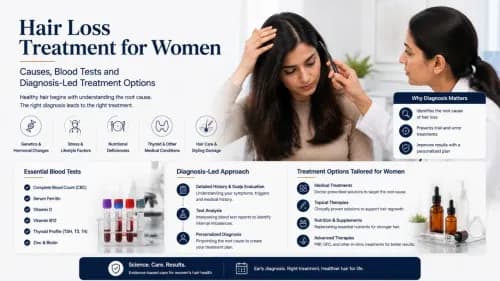
Female hair loss can have several causes, including female-pattern hair loss, hormonal conditions such as PCOS or thyroid disease, nutritional deficiencies, postpartum changes, menopause, and stress. Identifying the cause is the first step towards choosing the right hair treatment for women.
August 27, 2026 – 5 min read

Hair transplant pricing in Dehradun is highly variable. Current public clinic/hospital pages show standard FUE-style local prices around ₹40-₹70 per graft in some centres, with advertised totals ranging from roughly ₹40,000-₹65,000 for smaller 800-1,200 graft plans to ₹1,80,000-₹2,50,000+ for 4,000-5,000+ graft cases; premium implanter/DHI-style or branded protocols can cost more. The content does not pretend these advertisements form an official city average. Instead it teaches readers how to compare graft estimates, FUE/DHI labels, surgeon involvement, donor safety, written quotes and total travel cost. Kibo’s listed clinic remains in Khar West, Mumbai, so the page explicitly avoids claiming a Dehradun Kibo branch and objectively explains when local care versus travelling to a larger city is justified.
August 24, 2026 – 5 min read

There is no reliable direct public confirmation from Sunny Deol that establishes a hair transplant, surgeon, technique or graft count. A 2007 Times of India entertainment report described attention around his 'hair job' while discussing weaving, transplants and wigs, which confirms that his hair appearance was publicly discussed but does not prove surgery. Public photographs can support cautious observations about apparent hairline or density changes, yet they cannot distinguish transplant surgery from hair systems, styling, fibres, medication response or lighting. The article therefore labels every visual point as observation, rejects photo-based FUE/DHI/graft-count claims and uses Sunny Deol's search interest to teach readers how to evaluate celebrity hair-transplant rumours responsibly.
August 24, 2026 – 5 min read

Hair plugs are the old large-graft era of hair transplantation. The transplanted follicles may still survive, but widely spaced multi-hair tufts can create an obvious doll-hair appearance that differs from modern follicular-unit surgery. Current repair options include camouflage with finer grafts, plug excision or reduction, redistribution of reusable follicles, hairline redesign and scar camouflage. Because previous surgery can leave fibrosis, circular scars and a depleted donor area, repair is often staged and should be planned by an experienced corrective surgeon rather than treated as a simple high-graft transplant.
August 24, 2026 – 5 min read

Hair smoothening treatment can soften natural waves, tame frizz and add a glossy finish while keeping some natural bounce, making hair easier to manage without necessarily making it completely straight. The treatment can also cause dryness, breakage or irritation, so understanding the process, cost, side effects and maintenance helps you make an informed choice.
August 21, 2026 – 5 min read

Hair Botox is a salon conditioning treatment that can temporarily improve hair smoothness, shine, and manageability. However, side effects can include scalp irritation, chemical sensitivity, dryness, texture changes, and hair breakage, particularly when fragile hair is exposed to chemical or heat stress.
August 17, 2026 – 5 min read

A vegan hair treatment is a product, salon service, supplement, or medical formulation made without animal-derived ingredients. While some vegan treatments improve hair quality, support scalp health, or help correct a confirmed nutritional deficiency, they do not automatically treat medical hair loss.
August 17, 2026 – 5 min read
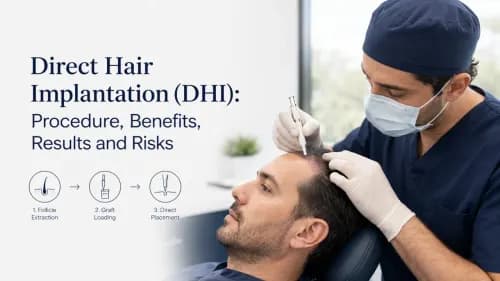
This guide explains what Direct Hair Implantation actually means, how the implanter pen is used, how DHI relates to FUE, and what the procedure can and cannot change. It covers candidacy, benefits, limitations, recovery, results, risks, cost and clinic-selection checks. Read it if you are comparing DHI with other transplant options and want to separate surgical facts from marketing claims before booking a consultation.
August 18, 2026 – 5 min read
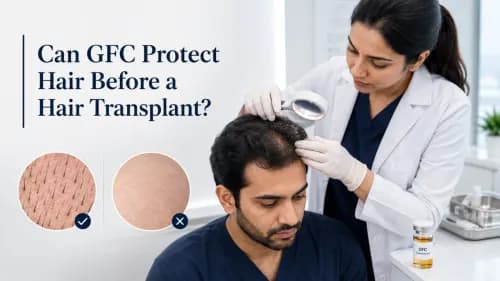
This article explains whether GFC before a hair transplant may support existing, miniaturised hair, what current evidence does and does not show, who may be considered for treatment, and when a hair transplant is more appropriate. It is most useful for people with thinning native hair who are deciding whether pre-transplant GFC is a worthwhile optional add-on, while making clear that it cannot regrow hair in completely bald areas or replace proven medical treatment or transplantation.
August 12, 2026 – 5 min read
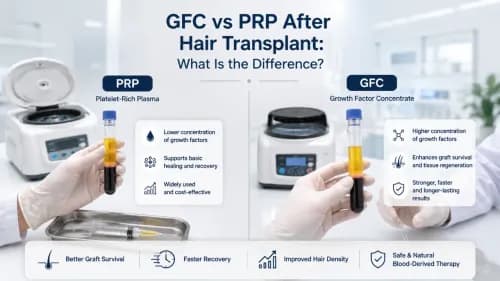
This article compares GFC and PRP after a hair transplant across preparation, clinical evidence, graft survival, hair growth, healing, shock loss, safety, treatment sessions and cost. It is most useful for people deciding whether either optional adjunct belongs in their recovery plan, while making clear that PRP currently has stronger transplant-specific evidence and neither treatment is proven universally superior.
August 12, 2026 – 5 min read
This article explains whether GFC has been shown to improve final hair transplant outcomes, including graft survival, density, healing, shock loss and growth speed. It separates transplant-specific evidence from studies on pattern hair loss, shows which outcomes remain uncertain, and explains why surgical quality and aftercare matter more. It is most useful for readers deciding whether GFC is worth adding as an optional post-transplant treatment.
August 12, 2026 – 5 min read
This guide explains when GFC may be started after a hair transplant, why scalp healing matters more than a fixed day, how a typical initial session plan may be structured, and when maintenance might be considered. It is most useful for people recovering from a transplant who want to decide whether GFC is necessary, how many sessions may be recommended, and what signs a surgeon checks before treatment.
August 12, 2026 – 5 min read
This blog explains what a GFC hair transplant means, how GFC may be used before, during or after conventional hair-transplant surgery, and what it can and cannot do. It also covers the procedure, possible benefits, differences from PRP, expected result timeline, suitability, side effects, cost factors and the importance of choosing a qualified clinic.
August 12, 2026 – 5 min read
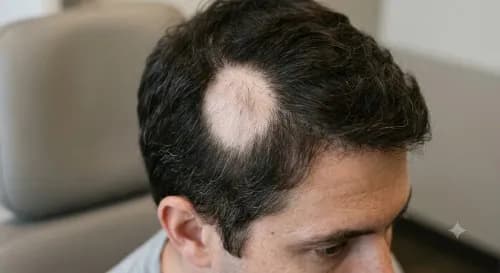
Hair often can grow back after alopecia areata because the follicles usually remain present beneath the skin. The immune system interrupts active growth, but it does not normally replace follicles with scar tissue. Some people recover without treatment, some regrow faster with treatment, and others have incomplete or repeated episodes.
August 12, 2026 – 5 min read

Alopecia areata is an autoimmune form of hair loss in which the body’s immune system targets hair follicles. The result is usually sudden, smooth, round or oval patches of hair loss. For a full overview of symptoms and types, read alopecia areata explained. The important point is that alopecia areata affects the follicle’s behaviour, not just the visible strand.
August 12, 2026 – 5 min read
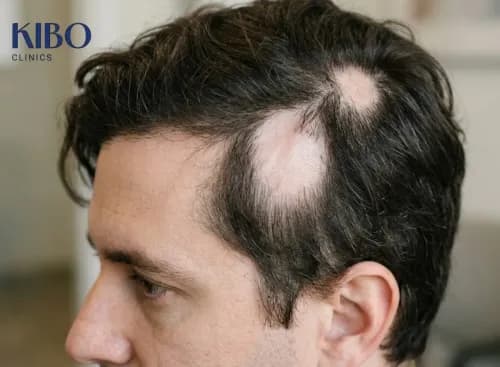
Alopecia areata is an autoimmune, usually non-scarring form of hair loss. In simple terms, the immune system reacts against hair follicles and interrupts active hair production. The result is often a sudden smooth patch on the scalp, beard, eyebrow or another hair-bearing area. Because “alopecia” means hair loss and “areata” means patchy, the name itself describes the most common pattern.
September 10, 2026 – 5 min read
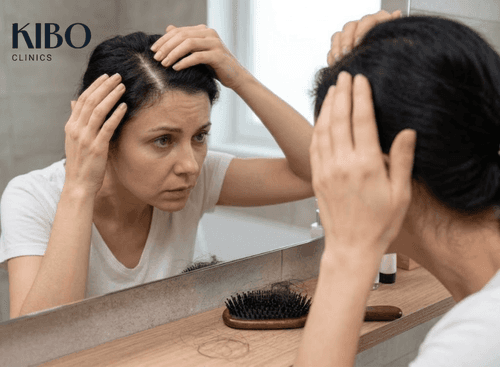
Yes, hair can recover after telogen effluvium when the trigger has passed and the follicles remain healthy. Telogen effluvium is usually a shift in the hair growth cycle, not permanent follicle destruction.
August 12, 2026 – 5 min read
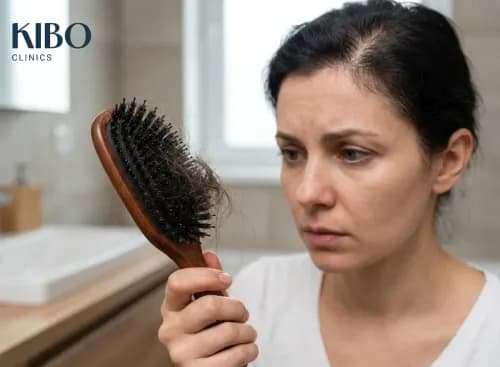
Telogen effluvium is a reactive shedding condition. It happens when a physical, hormonal, nutritional, medical or emotional stressor pushes more follicles than usual out of the active growth phase and into the resting phase.
August 12, 2026 – 5 min read

Telogen effluvium is a common cause of sudden hair shedding where more hairs than usual move into the resting, or telogen, phase of the hair growth cycle. The follicles are usually not dead. The issue is timing: too many hairs pause growth and prepare to shed around the same period, so the fall looks sudden and alarming.
August 12, 2026 – 5 min read

Yes, hair can recover to some extent from androgenetic alopecia, but the realistic answer depends on how advanced the miniaturisation is. Androgenetic alopecia, also called pattern hair loss, is not simply extra shedding.
August 12, 2026 – 5 min read
YOUR HAIR JOURNEY STARTS HERE