
PCOS and Hair Thinning: A Guide for Women
Published on Sat Apr 11 2026
Meera was 26 when she first noticed her ponytail getting thinner. "I thought it was stress," she said. "But then I started seeing my scalp through my hair in photos, and I panicked." After a series of tests, her doctor confirmed polycystic ovary syndrome — PCOS. "Nobody had connected my hair loss to my hormones. I didn't even know that was a thing."
Meera's experience is far more common than most women realise. PCOS-related hair thinning affects a significant proportion of women with the condition, yet it remains one of the least discussed and most poorly managed symptoms of PCOS. This guide covers everything you need to understand — what's happening, why, and what you can actually do about it.
What Is PCOS?
Polycystic ovary syndrome is one of the most common hormonal disorders affecting women of reproductive age, estimated to affect between 8% and 13% of women globally — though many cases remain undiagnosed. Despite its name, not all women with PCOS have cysts on their ovaries. The name comes from the appearance of the ovaries on ultrasound in many (but not all) affected women, where multiple small follicles give the ovary a "polycystic" appearance.
PCOS is fundamentally a hormonal and metabolic disorder. The defining feature is a disruption in the normal hormonal balance — particularly involving androgens (male hormones such as testosterone), insulin, and the hormones that regulate the menstrual cycle. This hormonal disruption is what connects PCOS to such a wide range of symptoms across different body systems.
Diagnosis is typically made using what's known as the Rotterdam criteria, where a woman needs to meet at least two of the following three features: irregular or absent periods, clinical or biochemical signs of elevated androgens, and polycystic ovaries on ultrasound. Because the diagnostic criteria are broad, PCOS presents very differently from woman to woman — which is part of why it's often missed or delayed in diagnosis.
The Symptoms of PCOS Beyond Hair Loss
Understanding PCOS as a whole-body condition helps explain why hair thinning is just one piece of a larger picture. Recognising the full pattern of symptoms is important both for diagnosis and for understanding how different treatments address different aspects of the condition.
| Body System | Common PCOS Symptoms |
|---|---|
| Menstrual cycle | Irregular, infrequent, or absent periods; unpredictable cycle lengths |
| Skin | Acne (particularly along jawline and chin); oily skin; dark patches (acanthosis nigricans) |
| Hair (scalp) | Thinning at crown and top of scalp; diffuse shedding; widening part line |
| Hair (body) | Excess facial and body hair (hirsutism) — chin, upper lip, chest, abdomen |
| Weight and metabolism | Weight gain or difficulty losing weight; insulin resistance; increased risk of type 2 diabetes |
| Fertility | Difficulty conceiving due to irregular or absent ovulation |
| Mood and mental health | Higher rates of anxiety, depression, and low self-esteem linked to hormonal fluctuations and visible symptoms |
| Sleep | Higher risk of sleep apnoea; poor sleep quality |
The combination of scalp hair thinning and excess facial or body hair — happening simultaneously — is one of the more diagnostically telling patterns of PCOS. If you're experiencing both, it's worth discussing with your doctor even if your other symptoms seem mild.
How PCOS Causes Hair Thinning
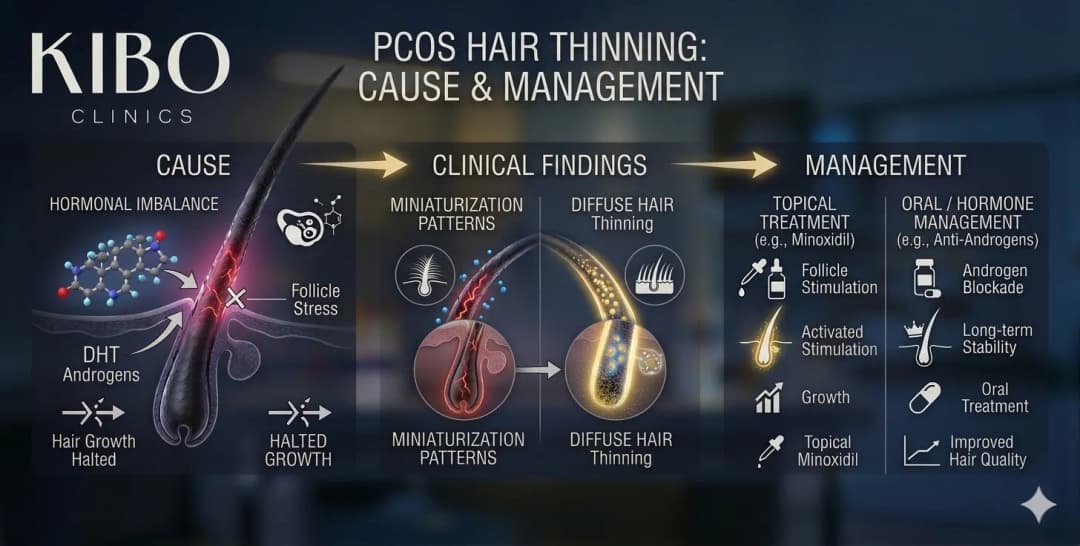
The connection between PCOS and scalp hair thinning comes down to androgens — specifically a hormone called dihydrotestosterone (DHT) and the way genetically sensitive hair follicles respond to it.
The Role of Androgens
In women with PCOS, the ovaries (and sometimes the adrenal glands) produce elevated levels of androgens — male hormones that are present in all women but normally at much lower levels than in men. These elevated androgens include testosterone and its more potent derivative, DHT.
DHT is the primary driver of androgenetic hair loss — the same process that causes male pattern baldness in men. In genetically predisposed follicles, DHT binds to androgen receptors in the hair follicle and progressively miniaturises it. Over successive hair growth cycles, the follicle produces thinner, shorter, lighter hairs until it eventually stops producing visible hair altogether.
In women with PCOS, this process is driven by the elevated androgen environment created by the hormonal imbalance of the condition. Women who are genetically predisposed to androgen-sensitive follicles will experience more noticeable thinning; those without this genetic predisposition may have elevated androgens but not experience significant hair loss.
The Role of Insulin Resistance
A significant proportion of women with PCOS — estimates range from 50% to 75% — have some degree of insulin resistance. When cells become resistant to insulin, the pancreas compensates by producing more insulin. Elevated insulin levels in turn stimulate the ovaries to produce more androgens, creating a feedback loop that worsens the hormonal imbalance at the root of PCOS.
This means that for many women with PCOS, addressing insulin resistance is not just a metabolic health issue — it directly impacts androgen levels and therefore hair loss. Lifestyle changes and medications that improve insulin sensitivity can have a meaningful downstream effect on hair thinning.
How PCOS Hair Loss Differs From Other Hair Loss
PCOS-related hair loss (also called female pattern hair loss or FPHL when driven by androgens) presents differently from some other forms of hair loss, and understanding the pattern helps with both diagnosis and treatment:
| Feature | PCOS / Androgenetic Hair Loss | Telogen Effluvium (Stress/Nutritional) | Alopecia Areata |
|---|---|---|---|
| Pattern | Diffuse thinning at crown and top; widening part; hairline usually preserved | Diffuse all over; often sudden increased shedding | Patchy, defined bald spots |
| Onset | Gradual over months to years | Often 2–3 months after a trigger event | Can be sudden |
| Reversibility | Partially reversible with treatment; early intervention matters | Often fully reversible once trigger is resolved | Variable; may regrow spontaneously or require treatment |
| Associated symptoms | Often alongside acne, irregular periods, excess body hair | Linked to stress, illness, nutritional deficiency, post-partum | Autoimmune; may affect eyebrows and eyelashes too |
| Scalp appearance | Miniaturised hairs visible; scalp increasingly visible through hair | Normal scalp; hairs shed at root | Smooth bald patches; exclamation mark hairs at edges |
It's also worth noting that PCOS can co-exist with other causes of hair loss — particularly telogen effluvium triggered by the stress and nutritional imbalances that often accompany PCOS. Unravelling the contributing factors is part of why a thorough evaluation is so important.
Getting the Right Diagnosis
If you suspect PCOS is behind your hair thinning, the path to diagnosis involves both your gynaecologist or endocrinologist (for PCOS assessment) and ideally a dermatologist (for scalp and hair evaluation). Neither should be seen in isolation.
Blood Tests to Ask For
A comprehensive hormonal blood panel helps identify the androgen excess driving hair loss and rules out other hormonal causes. Key tests include:
- Total and free testosterone: Elevated in many women with PCOS; free testosterone (the biologically active fraction) is particularly important
- DHEA-S (dehydroepiandrosterone sulphate): An androgen produced by the adrenal glands; elevated levels point toward adrenal androgen excess
- LH and FSH: Luteinising hormone and follicle-stimulating hormone; an elevated LH:FSH ratio is a classic PCOS marker
- Fasting insulin and glucose / HOMA-IR: Assesses insulin resistance
- Prolactin: To rule out hyperprolactinaemia as a cause of menstrual irregularity
- Thyroid function (TSH, free T3, free T4): Thyroid disorders are a common and frequently overlooked cause of hair thinning in women
- Ferritin (iron stores): Iron deficiency is extremely common in women and a major independent cause of hair shedding — it must be assessed and corrected
- Vitamin D and B12: Deficiencies in both are associated with hair loss and are common in the Indian population
Getting a full picture of your hormonal and nutritional status — rather than just a basic blood count — is essential. Many women with PCOS-related hair loss also have low ferritin or vitamin D, and treating these deficiencies alongside the hormonal component produces significantly better results than addressing either alone.
Scalp Assessment
A dermatologist experienced in hair loss can perform a trichoscopy — a non-invasive scalp examination using a dermatoscope — to assess follicle miniaturisation, scalp inflammation, and hair shaft diameter variation. This helps confirm the androgenetic pattern and rule out other conditions affecting the scalp. In some cases, a scalp biopsy may be recommended for a definitive histological assessment.
Treatment Options for PCOS-Related Hair Thinning
Effective management of PCOS hair thinning requires a layered approach — addressing the underlying hormonal imbalance, treating the scalp directly, and supporting overall health. There is no single tablet or shampoo that resolves this on its own. The most successful outcomes come from combining treatments strategically under medical supervision.
1. Hormonal Treatments
Because PCOS hair loss is driven by androgens, anti-androgen treatments form the most direct pharmacological approach.
- Combined oral contraceptive pill (COCP): Certain formulations of the contraceptive pill serve a dual purpose — they regulate the menstrual cycle and suppress ovarian androgen production. Pills containing anti-androgenic progestins (such as cyproterone acetate or drospirenone) are preferred for PCOS-related hair and skin symptoms. Results for hair improvement typically take 6–12 months of consistent use to become visible.
- Spironolactone: Originally a blood pressure medication, spironolactone is widely used off-label as an anti-androgen for PCOS symptoms including hair loss and acne. It works by blocking androgen receptors, reducing the ability of DHT to act on hair follicles. It is generally not used in women who are pregnant or trying to conceive. Doses typically range from 50mg to 200mg daily under medical supervision.
- Cyproterone acetate: A potent anti-androgen used in some countries (including India) either as part of a combined pill (Diane-35) or as a standalone medication. Effective for hair loss and hirsutism but requires monitoring due to potential side effects.
- Metformin: A medication primarily used for type 2 diabetes, metformin improves insulin sensitivity and is widely prescribed for PCOS. By reducing insulin levels, it indirectly lowers androgen production from the ovaries. While its primary effects are metabolic, improved insulin sensitivity supports better hormonal balance and may contribute to reduced hair shedding over time.
2. Topical Minoxidil
Minoxidil is the only topical treatment with strong evidence for female pattern hair loss, and it works regardless of the underlying cause — including androgen-driven loss in PCOS. It works by prolonging the anagen (growth) phase of the hair cycle and increasing blood flow to follicles, stimulating thicker and longer hair growth over time.
For women, a 2% solution or 5% foam formulation is typically used. Application is once or twice daily directly to the scalp at the areas of thinning. Results take time — most women see meaningful improvement at the 6–12 month mark, and treatment must be continued to maintain results. Stopping minoxidil typically results in reversal of gains within several months.
Oral minoxidil at low doses (0.25mg–1mg daily) is an increasingly used alternative, particularly for women who find topical application inconvenient. It has shown good efficacy with a generally manageable side effect profile at these low doses, though it should only be used under medical supervision.
3. Nutritional Correction
Nutritional deficiencies are extremely common in women with PCOS and are a significant, often underappreciated contributor to hair thinning. Correcting deficiencies should be done based on blood test results rather than general supplementation — taking iron supplements without confirmed deficiency, for example, can cause harm.
| Nutrient | Role in Hair Health | Common in PCOS? | Notes |
|---|---|---|---|
| Iron (Ferritin) | Essential for follicle cell division and oxygen delivery | Very common — especially with heavy periods | Ferritin below 40 ng/mL associated with hair loss even without anaemia |
| Vitamin D | Involved in hair follicle cycling; deficiency linked to alopecia | Very common in India | Optimise to 50–80 ng/mL for hair benefits |
| Zinc | Regulates 5-alpha reductase (DHT-producing enzyme); supports follicle structure | Moderately common | Excess zinc can also cause hair loss — test before supplementing |
| Vitamin B12 | Supports red blood cell production and follicle health | Common, especially in vegetarians/vegans and metformin users | Metformin reduces B12 absorption — monitor if on metformin |
| Biotin | Supports keratin production | True deficiency is rare | Widely marketed but evidence for hair benefit without deficiency is limited; high doses interfere with thyroid blood tests |
| Omega-3 fatty acids | Anti-inflammatory; supports scalp health and follicle environment | Low intake common in many Indian diets | Fish oil or algae-based omega-3; also beneficial for insulin sensitivity |
4. Lifestyle Interventions
This section is often listed last and given the least space in medical discussions of PCOS hair loss — which is a significant underrepresentation of its importance. For women with PCOS, particularly those with insulin resistance, lifestyle changes are not just supportive background measures. They directly impact androgen levels, insulin levels, and therefore the hormonal environment driving hair loss.
Dietary approach: A lower glycaemic index (low-GI) diet — prioritising whole grains, vegetables, legumes, lean proteins, and healthy fats over refined carbohydrates and sugars — reduces insulin spikes and improves insulin sensitivity over time. This directly reduces the ovarian androgen stimulation driven by hyperinsulinaemia. An anti-inflammatory dietary pattern (rich in omega-3 fatty acids, colourful vegetables, and fermented foods) also supports the broader hormonal environment. Crash dieting and severe caloric restriction, conversely, can trigger telogen effluvium and worsen hair shedding — a balanced, sustainable approach is far more beneficial.
Physical activity: Regular exercise improves insulin sensitivity, reduces circulating androgens, and lowers stress hormones — all directly relevant to PCOS hair loss. A combination of resistance training (which is particularly effective for insulin sensitivity and body composition in PCOS) and moderate cardiovascular activity 3–5 times per week is a well-supported approach. Over-exercising and under-eating is counterproductive and can worsen hair loss.
Stress management: Chronic stress elevates cortisol, which worsens insulin resistance and promotes androgen production — directly feeding the PCOS cycle. Stress also independently triggers telogen effluvium. Structured stress reduction — adequate sleep (7–9 hours is non-negotiable for hormonal health), and consistent relaxation practices — is genuinely therapeutic for PCOS and not simply a lifestyle suggestion.
Weight management: For women with PCOS who are overweight, even modest weight loss of 5–10% of body weight has been shown to significantly improve hormonal markers, reduce androgen levels, restore menstrual regularity, and support hair retention. The emphasis should be on sustainable, nourishing approaches rather than rapid weight loss, which can worsen shedding.
5. Platelet-Rich Plasma (PRP) Therapy
PRP therapy involves drawing a small amount of the patient's own blood, processing it to concentrate the growth-factor-rich platelets, and injecting this concentrated plasma into the scalp at areas of thinning. The growth factors in PRP — including PDGF, VEGF, and IGF-1 — stimulate follicle activity, promote angiogenesis (blood vessel formation) around follicles, and prolong the anagen growth phase.
PRP is not a hormonal treatment — it doesn't address the androgen excess driving PCOS hair loss at its source. Rather, it works at the follicle level to improve follicle health and function in the existing environment. For this reason, it's most effective when used alongside hormonal management rather than as a standalone treatment. Multiple sessions (typically 3–6 initially, followed by maintenance sessions every 6–12 months) are required, and results build gradually over several months.
PRP is particularly well-suited to women who cannot use certain hormonal medications — for example, those who are trying to conceive, have contraindications to the pill, or who have corrected nutritional deficiencies and still need additional follicle support.
6. Low-Level Laser Therapy (LLLT)
Low-level laser therapy uses specific wavelengths of light to stimulate cellular activity in hair follicles. Available as in-clinic devices and FDA-cleared home-use devices (laser caps and combs), LLLT has evidence for improving hair density and reducing shedding in androgenetic hair loss. Like PRP, it addresses follicle function rather than the underlying hormonal cause, and works best as part of a broader treatment plan.
Hair Care During PCOS-Related Hair Thinning
While hair care practices won't reverse androgen-driven miniaturisation, they can meaningfully reduce additional mechanical and chemical stress on already fragile hair — preventing breakage, reducing shedding from traction, and keeping the scalp environment healthier.
- Be gentle with wet hair: Hair is most vulnerable to breakage when wet. Use a wide-tooth comb rather than a brush immediately after washing, starting from the ends and working upward.
- Avoid tight hairstyles: Tight ponytails, braids, buns, and extensions create traction on already weakened follicles and can accelerate a pattern called traction alopecia — hair loss along the hairline and temples from sustained pulling. Looser, lower-tension styles are significantly kinder to thinning hair.
- Reduce heat styling: Frequent blow-drying on high heat, straightening, and curling adds mechanical stress to fragile hair shafts. Where possible, air-dry or use the lowest effective heat setting with a good heat protectant.
- Choose scalp-friendly products: Sulphate-free, gentle cleansing shampoos reduce scalp irritation without stripping necessary sebum. Heavy silicone-based conditioners applied to the scalp can clog follicles — apply conditioner to mid-lengths and ends only.
- Scalp massage: Regular gentle scalp massage (4–5 minutes daily) has some evidence for improving hair thickness over time, likely through increased blood flow to follicles. It's easy to incorporate and has no downside when done gently.
- Avoid chemical treatments during active shedding: Colouring, bleaching, relaxing, and perming all add chemical stress to hair and scalp. During periods of significant shedding, minimising these treatments reduces additional damage to fragile strands.
What Realistic Progress Looks Like
One of the most important things to understand about treating PCOS-related hair thinning is that progress is slow — and that's not a sign that treatment isn't working. Hair follicles operate on their own biological timeline. The anagen (growth) phase of the hair cycle is 2–6 years, and miniaturised follicles need time to recover their diameter and length through repeated growth cycles.
| Timeframe | Realistic Expectations |
|---|---|
| Month 1–3 | Reduction in daily shedding is often the first sign of improvement; visible density changes unlikely yet |
| Month 3–6 | Some patients notice fine new hairs along the part line or crown; texture may begin to improve |
| Month 6–12 | Meaningful visible improvement in most patients who have adhered consistently to treatment |
| Month 12–24 | Continued improvement; treated follicles progressively producing thicker, longer hairs through successive cycles |
| Ongoing | Maintenance of treatment (hormonal, topical, or both) is required long-term; stopping treatment typically results in gradual return of hair loss |
The goal with PCOS hair thinning is to halt further progression, allow the remaining follicles to recover, and — with sustained treatment — gradually restore visible density. Full restoration to pre-thinning density is not always achievable, particularly if significant miniaturisation has already occurred. This is why early treatment matters: the sooner the hormonal environment is addressed, the more follicles can be preserved.
When to Consider Hair Restoration Procedures
For women with PCOS whose hair thinning has progressed significantly despite medical management, hair restoration options may be discussed. However, there is an important principle that must guide this conversation: hair restoration procedures — including hair transplants — should only be considered once the underlying PCOS and hormonal imbalance are well-controlled.
Transplanting hair into a scalp where androgen-driven miniaturisation is still actively progressing risks losing both the transplanted follicles and further native hair in the surrounding areas. A stable hormonal environment, achieved through sustained medical management, is a prerequisite for good transplant outcomes in women with PCOS.
When hormones are controlled and hair loss has stabilised, options such as FUE hair transplant, PRP therapy, and in some cases scalp micropigmentation (SMP) for density camouflage can be meaningfully explored. The right combination depends on the degree of loss, the quality of the donor area, and individual goals — all of which should be assessed through a thorough consultation.
The Emotional Impact — and Why It Matters
Hair thinning from PCOS doesn't happen in isolation. It arrives alongside acne, weight changes, irregular periods, and often a lengthy diagnostic journey — each carrying its own emotional weight. For many women, hair loss is the symptom that finally breaks through the numbness of "managing" everything else, because it's visible, daily, and deeply tied to identity and femininity in ways that are hard to articulate.
Research consistently shows that women with hair loss experience significantly higher rates of anxiety, depression, and reduced quality of life compared to men with equivalent hair loss. This isn't vanity — it's a legitimate psychological response to a symptom that affects how you see yourself and how you feel seen by others.
Taking the emotional dimension seriously is part of good care. If hair thinning is affecting your mental health, it's worth naming this explicitly with your doctor — not just the physical symptoms. Psychological support, whether through counselling, peer communities, or simply a medical team that takes the impact seriously, is a legitimate and important part of PCOS management.
Why Kibo Clinics
At Kibo Clinics, we see women with PCOS-related hair thinning regularly — and we understand that this isn't simply a hair problem. It's a hormonal condition with hair consequences, and it requires a treatment approach that respects that complexity. Our evaluations include thorough scalp assessment alongside discussion of systemic health, hormonal status, and nutritional factors — because treating the hair without addressing the underlying hormonal environment produces limited and short-lived results.
Whether you're at the early stages of noticing thinning, well into a treatment journey that hasn't yet given you the answers you need, or considering whether procedures like PRP or hair transplant might be appropriate for your stage of hair loss — we offer honest, informed guidance built around your specific situation rather than a generic protocol.
Disclaimer: This blog is for informational purposes only. Consult qualified healthcare providers for personalised medical advice.