
Postpartum Hair Loss: When Will Your Hair Grow Back?
Published on Sat Apr 11 2026
Priya noticed it first in the shower, three months after her daughter was born. "The drain was completely clogged after every wash," she said. "I was pulling out handfuls of hair and I genuinely thought something was seriously wrong with me. I was already exhausted and overwhelmed — and now this." Her doctor reassured her it was normal. But knowing it was normal didn't make it feel any less frightening.
Postpartum hair loss is one of the most common and least prepared-for experiences of new motherhood. It affects the majority of women who have given birth, yet it rarely gets the attention it deserves in antenatal education or postnatal care. This guide covers exactly what's happening, why, when it stops, when your hair grows back — and what you can do to support recovery.
What Is Postpartum Hair Loss?
Postpartum hair loss — medically termed postpartum telogen effluvium — is a temporary but often dramatic increase in hair shedding that occurs in the weeks and months following childbirth. It is not a disease, not a sign of something going wrong, and not — despite how it can look and feel — permanent in the vast majority of cases.
To understand why it happens, it helps to understand the normal hair growth cycle first. Each hair follicle on your scalp independently cycles through three phases: anagen (active growth, lasting 2–6 years), catagen (a brief transitional phase lasting 2–3 weeks), and telogen (a resting phase lasting 2–4 months, after which the hair sheds and the cycle restarts). At any given time in a healthy adult, roughly 85–90% of scalp hairs are in anagen and 10–15% are in telogen — meaning only a small proportion are in the resting and shedding phase at once. This is why normal daily hair shedding of 50–100 hairs is barely noticeable.
Pregnancy changes this balance dramatically — and in a way that initially seems like a gift.
Why Pregnancy Gives You Better Hair (and Why That Matters)
During pregnancy, oestrogen levels rise significantly and remain elevated throughout gestation. One of the effects of high oestrogen is the prolongation of the anagen (growth) phase — fewer hairs enter the telogen resting phase than usual. The result is that a much higher proportion of your hairs are actively growing simultaneously, and far fewer are shedding. Many women notice their hair becoming noticeably thicker, fuller, and more lustrous during pregnancy — this is the physiological explanation for that change. You aren't just growing more hair; you're losing less of it than usual.
This sounds wonderful. But it sets the stage for what comes next.
What Happens After Delivery
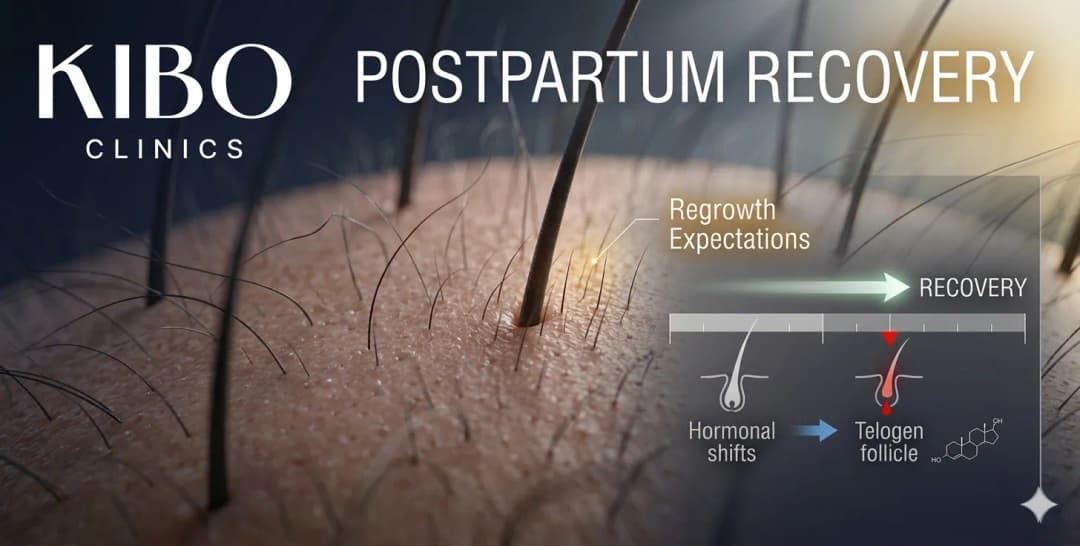
After childbirth, oestrogen levels drop sharply and rapidly — returning toward pre-pregnancy baseline within days to weeks. This hormonal shift is the trigger for postpartum telogen effluvium. The hairs that were held in the extended anagen phase during pregnancy are now released en masse into the telogen resting phase. Two to four months later — the normal duration of the telogen phase — these hairs shed simultaneously.
This is why postpartum hair loss typically peaks between 2 and 4 months after delivery, with many women reporting the most alarming shedding around the 3-month mark. It can feel sudden and extreme precisely because so many hairs — far more than would normally be shedding at any one time — enter the telogen and shedding phase together. In severe cases, women can lose up to 30% of their scalp hair volume within a relatively short window.
The shedding is often most noticeable along the hairline — particularly at the temples and the front of the scalp — where regrowth later appears as a distinct band of shorter, often frizzy hairs that stand up from the hairline. These "baby hairs" along the hairline are actually a visible sign that recovery is underway.
How Common Is It — Really?
Postpartum hair loss is extremely common. Studies estimate that it affects between 40% and 50% of women following childbirth, though many practitioners believe the true prevalence is higher because mild cases go unreported and women often don't raise it with their doctors. Some degree of increased shedding in the postpartum period is considered a near-universal experience among women with longer hair — it's simply more noticeable at greater lengths.
It is also worth noting that postpartum hair loss can occur after pregnancy loss, including miscarriage — the hormonal changes that trigger the process can follow any pregnancy, not only those that result in a live birth. This is rarely discussed and can add an additional layer of distress to an already difficult experience. Women who have experienced pregnancy loss and notice subsequent hair shedding are experiencing the same physiological process, and the same principles of recovery apply.
The Timeline: What to Expect and When
One of the most anxiety-provoking aspects of postpartum hair loss is not knowing how long it will last. Understanding the typical timeline helps enormously — even if individual variation means your experience may differ somewhat from the average.
| Timeframe | What's Happening | What You'll Notice |
|---|---|---|
| During pregnancy | High oestrogen prolongs anagen phase; minimal shedding | Thicker, fuller hair than usual; very little daily shedding |
| Birth to 6 weeks | Oestrogen drops sharply; retained hairs enter telogen phase | Hair may still look relatively normal; change not yet visible |
| Weeks 6–12 | Telogen hairs beginning to shed as follicles cycle | Increased shedding becomes noticeable; more hair in shower drain and on pillow |
| Months 3–4 | Peak shedding period; maximum number of hairs in telogen simultaneously | Most alarming phase; handfuls of hair when washing or brushing; visible thinning at temples and crown |
| Months 4–6 | Shedding begins to slow; follicles re-entering anagen growth phase | Shedding gradually reduces; fine new regrowth may begin to appear at hairline |
| Months 6–12 | Active regrowth phase; follicles producing new hair | Visible regrowth; characteristic short "baby hairs" at hairline; overall volume gradually returning |
| 12–18 months | Hair cycle fully normalised for most women | Hair returned to pre-pregnancy volume and texture for most women; some variation remains |
For most women, postpartum hair loss resolves completely by 12 months postpartum, with many seeing full recovery by 9 months. A smaller proportion of women find recovery takes closer to 15–18 months, particularly if the shedding was severe or if contributing factors like nutritional deficiency or thyroid dysfunction are also present.
Factors That Can Make Postpartum Hair Loss Worse
While postpartum telogen effluvium is a universal hormonal process, several factors can intensify shedding, delay recovery, or cause hair loss that goes beyond the typical postpartum pattern. Understanding these is important because many of them are addressable.
1. Iron Deficiency
Iron deficiency — and in particular low ferritin (stored iron) — is one of the most significant and commonly missed contributors to postpartum hair loss. Pregnancy itself is highly iron-demanding: the growing foetus draws heavily on maternal iron stores, and blood loss during delivery further depletes them. Breastfeeding adds an ongoing iron demand. The result is that iron deficiency is extremely common in the postpartum period, even in women who were not anaemic during pregnancy.
Here's the critical point: ferritin levels below approximately 40 ng/mL are associated with hair loss even in the absence of frank anaemia. A standard blood count (haemoglobin) can be entirely normal while ferritin is depleted — and it is the ferritin level that matters for hair. Many postpartum women are told their blood tests are "normal" when in fact their ferritin has not been specifically tested or has been overlooked at a level that is still affecting their hair.
Requesting a specific ferritin test — not just a full blood count — is one of the most important practical steps any postpartum woman with significant hair loss can take.
2. Thyroid Dysfunction
Postpartum thyroid dysfunction affects approximately 5–10% of women in the year following childbirth and is significantly under-diagnosed. The thyroid gland undergoes immune-mediated changes in the postpartum period that can cause it to first become overactive (hyperthyroid) and then underactive (hypothyroid). Both states can cause or worsen hair loss — but hypothyroidism in particular is strongly associated with diffuse hair shedding.
Symptoms of postpartum hypothyroidism include fatigue, weight changes, cold intolerance, low mood, brain fog, and — hair loss. Because these symptoms overlap so heavily with the normal experience of new motherhood, thyroid dysfunction is frequently attributed to "just being a new mum" and missed. A thyroid function test (TSH, free T3, and free T4) is a straightforward blood test that should be part of any evaluation of significant postpartum hair loss.
3. Nutritional Depletion
Pregnancy and breastfeeding are nutritionally demanding. If dietary intake or supplementation hasn't kept pace with these demands, deficiencies in vitamin D, vitamin B12, zinc, and protein can each independently contribute to hair shedding. Many women stop taking their prenatal vitamins after delivery — which is also when nutritional demands from breastfeeding remain high. Continuing postnatal supplementation throughout the breastfeeding period (and beyond, during recovery) is a sensible precaution.
4. Stress and Sleep Deprivation
Chronic stress elevates cortisol, which disrupts the hair growth cycle and can push additional follicles into the telogen phase — an independent trigger for telogen effluvium on top of the hormonal shedding already occurring. New motherhood is one of the most sleep-deprived, physiologically stressful periods many women will experience. This doesn't mean hair loss is unavoidable — but it does mean that prioritising rest and support wherever possible has a genuine physiological benefit, not just a psychological one.
5. Crash Dieting or Rapid Weight Loss
The pressure to lose "baby weight" quickly is significant and culturally pervasive — and it is directly counterproductive to hair recovery. Severe caloric restriction and rapid weight loss are well-established triggers for telogen effluvium. A woman whose body is already managing the hormonal transition of the postpartum period does not need the additional metabolic stress of crash dieting. Gradual, nourishing weight management — prioritising nutrient density over caloric restriction — supports both general recovery and hair regrowth.
6. Breastfeeding Hormones
Breastfeeding maintains elevated levels of prolactin and suppresses oestrogen — keeping the hormonal environment in a state that differs from pre-pregnancy normal. This is not itself a cause of additional hair loss beyond the initial postpartum shedding, but it does mean that the full hormonal recovery that supports hair regrowth may take slightly longer in exclusively breastfeeding women. Hair typically recovers fully regardless of breastfeeding duration — the timeline may simply extend somewhat.
Postpartum Hair Loss vs. Other Hair Loss: How to Tell the Difference
Most postpartum hair loss follows a recognisable and self-limiting pattern. However, it's important to know when what you're experiencing might be something beyond typical postpartum telogen effluvium — either a co-existing condition or a pattern that warrants different treatment.
| Feature | Typical Postpartum Hair Loss | May Indicate Something Else |
|---|---|---|
| Pattern | Diffuse all over scalp; most visible at temples and hairline | Patchy bald spots; significant crown thinning with hairline recession |
| Onset | Begins 6–12 weeks postpartum; peaks around month 3–4 | Begins very immediately after birth or very late (beyond 6 months) |
| Duration | Shedding resolves by 6 months; recovery complete by 12 months | Shedding continuing beyond 6 months with no sign of slowing |
| Regrowth | Visible new growth appears from month 4–6 onward | No visible regrowth after 6 months of shedding |
| Associated symptoms | Fatigue and mood changes typical of new motherhood | Significant fatigue, cold intolerance, weight changes, or other systemic symptoms beyond expected new mum experience |
| Scalp appearance | Normal scalp; hairs shed at root with small white bulb | Scalp inflammation, redness, scaling, or broken hairs |
If you're concerned that your hair loss doesn't fit the typical postpartum pattern — or if shedding is continuing well beyond 6 months without improvement — it is worth seeking a proper evaluation rather than continuing to wait. Earlier identification of a contributing condition means earlier treatment and better outcomes.
When to See a Doctor
While postpartum hair loss is usually self-limiting, there are specific circumstances where medical evaluation is genuinely important rather than optional:
- Shedding is extreme — losing significantly more than 100–150 hairs daily, or visible bald patches appearing
- Shedding shows no sign of slowing after 5–6 months postpartum
- No visible regrowth has appeared by 6 months after the shedding began
- You have additional symptoms such as significant fatigue, unexplained weight change, cold intolerance, or persistent low mood beyond typical new parent exhaustion
- Hair loss is concentrated in a specific pattern — significant crown thinning with hairline recession, or distinct bald patches — rather than diffuse shedding
- You have a personal or family history of thyroid disease, PCOS, or autoimmune conditions
- The hair loss is significantly affecting your mental health and daily functioning
The tests to request include: ferritin (not just haemoglobin), full thyroid panel (TSH, free T3, free T4, and thyroid antibodies), vitamin D, vitamin B12, zinc, and a hormonal panel if PCOS is a concern. A dermatologist experienced in hair loss can also perform trichoscopy to assess the pattern and health of follicles directly.
What You Can Do to Support Recovery
The most important thing to understand is that postpartum hair loss, in most cases, resolves on its own. The follicles are not damaged — they are simply resting. Your primary job during this period is to support the conditions for recovery rather than to fight a process that will resolve naturally. That said, there is a meaningful difference between doing nothing and actively supporting your body's recovery — and several strategies have good evidence or strong clinical rationale behind them.
Nutrition: The Foundation of Recovery
Hair follicles are among the most metabolically active cells in the body — they require a steady supply of protein, iron, vitamins, and minerals to function optimally. In the postpartum period, when nutritional demands are high and dietary intake may be chaotic (new parenthood rarely supports regular, balanced meals), targeted nutritional support is important.
- Protein: Hair is made of keratin — a protein. Adequate dietary protein is non-negotiable for hair regrowth. Aim for at least 1.2–1.6g of protein per kilogram of body weight daily. Good sources include eggs, lentils, legumes, paneer, chicken, fish, Greek yoghurt, and nuts. This is particularly important for vegetarian and vegan women, who may need to be more deliberate about combining protein sources.
- Iron: As discussed, ferritin levels matter enormously. Iron-rich foods include red meat, chicken liver, lentils, rajma, spinach, and fortified cereals. Consuming vitamin C alongside iron-rich foods significantly improves absorption — a simple practical habit like squeezing lemon over dal or having a glass of amla juice with a meal can make a meaningful difference. If blood tests confirm low ferritin, supplementation under medical guidance is appropriate.
- Vitamin D: Deficiency is extremely common in India despite abundant sunshine, largely due to indoor lifestyles, sun avoidance, and skin pigmentation. Supplementation at doses appropriate to your blood level — confirmed through testing — is sensible for most postpartum women.
- Biotin: Widely marketed for hair growth. True biotin deficiency is rare, and evidence for benefit without confirmed deficiency is limited. It won't cause harm at standard doses, but it is far less important than protein and iron. High-dose biotin also interferes with thyroid blood test accuracy — worth knowing if you're taking it alongside thyroid monitoring.
- Omega-3 fatty acids: Anti-inflammatory and supportive of scalp health. Found in fatty fish, flaxseeds, walnuts, and chia seeds. Fish oil or algae-based omega-3 supplements are a practical option, particularly for women who don't regularly eat fish.
- Continue postnatal vitamins: Many women stop taking prenatal or postnatal supplements once the baby is born. If breastfeeding, nutritional demands remain high — continuing a quality postnatal multivitamin through the breastfeeding period and beyond provides a nutritional safety net during a time when dietary consistency is difficult.
Scalp and Hair Care During Shedding
You cannot stop postpartum hair loss through hair care practices — but you can significantly reduce additional mechanical damage and breakage that adds to the appearance of thinning, and you can keep the scalp environment healthy to support regrowth.
- Wash hair regularly: A common instinct during postpartum shedding is to wash hair less frequently, to avoid seeing so much shedding. This is understandable but counterproductive — hairs that are in the shedding phase will shed regardless of whether you wash, and infrequent washing allows sebum, product residue, and dead skin to accumulate around follicles. Wash as frequently as suits your hair type, using a gentle, sulphate-free shampoo.
- Be gentle with wet hair: Wet hair is significantly more vulnerable to breakage than dry hair. Use a wide-tooth comb rather than a brush to detangle, working from ends upward. Avoid aggressive rubbing with a towel — pat dry or use a soft microfibre towel wrap instead.
- Avoid tight hairstyles: Tight ponytails, braids, and buns create traction on already fragile hair at the hairline — a pattern of loss called traction alopecia. During the postpartum period, loose hairstyles are significantly kinder to the hair. A loose bun, braid, or plait is practical for new parents and much gentler than tight elastic-bound styles.
- Reduce heat styling: Frequent heat styling adds physical stress to fragile postpartum hair shafts. Air-drying where possible, or using heat tools on the lowest effective setting with a heat protectant, reduces breakage and makes the hair you do have look better and last longer.
- Scalp massage: Regular gentle scalp massage — 3–5 minutes daily, using fingertips with light-to-moderate pressure — has evidence for improving hair thickness over time through increased blood flow to follicles. It is safe, costs nothing, and many women find it relaxing during an otherwise stressful period. It can be done with a few drops of a light carrier oil such as coconut or jojoba oil if desired, though oil itself is not essential for the benefit.
- Choose volumising hair care: While you're in the shedding phase, hair care products that add volume and body to fine, limp strands can improve the appearance of the hair you have. Lightweight volumising shampoos and conditioners (applied only to mid-lengths and ends, not the scalp) and root-lifting products can make a meaningful cosmetic difference during the waiting period.
Styling Strategies to Manage Appearance During Shedding
Beyond hair care, how you style your hair during the postpartum shedding phase can significantly affect how noticeable the thinning appears — both to yourself and to others.
- Consider a shorter cut: Shorter hair creates the appearance of greater volume and density. It also reduces the weight pulling on thinning strands, makes the regrowth phase look more uniform, and practically reduces the amount of shedding you see — simply because there is less hair length to accumulate visibly. Many women find a shorter cut during the postpartum period genuinely liberating.
- Dry shampoo and volumising sprays: Used at the roots, these products add texture, lift, and grip — all of which create the appearance of fuller hair. Dry shampoo is also a practical sanity-saver during the newborn phase when daily washing isn't always possible.
- Hair fibres and scalp concealers: Keratin fibre products (such as Toppik or Nanogen) cling to existing hair to create the appearance of density. Scalp-tinted concealers reduce the visibility of the scalp through thinning areas. Both are safe to use during postpartum recovery and can significantly ease the self-consciousness many women feel during this period.
- Change your parting: A side part or a slightly shifted parting can cover areas of noticeable thinning and reduce scalp visibility. Small adjustments to how you wear your hair can make a disproportionate difference to how you feel about it during this phase.
Medical Treatments: What Is and Isn't Appropriate Postpartum
It's worth addressing the question of medical treatments directly — because many women, understandably, want to do something active and find themselves looking at options like minoxidil or other hair loss treatments.
| Treatment | Appropriate Postpartum? | Notes |
|---|---|---|
| Iron supplementation | Yes — if ferritin is confirmed low | One of the most impactful interventions available; test first, then supplement at correct dose |
| Vitamin D supplementation | Yes — if levels are low | Safe during breastfeeding at appropriate doses; test to confirm deficiency |
| Postnatal multivitamin | Yes | Sensible nutritional safety net, especially while breastfeeding |
| Topical minoxidil | Not recommended while breastfeeding | Minoxidil is excreted in breast milk; not recommended during breastfeeding period. Can be considered after weaning if hair loss persists and is assessed as androgenetic rather than telogen effluvium |
| Oral minoxidil | Not recommended while breastfeeding | Same contraindication as topical; discuss with doctor after weaning if needed |
| PRP (Platelet-Rich Plasma) | Generally yes — discuss with provider | Uses patient's own blood; no systemic medication involved. Can support follicle recovery. Usually recommended from 6 months postpartum if hair loss is persisting |
| Low-level laser therapy (LLLT) | Yes — generally safe | Non-invasive; can support follicle activity during recovery phase |
| Anti-androgen medications | Not appropriate during breastfeeding | Only relevant if hair loss pattern is androgenetic rather than telogen effluvium; discuss with doctor after weaning |
| Hair transplant | Not appropriate during postpartum period | Postpartum hair loss is temporary and self-resolving; transplant is not indicated. Only considered if significant permanent androgenetic hair loss is confirmed and stable — typically assessed no earlier than 12–18 months postpartum |
The Emotional Reality of Postpartum Hair Loss
This section deserves as much space as the clinical information — because for many women, the emotional experience of postpartum hair loss is as significant as the physical one.
The postpartum period is already a time of enormous physical change, sleep deprivation, identity shift, and emotional vulnerability. Losing significant amounts of hair on top of everything else — at a time when you may already feel like your body isn't your own — can be deeply distressing. Many women describe feeling guilty about caring so much about their hair when they "should" be focused on the joy of new motherhood. This guilt is unnecessary and unhelpful. Grief over physical change is legitimate, and hair is deeply tied to identity and self-image in ways that are real and worth taking seriously.
Postpartum hair loss also frequently coincides with postpartum anxiety and depression — conditions that are significantly under-reported and under-treated. If you are experiencing persistent low mood, anxiety, intrusive thoughts, or difficulty functioning beyond the expected exhaustion of early parenthood, please raise this with your doctor separately from the hair loss conversation. These are distinct and treatable conditions that deserve their own attention.
Practical things that help many women emotionally during this period include: connecting with other mothers who are going through or have been through the same experience (online communities can be genuinely valuable here), taking photographs at regular intervals so you can track that recovery is actually happening when it's hard to perceive day to day, finding a hairstyle you feel comfortable and confident in rather than focusing on what's been lost, and reminding yourself — as often as needed — that this is temporary. The follicles are resting. The hair will return.
What If Hair Doesn't Fully Come Back?
For the vast majority of women, postpartum hair loss resolves completely — the follicles recover and hair returns to its pre-pregnancy volume. However, there are situations where recovery is incomplete:
- Underlying androgenetic hair loss: If a woman has a genetic predisposition to female pattern hair loss (androgenetic alopecia), the postpartum period can unmask or accelerate this. In these cases, what started as postpartum telogen effluvium transitions into or coexists with androgenetic hair loss — which does not self-resolve and requires specific treatment. The key distinguishing feature is the pattern: androgenetic loss tends to persist and concentrate at the crown and top of the scalp, with the hairline generally preserved, rather than the diffuse all-over shedding of telogen effluvium.
- Unaddressed nutritional deficiencies: Prolonged iron or vitamin D deficiency sustains hair shedding well beyond the typical postpartum window. Identifying and correcting these allows recovery to proceed.
- Thyroid conditions: Untreated postpartum thyroid dysfunction can cause persistent hair loss. Treatment of the underlying thyroid condition typically allows hair to recover, though this may take additional months.
If at 12 months postpartum your hair has not meaningfully recovered — or if it seems to be following a pattern of progressive thinning rather than regrowth — a proper evaluation is genuinely warranted. At that point, the question shifts from "is this postpartum hair loss?" to "what else is contributing?" and the answers are actionable.
Why Kibo Clinics
At Kibo Clinics, we see postpartum women at every stage of this journey — from those in the peak shedding phase wondering if something is seriously wrong, to women a year postpartum whose hair hasn't recovered as expected and who are now trying to understand why. Our approach is to evaluate thoroughly, explain honestly, and treat what's actually there rather than applying a one-size-fits-all response to what is often a multi-factorial situation.
We assess scalp health directly, recommend appropriate blood investigations where indicated, and help women understand whether what they're experiencing is the expected postpartum process, a correctable contributing factor like iron deficiency, an emerging androgenetic pattern requiring its own treatment, or some combination of all three. If you're worried about your postpartum hair loss — whether you're in the middle of it or wondering why it hasn't resolved — we're here to give you a clear picture and a practical plan.
Disclaimer: This blog is for informational purposes only. Consult qualified healthcare providers for personalised medical advice.