
Quick Answer:
Multani mitti is one of the most evidence-supported natural clays for controlling oil, clearing pores, and calming mild acne, but it will not transform your skin overnight. Most people with oily to combination skin notice a visible reduction in shine and breakouts within two to three weeks of consistent use two to three times per week. Results for skin tone and texture improvement typically build over four to eight weeks.
Key facts at a glance:
- Clay type: Smectite/montmorillonite-family mineral clay
- Primary mechanism: High adsorption capacity pulls oil and impurities from pores
- Best for: Oily, combination, and acne-prone skin
- Frequency: 1-3 times per week depending on skin type
- Results timeline: Texture improvement in 2-3 weeks; tone evening in 4-8 weeks with consistent use
- Not suitable for: Active eczema, rosacea, psoriasis, open wounds
What Is Multani Mitti (Fuller's Earth)?
Multani mitti, also called Fuller's Earth, is a mineral-rich clay from the smectite group that has been used in skincare for generations. In its natural form, multani mitti is a soft, pale yellow to greenish-brown powder that forms a smooth paste when mixed with water or liquid. It has a slightly alkaline pH ranging from 7.5 to 9 and a high adsorption capacity, meaning it physically attracts and holds oil, impurities, and dead skin cells from the surface of the skin.
Fuller's Earth is not regular soil or chalk. Its composition includes silica (50-65%), aluminium oxide (10-18%), magnesium oxide (3-8%), calcium oxide (1-5%), and iron oxide (1-4%). These are naturally occurring minerals, not manufacturer-added ingredients. This mineral density is precisely what gives multani mitti its measurable skin benefits, benefits that go beyond traditional belief and have a physical and chemical basis supported by published research.
According to Kibo Skin Clinics' dermatology team, multani mitti is best understood as a surface-level maintenance tool, one that is genuinely effective for what it does, as long as it is matched to the right skin type and used consistently.
How Does Multani Mitti Work? The Science Behind It
Multani mitti works through two distinct physical mechanisms: adsorption and mineral replenishment.
Adsorption is the primary mechanism. Fuller's Earth carries a negative ionic charge. Sebum molecules and many surface impurities carry a positive charge. When the clay paste is applied to the skin, the negatively charged clay particles attract positively charged oil, dead skin cells, and bacteria, physically drawing them out of the pores as the mask dries. Fuller's Earth has a cation exchange capacity (CEC) of 40-80 milliequivalents per 100 grams, which quantifies its ability to attract and bind these molecules. A 2020 review published in the International Journal of Cosmetic Science found that smectite-family clays reduce skin surface sebum by up to 50% within 20 minutes of application.
Mineral replenishment is the secondary mechanism. As the clay dries on the skin, it deposits trace minerals, primarily magnesium, silica, and calcium, onto the skin surface. Magnesium oxide contributes anti-inflammatory effects and helps soothe redness. Silica supports the clay's structural adsorption lattice. Iron oxide provides a mild antimicrobial effect.
A 2017 study in Applied Clay Science found that certain Fuller's Earth samples exhibit antimicrobial properties against Staphylococcus epidermidis and Propionibacterium acnes, two bacteria most associated with acne, likely because iron and trace minerals disrupt bacterial membranes.
Exfoliation is a third, mechanical mechanism. Multani mitti's fine particle size of 2-10 microns provides mild physical exfoliation as the dried clay is rinsed away. This is substantially gentler than most walnut-shell or sugar scrubs, which measure 200-400 microns, making multani mitti suitable for repeated use without micro-tearing the skin.
One important boundary: the evidence supports surface-level cleansing and mild antimicrobial effects. Multani mitti does not penetrate the dermis and cannot treat cystic acne, hormonal acne, deep pigmentation, or hair follicle conditions at the root level.
Mineral Composition of Multani Mitti and What Each Mineral Does
Multani mitti's mineral profile is what separates it from plain clay or kaolin and drives its specific skin benefits.
| Mineral | Approximate Content | Skin Benefit |
|---|---|---|
| Silica (SiO₂) | 50-65% | Structural lattice; drives adsorption capacity |
| Aluminium oxide | 10-18% | Increases negative charge; enhances oil-pull |
| Magnesium oxide | 3-8% | Anti-inflammatory; soothes redness |
| Calcium oxide | 1-5% | Supports skin-barrier mineral balance |
| Iron oxide | 1-4% | Mild antimicrobial; gives yellow-brown colour |
Fuller's Earth can adsorb up to 80% of its own weight in oil, making it one of the highest oil-absorption clays used in cosmetics. These minerals are naturally present in the clay deposit, they are not added by a formulator. This natural composition is one reason pure multani mitti is often well tolerated, as it contains no added synthetic preservatives.
Multani Mitti Benefits for the Face
Multani mitti benefits for the face are wide-ranging and consistent when the clay is used appropriately for your skin type. Applying multani mitti as a face pack can deliver the following:
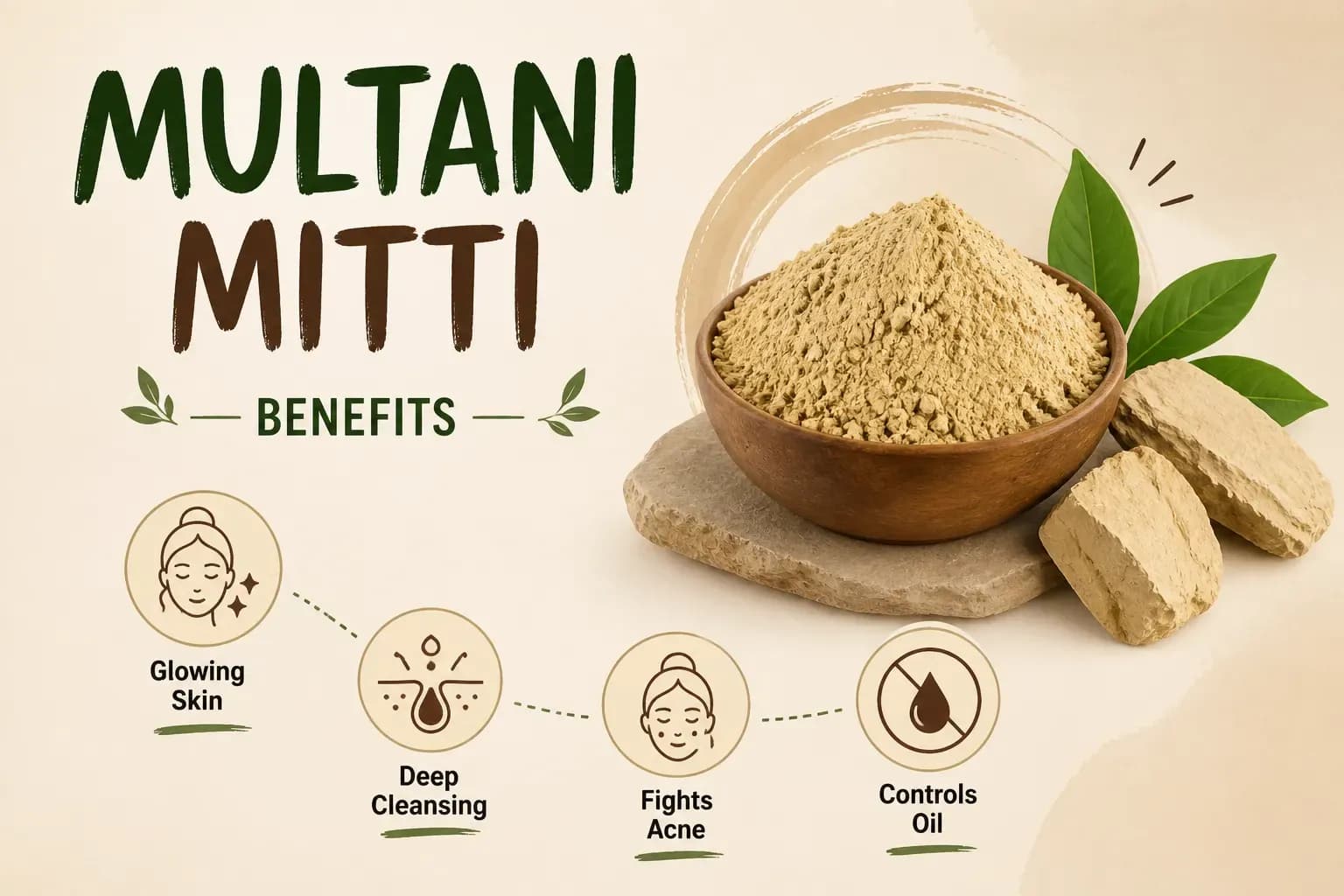
- Deep cleansing: Removes surface dirt, pollutants, and excess oil that accumulate during the day
- Pore decongestion: Draws out accumulated impurities from pores, reducing their appearance temporarily
- Oil control: Absorbs excess sebum and reduces visible shine; skin surface sebum can reduce by up to 50% within one session
- Gentle exfoliation: Removes dead skin cells as the dried clay is rinsed away, without the micro-tearing risk of coarser scrubs
- Blackhead and whitehead reduction: With consistent use over three to four weeks, reduced pore congestion lowers blackhead formation
- Calming inflammation: Magnesium content helps soothe mild redness and acne-related inflammation
- Improved texture: Regular use smooths skin surface over four to eight weeks
- Immediate post-use glow: Removal of dead cells and improved microcirculation during application gives skin a brighter look immediately after rinsing
These benefits are surface-level. If your concern goes beyond oiliness and mild breakouts, a clinical assessment is more appropriate than relying only on a home clay mask.
Multani Mitti Benefits Based on Your Skin Type
Multani mitti is not a one-size-fits-all solution. Using it correctly means adjusting frequency, mixing ingredients, and application time based on your specific skin type.
Oily skin: Multani mitti is most effective for oily skin. Use it up to three times per week. It absorbs excess oil, helps control breakouts, and leaves skin feeling consistently clean between sessions. Mixed with rose water, it provides adequate hydration without diluting the oil-control effect.
Combination skin: Apply multani mitti only to oily zones, the forehead, nose, and chin. Skip dry areas like the cheeks and jawline. This targeted approach gives you oil control where you need it without over-drying areas that do not produce excess sebum. Use it twice per week.
Normal skin: Use multani mitti once a week as a refresh treatment. Mixing with rose water or milk makes the application gentler. The result is cleaner skin and a brighter appearance without disrupting an already balanced complexion.
Dry skin: Use multani mitti only once every one to two weeks, and always mix it with a hydrating ingredient, honey or aloe vera work well. Do not wait for the mask to fully dry before rinsing; wash it off while still slightly damp to reduce the drying effect on the skin barrier.
Sensitive skin: Always patch test first. Mix multani mitti with aloe vera or cucumber juice to add soothing components. Leave it on for no more than eight to ten minutes. If your skin barrier is already weakened or irritated, skip multani mitti entirely until the barrier has recovered.
The Kibo Skin Clinics dermatology team consistently advises that the most common mistake people make with multani mitti is applying it the same way regardless of skin type, which leads to either dryness or disappointment.
Multani Mitti Benefits for Specific Skin Concerns
Beyond skin type, multani mitti can be targeted to specific skin concerns with consistent use.
For pigmentation that sits deeper than surface dullness, chemical peel for pigmentation may be more suitable than a clay mask alone.
| Concern | Benefit | Expected Result |
|---|---|---|
| Acne | Controls oil, reduces pore congestion, mild antimicrobial effect | Fewer surface breakouts over 3-4 weeks |
| Pigmentation and tan | Gentle exfoliation accelerates surface cell turnover | More even tone over 6-8 weeks |
| Dullness | Removes dead cell buildup and surface impurities | Brighter skin visible after 2-3 uses |
| Enlarged pores | Temporary physical removal of debris reduces pore appearance | Smoother-looking skin; effect is not permanent |
| Back and body acne | Same oil-control and cleansing mechanisms apply | Fewer back breakouts with weekly use |
Important limitation: Multani mitti addresses surface-level concerns. It cannot treat deep pigmentation, melasma, cystic acne, or post-inflammatory hyperpigmentation that sits below the epidermis. These conditions require clinical actives prescribed by a dermatologist.
Multani Mitti Benefits for the Scalp and Body
Most people think of multani mitti only as a face mask, but its benefits extend to the scalp and body as well.
Scalp: Multani mitti works as a scalp mask to absorb excess oil and remove product buildup. Use it once every seven to ten days, not more frequently. The scalp produces sebum as part of a natural protective mechanism, and stripping it too often with clay triggers a rebound effect where sebum production increases. Mix with aloe vera or diluted apple cider vinegar rather than plain water for a less drying scalp application. Avoid scalp use entirely if you have seborrheic dermatitis, the drying effect can worsen flaking.
Body: Multani mitti can be applied as a pre-shower treatment for:
- Back acne, same oil-clearing and mild antimicrobial mechanisms apply
- Tan removal on the neck, arms, and legs, gentle exfoliation fades surface tan over several weeks
- Rough patches on elbows and knees, dead cell removal improves texture
Scalp and body applications follow the same principle as facial use: appropriate frequency, adequate moisture restoration, and no use on broken or irritated skin.
Multani Mitti Powder, Soap, and Face Wash: Which Form Should You Use?
Multani mitti is available in three main forms. Each suits a different usage pattern.
Multani mitti powder is the most versatile form. The powder can be combined with different liquids and additives based on your skin's needs on any given day, rose water for oily skin, milk for dry skin, aloe vera for sensitive skin. It contains no added preservatives or fillers, so you know exactly what is going on your skin. It is also the most affordable option.
- Oily skin day: mix with plain rose water
- Dry skin day: mix with milk
- Sunburned or reactive skin: mix with aloe vera gel
Multani mitti soap is the everyday, milder version. The clay is incorporated into a soap base that is rinsed off quickly, making it practical for daily cleansing. The quick-rinse format means the oil-absorption effect is milder than a mask, but the cleansing benefit remains. Look for multani mitti soaps that include glycerin or natural oils to offset the clay's drying effect, skin should feel clean but not tight after use.
Multani mitti face wash offers a quick way to get mild clay-cleansing benefits without mixing or waiting. It removes excess oil, provides light exfoliation, and fits into a daily skincare routine. Like the soap, it is gentler than a full mask application because the contact time with skin is shorter.
Kibo Skin Clinics recommends the powder form for anyone who wants the full oil-control and skin-clearing benefit, and the soap or face wash form for maintenance between mask sessions.
How to Use Multani Mitti: Step-by-Step Skincare Routine
Using multani mitti correctly requires more than just mixing it with water and applying it. Follow this structured routine for the best results.
| Step | What to Do |
|---|---|
| Preparation | Measure 2 tablespoons of pure multani mitti powder. Add rose water, milk, or plain water to form a smooth paste. Mix in aloe vera gel if your skin is dry or sensitive. |
| Pre-application | Cleanse your face with your regular cleanser first. The mask works significantly better on a clean surface. |
| Application | Spread an even layer over the face, avoiding the eye area and lips. |
| Wait time | Leave on for 15-20 minutes for oily or normal skin. Remove after 10 minutes or less for dry or sensitive skin. Do not let it dry to a tight, cracked state on dry skin. |
| Rinse | Wash off with lukewarm water using gentle circular motions. Finish with a cold water splash to close pores. |
| Aftercare | Pat dry gently. Apply a moisturiser immediately. Skipping the moisturiser is the single most common mistake with multani mitti, it leads to dryness rebound. |
Always perform a patch test before your first use. Apply a small amount to your inner wrist or jawline and wait 24 hours. If redness, itching, or irritation appears, do not use it on your full face. If you experience persistent irritation or an allergic reaction, consult a dermatologist.
Best Combinations: What to Mix with Multani Mitti for Different Skin Needs
Multani mitti's effectiveness increases when paired with the right complementary ingredients. The combination you choose should match your current skin condition.
Multani mitti with rose water: The classic combination. Rose water calms inflammation, balances skin pH, and adds light hydration while multani mitti removes excess oil and impurities. Best for oily and combination skin. Rose water's pH of approximately 5.5 also partially offsets multani mitti's alkaline pH.
Multani mitti with milk: A nourishing combination for normal to slightly dry skin. Milk contains lactic acid, which provides light exfoliation and gentle brightening, while its natural fats moisturise the skin and buffer the drying effect of the clay. This combination is gentler than a plain water or rose water mix.
Multani mitti with aloe vera gel: The most suitable combination for sensitive skin or skin that is mildly irritated. Aloe vera's anti-inflammatory and cooling properties help counteract multani mitti's alkaline drying effect. Keep application time shorter, 8-10 minutes, for this combination.
Multani mitti with honey: A good choice for dry skin users who still want the oil-control benefit. Honey is a humectant that draws moisture into the skin and partially counteracts the drying effect of the clay. Mix one teaspoon of honey into the paste and reduce application time slightly.
According to Kibo Skin Clinics, choosing the right mixing liquid is as important as choosing the right frequency, both determine whether multani mitti helps or harms your skin barrier.
Multani Mitti vs Kaolin vs Bentonite: Which Clay Is Right for Your Skin?
Not all skin clays are the same. Multani mitti, kaolin, and bentonite are the three most commonly used clays in skincare. Choosing the wrong one for your skin type is one of the most common reasons people find clay masks either too drying or insufficiently effective.
| Feature | Multani Mitti (Fuller's Earth) | Kaolin Clay | Bentonite Clay |
|---|---|---|---|
| Oil absorption | Very high (up to 80% of its weight) | Low to moderate | Very high |
| Best skin type | Oily, combination, acne-prone | Dry, sensitive, normal | Oily, very congested pores |
| Exfoliation intensity | Mild | Very gentle | Moderate |
| Mineral richness | High (silica, magnesium, iron) | Moderate (mainly aluminium silicate) | High (calcium, magnesium) |
| Drying effect | Moderate to high | Low | High |
| pH level | Slightly alkaline | Mildly acidic to neutral | Alkaline |
| Best use | Oil control, dullness, surface congestion | Gentle cleansing for sensitive skin | Heavy oiliness and stubborn pore buildup |
Who Should Use Multani Mitti?
Multani mitti is best suited to oily, combination, and acne-prone skin that needs surface-level oil control and pore cleansing. It may also help with mild dullness, rough texture, and recent surface tanning.
| Suitable For | Use With Caution or Avoid |
|---|---|
| Oily and combination skin | Very dry or barrier-damaged skin |
| Mild surface acne and clogged pores | Active eczema, rosacea, or psoriasis flare |
| Dullness and rough texture | Open wounds, sunburn, or inflamed skin |
| Mild surface tan | Deep pigmentation, melasma, or cystic acne |
Side Effects and Precautions
Multani mitti is generally well tolerated when used in the right frequency, but overuse can strip natural oils and weaken the skin barrier.
- Dryness, tightness, or flaking after use
- Redness or irritation when left on too long
- Rebound oiliness after excessive use
- Worsening sensitivity on already damaged skin
- Irritation from harsh add-ins such as undiluted lemon juice
Always patch test before first use, rinse before the mask becomes fully cracked, moisturise immediately after, and reduce frequency if your skin feels tight or itchy.
How Often Should You Use Multani Mitti?
| Skin Type | Recommended Frequency |
|---|---|
| Oily skin | 2 to 3 times per week |
| Combination skin | 1 to 2 times per week, mainly on oily zones |
| Normal skin | Once per week |
| Dry skin | Once every 10 to 14 days with honey, milk, or aloe vera |
| Sensitive skin | Occasionally, after a patch test, with a soothing base |
When Multani Mitti Is Not Enough
Multani mitti only works at the skin surface. It cannot treat cystic acne, deep scars, melasma, persistent post-inflammatory hyperpigmentation, or long-standing pigmentation. These concerns may need professional treatment such as prescription skincare, chemical peel treatment, laser procedures, or combination therapy.
Before moving to a clinic-based option, review chemical peel treatment cost to understand how peel depth and sessions affect pricing.
For isolated marks and uneven patches, chemical peel for dark spots explains when controlled exfoliation may be considered.
Final Thoughts
Multani mitti benefits oily and combination skin by absorbing excess oil, clearing surface impurities, and providing mild exfoliation. It can improve shine, surface congestion, dullness, and texture when used consistently and in moderation.
The key is using it according to your skin type, avoiding over-drying, and moisturising after every application. If your concern includes persistent acne, deep pigmentation, or recurring irritation, schedule a skin consultation at Kibo Skin Clinic for a more targeted plan.
Frequently Asked Questions
Q1. What are the main multani mitti benefits for skin?
Its main benefits include oil control, pore cleansing, mild exfoliation, reduced surface congestion, and temporary improvement in dullness and texture.
Q2. Can multani mitti be used every day?
No. Daily use can over-dry the skin and disrupt the skin barrier. Most oily skin types should limit use to two or three times per week.
Q3. Is multani mitti good for acne?
It may help mild surface acne by controlling oil and pore buildup, but it cannot treat cystic or hormonal acne.
Q4. Is multani mitti good for dry skin?
Dry skin can use it occasionally when mixed with hydrating ingredients such as honey, milk, or aloe vera, but frequent use may worsen dryness.
Q5. Does multani mitti remove pigmentation?
It may improve mild surface dullness and tan, but it cannot treat deep pigmentation or melasma.
Medical Disclaimer : Information from Kibo Hair Clinics is for educational purposes only. It does not replace diagnosis, trichoscopy, blood test interpretation, prescription treatment, procedure advice, or side-effect counselling from a qualified dermatologist or hair restoration doctor.