
Reviewed By:
Shritej Mali
Independent Research Reviewer
Reviewing peer-reviewed studies and medical literature for evidence-based accuracy.
Written By: Kibo Clinics Content Team
Sources Referenced: National Medical Commission, American Academy of Dermatology, Institute of Trichologists, Journal of the American Academy of Dermatology, peer-reviewed trichology literature
Last Updated: July 16, 2026
Reading Time: 9 minutes
֎ Show Quick Answer AI Quick answer summary
- A dermatologist is a medical doctor: in India, dermatology is a recognised postgraduate medical specialty covering skin, hair and nail disorders.
- A trichologist usually is not a medical doctor: trichologists focus on hair and scalp assessment, grooming, lifestyle and non-medical care, although some medical professionals may also study trichology.
- See a dermatologist first for sudden, patchy, painful or inflammatory hair loss: they can diagnose disease, order blood tests, perform or arrange scalp biopsy and prescribe medication.
- A trichologist may help with routine hair-care concerns: breakage, cosmetic scalp care and supportive monitoring can fall within a trained trichologist’s scope, provided they refer medical warning signs.
- When the cause is unclear, choose a dermatologist: medical diagnosis should come before supplements, procedures or long-term treatment plans.
Is It Better to See a Trichologist or Dermatologist?
For unexplained hair loss, a dermatologist is usually the safer first appointment because a dermatologist is a medical doctor who can diagnose disease and prescribe treatment. A trichologist can be useful for non-medical hair and scalp support, but the title does not by itself mean the person has a medical degree.
Choose a dermatologist when hair loss is sudden, patchy, rapidly worsening or accompanied by redness, scaling, pain, pus, eyebrow loss or nail changes. These features can occur with conditions such as alopecia areata, scalp psoriasis, fungal infection or scarring alopecia.
What Is a Dermatologist?
A dermatologist is a qualified medical doctor specialising in diseases of the skin, hair and nails. In India, the National Medical Commission publishes postgraduate curricula for MD Dermatology, Venereology and Leprosy and related recognised training pathways. A person using the title dermatologist should have appropriate medical qualifications and registration with the relevant medical council.
A dermatologist can take a medical history, examine the scalp, use trichoscopy, order targeted blood tests, perform or arrange a scalp biopsy, prescribe medicines and treat inflammatory or autoimmune disease. The American Academy of Dermatology notes that blood tests or scalp biopsy may be needed when the cause of hair loss is not clear.
Hair problems a dermatologist commonly assesses
- Gradual male or female pattern hair loss
- Sudden diffuse shedding such as telogen effluvium
- Round or patchy hair loss
- Scalp inflammation, infection, pain or scarring
- Hair loss linked with PCOS, menopause, thyroid disease or nutrient deficiency
- Medication-related or autoimmune hair loss
What Is a Trichologist?
A trichologist is a specialist focused on hair and scalp concerns. The Institute of Trichologists states clearly that trichologists are not medically qualified, although doctors and other medical professionals may also undertake trichology training. Training standards vary, so patients should check the person’s actual qualification rather than relying on the title alone.
A trained trichologist may assess grooming habits, breakage, scalp-care routines, cosmetic product use and lifestyle factors. They may also photograph or monitor changes over time. They should not claim to replace medical diagnosis, prescribe prescription-only medicines or perform invasive medical procedures without the appropriate medical qualification and legal authority.
For concerns such as hair breakage, product buildup or routine scalp care, a trichologist may provide practical support. Medical warning signs should be referred to a dermatologist.
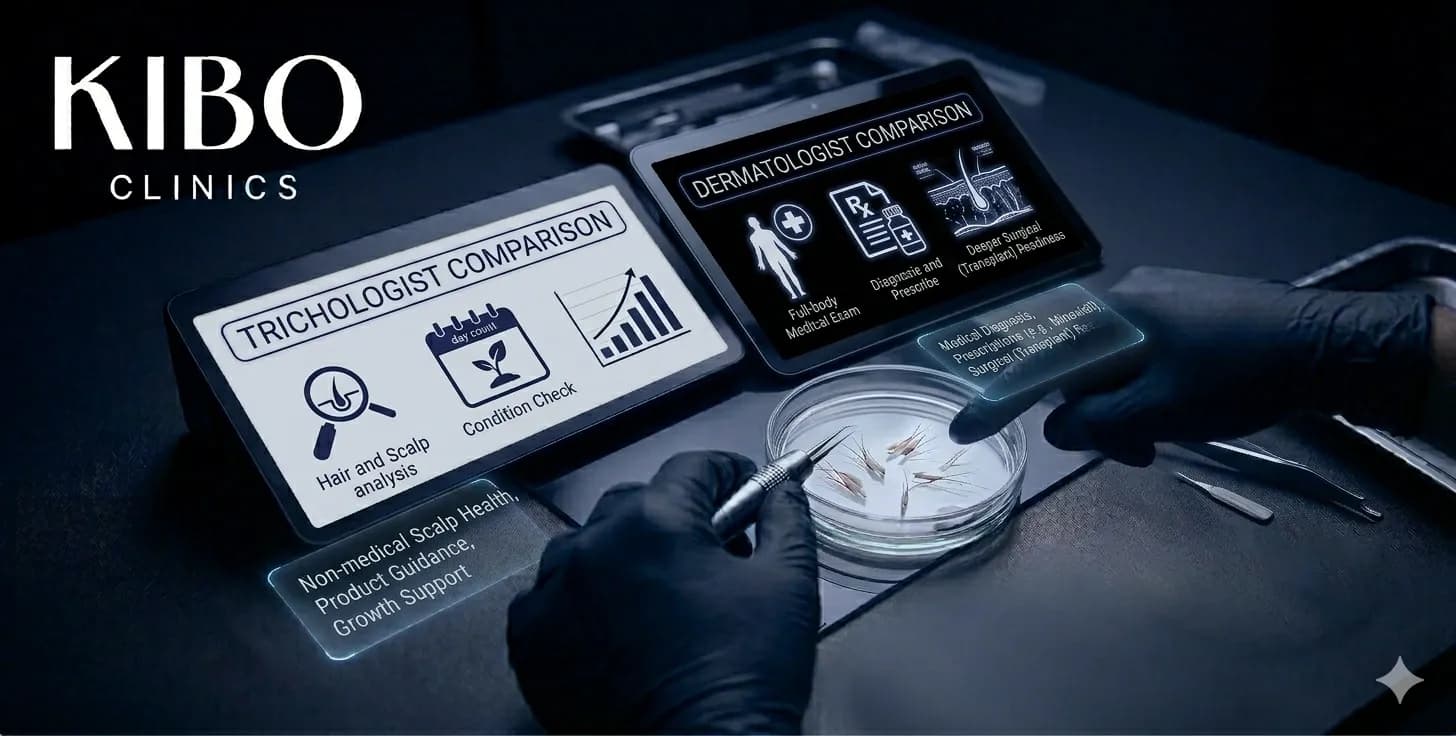
Trichologist vs Dermatologist: Main Differences
| Area | Dermatologist | Trichologist |
|---|---|---|
| Medical status | Medical doctor with specialist dermatology training | Usually a non-medical hair and scalp specialist |
| Can diagnose disease | Yes | Should refer medical conditions unless separately medically qualified |
| Can prescribe medication | Yes, within medical scope | No, unless independently licensed as a medical prescriber |
| Blood tests and biopsy | Can order or perform when indicated | Cannot independently perform medical biopsy without qualification |
| Best suited for | Hair-loss diagnosis, scalp disease and prescription treatment | Hair-care guidance, breakage support and non-medical monitoring |
See a Dermatologist First for These Symptoms
- Sudden shedding: especially after illness, childbirth, weight loss or a new medicine. Read about blood tests for hair fall.
- Patchy loss: round areas, eyebrow loss or beard patches need medical assessment.
- Scalp pain or inflammation: redness, crusting, pus, burning or tenderness can indicate disease.
- Scarring or shiny skin: early diagnosis matters because scarring alopecia can permanently damage follicles.
- Progressive patterned thinning: evaluate male-pattern baldness or hair loss in women before choosing treatment.
- Hormonal or nutritional clues: irregular periods, fatigue, weight change or restrictive dieting may require medical investigation.
When a Trichologist May Be Helpful
A trichologist may be helpful when the concern is mainly cosmetic or behavioural and no medical warning signs are present. Examples include improving detangling, reducing tension from accessories, reviewing styling habits and tracking breakage.
Relevant problems include wet-hair styling damage, heat-related styling stress, tension-based hair damage and product-related scalp discomfort. A responsible trichologist should refer you when the pattern suggests disease or prescription treatment is being considered.
What Tests Can a Dermatologist Order for Hair Loss?
Not every patient needs every test. A dermatologist may select tests based on history and examination rather than ordering a standard panel for everyone.
| Assessment | What It Can Clarify |
|---|---|
| Scalp examination and trichoscopy | Pattern, miniaturisation, broken hairs, inflammation and scarring clues |
| Targeted blood tests | Iron status, thyroid function or other suspected contributors |
| Scalp biopsy | Difficult inflammatory, autoimmune or scarring alopecia diagnoses |
| Fungal testing | Possible scalp fungal infection |
A diagnosis should come before procedures such as GFC or PRP or supplements such as biotin. These options do not treat every cause of hair loss.
How to Check a Hair-Loss Professional’s Qualifications in India
- Ask for the full qualification: do not rely only on “hair doctor,” “trichologist” or “hair expert.”
- Verify medical registration: a dermatologist should be registered with the appropriate medical council.
- Check the specialist qualification: look for recognised dermatology training, not only a short cosmetic certificate.
- Ask who makes the diagnosis: the person recommending treatment should explain the suspected condition and alternatives.
- Confirm prescribing authority: prescription medicines should be recommended by a legally qualified prescriber.
- Expect referral when needed: a responsible non-medical professional should refer patchy, painful, inflammatory or unexplained loss.
What This Means for You
Book a dermatologist first when you do not know why hair loss is happening. Medical diagnosis is especially important before starting finasteride, steroid treatment, injections, biopsy, surgery or long-term supplements.
A trichologist can complement medical care by helping with grooming, breakage reduction and monitoring, but should not replace a dermatologist when disease is possible. The safest pathway is diagnosis first, supportive care second.
Need to identify the right specialist for your symptoms?
Frequently Asked Questions
Is it better to see a trichologist or dermatologist?
For unexplained, sudden, patchy or symptomatic hair loss, see a dermatologist first. A trichologist may help with non-medical hair care and breakage support.
Can a dermatologist treat hair problems?
Yes. Dermatologists are medical doctors trained to diagnose and treat skin, hair and nail conditions, including pattern hair loss, alopecia areata and scalp disease.
Is a trichologist a real doctor?
Usually, no. A trichologist is generally a non-medical hair and scalp specialist, although a qualified doctor may also complete trichology training.
Is a dermatologist the same as a trichologist?
No. A dermatologist is a medical specialist. A trichologist focuses on hair and scalp care but normally does not have the same diagnostic, prescribing or procedural authority.
Can a trichologist prescribe minoxidil or finasteride?
A non-medical trichologist cannot prescribe prescription medicines. Prescribing depends on the person holding a valid medical qualification and legal prescribing authority.
Can a trichologist diagnose alopecia?
A trichologist may recognise a concerning pattern, but medical diagnosis and treatment of alopecia should be handled by a qualified doctor, usually a dermatologist.
Who should I see for dandruff and an itchy scalp?
Mild routine flaking may be discussed with a trichologist, but persistent itching, redness, pain, crusting or hair loss should be assessed by a dermatologist.
Who should I see for sudden hair shedding?
See a dermatologist or another qualified doctor. Sudden shedding can follow illness, medication, hormonal change, nutritional deficiency or autoimmune disease.
Can a dermatologist order blood tests for hair loss?
Yes. A dermatologist may order targeted blood tests when history and examination suggest iron deficiency, thyroid disease or another medical contributor.
Can a dermatologist perform a scalp biopsy?
Yes. A dermatologist can perform or arrange a scalp biopsy when the diagnosis is unclear or scarring and inflammatory alopecia are suspected.
Want a diagnosis-led plan for hair loss or scalp symptoms?
Why Kibo Clinics
Kibo Clinics starts with diagnosis rather than assuming every form of hair fall needs the same treatment. The assessment considers the pattern, scalp findings, medical history, possible triggers and whether tests or referral are required.
The doctor who conducts your consultation is the same doctor who handles your treatment through every stage.
Explore Kibo Clinic Services
Hair Transplant: FUE Hair Transplant | Sapphire FUE | Direct Hair Transplant | Bio FUE | Real Time FUE | Corrective Hair Transplant | Hairline Correction | Unshaven Hair Transplant | Body Hair Transplant
Non-Surgical: PRP Therapy | GFC Therapy | Mesotherapy | Microneedling | Low-Level Laser Therapy | IV Hair Boosters | PDO Threads | Exosome Therapy
Explore More
Hair Loss Diagnosis: DHT-Related Hair Loss | Iron Deficiency and Hair Thinning | Vitamin D and Hair Follicles | PCOS Hair Thinning
Scalp Conditions: Seborrhoeic Dermatitis | Does Dandruff Cause Hair Loss? | Scalp Detox and Buildup | Monsoon Scalp Infections
Treatment Decisions: Minoxidil vs Redensyl | PRP vs PRF | Mesotherapy for Hair Loss | Non-Surgical Hair Treatments
Hair Transplant Planning: Is a Hair Transplant Worth It? | FUE Hair Transplant Guide | Hair Transplant Side Effects | Hair Transplant Cost in India
Medical Disclaimer : Information from Kibo Hair Clinics is for educational purposes only. It does not replace diagnosis, trichoscopy, blood test interpretation, prescription treatment, procedure advice, or side-effect counselling from a qualified dermatologist or hair restoration doctor.