
Quick Answer:
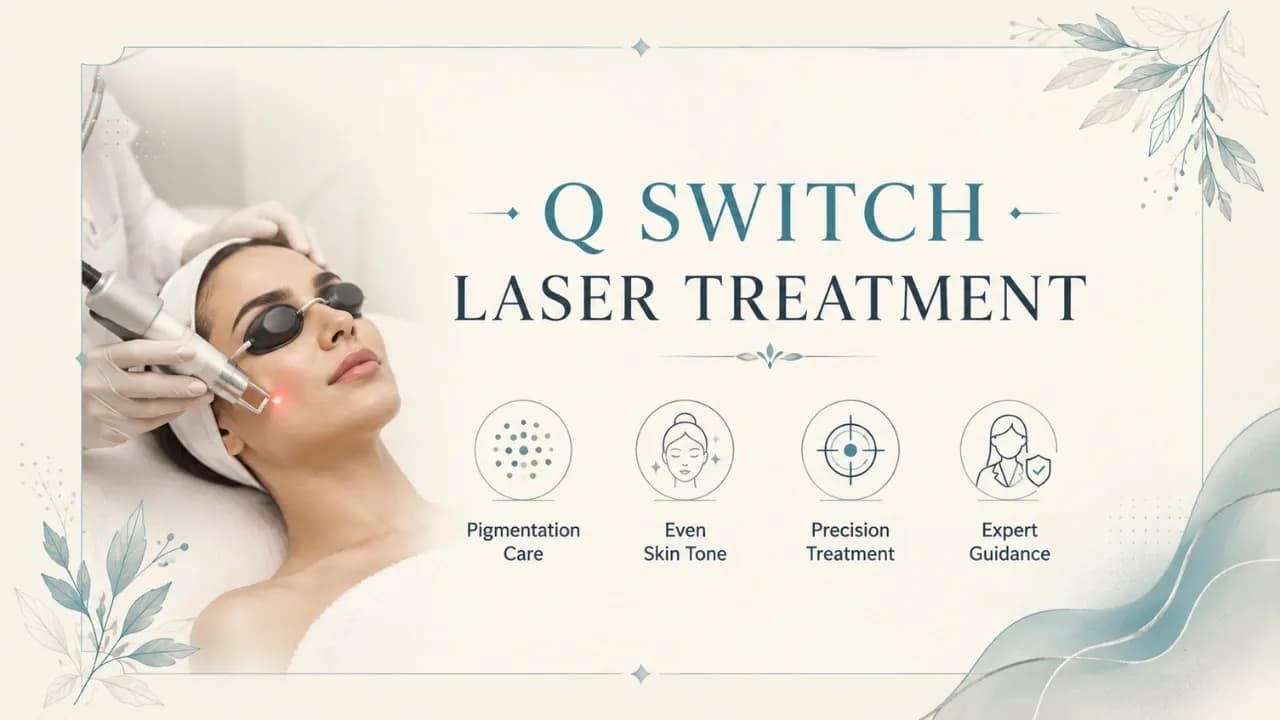
Q switch laser treatment uses extremely short pulses of laser energy to fragment excess melanin or tattoo pigment while limiting damage to surrounding skin. It is commonly used for sunspots, freckles, post-acne pigmentation, selected melasma cases and tattoo fading. Most concerns require multiple sessions, and daily sun protection plus correct aftercare are essential because pigmentation can recur or temporarily worsen if the skin is irritated or exposed to UV.
Q switch laser treatment is a non-invasive skin procedure that uses ultra-short pulses of high-intensity light to break down pigmentation, tattoo ink, and other skin irregularities at the cellular level. It is one of the most clinically studied laser modalities available, with a strong safety profile across most skin types. Most patients see visible improvement within 2–4 sessions, with optimal results typically appearing after 4–6 sessions spaced 4–6 weeks apart.
Q switch laser treatment is a dermatological procedure that delivers concentrated laser energy in nanosecond-to-picosecond pulses to target specific chromophores — primarily melanin and tattoo ink — without damaging surrounding tissue. The "Q switch" refers to the optical mechanism that stores energy and releases it in an extremely short, high-peak burst.
According to Kibo Skin's clinical team, Q switch laser treatment is suitable for addressing melasma, post-inflammatory hyperpigmentation, freckles, sunspots, tattoo removal, and overall skin rejuvenation. It does not require incisions, anaesthesia, or extended downtime.
Key facts at a glance:
- Pulse duration: 5–20 nanoseconds (standard Q switch); some devices operate at picosecond range
- Wavelengths used: 532 nm (targets superficial pigment), 1064 nm (targets deeper pigment and darker skin tones), 694 nm (ruby, for tattoo removal)
- Downtime: 24–72 hours of mild redness in most cases
- Sessions typically needed: 4–8, depending on condition severity
Q switch laser treatment matters because it selectively targets problem areas without broadly damaging the skin surface, making it safer than ablative laser options for pigmentation correction.
How Q Switch Laser Treatment Works: The Complete Breakdown
Q switch laser treatment works because the ultra-short energy pulse creates a photoacoustic effect — the rapid thermal expansion of targeted pigment particles causes them to shatter into micro-fragments small enough for the body's lymphatic system to clear naturally.
Step-by-step mechanism:
- Energy storage: The Q switch device uses a Pockels cell or acousto-optic modulator to store energy inside the laser cavity.
- Rapid release: The stored energy is released in a pulse lasting 5–20 nanoseconds, generating extremely high peak power (often exceeding 100 megawatts).
- Selective photothermolysis: The specific wavelength is absorbed preferentially by the target chromophore (melanin or ink) rather than surrounding skin cells.
- Photoacoustic fragmentation: The rapid heating causes the pigment particle to expand and shatter into smaller fragments.
- Immune clearance: The body's macrophages and lymphatic system gradually remove the fragmented particles over 4–8 weeks between sessions.
- Surface remodelling: Repeated sessions stimulate collagen production in the dermis, contributing to improved skin texture and tone.
The reason Q switch laser treatment is preferred over continuous-wave lasers for pigmentation is that the short pulse duration keeps heat confined to the target particle, significantly reducing the risk of post-inflammatory hyperpigmentation — a concern particularly relevant for South Asian and East Asian skin types.
Key Benefits of Q Switch Laser Treatment: What You Actually Gain
Q switch laser treatment offers measurable improvements across several skin concerns, with benefits observable as early as the first session and compounding over subsequent treatments.
Key Advantages at a Glance
- Pigmentation reduction: Clinical studies report 60–90% reduction in melanin density for conditions like solar lentigines after 4–6 sessions
- Tattoo fading: Multi-colour tattoos show significant fading; black and dark blue inks respond fastest, typically clearing 50–75% per treatment cycle
- Skin brightening: The treatment breaks down epidermal melanin clusters responsible for uneven skin tone
- Collagen stimulation: The 1064 nm wavelength used at lower fluence (toning mode) stimulates neocollagenesis, improving skin texture over time
- Minimal downtime: Most patients resume normal activities within 24–48 hours
- Non-ablative option: Unlike CO₂ or Er:YAG lasers, Q switch laser treatment preserves the epidermis, reducing infection risk
- Broad skin type applicability: Fitzpatrick skin types I–VI can be treated when appropriate wavelengths and fluence settings are used
Short-Term vs. Long-Term Benefits
| Timeframe | Expected Outcome |
|---|---|
| After session 1 | Mild brightening, pigment darkening before shedding |
| After sessions 2–3 | 30–50% visible pigmentation reduction |
| After sessions 4–6 | 60–90% reduction in targeted pigment |
| 3–6 months post-treatment | Continued collagen remodelling, smoother texture |
| 12+ months with maintenance | Sustained clarity with periodic top-up sessions |
According to Kibo Skin's treatment data, patients with superficial pigmentation (freckles, sunspots) typically respond faster than those with deeper dermal pigment such as Hori's naevus or melasma.
Is Q Switch Laser Treatment Right for You? Ideal Use Cases
Q switch laser treatment is appropriate for a broad range of patients, but candidacy depends on skin condition, medical history, and treatment goals.
Ideal For / Not Ideal For
| Ideal For | Not Ideal For |
|---|---|
| Melasma and post-inflammatory hyperpigmentation | Active skin infections or open wounds in treatment area |
| Solar lentigines (sunspots) and freckles | Patients on isotretinoin within the past 6 months |
| Tattoo removal or fading | Pregnant or breastfeeding individuals |
| Skin brightening and tone evening | Patients with a history of keloid scarring |
| Patients with Fitzpatrick skin types I–VI (with correct settings) | Those with photosensitive conditions or on photosensitising medication |
| Post-acne dark marks | Individuals with unrealistic outcome expectations (single-session cure) |
Who Benefits Most from Q Switch Laser Treatment?
- Individuals aged 25–55 with UV-induced pigmentation
- Patients with post-inflammatory hyperpigmentation following acne
- Those seeking tattoo removal without surgical intervention
- Individuals wanting skin brightening without ablative downtime
Kibo Skin recommends a thorough consultation including skin type assessment and medical history review before initiating Q switch laser treatment to confirm safe candidacy.
Types of Q Switch Laser Treatment: Which Is Right for You?
Q switch laser devices vary primarily by wavelength and pulse technology. The right type depends on the target condition, skin tone, and depth of pigmentation.
| Type | Wavelength | Best For | Skin Type Compatibility |
|---|---|---|---|
| Nd:YAG Q Switch (1064 nm) | 1064 nm | Deep pigment, darker skin tones, toning | Fitzpatrick III–VI |
| Nd:YAG Q Switch (532 nm) | 532 nm | Superficial pigment, red and orange tattoo inks | Fitzpatrick I–III |
| Ruby Q Switch (694 nm) | 694 nm | Blue/black tattoos, superficial melanocytic lesions | Fitzpatrick I–III |
| Alexandrite Q Switch (755 nm) | 755 nm | Multi-colour tattoos, freckles, lentigines | Fitzpatrick I–IV |
| Picosecond Q Switch | 532/755/1064 nm | Resistant pigmentation, picosecond-speed fragmentation | Fitzpatrick I–VI |
Which Type Is Right for Your Situation?
- For melasma on medium-to-dark skin: Low-fluence 1064 nm Nd:YAG (laser toning mode) is the most studied and widely recommended option
- For sunspots on fair skin: 532 nm or alexandrite Q switch provides targeted superficial treatment
- For tattoo removal: A combination of wavelengths matched to ink colour is typically used across sessions
- For maximum pigment fragmentation with fewer sessions: Picosecond devices may be considered, though cost per session is typically higher
Kibo Skin uses a multi-wavelength Q switch protocol, selecting the appropriate setting based on individual skin assessment rather than a fixed protocol.
How to Get Started with Q Switch Laser Treatment: Step-by-Step Guide
Starting Q switch laser treatment involves preparation, the procedure itself, and a structured aftercare routine. Skipping preparation steps is one of the most common reasons for suboptimal results or side effects.
Prerequisites Before Your First Session
- Avoid sun exposure for at least 2–4 weeks before treatment
- Discontinue retinoids, AHAs, and BHAs 5–7 days before the session
- Confirm no active cold sores, rashes, or skin infections in the treatment area
- Inform your provider of all medications, particularly photosensitisers (doxycycline, certain antihistamines)
Step-by-Step Process
- Initial consultation: Skin assessment using a dermatoscope or Wood's lamp to classify pigment depth and type. Kibo Skin includes a Fitzpatrick typing assessment at this stage.
- Pre-treatment preparation: Topical numbing cream (lidocaine 4–5%) applied 20–30 minutes before the session if needed. Cleanse and remove all makeup.
- Eye protection: Protective eyewear or external eye shields are placed on both patient and operator.
- Test spot (first session): A small test patch may be performed at the recommended fluence to assess skin reaction before full treatment.
- Laser application: The handpiece is passed systematically across the treatment area. Patients typically describe the sensation as a rubber band snap. Session duration: 15–30 minutes depending on area size.
- Immediate post-care: A soothing gel or cooling device is applied immediately. Treated areas may appear red and mildly swollen for 24–48 hours.
- Aftercare instructions: Apply SPF 30–50 daily. Avoid direct sun, heat, and active skincare ingredients for 7 days.
- Follow-up session scheduling: Next session is booked 4–6 weeks later to allow immune clearance of fragmented pigment.
Common Mistakes to Avoid
- Sun exposure between sessions: UV exposure can trigger rebound hyperpigmentation and negate results
- Picking or exfoliating treated skin: Can cause scarring or pigmentary changes
- Expecting single-session results: Q switch laser treatment is a multi-session process; realistic expectations are essential
- Using strong actives too soon: AHAs, retinoids, and vitamin C serums should be reintroduced only after skin fully settles (typically 7–10 days)
Q Switch Laser Treatment vs. Alternatives: An Honest Comparison
Several laser and light-based treatments address pigmentation and tattoo removal. Q switch laser treatment occupies a specific position — non-ablative, highly targeted, and suitable for a wide range of skin tones.
| Feature | Q Switch Laser | IPL (Intense Pulsed Light) | Ablative Fractional Laser (CO₂/Er:YAG) | Chemical Peel |
|---|---|---|---|---|
| Pigmentation targeting | Highly selective | Moderate, broader spectrum | Moderate (surface resurfacing) | Moderate |
| Tattoo removal | Yes | No | No | No |
| Downtime | 24–72 hours | 24–48 hours | 5–14 days | 3–10 days |
| Skin type safety | Broad (I–VI with correct settings) | Best for Fitzpatrick I–III | Primarily I–III | I–IV depending on peel depth |
| Sessions needed | 4–8 | 3–6 | 1–3 | 3–6 |
| Collagen stimulation | Moderate | Low-moderate | High | Low |
| Risk of PIH in darker skin | Low-moderate (with appropriate settings) | Moderate-high | High | Moderate |
| Cost per session (approx. INR) | ₹3,000–₹15,000 | ₹2,500–₹8,000 | ₹8,000–₹30,000 | ₹1,500–₹8,000 |
The bottom line: Q switch laser treatment is the most targeted option for pigmentation and tattoo removal, particularly for patients with medium-to-dark skin tones where IPL and ablative lasers carry higher risks. For severe textural concerns like deep acne scarring, ablative fractional lasers may outperform Q switch.
Q Switch Laser Treatment Results: What to Expect & Real Case Studies
Q switch laser treatment results vary depending on condition type, skin tone, pigment depth, number of sessions, and adherence to aftercare. Kibo Skin advises patients to plan for a minimum 3-month treatment window before evaluating final outcomes.
Realistic Results Timeline
| Milestone | What Typically Happens |
|---|---|
| After session 1 | Treated pigment darkens slightly (oxidation response), then begins to shed within 7–14 days. Mild brightening visible. |
| After sessions 2–3 (weeks 8–12) | 30–50% reduction in visible pigmentation for most superficial conditions. |
| After sessions 4–6 (months 4–6) | 60–90% pigment reduction for solar lentigines and post-inflammatory hyperpigmentation. Melasma improvements are more variable (40–70%). |
| 3–6 months post-final session | Continued collagen remodelling improves skin texture. Maintenance sessions every 3–6 months help sustain results. |
Factors That Affect Q Switch Laser Treatment Results
- Pigment depth: Epidermal pigment responds faster than dermal or mixed pigment
- Skin tone: Darker skin tones require lower fluence settings, which may extend the number of sessions needed
- Sun exposure compliance: Patients who use SPF consistently between sessions see significantly better outcomes
- Condition type: Melasma is hormonally driven and prone to recurrence; ongoing sun protection and maintenance sessions are typically required
- Device quality: Clinical-grade Q switch devices produce more consistent results than low-energy aesthetic devices
Q Switch Laser Treatment Pricing: What It Costs in India
Q switch laser treatment cost in India varies by clinic type, device quality, treatment area, and number of sessions required.
Typical Q Switch Laser Treatment Cost Breakdown (India)
| Treatment Type | Cost Per Session (INR) | Estimated Total (Full Course) |
|---|---|---|
| Pigmentation / skin brightening | ₹3,000–₹8,000 | ₹15,000–₹48,000 |
| Melasma treatment | ₹4,000–₹10,000 | ₹24,000–₹60,000 |
| Tattoo removal (small, per session) | ₹5,000–₹15,000 | ₹25,000–₹90,000+ |
| Full face laser toning | ₹3,500–₹8,000 | ₹18,000–₹48,000 |
Hidden Costs to Be Aware Of
- Pre-treatment topicals (SPF, prescribed lightening agents): ₹500–₹2,000/month
- Numbing cream if not included in session fee
- Maintenance sessions every 3–6 months post-treatment
- Consultation fees (₹500–₹2,000 per visit at specialist clinics)
Is Q Switch Laser Treatment Worth the Investment?
For patients with moderate-to-severe pigmentation, tattoos, or persistent uneven skin tone, Q switch laser treatment typically delivers measurable improvement that over-the-counter products cannot replicate. The cost-per-result ratio is favourable compared to ablative alternatives, given the lower downtime and lower risk of side effects. Kibo Skin recommends assessing cost in the context of total sessions needed rather than evaluating single-session pricing.
Q Switch Laser Treatment Side Effects and Limitations: What to Know Before You Start
Q switch laser treatment is generally well tolerated when the wavelength, fluence and treatment interval are selected for the patient’s skin type and pigment depth. Temporary reactions are expected, while persistent or worsening symptoms require clinical review.
Common Side Effects
- Redness and mild swelling for approximately 24–72 hours.
- Temporary warmth, tenderness or a sunburn-like sensation after treatment.
- Darkening or crusting of targeted pigment before it gradually sheds.
- Temporary dryness or mild sensitivity while the skin barrier settles.
Less Common Risks
- Post-inflammatory hyperpigmentation, particularly after excessive sun exposure or overly aggressive settings.
- Hypopigmentation when melanin is reduced beyond the intended target.
- Blistering, burns or scarring if unsuitable laser parameters are used.
- Reactivation of cold sores in susceptible patients when treatment is performed near the mouth.
Important Limitations
Q switch laser treatment does not guarantee permanent clearance of every pigmentation condition. Melasma can recur because hormonal and UV triggers remain active, while tattoo clearance varies with ink colour, depth, density and previous treatment. Multiple sessions are usually necessary, and maintenance may be required for recurrent pigmentation.
Q Switch Laser Aftercare: What to Do After Treatment
Correct aftercare helps the treated skin recover and reduces the chance of rebound pigmentation. Follow the treating clinician’s instructions if they differ from general guidance.
- Use a gentle cleanser and simple moisturiser while redness or sensitivity is present.
- Apply broad-spectrum SPF 30–50 every morning and minimise direct sun exposure.
- Avoid retinoids, AHAs, BHAs, scrubs and strong vitamin C products until the skin has settled, typically for about 5–7 days.
- Avoid hot showers, saunas, steam rooms and strenuous exercise for the first 24–48 hours if the skin remains flushed.
- Do not scratch, peel or pick darkened pigment or small crusts; allow them to shed naturally.
- Seek medical review if you develop persistent blistering, increasing pain, discharge or worsening swelling.
Expert Tips
- Choose a qualified dermatologist or trained laser practitioner who assesses both pigment depth and Fitzpatrick skin type before selecting settings.
- Do not chase faster results with closely spaced sessions. Pigment fragments require time to clear between treatments.
- Be consistent with sunscreen throughout the treatment course; UV exposure can reactivate melanin and reduce the durability of results.
- Tell your clinician about photosensitising medicines, recent tanning, active infections and previous reactions to laser treatment.
- Evaluate progress across a planned treatment course using photographs taken in similar lighting rather than judging the result immediately after each session.
Frequently Asked Questions
Q: How many Q switch laser sessions are usually needed?
Many pigmentation concerns require approximately 4–8 sessions, although the number varies with pigment depth, skin tone, condition type and the laser settings used.
Q: Is Q switch laser treatment painful?
Most patients describe the sensation as brief snapping or stinging. Cooling and, when appropriate, topical numbing can make the procedure more comfortable.
Q: How long is the downtime after Q switch laser?
Mild redness, swelling or sensitivity commonly settles within 24–72 hours. Targeted spots may temporarily darken or crust before shedding.
Q: Can Q switch laser permanently remove pigmentation?
Some isolated pigment lesions may clear substantially, but recurrence is possible. Melasma in particular can return because hormonal and UV triggers are not removed by the laser itself.
Q: Is Q switch laser suitable for darker skin tones?
It can be used on darker skin when an appropriate wavelength and conservative settings are selected. A professional skin assessment is important because excessive energy can increase the risk of pigmentary changes.
Medical Disclaimer : Information from Kibo Hair Clinics is for educational purposes only. It does not replace diagnosis, trichoscopy, blood test interpretation, prescription treatment, procedure advice, or side-effect counselling from a qualified dermatologist or hair restoration doctor.