
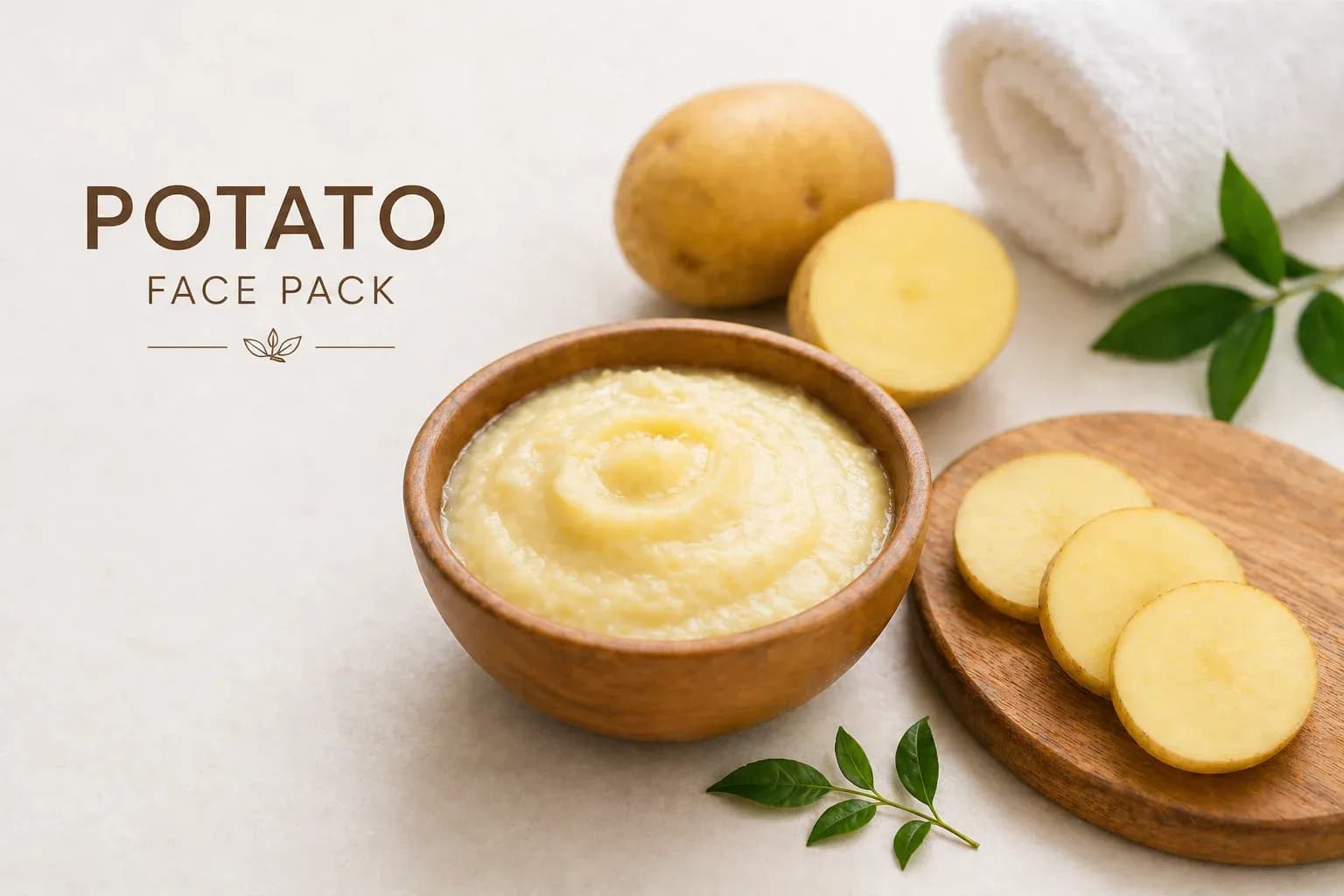
Quick Answer:
A potato face pack is a topical skin treatment made from raw potato juice, grated potato, or potato starch, applied to cleansed skin to brighten tone, reduce tan, and fade dark spots. Potato contains catecholase, vitamin C (approximately 19.7 mg per 100 g), and anti-inflammatory phenolics that work together to interrupt melanin production at the cellular level. Used consistently 3-4 times per week, most users see visible improvement in surface tan and dullness within 2-3 weeks, and meaningful fading of mild dark spots within 4-6 weeks.
Potato face packs are not an overnight fix and not a clinical substitute, but they are one of the few kitchen ingredients with a measurable, enzyme-driven mechanism that dermatologists acknowledge as biologically plausible for mild skin brightening.
What Is a Potato Face Pack?
A potato face pack is a DIY or formulated skin treatment that uses raw potato (Solanum tuberosum) as its primary active ingredient. It is applied to cleansed skin, left on for 15-20 minutes, and rinsed off with lukewarm water.
Potato face packs are used primarily for:
- Skin brightening and tan removal
- Reducing the appearance of dark circles and pigmentation
- Soothing inflammation and mild sunburn
- Hydrating dry or dull skin
The pack works because potato contains catecholase, also called a tyrosinase inhibitor, an enzyme that interrupts melanin production, the biological process responsible for skin darkening. This makes potato one of the most accessible natural depigmenting agents available, particularly in the context of Indian home skincare.
Key Terms Defined:
- Catecholase: A potato enzyme that reduces melanin synthesis in skin cells
- Melanin: The pigment responsible for skin darkening, tanning, and hyperpigmentation
- Hyperpigmentation: Uneven darkening of skin patches caused by excess melanin production
- Tyrosinase: The enzyme melanocytes use to convert tyrosine into melanin; catecholase inhibits this enzyme
Kibo Skin's clinical team notes that potato face packs are most effective as a first-line home remedy for mild brightening concerns, not as a replacement for evidence-backed clinical actives in cases of moderate or severe hyperpigmentation.
How Does a Potato Face Pack Work? The Complete Mechanism
A potato face pack works because its active compounds penetrate the outer skin layer (epidermis) and act on melanocytes, the cells responsible for producing melanin. The causal chain involves multiple compounds acting simultaneously.
Here is the step-by-step mechanism:
Catecholase inhibits melanin production. When potato juice contacts skin, catecholase reduces the activity of tyrosinase, the enzyme that converts tyrosine into melanin. Less tyrosinase activity means less pigmentation produced at the cellular level.
Vitamin C accelerates skin cell renewal. Potato contains approximately 20 mg of vitamin C per 100 g. Vitamin C stimulates collagen synthesis and speeds up the natural shedding of pigmented skin cells, accelerating visible brightening.
Starch provides a mild exfoliating film. Potato starch creates a thin layer on skin as the pack dries, which helps lift dead skin cells mechanically when rinsed off, a process dermatological literature refers to as stratum corneum exfoliation via biopolymer particles.
Potassium and B vitamins support the skin barrier. These micronutrients help maintain transepidermal water loss, leaving skin softer and less dehydrated after rinsing.
Anti-inflammatory phenolics reduce redness. Potato contains chlorogenic acid and solanine precursors, both of which can calm mild skin irritation and puffiness by inhibiting interleukin-6 (IL-6), a key inflammatory marker in skin cells.
Common Misconception: A single application does not bleach or permanently lighten skin. Results from a potato face pack are observable after 10-14 consistent applications, not overnight. The mechanism is gradual and cumulative.
What Are the Key Benefits of a Potato Face Pack?
Potato face pack benefits fall into two categories: short-term effects visible within the first few days, and long-term changes that develop after 3-6 weeks of regular use.
For marks that persist beyond mild surface discoloration, chemical peel for dark spots may offer more controlled exfoliation.
Short-Term Benefits (Days 1-7)
- Immediate surface brightening: Skin appears more even-toned after the first 2-3 uses due to surface-level enzyme activity and light starch exfoliation
- Reduced puffiness: Particularly around the eye area when cooled potato juice or slices are applied; the cold temperature constricts blood vessels
- Soothing effect on sunburn: Anti-inflammatory compounds calm UV-stressed skin within 24 hours of application
Long-Term Benefits (Weeks 2-6)
- Tan removal: Regular use at 3-4 times per week may reduce sun tan noticeably within 2-3 weeks
- Fading of dark spots and blemish marks: Catecholase activity reduces post-inflammatory hyperpigmentation over 4-6 weeks of sustained use
- Improved skin texture: Starch exfoliation and vitamin C collagen support produce a smoother, more even skin surface
- Reduced dark circles: The depigmenting action of potato juice may lighten under-eye discolouration with 3-4 weeks of consistent application
Benefits at a Glance
| Benefit | Mechanism | Typical Onset |
|---|---|---|
| Skin brightening | Catecholase inhibits melanin | 3-5 applications |
| Tan removal | Enzyme + vitamin C action | 2-3 weeks |
| Dark spot fading | Reduced melanin synthesis | 4-6 weeks |
| Puffiness reduction | Anti-inflammatory phenolics | 1-2 applications |
| Skin hydration | Potassium + water content | Immediate |
| Smoother texture | Starch exfoliation | 1-2 weeks |
According to Kibo Skin's dermatology team, these benefits are most reliably achieved when potato face packs are used as part of a consistent routine that also includes daily SPF use, without sun protection, pigmentation progress can reverse within days of UV exposure.
What Are the Different Types of Potato Face Pack?
Potato face packs are not one-size-fits-all. The additional ingredients mixed with potato juice determine which skin concern each variant targets most effectively.
1. Potato + Lemon Juice Pack
Best for: Oily skin and tan removal.
Lemon juice adds alpha-hydroxy acids (AHAs) that boost surface exfoliation alongside potato's catecholase activity. This combination delivers the strongest surface brightening effect of all variants.
Caution: Lemon juice is phototoxic under UV exposure. Apply only at night. Do not use on broken, sunburned, or sensitive skin without patch testing first.
Frequency: 2-3 times per week.
2. Potato + Honey Pack
Best for: Dry and combination skin.
Honey is a natural humectant that draws moisture into the skin barrier, addressing dehydration-related dullness while potato addresses pigmentation. The dual action makes this combination effective for skin that appears dull primarily due to dryness rather than deep melanin accumulation.
Frequency: Can be used daily. Suitable for most skin types including sensitive skin.
3. Potato + Turmeric Pack
Best for: Acne-prone skin with post-acne dark marks.
Turmeric adds curcumin, which has documented antibacterial and anti-inflammatory properties. Curcumin inhibits the inflammatory cascade that drives post-inflammatory hyperpigmentation, complementing potato's catecholase-driven melanin inhibition.
Frequency: 2-3 times per week. Note: turmeric can temporarily stain lighter skin tones, rinse thoroughly and avoid contact with fabric.
4. Potato + Curd (Yoghurt) Pack
Best for: Dull, dehydrated, and sensitive skin.
Lactic acid in yoghurt provides gentle chemical exfoliation while potato hydrates and brightens. The combination is one of the least irritating variants, making it suitable for reactive skin types that cannot tolerate lemon or turmeric.
Frequency: 3-4 times per week.
5. Plain Potato Juice Pack
Best for: Beginners, reactive skin, or daily maintenance brightening.
No additional actives means a lower risk of irritation. Effective for mild pigmentation, daily skin maintenance, and as the starting point before introducing combination variants.
Frequency: Daily use is generally safe for most skin types.
6. Potato + Besan (Gram Flour) Pack
Best for: Oily, tan-prone skin needing gentle physical exfoliation.
Besan acts as a mild physical scrub, lifting dead skin cells and excess sebum while potato juice works on melanin at the cellular level. Particularly effective for body tan on arms and neck, not just the face.
How to mix: 2 tablespoons grated potato or juice + 1 tablespoon besan + enough rose water to form a paste. Apply, leave 15 minutes, then scrub gently in circular motions before rinsing.
Frequency: 2-3 times per week. Avoid on active acne, the scrubbing motion can spread bacteria.
7. Potato + Coffee Pack
Best for: Dull, tired skin and under-eye bags.
Coffee grounds provide physical exfoliation while caffeine constricts blood vessels, reducing puffiness. Potato adds catecholase and vitamin C. The combination targets two separate mechanisms simultaneously: physical removal of dead cells and enzymatic melanin inhibition.
How to mix: 1 tablespoon potato juice + 1 teaspoon finely ground coffee (not instant) + 1 teaspoon honey as a binding agent.
Frequency: Once per week. Do not apply coffee grounds directly under the eye, the particles may cause micro-tears on thin under-eye skin.
8. Potato + Aloe Vera Pack
Best for: Sunburned or post-beach skin needing soothing and brightening simultaneously.
Aloe vera's acemannan compounds reduce UV-induced inflammation while potato juice targets post-tan pigmentation. This is the gentlest combination among all variants and is suitable even for reactive or sensitised skin.
How to mix: Equal parts fresh potato juice and pure aloe vera gel. Apply and leave for 20 minutes.
Frequency: Daily or as needed after sun exposure.
Pack Type Summary
| Pack | Skin Type | Primary Action | Frequency |
|---|---|---|---|
| Potato + Lemon | Oily / Tanned | Deep brightening | 2-3x per week |
| Potato + Honey | Dry / Combination | Brightening + hydration | Daily |
| Potato + Turmeric | Acne-prone | Brightening + antibacterial | 2-3x per week |
| Potato + Curd | Sensitive / Dull | Gentle exfoliation + brightening | 3-4x per week |
| Plain Potato Juice | All types / Beginners | Mild brightening | Daily |
| Potato + Besan | Oily / Tan-prone | Physical exfoliation + brightening | 2-3x per week |
| Potato + Coffee | Dull / Puffy | Caffeine de-puffing + brightening | 1x per week |
| Potato + Aloe Vera | Sunburned / Reactive | Soothing + inflammation relief | Daily |
How to Apply a Potato Face Pack: Step-by-Step Guide
Applying a potato face pack correctly determines how much benefit the active compounds deliver. Skipping steps, particularly cleansing before application and moisturising after, significantly reduces results.
What You Need
- 1 medium raw potato (fresh, not sprouted or green)
- A grater or blender
- Clean muslin cloth or fine strainer
- A clean brush or fingertips for application
- Mild, pH-balanced cleanser for pre-wash
- Lightweight, non-comedogenic moisturiser for post-wash
Step-by-Step Application
Cleanse your face. Wash with a gentle, pH-balanced cleanser to remove surface oil, sunscreen, and impurities. Pat dry with a clean towel. This step matters because clean skin allows better enzyme absorption, applying to dirty or oily skin significantly reduces active compound penetration.
Prepare the potato. Grate one raw potato and squeeze the juice through a muslin cloth, or blend the potato to a smooth paste. Use the juice or paste immediately, potato juice oxidises within 20-30 minutes of preparation, turning yellow-brown as catecholase loses potency. Oxidised juice delivers minimal brightening benefit.
Add secondary ingredients if needed. Based on your skin type, mix in honey, curd, lemon, turmeric, besan, coffee, or aloe vera following the combinations detailed above. Prepare only what you will use in one session.
Apply evenly to the face. Use a brush or clean fingertips. Apply a thin, even layer across the entire face, avoiding the immediate eye contour. For dark circles specifically, apply gently with a cotton pad to the under-eye area only.
Leave on for 15-20 minutes. Do not exceed 20 minutes. Potato's natural acidity (pH approximately 5.5-6.0) can cause mild irritation on sensitive skin with prolonged contact. Longer application time does not improve results.
Rinse with lukewarm water. Use gentle circular motions to lift the pack, then follow with a splash of cool or cold water to close pores. Avoid warm or hot water, heat reduces the brightening effect.
Moisturise immediately. Apply a lightweight, non-comedogenic moisturiser to lock in hydration before the skin has time to feel tight. This step is not optional, the starch in potato can be mildly drying without follow-up hydration, and skipping it can lead to flaking on dry skin types.
Common Mistakes to Avoid
- Using sprouted or green potatoes: These contain elevated concentrations of solanine that can cause localised skin irritation
- Leaving the pack on too long: More than 20 minutes does not improve results and may cause dryness or tightness
- Skipping moisturiser: Potato starch can be mildly drying without post-application hydration
- Applying to broken or sunburned skin: Wait for the skin barrier to recover before use
- Using lemon variants without patch testing: Lemon is phototoxic under UV exposure; always apply lemon-potato packs at night only
- Preparing juice in advance: Fresh preparation is essential, do not store potato juice overnight and use it the following day
Potato Face Pack for Specific Skin Concerns: Use Cases and Application Guidance
Different skin concerns require different formulations and application approaches.
For Tan Removal
Apply a potato + lemon juice pack (or potato + besan pack for oily skin) 3 times per week on sun-exposed areas including the face, neck, and hands. In most users, a visible reduction in surface tan is observable within 2-3 weeks of consistent use. Pair this routine with SPF 30+ sunscreen applied every morning, without daily sun protection, any tan reduction can reverse within days of UV re-exposure.
For stubborn or long-standing tanning, chemical peel for tan removal may provide faster results than home remedies.
For Dark Circles
Apply cooled potato juice (refrigerate for 10 minutes after fresh preparation) under the eye area using a cotton pad. Leave for 15 minutes, then gently blot off, do not rub. Use this approach 4-5 times per week. Consistent application may reduce under-eye discolouration within 3-4 weeks. Plain potato juice without additional actives is best for this area, turmeric can stain the delicate under-eye skin.
For Post-Acne Marks (Post-Inflammatory Hyperpigmentation)
Apply a potato + turmeric pack on affected areas 3 times per week. The combination of catecholase and curcumin targets post-inflammatory hyperpigmentation through two complementary mechanisms: melanin inhibition and inflammatory pathway suppression. Results are typically visible after 4 weeks of consistent use. If breakouts are still active, allow them to resolve before applying, do not use turmeric variants on open or active acne lesions.
When pigmentation is deeper or recurring, chemical peel for pigmentation may be more suitable after a dermatologist assessment.
For Dull Skin Before an Event
A single application of plain potato juice pack can produce an immediate brightening effect by removing surface dead cells and improving light reflection. This works best on cleansed skin with no active breakouts. For a same-day event, apply in the morning, follow with moisturiser and SPF, and allow at least 30 minutes before applying makeup.
For Dry and Dehydrated Skin
The potato + honey pack provides dual action: honey se
The potato + honey pack provides dual action: honey seals in moisture while potato supports mild brightening. Use it 2 to 3 times per week, leave it on for 15 minutes, and rinse with lukewarm water. Follow with a moisturiser.
For Oily and Acne-Prone Skin
Use plain potato juice or a potato + besan pack. Avoid thick honey-based combinations if they feel heavy on your skin. Do not apply over active, inflamed acne or open lesions.
Who Should Use a Potato Face Pack?
A potato face pack may suit people with mild dullness, recent tan, surface-level dark spots, or dehydration-related uneven tone.
| Suitable For | Use With Caution or Avoid |
|---|---|
| Mild surface tan and dullness | Active sunburn, cuts, or broken skin |
| Normal, oily, and combination skin | Very reactive or allergy-prone skin |
| Post-acne marks after lesions have healed | Active cystic acne or inflamed breakouts |
| Dry skin when combined with honey or curd | Known sensitivity to potato, lemon, or turmeric |
Potato Face Pack Side Effects and Precautions
Potato is generally mild, but DIY face packs can still irritate the skin, especially when mixed with lemon, coffee, besan, or turmeric.
- Patch test the mixture for 24 hours before full-face use
- Do not use green or sprouted potatoes
- Avoid undiluted lemon juice
- Do not apply on sunburned, cut, or inflamed skin
- Do not leave the pack on for more than 20 minutes
- Moisturise after every use
- Stop use if you develop burning, itching, redness, or worsening pigmentation
How Often Should You Use a Potato Face Pack?
| Skin Type | Recommended Frequency |
|---|---|
| Oily skin | 2 to 3 times per week |
| Combination skin | 2 times per week |
| Normal skin | 1 to 2 times per week |
| Dry skin | Once per week with honey, curd, or aloe vera |
| Sensitive skin | Occasionally, after a patch test |
When a Potato Face Pack Is Not Enough
A potato face pack works mainly on surface-level dullness and recent tanning. It cannot treat deep pigmentation, melasma, persistent post-inflammatory hyperpigmentation, active acne, or long-standing dark patches.
In such cases, chemical peel treatment can be considered as part of a dermatologist-guided plan.
Before choosing a clinic-based option, compare chemical peel treatment cost across peel depths and session plans.
These concerns may need professional treatment such as prescription skincare, chemical peel treatment, laser procedures, or a combination plan selected according to skin type and pigment depth.
Final Thoughts
A potato face pack may help brighten dull skin, reduce mild surface tan, and gradually improve the appearance of recent dark spots. Results are modest and depend on consistent use, suitable ingredients, moisturising, and daily sun protection.
For deeper pigmentation, recurring dark patches, or persistent acne marks, schedule a skin consultation at Kibo Skin Clinic to understand whether a chemical peel, prescription routine, or another clinical option is more appropriate.
Frequently Asked Questions
Q1. Does potato face pack remove dark spots?
It may gradually improve mild surface dark spots, but deeper pigmentation usually needs professional treatment.
Q2. Can I use potato face pack every day?
Plain potato juice may be tolerated frequently by some skin types, but most people should limit face packs to 2 or 3 times per week.
Q3. Is potato face pack good for tan removal?
It may help reduce recent surface tan over several weeks, especially when combined with daily sunscreen.
Q4. Can potato face pack cause irritation?
Yes. Irritation is more likely with lemon, coffee, turmeric, or overuse. Patch testing is recommended.
Q5. Which potato face pack is best for dry skin?
Potato with honey, curd, or aloe vera is generally gentler for dry skin than lemon or besan combinations.
Medical Disclaimer : Information from Kibo Hair Clinics is for educational purposes only. It does not replace diagnosis, trichoscopy, blood test interpretation, prescription treatment, procedure advice, or side-effect counselling from a qualified dermatologist or hair restoration doctor.