

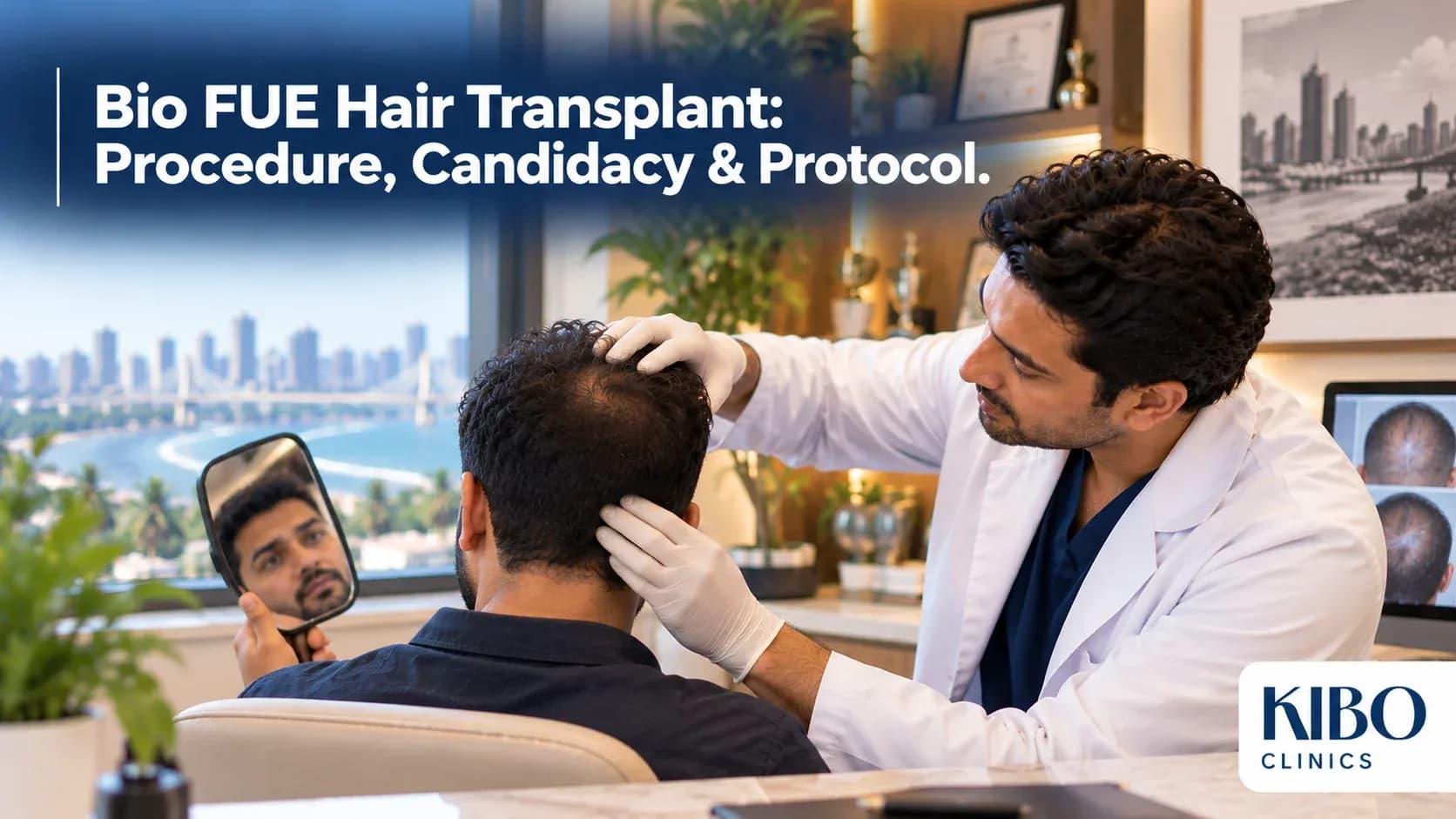
What Is Bio FUE?
"Bio FUE" is not a universally standardized surgical classification the way FUE and FUT are. Across clinics, the term gets used for different combinations of FUE with biological support, which may include platelet-rich plasma (PRP), growth-factor concentrate (GFC), cytokine-rich plasma, regenerative-cell preparations, graft-holding solutions, donor-site treatment, recipient-site treatment, or a combination of these. At Kibo, Bio FUE means a doctor-planned FUE procedure with a clearly named and disclosed biological-support protocol, applied only where clinically appropriate.
We don't position Bio FUE as automatically superior to standard FUE. A 2025 systematic review found promising results for PRP as an adjunct, but it included only three controlled studies involving 217 participants, with substantial variation in PRP preparation, protocols, outcome measures and follow-up. The authors concluded further high-quality standardised trials are needed.
How Is Bio FUE Different From Standard FUE?
Usually, the difference is an added biological-support step, not a different harvesting method. Both procedures still require diagnosis, donor assessment, graft handling, recipient-site design, implantation and aftercare. The clinical value of the added component depends entirely on the exact material and protocol used, not on the "Bio" label alone.
| Topic | Standard FUE | Bio FUE at Kibo |
|---|---|---|
| Surgical base | Individual follicular-unit excision and implantation | The same FUE foundation |
| "Bio" component | None or standard graft storage and care | A named, documented biological-support step, when prescribed |
| What must be compared | Diagnosis, donor planning, operator roles, graft handling, site creation, implantation, risks, aftercare | All standard FUE factors, plus the exact biological material, processing, use location, evidence and cost |
| Result language | No guarantee | No guarantee, and no automatic superiority claim |
| Best question to ask | "Who performs each surgical step?" | "What exactly does 'Bio' mean here, and what evidence applies to it?" |
What Does the Procedure Include?
Assessment and Planning
The consultation covers your medical and hair-loss history; scalp and donor-area examination; assessment of miniaturisation, density, hair calibre, curl and the safe donor area; diagnosis or differential diagnosis; review of current medicines and medical conditions; discussion of medical treatment where relevant; goals and hairline planning; a graft estimate; and a consent discussion.
Surgical FUE Components
The core surgical steps are donor and recipient marking, local anaesthesia, follicular-unit excision with an appropriate punch and technique, graft inspection and counting, hydrated and documented storage, recipient-site creation, placement at the planned angle and direction, and discharge with written instructions. Which steps are performed by the surgeon and which by trained staff under supervision should always be stated clearly. Professional guidance emphasises physician-driven decision-making and transparency about team roles.
Biological-Support Components
Where a biological component is prescribed, it's named and described separately rather than bundled as a vague "regenerative" add-on:
- PRP (platelet-rich plasma): patient-derived plasma with platelets, prepared according to a documented protocol
- GFC (growth-factor concentrate): described only with a documented medical protocol and appropriate internal approval
- Exosomes or other regenerative products: source, processing, intended use and evidence status disclosed, and whether it's part of the core transplant or an optional adjunct; we don't use "stem-cell" or "regenerative" language as a substitute for explaining the actual product
- Graft-holding solution: whether the biological material is used to store grafts, inject recipient or donor areas, treat the scalp, or more than one of these
Aftercare and Follow-Up
Wound-care instructions, washing guidance, prescribed medicines, warning signs, contact arrangements and planned follow-up visits are part of the service, as part of a 12-month care journey of scheduled reviews through the healing and growth period.
Who May Be a Candidate?
Bio FUE is a possible protocol for a patient who is already a reasonable hair-transplant candidate, not a treatment that creates candidacy on its own. The assessment covers:
- Diagnosis: Pattern hair loss should be distinguished from alopecia areata, telogen effluvium, active inflammatory or scarring alopecia, infection, traction-related loss, nutritional or endocrine causes, and other conditions.
- Disease activity: Active or progressive disease may need treatment and stabilisation before elective transplantation.
- Donor supply: Density, calibre, miniaturisation, safe donor-area boundaries, hair characteristics and future needs must be assessed. Donor supply is finite.
- Recipient capacity: The skin must be able to support the planned grafts. Scarred or inflamed recipient tissue may need specialised assessment and can have less predictable growth.
- Medical readiness: Conditions, allergies, medicines, bleeding risk, blood pressure, diabetes, smoking, anaesthesia risk, and lab testing where indicated.
- Expectations: The realistic goal may be improved framing or coverage, not a full head of hair. A second procedure may be needed and should be discussed before consent.
- Long-term plan: Native hair may continue to thin; medical therapy and follow-up may be part of preserving the overall appearance.
A consultation rather than a booking is advised when there's rapidly progressing loss, suspected active scarring alopecia, active alopecia areata, unexplained diffuse shedding, insufficient donor density, severe uncontrolled systemic illness, active scalp infection or inflammation, or a request for a graft count that hasn't been clinically assessed. Patients who are very young or whose pattern is still evolving may need medical stabilisation first.
What Happens During the Procedure?
- Consultation and confirmation: Review diagnosis, goals, medical history, medicines and the selected protocol.
- Design and documentation: Photograph the baseline, mark recipient and donor areas, confirm the hairline and planned coverage, and document the planned graft count.
- Preparation and comfort-focused numbing: Prepare the scalp and administer local anaesthesia. The patient remains awake in many procedures, though the exact comfort plan varies.
- Donor excision: Extract follicular units individually with a suitable punch and a conservative donor plan. FUE is not scarless; it leaves small scars and can cause overharvesting if poorly planned.
- Graft inspection and holding: Count and inspect grafts; keep them hydrated and protected according to the documented protocol, minimising avoidable time outside the body.
- Recipient-site creation: Create sites with attention to angle, direction, distribution, density, and your existing hair.
- Biological support: If prescribed, apply or administer the named PRP, GFC, or other component exactly as described in the written consent and quote.
- Implantation: Place grafts according to the design; document the number and type of grafts used.
- Discharge: Medicines, washing instructions, activity restrictions, warning signs, emergency contact information, and follow-up dates.
This sequence, instrumentation, staffing and biological steps can vary by surgeon and patient. The fundamental components remain similar across clinics, but the detailed sequence isn't universal.
Recovery and Results Timeline
- First days: Tenderness, pinkness, mild swelling, numbness and small crusts may occur. Follow your surgeon's specific instructions.
- First 1-2 weeks: Crusts gradually loosen; avoid picking or rubbing grafts. Exact washing rules vary by surgeon.
- Weeks 2-8: Transplanted hairs may shed. This can be a normal part of the early process for many patients.
- Months 3-6: New growth may become visible, often fine at first.
- Months 6-12 or longer: Density and calibre mature gradually. Many patients see results around six to nine months and some take up to 12 months.
- Long term: Native, non-transplanted hair can continue to thin; medical therapy may still be recommended.
We don't claim that Bio FUE necessarily heals faster, grows sooner, or produces denser hair than standard FUE. These are protocol-specific claims that require direct comparative evidence, which doesn't currently exist for most biological adjuncts.
Benefits and Limitations
Hair transplantation is surgery; no surgical procedure is risk-free. Possible issues include pain or injection discomfort, bleeding, infection, swelling, numbness, inflammation, folliculitis, temporary shedding, poor or uneven growth, scarring, overharvesting, an unnatural hairline or direction, donor depletion, and the need for additional treatment. The precise risk depends on the patient, diagnosis, technique, operator, facility and aftercare.
FUE does not mean "scarless." Professional guidance specifically describes FUE as leaving no linear scar while still producing small scars, and warns about the risk of overharvesting. A biological adjunct may be proposed to support the graft environment, but no ethical clinic should guarantee survival or density from it. The evidence remains promising but heterogeneous.
What Does Bio FUE Cost?
Cost depends on graft requirement, diagnosis, technique, surgeon and facility involvement, the biological component (if any), medicines, aftercare and follow-up. A written quote should state whether the unit is a graft, follicular unit, or hair, and should clearly state inclusions and exclusions, including whether any biological-support component is bundled into the base price or billed separately. Use our checklist for comparing hair transplant quotes before deciding.
What Should a Patient Ask Before Booking?
- What exactly does "Bio" mean in this protocol, and what evidence applies to it?
- Is the biological material autologous (from my own body), allogeneic, or synthetic?
- Is it used as a graft-holding solution, an injection, a donor-site treatment, a recipient-site treatment, or more than one of these?
- Who performs extraction, recipient-site creation, and implantation?
- How is graft count recorded and disclosed?
- What is not included unless specifically written in the quote?
- What would make standard FUE, FUT, medical therapy, or no surgery more appropriate for me instead?
For the full version of this checklist, see our guide on questions to ask at your hair transplant consultation. A consultation is an assessment, not a commitment. Booking one never means committing to surgery.
Bottom Line
Bio FUE is FUE first. "Bio" is a named, optional biological-support step applied only when it's clinically appropriate, not an automatic upgrade. The question worth asking isn't whether Bio FUE is "better." It's what exactly the biological component is, what evidence supports it, and who performs each surgical step. Kibo follows a planning-first, No Ghost Surgery approach with a 12-month care journey, whichever protocol fits your case.
What is Bio FUE hair transplant?
What does Bio FUE include at Kibo?
Is Bio FUE the same as standard FUE?
What is the role of PRP, GFC, or exosomes in Bio FUE?
Does Bio FUE improve graft survival?
Who may suit Bio FUE?
Can women have Bio FUE?
Can Bio FUE be used for advanced hair loss?
Is Bio FUE permanent?
How long is Bio FUE recovery?
What does Bio FUE cost?
What should I ask before booking?
Medical Disclaimer : Information from Kibo Hair Clinics is for educational purposes only. It does not replace diagnosis, trichoscopy, blood test interpretation, prescription treatment, procedure advice, or side-effect counselling from a qualified dermatologist or hair restoration doctor.