Everything a patient asks before and after a transplant: how FUE and FUT differ, what grafts actually cost in Indian cities, how long recovery takes, and how to judge whether a clinic is being straight with you.

This guide explains who may realistically be a candidate for exosome hair treatment, covering pattern hair loss, diffuse or temporary shedding, other hair-loss conditions, and non-surgical alternatives, so readers understand that suitability depends on a proper diagnosis rather than thinning alone.
September 15, 2026 – 5 min read

This guide examines whether exosomes work for androgenetic alopecia in both men and women, covering what current systematic reviews show, how the evidence differs between male and female pattern hair loss, and when exosome therapy might realistically be considered alongside established treatments like minoxidil and finasteride.
September 10, 2026 – 5 min read

This guide covers the reported side effects of exosome hair treatment, what current safety data actually shows, the key risks and disadvantages, and who should avoid the treatment altogether. It also outlines what to check with a provider before considering exosome therapy, drawing on recent systematic reviews and FDA regulatory guidance on unapproved regenerative products.
September 10, 2026 – 5 min read

This guide explains what exosome hair treatment is, how it may work, and what current clinical evidence actually shows, drawing on recent systematic reviews and studies. It covers the procedure, expected timelines, sessions, cost in India, safety, and how exosomes compare with PRP, GFC and stem-cell approaches, with an evidence-first, non-promotional view of a still-investigational treatment.
September 10, 2026 – 5 min read

Hair transplant can be a safe procedure for suitable candidates when performed by a qualified medical team. Understanding possible risks, side effects, donor-area planning, anaesthesia safety, clinic hygiene and post-procedure care helps patients make an informed decision.
August 31, 2026 – 5 min read

Hair transplant pricing in Dehradun is highly variable. Current public clinic/hospital pages show standard FUE-style local prices around ₹40-₹70 per graft in some centres, with advertised totals ranging from roughly ₹40,000-₹65,000 for smaller 800-1,200 graft plans to ₹1,80,000-₹2,50,000+ for 4,000-5,000+ graft cases; premium implanter/DHI-style or branded protocols can cost more. The content does not pretend these advertisements form an official city average. Instead it teaches readers how to compare graft estimates, FUE/DHI labels, surgeon involvement, donor safety, written quotes and total travel cost. Kibo’s listed clinic remains in Khar West, Mumbai, so the page explicitly avoids claiming a Dehradun Kibo branch and objectively explains when local care versus travelling to a larger city is justified.
August 24, 2026 – 5 min read

There is no reliable direct public confirmation from Sunny Deol that establishes a hair transplant, surgeon, technique or graft count. A 2007 Times of India entertainment report described attention around his 'hair job' while discussing weaving, transplants and wigs, which confirms that his hair appearance was publicly discussed but does not prove surgery. Public photographs can support cautious observations about apparent hairline or density changes, yet they cannot distinguish transplant surgery from hair systems, styling, fibres, medication response or lighting. The article therefore labels every visual point as observation, rejects photo-based FUE/DHI/graft-count claims and uses Sunny Deol's search interest to teach readers how to evaluate celebrity hair-transplant rumours responsibly.
August 24, 2026 – 5 min read

Hair plugs are the old large-graft era of hair transplantation. The transplanted follicles may still survive, but widely spaced multi-hair tufts can create an obvious doll-hair appearance that differs from modern follicular-unit surgery. Current repair options include camouflage with finer grafts, plug excision or reduction, redistribution of reusable follicles, hairline redesign and scar camouflage. Because previous surgery can leave fibrosis, circular scars and a depleted donor area, repair is often staged and should be planned by an experienced corrective surgeon rather than treated as a simple high-graft transplant.
August 24, 2026 – 5 min read
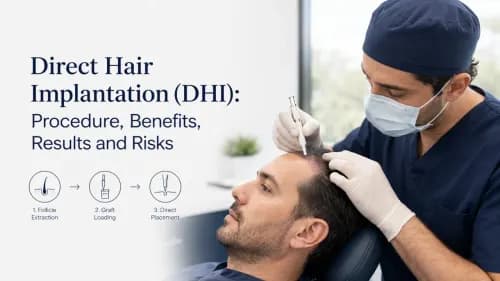
This guide explains what Direct Hair Implantation actually means, how the implanter pen is used, how DHI relates to FUE, and what the procedure can and cannot change. It covers candidacy, benefits, limitations, recovery, results, risks, cost and clinic-selection checks. Read it if you are comparing DHI with other transplant options and want to separate surgical facts from marketing claims before booking a consultation.
August 18, 2026 – 5 min read
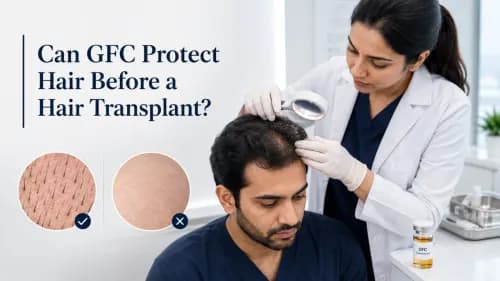
This article explains whether GFC before a hair transplant may support existing, miniaturised hair, what current evidence does and does not show, who may be considered for treatment, and when a hair transplant is more appropriate. It is most useful for people with thinning native hair who are deciding whether pre-transplant GFC is a worthwhile optional add-on, while making clear that it cannot regrow hair in completely bald areas or replace proven medical treatment or transplantation.
August 12, 2026 – 5 min read
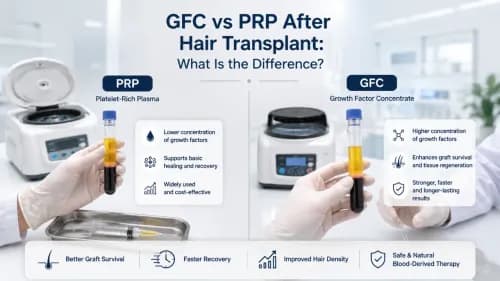
This article compares GFC and PRP after a hair transplant across preparation, clinical evidence, graft survival, hair growth, healing, shock loss, safety, treatment sessions and cost. It is most useful for people deciding whether either optional adjunct belongs in their recovery plan, while making clear that PRP currently has stronger transplant-specific evidence and neither treatment is proven universally superior.
August 12, 2026 – 5 min read
This article explains whether GFC has been shown to improve final hair transplant outcomes, including graft survival, density, healing, shock loss and growth speed. It separates transplant-specific evidence from studies on pattern hair loss, shows which outcomes remain uncertain, and explains why surgical quality and aftercare matter more. It is most useful for readers deciding whether GFC is worth adding as an optional post-transplant treatment.
August 12, 2026 – 5 min read
This guide explains when GFC may be started after a hair transplant, why scalp healing matters more than a fixed day, how a typical initial session plan may be structured, and when maintenance might be considered. It is most useful for people recovering from a transplant who want to decide whether GFC is necessary, how many sessions may be recommended, and what signs a surgeon checks before treatment.
August 12, 2026 – 5 min read
This blog explains what a GFC hair transplant means, how GFC may be used before, during or after conventional hair-transplant surgery, and what it can and cannot do. It also covers the procedure, possible benefits, differences from PRP, expected result timeline, suitability, side effects, cost factors and the importance of choosing a qualified clinic.
August 12, 2026 – 5 min read

Akshaye Khanna has publicly spoken about premature hair loss, but there is no verified public confirmation that he underwent a hair transplant. This guide separates confirmed information from photo-based speculation, explains what may change hair appearance, and shows what people with a similar hair-loss pattern should consider before choosing treatment.
August 17, 2026 – 5 min read
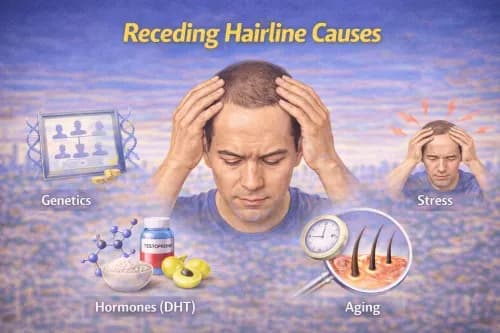
This guide leads with diagnosis rather than assuming genetics: it separates pattern hair loss, a normal mature hairline, traction alopecia, telogen effluvium, and frontal fibrosing alopecia using a clear comparison table, covers how men and women present differently, and explains why a transplant is only appropriate after diagnosis and stability, not as a first response.
September 23, 2026 – 5 min read
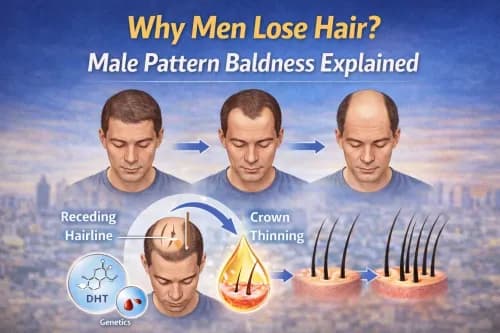
Male pattern baldness, also referred to as androgenetic alopecia, is the most commonly occurring form of hair loss affecting 30-50% men by age 50. It is caused by the androgen hormone dihydrotestosterone (DHT) shrinking hair follicles causing hair to become thinner and shorter. The symptoms of male pattern baldness might appear early, but they will become more prominent as you grow older. The common signs of male pattern baldness include a receding hairline and hair thinning at the crown. This condition can be caused by multiple factors: Genetics - Hereditary factors are a primary cause. Hormonal imbalance - DHT binds with your hair follicles and stunts hair regrowth. Age - While in some cases, hair fall might start early, the risk increases with age. Ethnicity - This condition is most likely to affect caucasian men while men from chinese or japanese ethnicities are at the lowest risk. Male pattern baldness treatment options include Minoxidil, Finasteride or even hair hair transplants. But their effectiveness depends on what stage of hair loss you scalp based on the Hamilton-Norwood scale. Male pattern baldness is a distressing condition for men, but it can be managed and even reversed with the help of timely and regular treatment. Here’s a guide to everything you need to know about androgenetic alopecia.
August 12, 2026 – 5 min read
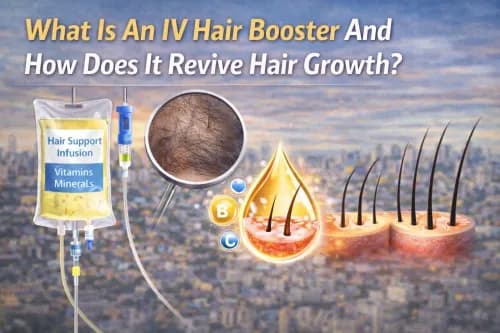
IV hair booster treatment involves delivering a targeted blend of vitamins, minerals, amino acids, and antioxidants directly into the bloodstream through an intravenous (IV) infusion. By bypassing the digestive system, this method ensures maximum absorption and faster availability of nutrients compared to oral supplements or topical applications, which rely on slower and often incomplete absorption. Receiving a solution of all necessary nutrients through IV, you get 100% bioavailability of the ingredients needed. The goal is to nourish hair follicles at a deeper level, supporting regeneration, strength, and overall scalp health. So, if you’re wondering what is an IV hair booster treatment, you’re in the right place. For those who struggle with constant hair loss and breakage despite trying all sorts of products to remedy their condition, there is hope yet. Hair fall due to stress, after illness, and premature thinning can also be addressed with an alternative solution. In this blog post, we’ll walk you through the ins and outs of using IV hair boosters, explaining its working principle, and if you should go with it considering your unique hair problems.
August 12, 2026 – 5 min read

You may have been religiously taking oral supplements from day one of your hair restoration journey, yet the results remain stagnant. This common frustration is rarely due to the supplements themselves, but rather the physiological barrier of the digestive tract. Most oral nutrients suffer from low bioavailability, losing a significant percentage of their therapeutic value during ‘first-pass metabolism’ before they ever reach your scalp. IV Hair Booster Therapy provides a clinical bypass to this bottleneck. By delivering high-dose concentrations of Biotin, Zinc, and essential Amino Acids directly into the venous system, we achieve near-100% nutrient absorption. This immediate saturation nourishes the follicles at a cellular level, effectively arresting shedding and triggering the anagen (growth) phase. As this remains a specialized clinical intervention, we have compiled this definitive list of IV hair booster FAQs to address the biological mechanisms, safety protocols, and expected outcomes of the treatment.
August 12, 2026 – 5 min read
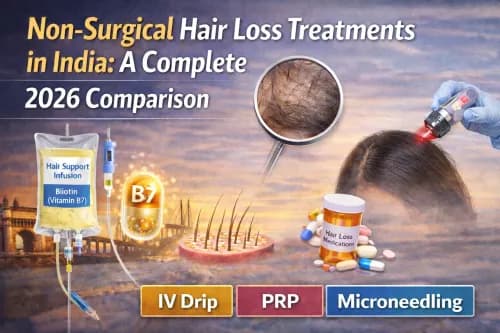
If you’re suffering from hair loss and looking for a way to improve your hair health, you should look into a few modern hair restoration techniques like PRP or IV drips. Earlier treatment plans used to be a choice between invasive surgeries and expensive but ineffective procedures. Now, you can opt for non-surgical hair loss treatments in India that are proven to show promising and more permanent results. Modern techniques like GFC, PRP, and targeted IV infusions reactivate dormant follicles and reverse thinning at a cellular level. Moreover, these techniques are designed to address particular stages of hair fall throughout the entire phase. So, every treatment plan is created with individual conditions and root causes.
August 12, 2026 – 5 min read
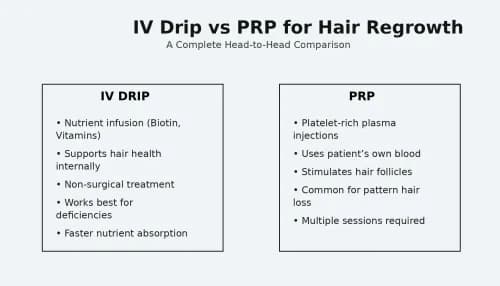
IV Therapy vs PRP for hair fall are two distinct treatments that work at different levels. PRP stimulates your follicles directly using your own growth factors. IV Hair Booster Drips correct the nutritional deficiencies driving your hair fall from within. For most patients experiencing hair fall, combining both delivers the strongest results. The right protocol for you depends on your hair fall pattern, your bloodwork, and your clinical assessment.
August 12, 2026 – 5 min read

A biotin IV infusion for hair growth pushes concentrated Vitamin B7 directly into your bloodstream. By bypassing the digestive tract, a biotin IV drip for hair ensures 100% bioavailability, accelerating keratin synthesis and strengthening the hair shaft from within. While traditional oral supplements are effective for general maintenance, intravenous therapy is a clinically superior option for individuals with malabsorption issues, chronic stress-induced shedding, or documented deficiencies. Most patients observe a visible improvement in hair density and texture within 8 to 12 weeks of consistent clinical sessions.
August 21, 2026 – 5 min read
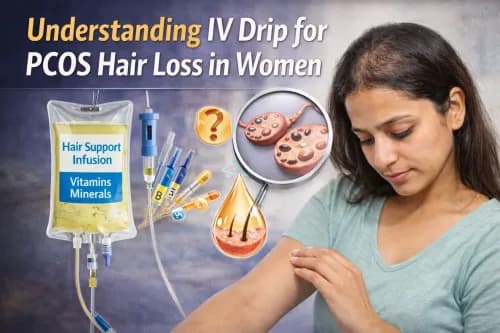
Trichologists and dermatologists recommend the IV drip therapy to tackle excessive hair shedding caused by women with PCOS. Administered via an IV drip, this treatment involves injecting vital nutrients into the bloodstream which is then delivered to the hair follicles present in the scalp. When paired with other measures such as hormone control, oral supplement intake, and lifestyle changes, IV drip therapy can give you the best chance of hair regrowth and recovery. Let’s understand how these therapies work, what their key components are, and how effective they prove in reducing hair loss due to PCOS.
August 12, 2026 – 5 min read
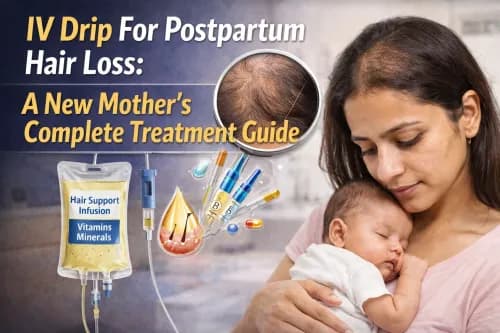
Childbirth is the purest form of joy. However, in its aftermath, a woman’s body undergoes a series of emotional, physical, and hormonal changes. The labour and the postpartum hair fall itself can take a toll on new mothers, making it the most challenging phase in a woman’s life. Therefore, to replenish depleted nutrients and energy levels, and ensure the recovery and overall well-being of new mothers, treatments like intravenous (IV) drip for postpartum hair loss can offer many benefits. Read on to know how IV drip for postpartum hair loss is a boon for new mothers and how it helps treat female pattern baldness.
August 12, 2026 – 5 min read
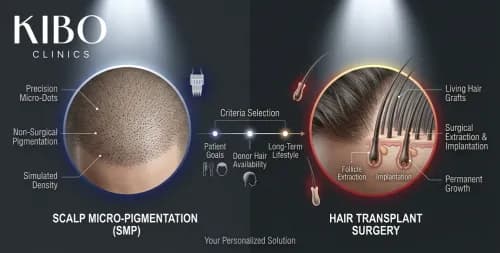
Discover what SMP is and how pigment creates buzz cut illusion, compare SMP's immediate cosmetic results versus transplant's growing hair, understand styling limitations versus versatility, and determine which approach matches your goals.
August 12, 2026 – 5 min read
YOUR HAIR JOURNEY STARTS HERE