
Quick Answer:
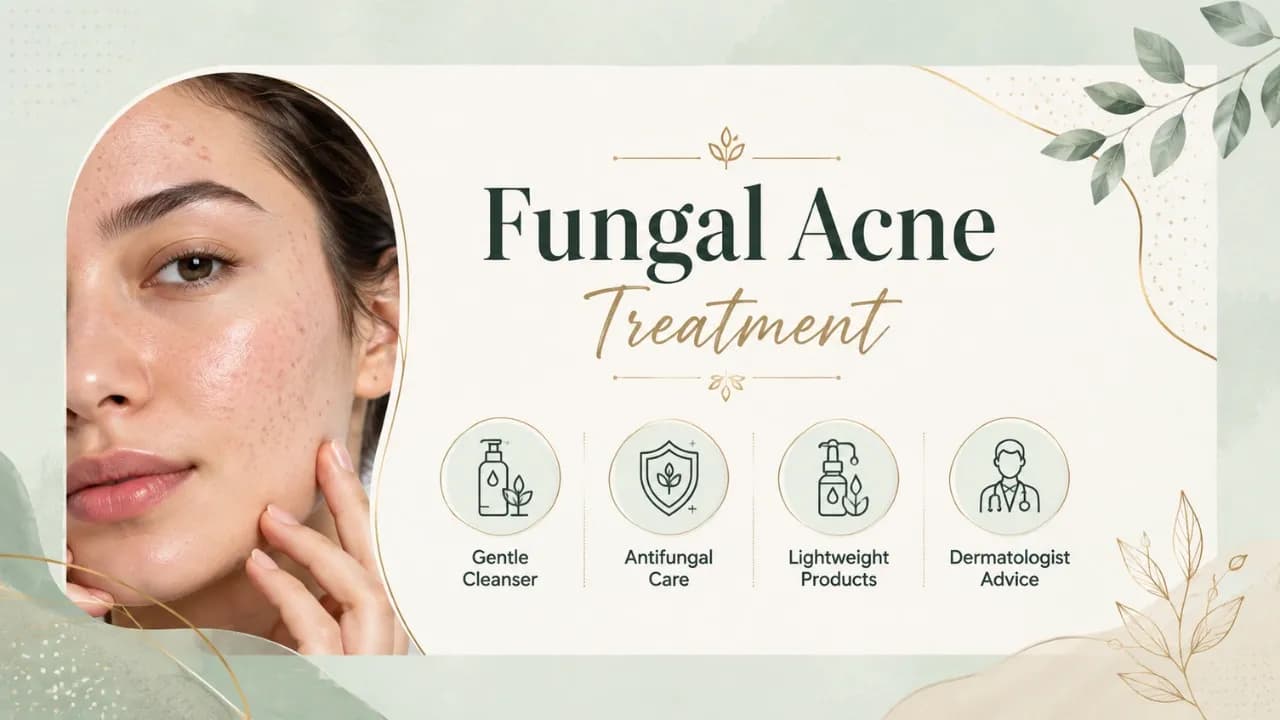
Fungal acne treatment targets Malassezia yeast rather than acne-causing bacteria. Mild cases may be managed with appropriate topical antifungal cleansers or creams, while persistent, widespread or severe cases should be assessed by a dermatologist and may require prescription treatment. Improvement often develops over several weeks, and preventing recurrence depends on controlling sweat, avoiding products that repeatedly trigger the condition and following an appropriate maintenance routine.
Fungal acne is caused by an overgrowth of yeast on the skin, not bacteria — which means standard acne treatments often make it worse. Effective fungal acne treatment targets the underlying Malassezia yeast using antifungal ingredients, lifestyle adjustments, and a carefully chosen skincare routine. Most people see visible improvement within 2–4 weeks of starting the right treatment.
Fungal acne treatment refers to any clinical or at-home approach designed to eliminate Malassezia folliculitis — a condition caused by yeast overgrowth inside hair follicles, not by acne-causing bacteria. According to Kibo Skin's dermatology team, this distinction is critical: treating fungal acne with standard antibacterial acne products can disrupt the skin microbiome further and prolong the condition.
What Is Fungal Acne?
Fungal acne, clinically called Malassezia folliculitis, occurs when the yeast Malassezia — naturally present on all skin — overgrows and clogs hair follicles. It produces small, uniform, itchy bumps that are often mistaken for bacterial acne. Unlike bacterial acne, fungal acne does not typically respond to benzoyl peroxide or salicylic acid.
What Is the Difference Between Bacterial Acne and Fungal Acne?
| Feature | Fungal Acne (Malassezia Folliculitis) | Bacterial Acne (Acne Vulgaris) |
|---|---|---|
| Cause | Yeast (Malassezia) overgrowth | Bacteria (C. acnes) overgrowth |
| Appearance | Uniform, small, itchy pustules | Varied — blackheads, whiteheads, cysts |
| Location | Forehead, chest, back | Face, neck, chest, back |
| Itchiness | Common | Rare |
| Response to antibiotics | None or worsening | Often effective |
| Treatment | Antifungal agents | Antibiotics, benzoyl peroxide, retinoids |
Misidentifying fungal acne as bacterial acne is one of the most common reasons breakouts persist for months without improvement. Kibo Skin recommends confirming the diagnosis before beginning any treatment protocol.
How Fungal Acne Treatment Works: The Complete Breakdown
Fungal acne treatment works by reducing the population of Malassezia yeast on the skin surface and inside follicles, restoring the natural skin microbiome balance. The treatment targets yeast cells directly, either by disrupting their cell membrane (antifungal agents) or by removing the oily, nutrient-rich environment that allows yeast to thrive.
The Core Mechanism Explained
Malassezia yeast feeds on fatty acids found in sebum. When sebum production is high — due to heat, humidity, hormonal changes, or occlusive products — yeast multiplies rapidly inside follicles. This triggers an inflammatory response: the visible bumps characteristic of fungal acne.
Antifungal treatments work because they inhibit the synthesis of ergosterol, a key component of the fungal cell membrane. Without ergosterol, the yeast cell wall breaks down and the organism dies. This is why antifungal ingredients like ketoconazole, zinc pyrithione, and selenium sulfide are effective, while salicylic acid or benzoyl peroxide are not.
Step-by-Step: How Fungal Acne Treatment Clears Skin
- Antifungal agent applied — targets Malassezia directly on the skin surface and inside follicles
- Yeast population reduced — cell membrane disruption kills active yeast within days to weeks
- Inflammation subsides — as yeast count drops, follicular inflammation decreases
- Skin barrier stabilises — sebum production normalises when yeast is no longer triggering excess oil signals
- Maintenance phase begins — ongoing use of antifungal-safe products prevents recurrence
How Long Do Antifungal Treatments Take to Work?
Most people see initial improvement within 2–4 weeks of consistent antifungal use. Full clearance typically takes 6–12 weeks, depending on the severity of the overgrowth and whether any contributing factors (humidity, occlusive products, diet) have been addressed.
Common Misconceptions About Fungal Acne Treatment
- "Any acne product will work" — False. Products containing fatty acids or esters can feed Malassezia and worsen fungal acne.
- "Fungal acne always needs prescription medication" — Mild to moderate cases often respond well to over-the-counter antifungal shampoos used as cleansers.
- "Fungal acne is contagious" — False. Malassezia is a commensal organism already present on all skin; it is not transmitted between people.
Key Benefits of Fungal Acne Treatment: What You Actually Gain
Proper fungal acne treatment, when correctly matched to the condition, delivers measurable short- and long-term skin improvements. Kibo Skin's clinical observations indicate that patients who follow an antifungal-specific routine experience faster, more sustained clearance than those who use general acne treatments.
Short-Term Benefits (Weeks 1–4)
- Reduced itchiness — antifungal agents typically reduce follicular irritation within 7–14 days
- Decrease in new bumps — yeast population reduction slows new lesion formation within 2–3 weeks
- Less skin inflammation — redness and swelling around affected follicles begin to subside
Long-Term Benefits (Months 1–3+)
- Sustained clearance — continued use of antifungal-safe products prevents recurrence in most cases
- Improved skin texture — as follicular plugs clear, skin surface smooths out over 4–8 weeks
- Balanced skin microbiome — targeted antifungal treatment preserves bacterial flora while reducing yeast
- Better product tolerance — once Malassezia is controlled, more skincare ingredients can be introduced safely
- Reduced risk of scarring — early, correct treatment prevents the deeper inflammation that causes post-inflammatory hyperpigmentation
Who Benefits Most from Fungal Acne Treatment?
Those who benefit most include people who:
- Have persistent, uniform breakouts that haven't responded to traditional acne treatments
- Live in hot, humid climates or sweat heavily
- Have recently taken broad-spectrum antibiotics (which can allow yeast to overgrow)
- Use occlusive, fatty-acid-rich skincare or haircare products
- Have conditions such as seborrheic dermatitis or dandruff, which also involve Malassezia
Types of Fungal Acne Treatment: Which Is Right for You?
Fungal acne treatment options range from over-the-counter topical products to prescription oral medications. Kibo Skin categorises these into four main types, each suited to different severities and lifestyle needs.
Type 1: Antifungal Cleansers and Shampoos
Products containing ketoconazole 1–2%, selenium sulfide 1–2.5%, or zinc pyrithione are available without a prescription. These are commonly used as leave-on cleansers for 5–10 minutes before rinsing. This approach is well-suited to mild fungal acne and is an effective fungal acne treatment at home.
Type 2: Over-the-Counter Antifungal Creams
Topical creams containing clotrimazole, miconazole, or terbinafine can be applied directly to affected areas. These are appropriate for moderate fungal acne on the face, chest, or back and can be used as standalone treatments or alongside antifungal cleansers.
Type 3: Prescription Topical Antifungals
For moderate to severe cases, dermatologists may prescribe ketoconazole 2% cream or ciclopirox for topical application. These formulations are more concentrated than OTC options and typically produce faster results.
Type 4: Oral Antifungal Medications
Oral agents such as itraconazole or fluconazole are reserved for severe or widespread fungal acne that has not responded to topical treatments. These medications work systemically and typically produce results within 2–4 weeks, though they carry more potential side effects and require medical supervision.
Comparison: Fungal Acne Treatment Types at a Glance
| Treatment Type | Best For | Availability | Typical Timeline |
|---|---|---|---|
| Antifungal cleansers (zinc pyrithione, selenium sulfide) | Mild cases, body acne | OTC | 4–8 weeks |
| OTC antifungal creams (clotrimazole, miconazole) | Mild to moderate facial/body | OTC | 4–8 weeks |
| Prescription topical antifungals | Moderate to severe | Prescription | 2–6 weeks |
| Oral antifungals (itraconazole, fluconazole) | Severe or widespread | Prescription only | 2–4 weeks |
How to Start Fungal Acne Treatment at Home: Step-by-Step Guide
Starting fungal acne treatment at home is achievable for mild to moderate cases. Kibo Skin recommends the following protocol as a first-line approach before escalating to prescription options.
Prerequisites: What You Need Before You Start
- Confirmed or strongly suspected fungal acne (uniform, itchy bumps unresponsive to standard acne care)
- An antifungal cleanser containing ketoconazole, selenium sulfide, or zinc pyrithione
- A non-comedogenic, Malassezia-safe moisturiser (free from fatty acids such as lauric, myristic, and palmitic acid)
- A gentle, fragrance-free SPF for daytime use
Step-by-Step: Fungal Acne Treatment at Home
- Cleanse with an antifungal product — Apply a ketoconazole or zinc pyrithione shampoo/cleanser to affected areas. Leave on for 5 minutes before rinsing. Do this once daily.
- Pat skin dry gently — Do not rub, which can spread yeast to surrounding follicles.
- Apply an OTC antifungal cream (optional for moderate cases) — Apply a thin layer of clotrimazole or miconazole to affected areas after cleansing.
- Moisturise with a Malassezia-safe product — Choose a moisturiser free from fatty acid esters. Squalane, glycerin, and hyaluronic acid are generally safe options.
- Apply SPF in the morning — Use a mineral sunscreen (zinc oxide or titanium dioxide), which is less likely to feed Malassezia than chemical sunscreen formulations.
- Audit and replace occlusive products — Check all skincare, haircare, and body products for Malassezia-feeding ingredients (polysorbates, fatty alcohols, oils high in C11–C24 fatty acids).
- Continue for a minimum of 8 weeks — Even after visible improvement, continue antifungal use for 4 additional weeks to prevent relapse.
Common Mistakes to Avoid
- Using oil-based moisturisers — fatty acids feed Malassezia and can worsen the condition
- Stopping treatment too early — discontinuing once bumps clear allows yeast to repopulate quickly
- Using acne-specific treatments (benzoyl peroxide, salicylic acid) as the primary treatment — these do not address yeast
- Ignoring haircare products — conditioners and styling products containing oils can drip onto the forehead and back, reintroducing Malassezia food sources
- Applying thick, occlusive body lotions to affected areas after exercise
Fungal Acne Treatment vs. Alternatives: An Honest Comparison
The right treatment for fungal acne depends on correctly identifying the condition. Fungal acne is frequently treated with approaches designed for bacterial acne, which explains why many people experience prolonged breakouts without resolution.
Fungal Acne Treatment vs. Bacterial Acne Treatments
| Factor | Antifungal Treatment | Benzoyl Peroxide | Salicylic Acid | Antibiotics |
|---|---|---|---|---|
| Target organism | Malassezia yeast | C. acnes bacteria | Bacteria / keratin plugs | Bacteria |
| Effective for fungal acne | ✅ Yes | ❌ No | ❌ No | ❌ No (may worsen) |
| OTC availability | ✅ Yes | ✅ Yes | ✅ Yes | ❌ Prescription only |
| Typical timeline | 4–8 weeks | 4–8 weeks | 4–8 weeks | 6–12 weeks |
| Risk of worsening fungal acne | Low | Moderate | Low-moderate | High |
| Suitable for sensitive skin | Moderate | Low | Moderate | Moderate |
Kibo Skin's recommendation: If a breakout has not responded to 8+ weeks of bacterial acne treatment, fungal acne should be considered and tested with a 2–4 week antifungal trial before seeking further prescription intervention.
What Is the Difference Between Fungal Acne and Regular Acne?
The core difference is the causative organism. Bacterial acne is caused by Cutibacterium acnes (formerly Propionibacterium acnes), which responds to antibiotics and topical bactericides. Fungal acne is caused by Malassezia yeast, which requires antifungal treatment. The two conditions can coexist, making accurate identification particularly important.
Fungal Acne Treatment Results: What to Expect and When
Results from fungal acne treatment vary depending on severity, treatment type, and whether contributing factors have been addressed. Kibo Skin advises patients to set realistic expectations across a structured timeline.
Realistic Treatment Timeline
| Timeframe | What Typically Happens |
|---|---|
| Week 1–2 | Itchiness and irritation reduce; no major visual change yet |
| Week 3–4 | New lesion formation slows; existing bumps begin to flatten |
| Week 5–8 | Visible clearance in most mild to moderate cases; texture improving |
| Month 3 | Near-complete clearance in most cases with consistent treatment |
| Month 6 | Full microbiome stabilisation; recurrence risk low if maintenance is maintained |
Factors That Affect Your Results
- Climate and humidity — hot, humid environments accelerate yeast growth and may slow clearance
- Occlusive clothing or equipment — tight clothing trapping sweat and heat extends the treatment timeline
- Diet — high-sugar and high-refined-carbohydrate diets may support yeast proliferation
- Concurrent conditions — seborrheic dermatitis, dandruff, or immunosuppression can make treatment less straightforward
- Product compliance — inconsistent use of antifungal products is the most common reason for slow or incomplete results
Studies suggest that when patients follow an antifungal-specific skincare routine consistently, clinical improvement rates reach 70–80% within 8 weeks for mild to moderate cases.
Is Fungal Acne Treatment Right for You?
Fungal acne treatment is appropriate for anyone with confirmed or suspected Malassezia folliculitis. Kibo Skin uses the following framework to assess suitability.
Ideal For / Not Ideal For
| Fungal Acne Treatment IS Ideal For | Fungal Acne Treatment IS NOT the Right First Step For |
|---|---|
| Persistent, uniform, itchy breakouts unresponsive to standard acne care | Breakouts confirmed as cystic bacterial acne by a dermatologist |
| Breakouts after antibiotic use | Perioral dermatitis (requires different antifungal or anti-inflammatory approach) |
| People in hot, humid climates or those who sweat heavily | Rosacea (distinct condition requiring different treatment) |
| Those using heavy, oil-rich skincare or haircare products | Individuals with known allergy to antifungal agents |
| People with concurrent dandruff or seborrheic dermatitis | Cases where no diagnosis has been made — see a dermatologist first |
| Breakouts concentrated on forehead, chest, or back | Severe hormonal acne without a fungal component |
Expert Tips
Correct diagnosis and consistent treatment are more important than adding multiple products at once. Use the following practices to reduce irritation and lower the chance of relapse.
- Confirm before treating — Fungal acne can resemble bacterial acne, folliculitis and other inflammatory skin conditions. Seek professional assessment if the diagnosis is uncertain.
- Introduce one treatment change at a time — This makes it easier to identify whether a product is helping or irritating the skin.
- Shower soon after sweating — Remaining in damp workout clothing creates a warm, occlusive environment that can encourage Malassezia overgrowth.
- Review facial, body and hair products together — Products that touch the forehead, chest or back can contribute to recurrent breakouts even when the facial routine is appropriate.
- Keep moisturising simple — Antifungal products can be drying, so use a lightweight moisturiser that your skin tolerates instead of skipping hydration completely.
- Do not self-prescribe oral antifungals — Prescription antifungal medicines can have side effects and drug interactions and should be used under medical supervision.
- Continue the recommended maintenance plan — Malassezia naturally lives on the skin, so recurrence is possible after visible bumps have cleared.
When Should You See a Dermatologist?
At-home care is most appropriate when the breakout is mild and the diagnosis is reasonably clear. A dermatologist should assess persistent, recurrent or unusual breakouts before stronger treatment is started.
- The bumps have not improved after several weeks of consistent, appropriate topical care.
- The breakout is widespread across the face, chest, shoulders or back.
- Lesions become painful, swollen, crusted or begin to discharge.
- You also have blackheads, cysts or differently sized inflammatory lesions that may suggest another acne condition.
- You are considering oral antifungal medicines or have other medicines or health conditions that may affect treatment choice.
- You are pregnant or breastfeeding and need advice on medicated treatment.
How to Prevent Fungal Acne from Coming Back
Malassezia is normally present on the skin, so treatment controls overgrowth rather than permanently removing the yeast. Long-term prevention focuses on reducing the conditions that repeatedly encourage it to multiply.
- Change out of sweaty clothes and cleanse the affected areas after exercise.
- Choose breathable clothing when heat and humidity repeatedly trigger body breakouts.
- Avoid repeatedly using heavy or occlusive products that coincide with flare-ups.
- Keep pillowcases, towels, workout clothes and frequently used headwear clean.
- Follow any maintenance antifungal schedule recommended by your clinician rather than stopping all treatment immediately after clearance.
When choosing daily sunscreen, favour a lightweight formula that your skin tolerates rather than skipping UV protection because of breakout concerns.
Frequently Asked Questions
Q: What does fungal acne look like?
Fungal acne commonly appears as clusters of small, similarly sized and itchy bumps, often on the forehead, chest or back. Unlike typical acne, blackheads and deep cysts are usually not the dominant feature.
Q: How long does fungal acne treatment take?
The supplied guidance indicates that initial improvement may appear within about 2–4 weeks, while fuller clearance can take several more weeks depending on severity, treatment consistency and ongoing triggers.
Q: Can salicylic acid or benzoyl peroxide cure fungal acne?
They do not directly treat Malassezia yeast and therefore should not be relied on as the primary antifungal treatment. Some people can have bacterial acne and fungal folliculitis at the same time, so diagnosis matters.
Q: Can fungal acne come back?
Yes. Because Malassezia normally lives on the skin, recurrence can occur when heat, humidity, sweat, occlusive products or other triggers again favour yeast overgrowth.
Q: When are prescription antifungals needed?
Prescription topical or oral antifungals may be considered when fungal acne is severe, widespread, recurrent or unresponsive to appropriate over-the-counter care. Oral treatment should be medically supervised.
Medical Disclaimer : Information from Kibo Hair Clinics is for educational purposes only. It does not replace diagnosis, trichoscopy, blood test interpretation, prescription treatment, procedure advice, or side-effect counselling from a qualified dermatologist or hair restoration doctor.