Everything You Need to Know About Chemical Peel Treatment
Published on Tue Jun 16 2026
Quick Answer:
A chemical peel treatment is a cosmetic procedure that removes the outer layer of your skin. It uses an acidic solution to exfoliate the skin on the face, neck, and hands. With this treatment, you can reduce the appearance of acne scars, wrinkles, fine lines, dead skin, and uneven complexion. Chemical peeling treatment has three major types: superficial, medium, and deep peels. Each type offers different benefits and results, depending on your skin goals. The process begins with an initial consultation to understand your skin type and determine the safest approach before the treatment. Once the peeling therapy is complete, ensure you follow post-treatment care. This includes applying ointments and attending follow-up visits with your doctor, which are crucial to minimise risks and prevent further complications.
Dealing with real-life skin issues can be frustrating, especially when you try several skincare products but nothing seems to work. In such cases, it is normal for you to consider other options, such as chemical peel treatment. This treatment has been proven to help reduce wrinkles, fine lines, acne, scarring, and other skin-related issues. If you have already made up your mind and are thinking about trying the skin-peeling technique, here's everything you need to know about chemical peel therapy.
What Is a Chemical Peel Therapy?
Chemical peel-off treatment is a dermatological procedure that removes the outer layer of your skin to give you youthful skin. This treatment reduces the appearance of blemishes like acne, scars, fine lines, wrinkles, and improves uneven skin tone. After the treatment, the new skin looks rejuvenated, with fewer wrinkles and fine lines, making your skin smoother and more glowing. Chemical peels are performed on the face, neck, and hands to improve their appearance.
Types of Chemical Peel Treatment
Different types of peeling treatment provide different results. You can discuss with your doctor the depth of the skin peeling treatment based on your skin type and requirements. Here are some types of chemical peel therapies.
1. Light Chemical Peel (Superficial)
The light chemical peeling method is a mild skin-peeling technique. It may be the best option if you want to improve the outermost layer of your skin. Using this peeling process, you can reduce acne, scars, skin tone, and wrinkles, as well as improve skin texture. Recovery time for the light chemical peel is 3 to 5 days.
2. Medium Chemical Peel
Medium chemical peel gives your skin a rejuvenated appearance. This chemical peel treatment removes the outermost layer of your skin along with the upper part of the middle skin layer. A medium chemical peel is used mainly for uneven skin tone, acne scars, and wrinkles. This chemical peel method may take a week or two for recovery.
3. Deep Chemical Peel
Deep chemical peeling is the most dramatic dermatological procedure because it penetrates the middle to lower layers of your skin. This type of peeling treatment is for severe skin issues such as extensive sun damage, deep wrinkles, and severe acne scarring. Recovery time for deep chemical peels is 3 to 5 weeks, and in some cases, it can take a month to fully recover. Though the skin heals within a month, skin redness may persist for 3 to 6 months.
Using deep chemical peeling can significantly affect your skin. You must follow your doctor's clear instructions to help your skin heal effectively, especially in deep chemical peel therapy.
Step-by-Step Process of Chemical Peel Treatment
Understanding the step-by-step process will help you determine if you really want to undergo the treatment. Here's everything you must know from the initial conversation to follow-up visits after the treatment.
1. Introductory Consultation
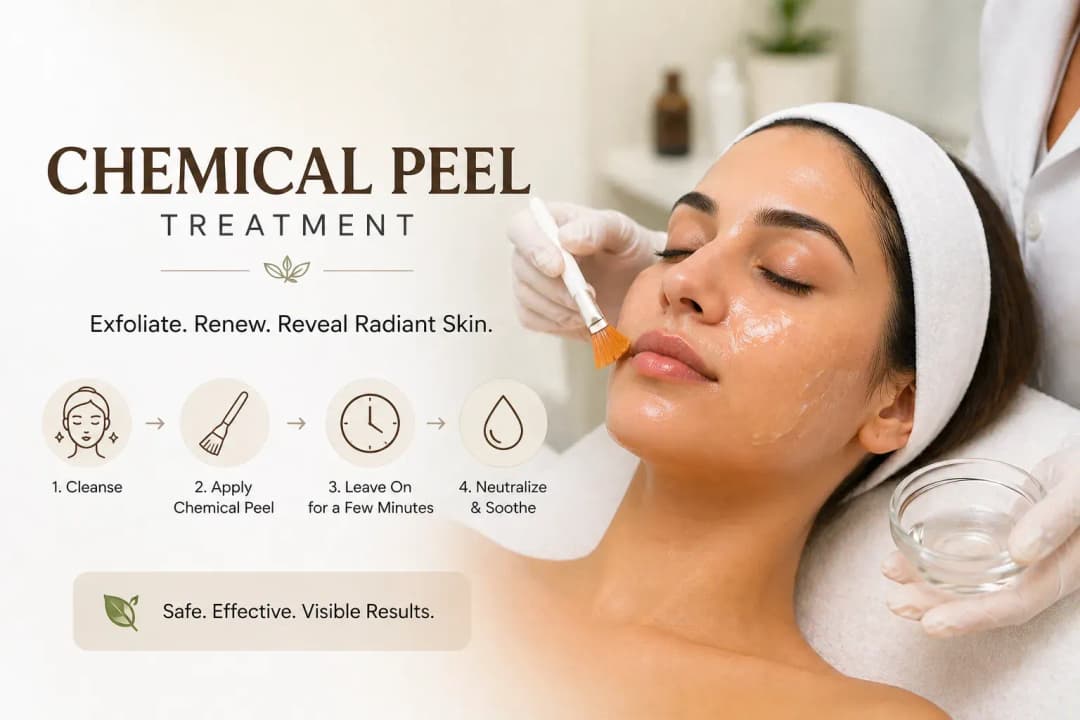
Consultation is the first process of chemical peeling treatment. Your dermatologist examines your skin, understands your skin goal, and, based on the condition, decides which peeling method is most suitable.
2. Pre-procedure Treatment
Pre-procedure treatment is about cleansing your skin before the therapy. If your skin has any makeup, oil, or dirt, your doctor will cleanse it thoroughly before starting the treatment to ensure it is clean enough for the chemical to penetrate.
3. Chemical Peeling Application
A dermatologist will apply the chemical solution depending on the chemical treatment types your skin requires. Doctors apply the chemical using a brush or applicator. You may feel a tingling or burning sensation in the treated area of your skin.
4. Monitor and Neutralise Reaction
After applying the chemical peel, your doctor will observe your skin's reaction. In the case of medium-to-deep peeling, there's a risk of skin irritation. If your skin has an excessive reaction, your doctor will apply a solution to neutralise the reaction.
5. Post-peeling Treatment Care
After the peeling treatment has been successfully completed, your doctor may recommend a soothing ointment and sun protection products to help prevent potential discomfort. Depending on the chemical peel treatment, recovery times vary, so it's best to follow the doctor's instructions to avoid any inconvenience.
6. Follow-up Appointment
Chemical peeling procedures may have side effects such as redness or swelling. The follow-up appointment is to examine your healing process and treat any side effects, if you have any. The follow-up will also help in determining when you can have your next session.
Post-Chemical Peel Care Guideline
The post-care guidelines are essential for healing your skin effectively without causing side effects or complications. Below are the aftercare instructions you must follow.
- Keep your skin hydrated using a mild cleanser and moisturiser
- Use an SPF 30+ sunscreen to avoid sun damage
- Do not peel the skin and allow it to shed naturally
- Avoid skincare products with active ingredients like retinoids
- Avoid hot showers and intense workouts for a few days
- Take follow-up visits every week
Chemical Peel Treatment Benefits
Chemical peeling therapy reduces several skin issues while improving your skin's overall appearance. Here are some benefits of chemical peel treatment you must know.
- Improves skin texture and gives smoother, shinier skin
- Helps reduce acne and breakouts, scars
- Unclogs pores and removes breakouts
- Improves dull and tired-looking skin
- Reduces the appearance of fine lines and wrinkles
- Reduces sun damage and dark spots
- Enhances natural skin glow
Chemical Peeling Treatment Side Effects
While chemical peel therapy is a safe dermatological procedure, it may cause complications. The following are some chemical peel side effects you may experience if you do not follow post-treatment care instructions or if you have sensitive skin.
1. Hyperpigmentation
Hyperpigmentation happens to patients with a dark complexion. This can cause dark spots in the treated areas, making them excessively pigmented.
2. Hypopigmentation
Hypopigmentation causes the treated area to lose its skin colour, resulting in lighter patches and white spots, similar to those seen in vitiligo. This condition happens to patients with a darker skin tone.
3. Allergic Reaction
Chemical peel treatment may cause an allergic reaction. In an initial consultation, it is crucial to disclose known allergies to your doctor so they can choose a safe treatment approach.
4. Skin Redness and Swelling
Redness and swelling are common conditions that occur after the peeling treatment. The condition disappears within a few days or, at most, within a week.
5. Scarring
An individual with a history of keloid formation or abnormal scarring may have scarring as a side effect after the chemical peel treatment.
6. Skin Texture
In rare cases, peeling therapy may change your skin texture, making it rougher, drier, tighter, more uneven, and darker. The condition can be temporary and rarely stays permanent.
7. Infection
You may be at risk of infection after the chemical peeling if there's a delay in follow-ups and the treated area is handled unhygienically.
Chemical Peel vs Laser Treatment
Understanding the differences between chemical peels and laser treatments will help you determine which option is best for your skin therapy. Here's a detailed comparison of both skin treatments.
| Chemical Peel | Laser Treatment |
|---|---|
| A chemical treatment that peels the outer layer of the skin | A treatment that targets the deeper skin layer with a lighting effect |
| Reduces skin-related problems like acne, scars, dead skin, and uneven skin tone | Reduces skin pigmentations and scars while stimulating collagen |
| While it provides a deeper peeling, it is usually used for superficial to moderate chemical peel treatment | Laser treatment usually targets the deeper layers of the skin |
| It gives a mild tingling or a burning sensation | It gives a snapping, stinging or burning sensation |
| Multiple sessions are required and show results gradually | The number of sessions depends on the concerns |
Kibo Skin Clinics' Perspective on Chemical Peeling Treatment
Treatments like chemical peels work best when you first understand what's actually causing your skin concerns. Instead of taking a one-size-fits-all approach, Kibo Skin Clinics focuses on identifying the root cause of your skin problem through its skin test. This way, you can support your skin from the inside while undergoing a chemical treatment.
Chemical peel treatment can be a great option when you are dealing with multiple skin issues. It can improve your skin texture, skin tone, acne scars, and overall appearance. However, as with any skin treatment, you need to understand your skin goals before undergoing peeling therapy. This treatment may have side effects. Hence, follow-up visits and post-treatment care are crucial to prevent potential skin complications.
Frequently Asked Questions
Q1. What is the price of the chemical peel treatment in India?
Depending on the peeling depth, the price of chemical peel treatment in India ranges from Rs. 2,000 to Rs. 15,000 per session. For superficial peels, you may be charged around Rs. 1,500 to Rs. 4,000 or for deep chemical therapy, you may be charged around Rs. 6,000 to Rs. 15,000.
Q2. Is a chemical peel good for all skin types?
While chemical peeling is generally effective for all skin types, it can be dangerous for people with sensitive skin. Superficial peeling is safe, but when it comes to medium and deep peeling therapy, it can cause hyperpigmentation and excessive redness.
Q3. Is a chemical peel painful?
Chemical peeling isn't painful, but it may give a tingling, itching, and burning sensation. Apply the recommended ointment on the affected area to soothe the condition.
Q4. How many sessions are needed for a chemical peel?
Depending on the peeling depth and skin goal, the treatment generally needs 3 to 8 sessions. Light peeling therapy requires 4 to 8 sessions every second and fourth week. Medium peeling needs 3 to 6 sessions every three to six months. And in the case of deep peeling, it usually requires only one session.
Q5. What is the best age to get a chemical peel treatment?
The best age for a chemical peel therapy depends on the skin's goal. However, teens to early 20s are a suitable age to get peeling therapy. You can have a light peeling treatment in your 20s, and a medium to deep peeling treatment after your 30s and 40s.
Q6. Does skin grow back after chemical peeling?
The skin grows back within 2 weeks of the treatment. However, for some patients, it can take up to 2 to 3 months to fully develop skin.
Q7. Can you do a chemical peel treatment at home?
Yes, you can do a skin peeling process at home using products that have AHA and BHAs. It can help in exfoliating the outer surface of the skin and improve mild acne. However, they aren't as strong and effective as chemical treatment at clinics. Remember, it could be risky trying such a process at home, so it's better to do a patch test before applying any product to your skin.
Q8. What is the cost of chemical peel treatment in Mumbai?
The cost of chemical peel treatment in Mumbai varies by treatment type and the clinic you choose. The average cost of a chemical exfoliation procedure ranges from Rs. 2,000 to Rs. 50,000 per session.
Medical Disclaimer
This content is for educational and informational purposes only and does not constitute medical advice. Chemical peel outcomes vary by skin type, concern severity, peel depth, and aftercare compliance. Always consult a qualified dermatologist before undergoing any chemical peel treatment. Kibo Skin Clinics offers professional skin assessments and customised chemical peel protocols across its Mumbai locations.