
Best Hair Transplant Technique: FUE, FUT or DHI Guide
Published on Sun Mar 22 2026
Walking into three different hair transplant clinics and receiving three completely different technique recommendations creates exactly the kind of confusion that prevents people from moving forward with treatment. One surgeon insists FUE is the only modern choice. Another explains why FUT remains the gold standard for extensive cases. A third demonstrates how DHI provides superior precision worth the premium cost. Each clinic presents compelling arguments backed by before-after galleries, leaving you wondering whether the recommendation reflects what's actually best for your case or what the clinic specializes in offering.
The Three Techniques That Started Three Different Conversations
Vikram had been researching hair transplants for six months before scheduling consultations at three highly-rated Mumbai clinics. His pattern was straightforward: moderate recession affecting the hairline and temples, with decent donor density in the back and sides. He expected clinics to recommend similar approaches with perhaps minor variations in graft count or pricing.
The first clinic examined his scalp for twenty minutes and recommended FUE with 2,500 grafts at ₹140 per graft, emphasizing that no one wants a linear scar anymore and that FUE's dot scars would be completely invisible even with short hair. Total: ₹3,50,000.
The second clinic spent thirty minutes discussing donor preservation and recommended FUT with 3,200 grafts at ₹90 per graft, explaining that strip harvesting maximizes graft yield and minimizes donor depletion for potential future procedures. They noted his hair was long enough to conceal the linear scar. Total: ₹2,88,000.
The third clinic used digital imaging to show projected results and recommended DHI with 2,800 grafts at ₹180 per graft, highlighting precise angle control and higher graft survival from minimal handling time. Total: ₹5,04,000.
He left completely confused. The techniques differed. The graft counts ranged from 2,500 to 3,200. The costs varied from ₹2,88,000 to ₹5,04,000. Which clinic was being honest, and which ones were recommending techniques based on what they did best rather than what he actually needed?
His dermatologist, who had referred several patients for transplants over the years, gave him perspective: "The best technique isn't universal. It depends on your specific donor characteristics, how much coverage you need, whether you're willing to accept certain trade-offs, and what your priorities are for scarring versus cost versus procedure time. Any clinic claiming one technique is categorically superior to others is oversimplifying to close a sale."
Understanding What Each Technique Actually Does
All modern hair transplants move permanent hair follicles from areas genetically resistant to balding (usually the back and sides of the scalp) to thinning or bald areas. The fundamental difference between techniques lies in how those follicles are extracted from the donor area and how they're implanted into the recipient area. These mechanical differences create distinct advantages and trade-offs that matter differently depending on your specific case.
Follicular Unit Extraction FUE: Individual Graft Harvesting
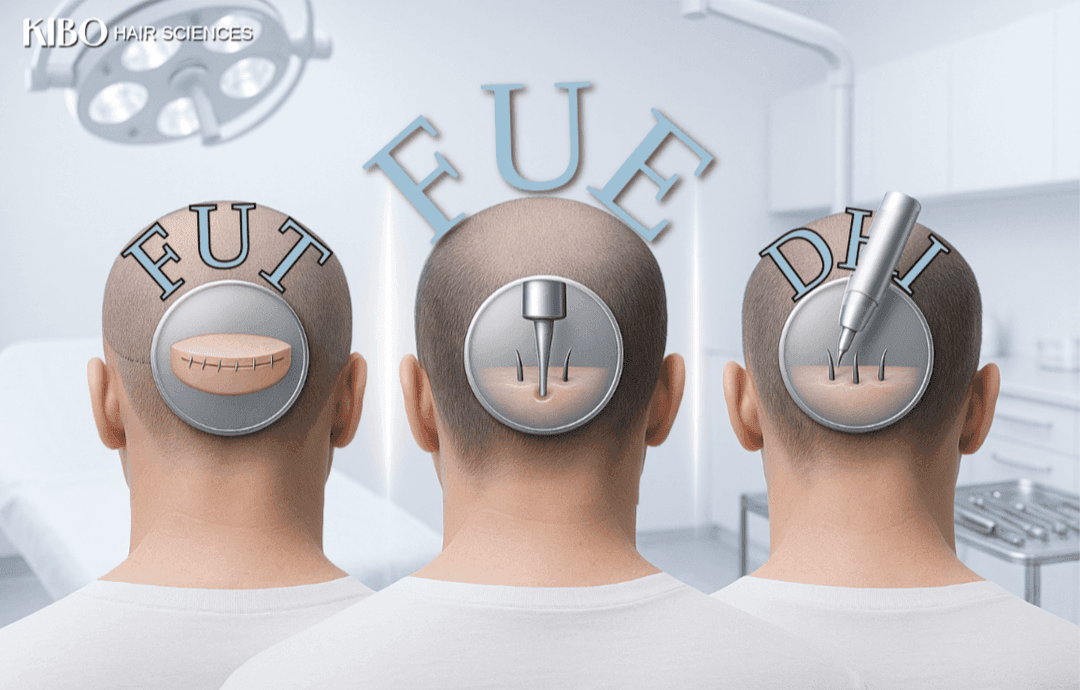
FUE removes individual follicular units directly from the donor area using micro-punch tools typically 0.8 to 1.0 millimeters in diameter. Each follicular unit, containing one to four naturally grouped hairs, is extracted separately and then implanted into recipient sites. FUE hair transplant avoids the linear scar associated with strip harvesting, leaving tiny dot scars distributed across the donor area that are generally difficult to detect even with very short hair.
The extraction process requires shaving the donor area to allow precise visualization of follicular unit angles. Advanced variations include Sapphire FUE, which uses sapphire-bladed punches for potentially cleaner incisions and faster healing, and Bio FUE, which incorporates growth factor treatments during extraction and storage.
What makes FUE advantageous: No linear scar makes it ideal for patients who wear hair very short or shaved. Faster visible healing in the donor area typically 5 to 7 days before scabbing resolves. Flexibility to harvest from body areas like beard or chest if scalp donor supply is limited. Less initial discomfort compared to strip removal. Ability to perform unshaven hair transplant in select cases where donor area doesn't require full shaving.
What creates FUE disadvantages: Longer procedure time because each graft is extracted individually, making large sessions requiring 4,000 or more grafts time-intensive. Higher per-graft cost reflecting the labor intensity. Potential for lower graft yield per session compared to FUT if donor density or scalp characteristics limit how aggressively follicles can be harvested without creating visible thinning. Risk of transection (follicle damage during extraction) if punch depth or angle isn't perfectly calibrated. Understanding factors affecting graft survival becomes especially important with FUE since individual handling increases exposure time.
Follicular Unit Transplantation FUT: Strip Harvesting Method
FUT removes a horizontal strip of scalp tissue from the donor area, typically 1 to 1.5 centimeters wide and 15 to 25 centimeters long depending on how many grafts are needed and scalp laxity. The strip is then microscopically dissected into individual follicular units by trained technicians. The donor incision is closed with sutures or staples, leaving a linear scar that can usually be concealed by hair as short as 2 to 3 centimeters.
What makes FUT advantageous: Maximum graft yield in a single session because the entire strip contains usable follicles with minimal wastage, making it efficient for extensive baldness requiring 3,500 to 5,000 or more grafts. Lower transection rate during harvesting since follicles are dissected under magnification rather than extracted blindly through skin. More cost-effective per graft due to faster harvesting compared to individual FUE extraction. Donor area doesn't require shaving, allowing patients to maintain existing hair length. Better donor preservation for potential future procedures since the strip method doesn't diffusely thin the donor zone.
What creates FUT disadvantages: Linear scar in donor area that may be visible with very short hairstyles, though modern closure techniques have significantly improved scar quality. More initial discomfort in donor area during first week post-surgery compared to FUE's tiny punch sites. Longer restriction on strenuous physical activity during early healing phase typically 2 to 3 weeks. Potential for temporary or in rare cases permanent numbness around scar area from nerve involvement during strip removal. Not suitable for patients with very tight scalps or poor healing capacity.
Direct Hair Implantation DHI: Precision Implanter Technique
DHI modifies the FUE extraction process by using a specialized Choi implanter pen for the implantation phase. Follicles are extracted individually like standard FUE, but instead of creating recipient sites separately and then placing grafts, the implanter pen simultaneously creates the incision and places the follicle in one motion. Direct Hair Transplant DHT offers precise control over angle, depth, and direction of each implanted hair.
What makes DHI advantageous: Precise angle control allows exact matching of natural hair direction and emergence angle, particularly important for hairline correction where naturalness depends on subtle directional variations. Reduced handling time between extraction and implantation potentially improves graft survival since follicles spend less time outside the body. Simultaneous incision and implantation may reduce bleeding and trauma in recipient area. Some cases allow implantation without creating pre-made sites, potentially preserving more of the existing miniaturized hair.
What creates DHI disadvantages: Highest cost per graft reflecting specialized equipment and technique complexity. Longer procedure time because loading each follicle into implanter pen and precisely placing it is more time-intensive than bulk site creation followed by graft placement. Requires highly experienced surgeon specifically trained in implanter pen technique, as improper use can damage grafts or create unnatural results. Limited number of grafts achievable in single session compared to FUT due to time constraints. Not all hair types or scalp conditions are suitable for implanter pen approach.
The Comparison That Actually Matters: Your Specific Case
Comparing techniques in abstract terms creates the illusion that one method is objectively superior. In reality, the best technique for you depends on factors specific to your situation that can only be evaluated during thorough consultation. A patient needing 4,500 grafts to address extensive crown and mid-scalp thinning who maintains shoulder-length hair faces different optimization than someone needing 1,800 grafts for isolated hairline recession who prefers buzz cuts.
Your hair loss extent and pattern: Mild to moderate thinning affecting smaller areas requiring 1,500 to 2,500 grafts works well with FUE or DHI. Extensive baldness requiring 3,500 to 5,000 or more grafts often benefits from FUT's ability to harvest large numbers efficiently in single session. Crown restoration cases may need different approaches than isolated hairline work due to density requirements and coverage area.
Your donor area characteristics: Good donor density with flexible scalp laxity makes FUT efficient. Tight scalp or previous scarring may favor FUE. Limited scalp donor supply might require considering body hair transplant supplementation, which only works with FUE extraction technique. Understanding your hair thickness and how it affects coverage influences whether you need maximum graft numbers or can achieve goals with fewer grafts placed precisely.
Your aesthetic priorities and lifestyle: Preference for very short or shaved hair makes FUE or DHI necessary to avoid visible linear scar. Willingness to maintain longer hair (3 centimeters or more) makes FUT's linear scar a non-issue for most patients. Active lifestyle with frequent swimming, intense exercise, or outdoor sports may benefit from FUE's faster initial healing. Professional situations requiring minimal visible signs of recent procedure may favor techniques with quickest recovery.
Your budget and session planning: FUT generally offers most cost-effective per-graft pricing for large sessions. FUE sits middle range. DHI typically highest cost. However, total cost depends on graft numbers needed, so a well-planned FUE procedure requiring fewer grafts due to strategic placement might cost less than FUT with higher graft count. Some patients benefit from staged approach with multiple smaller sessions rather than single mega-session, which influences technique selection and budgeting.
Your plans for potential future procedures: If you might need additional density in same areas or new areas become affected years later, conserving donor area matters. FUT concentrated harvesting preserves broader donor zone for future FUE if needed. FUE distributed harvesting can make subsequent FUT difficult if donor area has been diffusely thinned. DHI extraction pattern affects what remains available. Planning for long-term progression rather than just current needs influences technique strategy.
Warning Signs of Technique-Driven Rather Than Patient-Driven Recommendations
When a clinic immediately recommends a specific technique before thoroughly examining your scalp, discussing your goals, or explaining why other options don't suit your case, that's a red flag. The recommendation should follow assessment, not precede it. If the explanation focuses entirely on technique features without connecting them to your specific characteristics, the clinic may be selling what they do best rather than what you actually need.
Dismissing all other techniques as outdated or inferior without acknowledging their valid applications suggests oversimplification for sales purposes. FUT isn't obsolete just because FUE exists. It remains highly effective for appropriate cases. FUE isn't automatically superior just because it's newer. Its advantages matter only if they align with your priorities. DHI isn't worth premium cost for every patient. Its precision benefits certain cases more than others.
Inability or unwillingness to discuss technique trade-offs honestly indicates the clinic prioritizes closing sales over informed consent. Every technique has limitations. A surgeon confident in their abilities will explain exactly what you're trading when you choose one approach over another, not pretend their preferred method has no disadvantages.
What Medical-Grade Technique Selection Looks Like
Proper technique selection begins with scalp examination under magnification to assess donor density measured in follicular units per square centimeter, individual hair caliber and color, scalp laxity and flexibility, existing miniaturization patterns indicating progression, and scar tissue from any previous procedures. This objective assessment determines what's physically possible before discussing what's aesthetically desirable.
The surgeon should measure your recipient area precisely, calculate coverage needs based on target density appropriate for natural appearance, explain extraction capacity limits for your specific donor characteristics, and discuss how different techniques would handle your case differently with specific graft count estimates and visual outcome predictions for each viable option.
Transparent documentation means receiving written comparison showing exact graft count achievable with each technique for your donor characteristics, realistic density expectations in recipient area, itemized cost breakdown reflecting all components not just per-graft rates, scarring pattern and visibility with your typical hair length, recovery timeline and activity restrictions for each option, and long-term implications for donor preservation if future procedures become necessary.
The decision should be collaborative, with the surgeon recommending their clinical judgment about optimal approach while respecting your informed preferences about trade-offs you're willing to accept. Reviewing what to prepare for during your first consultation helps you ask the right questions about technique selection rationale.
Why Technique Alone Doesn't Determine Outcome Quality
The technique used matters far less than how well it's executed. A meticulously planned and performed FUT produces better results than a carelessly executed DHI. The surgeon's skill in extracting grafts without damage, the team's ability to keep follicles viable during storage, the precision of recipient site creation matching natural hair angles, and the attention to strategic density distribution across the treatment area all influence outcomes more than which technique name appears on the invoice.
This explains why patients sometimes see dramatically different results from the same technique at different clinics. The mechanical process of FUE extraction is standardized, but the judgment about how many grafts to extract from which donor zones, how long grafts can safely remain outside the body, what recipient density to target in different areas, and how to design hairline shape and temple transitions separates excellent outcomes from mediocre ones. Understanding why same graft count produces different visual results highlights that surgical planning and execution matter more than technique brand.
Recovery and Results Timeline Across Techniques
Initial healing differs between techniques but final growth timeline remains similar. FUE and DHI donor areas show tiny scabs for 5 to 7 days that fall off revealing small pink dots fading over 2 to 3 weeks. FUT donor area has suture line that's removed at 10 to 14 days with linear scar gradually softening and flattening over 6 to 12 months. Recipient area healing is comparable across all techniques, with crusting around implanted hairs for 7 to 10 days regardless of whether sites were created separately or via implanter pen.
The shedding phase begins 2 to 4 weeks post-procedure where transplanted hairs fall out while follicles reset before producing new growth, which is normal and expected with all techniques. Early regrowth becomes visible around 3 to 4 months but hair is fine and sparse initially. Significant cosmetic improvement appears 6 to 9 months as density increases and hair shafts mature. Final result evaluation occurs at 12 to 18 months when all follicles have completed growth cycles and achieved full diameter. Understanding the complete hair transplant results timeline prevents premature judgment during early phases when all techniques look similar.
Why Kibo Clinics
When patients come to us after consultations at multiple clinics, they often describe confusion from receiving different technique recommendations for what appeared to be the same problem. We approach technique selection as a clinical decision driven by your specific characteristics rather than a marketing preference based on what we want to perform. Our consultation process includes detailed donor area assessment using dermatoscopic imaging to measure actual follicular density per square centimeter, scalp laxity testing to determine strip harvesting feasibility if FUT is being considered, recipient area mapping to calculate precise graft requirements for your coverage goals and density expectations, and discussion of your lifestyle priorities regarding scarring visibility, recovery timeline, and budget constraints.
We provide written documentation comparing all viable techniques for your specific case, showing exact graft count achievable with FUE versus FUT versus DHI based on your donor characteristics, realistic density expectations in recipient area with each approach, itemized cost breakdown including all assessments and care not just per-graft rates, scarring pattern and visibility given your typical hair length preferences, recovery timeline and activity restrictions specific to each technique, and long-term donor preservation implications if you might need additional procedures years later. This transparency allows you to make informed decisions about trade-offs that matter to you personally rather than accepting our recommendation blindly.
We offer multiple techniques including FUE, Sapphire FUE, DHI, and Real-Time FUE precisely because different cases optimize differently. Our recommendation reflects what actually suits your situation, not what we're most comfortable performing. Understanding factors affecting long-term hair health extends beyond just surgical technique to include how you care for both transplanted and existing hair after the procedure.
Our No Ghost Surgery pledge means the surgeon who evaluates you and recommends a technique personally performs your extraction and implantation regardless of which method is chosen. We don't delegate surgical work to technicians while positioning the procedure as surgeon-led. The consistency between assessment, planning, and execution ensures the rationale behind technique selection actually translates to how your procedure is performed.
Get a call back to understand which hair transplant technique suits your specific case with personalized assessment by certified surgeons.
Frequently Asked Questions
Which hair transplant technique is best: FUE, FUT, or DHI?
No single technique is universally best. The optimal choice depends on your specific hair loss extent, donor area characteristics, aesthetic priorities, lifestyle, and budget. FUE works well for patients wanting to avoid linear scars and willing to accept potentially fewer grafts per session. FUT efficiently harvests large graft numbers for extensive baldness when linear scar concealment isn't a concern. DHI offers precise angle control beneficial for hairline work when premium cost is acceptable. A qualified surgeon evaluates your scalp, discusses your goals, and recommends technique based on what actually optimizes your individual case rather than generic superiority claims.
Does FUE leave scars like FUT?
Both FUE and FUT create scars but in different patterns. FUE leaves tiny circular scars distributed across donor area, typically 0.8 to 1.0 millimeters in diameter per extraction site. These dot scars are generally difficult to detect even with very short hair (3 to 5 millimeters) and become virtually invisible with slightly longer styles. FUT creates a single linear scar where the strip was removed, usually concealable by hair as short as 2 to 3 centimeters. Modern closure techniques have significantly improved FUT scar quality making it thinner and less noticeable than older strip methods. Your typical hairstyle preference determines which scarring pattern matters more for your situation.
Is DHI worth the extra cost compared to standard FUE?
DHI's premium pricing reflects specialized implanter pen equipment and more time-intensive procedure. Whether the cost difference is worthwhile depends on your specific priorities. DHI's precise angle control and potentially improved graft survival from reduced handling time benefit cases where hairline naturalness is critical or where maximizing every graft matters due to limited donor supply. For straightforward crown or mid-scalp restoration where angle precision is less critical, standard FUE often achieves comparable results at lower cost. The key is whether DHI's specific advantages align with your case characteristics and whether you value those benefits enough to justify typically 30 to 50 percent higher per-graft pricing.
How many grafts can be transplanted in one session with each technique?
Graft capacity per session varies by technique and individual donor characteristics. FUT can harvest 3,500 to 5,000 or more grafts in single session from patients with good scalp laxity and donor density, making it efficient for extensive baldness. FUE typically achieves 2,000 to 3,500 grafts per session depending on donor density and how aggressively surgeon can extract without creating visible thinning, with mega-sessions of 4,000 plus grafts possible but requiring very long procedure time. DHI generally limited to 2,000 to 3,000 grafts per session due to time-intensive implanter pen process. These are approximate ranges. Your actual capacity depends on specific scalp characteristics, donor density measurements, and surgeon's assessment of safe extraction limits.
Which technique has fastest recovery time?
Recovery timeline varies between donor area and recipient area healing. For donor area, FUE and DHI show faster visible healing with tiny scabs falling off 5 to 7 days post-procedure leaving small pink dots that fade over 2 to 3 weeks. FUT has longer donor recovery with suture line present for 10 to 14 days until removal and linear scar gradually softening over several months. However, recipient area healing is similar across all techniques, with crusting around transplanted hairs for 7 to 10 days regardless of method. Return to normal activities depends more on individual healing and procedure extent than technique choice. Most patients resume desk work within 7 to 10 days regardless of technique, with physical activity restrictions lasting 2 to 3 weeks for FUT versus 10 to 14 days for FUE or DHI.
Can technique be changed if I need second procedure later?
Yes, technique can be changed for subsequent procedures based on remaining donor supply and aesthetic goals. Patients who had FUT first can have FUE later harvesting from areas above, below, or lateral to original strip scar. Patients who had FUE first can have additional FUE from un-harvested donor zones or potentially FUT if sufficient laxity remains and enough virgin donor area exists for strip removal. DHI and FUE are interchangeable since both use individual extraction. The key factor is whether adequate donor hair remains and whether previous harvesting pattern left sufficient supply for second procedure. Conservative initial planning that doesn't over-harvest donor area preserves flexibility for future technique choices if additional coverage becomes necessary years later.
Does hair type affect which technique works best?
Hair characteristics influence technique selection and expected outcomes. Thick coarse hair creates more visual coverage per graft than fine thin hair, affecting how many grafts are needed regardless of technique. Curly or wavy hair provides better scalp coverage than straight hair, potentially allowing good results with fewer grafts. Very tight curly hair can make FUE extraction technically challenging requiring specialized curved punches, while FUT dissection under microscope works well for all hair types. Hair color contrast with scalp affects visibility. Dark hair on light scalp shows gaps more than similar-colored hair and scalp, influencing density targets and graft requirements. Your surgeon should assess these characteristics during consultation and explain how they affect technique recommendation and realistic outcome expectations for your specific hair type.
What are warning signs a clinic is recommending wrong technique?
Red flags include immediate technique recommendation before thorough scalp examination and goal discussion, dismissing all other techniques as inferior without acknowledging their valid applications, inability to explain specifically why recommended technique suits your case better than alternatives, showing only before-after photos from one technique suggesting limited experience with others, pressure to commit immediately without allowing time to research and compare options, vague explanations about graft calculations or extraction capacity with chosen technique, and focusing entirely on technique brand names rather than how execution specifics will address your particular pattern and characteristics. Reputable surgeons discuss multiple viable options, explain trade-offs honestly, provide written comparison of approaches specific to your case, and respect your need for informed decision-making time.
Disclaimer
This content is for informational purposes only and does not substitute medical advice. Hair transplant technique selection and outcomes vary by individual based on hair loss pattern, donor characteristics, surgeon expertise, and patient preferences. Always consult a qualified hair transplant surgeon for personalized assessment and treatment planning before undergoing any procedure.
Hair Transplant
FUE Hair Transplant | Sapphire FUE Hair Transplant | Direct Hair Transplant (DHT) | Corrective Hair Transplant | Hairline Correction
Hair Regrowth
PRP Therapy | GFC Therapy | Mesotherapy for Hair Regrowth | Microneedling for Hair Regrowth | Low Level Laser Therapy (LLLT)