

֎ Show Quick Answer
AI Quick answer summary
- A GFC hair transplant is not a separate transplant technique. It usually means GFC injections are combined with a standard FUE or FUT hair transplant.
- The transplant relocates viable follicles, while GFC may support the scalp environment, recovery and nearby thinning native hair.
- GFC cannot create new follicles, increase donor supply, guarantee graft survival or permanently stop future genetic hair loss.
- The ideal timing, number of sessions and expected benefit depend on diagnosis, scalp condition, surgical plan and the doctor’s protocol.
GFC Hair Transplant: Benefits, Procedure, Results and Safety
When you start exploring hair-restoration treatments, you may quickly feel overwhelmed. One clinic may suggest a hair transplant, another may recommend GFC, and someone else may tell you that combining both will give you better results.
You may also come across dramatic before-and-after photographs, fixed treatment packages and promises of faster hair growth. This can make it difficult to understand what the procedure actually involves and what you can realistically expect.
The first thing you should know is that a “GFC hair transplant” is not a separate hair-transplant technique.
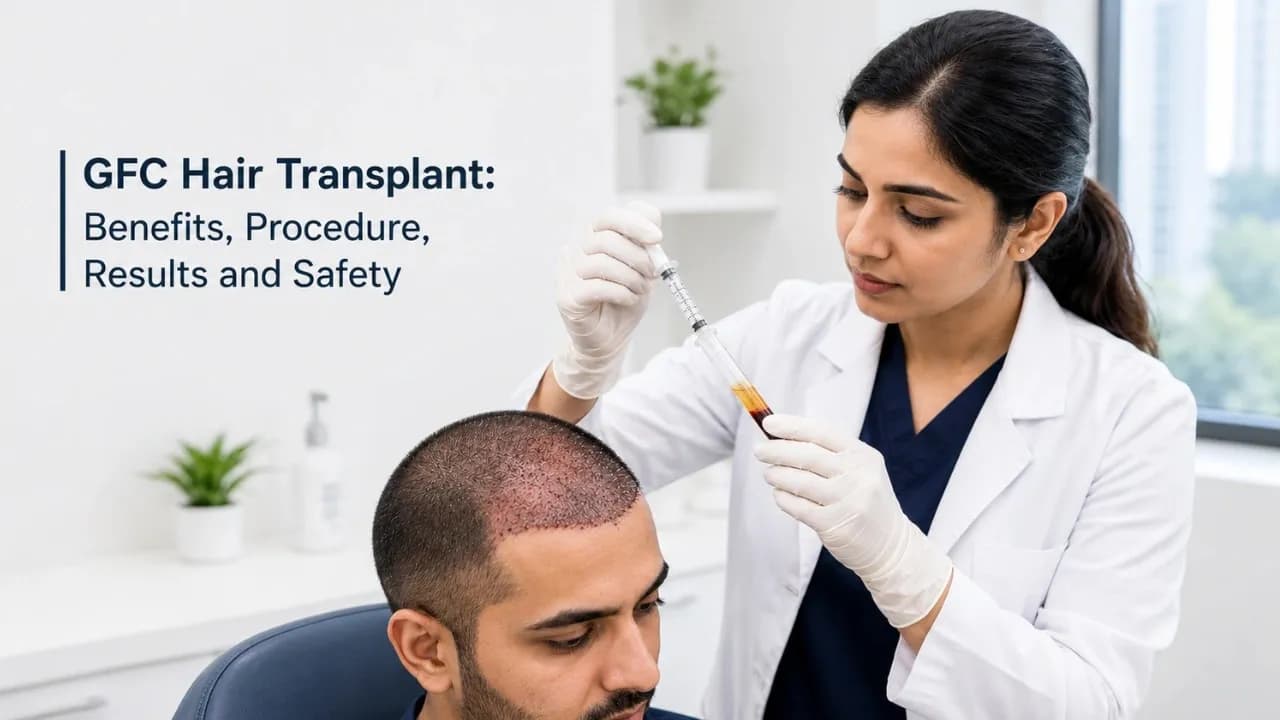
Growth Factor Concentrate, commonly known as GFC, is an injectable treatment prepared from your own blood. A hair-restoration specialist may use it before, during or after a conventional hair transplant to support your scalp and existing hair follicles.
The transplant itself moves healthy follicles from a donor area to a thinning or bald area. GFC does not perform this function. It cannot create new follicles, increase your donor supply or guarantee that every graft will survive.
GFC should therefore be viewed as a possible supportive treatment rather than a replacement for surgery.
What Is a GFC Hair Transplant?
When a clinic uses the term “GFC hair transplant,” it usually means that you will undergo a standard FUE or FUT hair transplant along with GFC injections.
During a hair transplant, your surgeon removes healthy follicles from a donor area, which is usually located at the back or sides of your scalp. These follicles are then implanted into areas where your hair has become thin or permanently lost.
GFC is prepared separately. A small sample of your blood is collected and processed in a specialised system. The aim is to isolate a concentrated solution containing naturally occurring growth factors.
Growth factors are proteins involved in cell communication, tissue repair and healing. By injecting this concentrate into selected areas of your scalp, your doctor may try to create a more supportive environment for recovery and follicle activity.
Because GFC comes from your own blood, it is known as an autologous treatment. This generally reduces the likelihood of an allergic reaction to the injected material.
However, GFC cannot move follicles into bald areas. It also cannot regenerate follicles that have been permanently destroyed. If you have advanced baldness, you may still require a transplant to restore hair in those areas.
How Does GFC Work?
Your blood naturally contains proteins that take part in healing and tissue repair. These proteins are known as growth factors.
During GFC preparation, your blood is processed to produce a concentrated solution of these factors. Your doctor then injects the solution into areas of your scalp that require treatment.
The aim is to support the biological environment around your follicles. In theory, this may help tissue recovery, improve local signalling and support follicles that are still alive but have started to weaken or shrink.
You should not assume that GFC will work the same way for every type of hair loss.
Your hair may be thinning because of genetic sensitivity, hormonal changes, thyroid problems, nutritional deficiencies, autoimmune disease, medication use, illness or prolonged emotional stress. GFC cannot correct every underlying cause.
For example, if you have low iron levels or an uncontrolled thyroid condition, injections alone will not address the main problem. You will need an accurate diagnosis and a treatment plan designed around the actual cause of your hair loss.
Why Might You Receive GFC With a Hair Transplant?
A hair transplant creates hundreds or thousands of small surgical sites. After the grafts are placed, your scalp needs time to heal. The transplanted follicles must also settle into their new location before they begin a fresh growth cycle.
Your surgeon may recommend GFC to support this recovery period.
Possible reasons for adding GFC include:
- Supporting your scalp’s natural healing response
- Helping maintain a healthy environment around your grafts
- Supporting thinning native hair close to the transplant area
- Improving the overall condition of your scalp
- Reducing the intensity of early redness or discomfort
- Adding a non-surgical supportive treatment to your long-term plan
These are possible benefits, not guaranteed results.
Your final transplant outcome will still depend mainly on the diagnosis, donor-hair quality, graft handling, surgical technique, hairline design and aftercare.
GFC cannot compensate for poor planning, weak donor follicles or incorrect graft placement.
What Happens During the Procedure?
Your treatment usually begins with a detailed consultation.
Hair and scalp assessment
Your doctor examines your hair-loss pattern, scalp condition and donor area. You should also be asked about your medical history, current medicines, family history and previous hair treatments.
This assessment helps your doctor determine whether you are suitable for a transplant and whether adding GFC is reasonable.
Not every form of hair loss should be treated with surgery. If you have an active infection, inflammatory scalp disease or unstable hair loss, your doctor may first recommend medical treatment.
Blood collection
A small amount of blood is taken from a vein in your arm. This step is similar to a routine blood test and usually takes only a few minutes.
GFC preparation
Your blood is placed in a specialised processing system. The preparation method may vary depending on the kit and protocol used by the clinic.
This variation matters because not every GFC preparation is identical. The concentration, handling process and injection schedule may differ between providers.
Hair transplantation
Your surgeon performs the transplant using the agreed technique.
With Follicular Unit Extraction, or FUE, individual follicular units are removed from your donor area.
With Follicular Unit Transplantation, or FUT, a narrow strip of tissue is removed and divided into individual grafts.
The grafts are then placed into the recipient area at carefully planned angles and directions. This step has a major influence on how natural your final result appears.
GFC injections
The prepared concentrate may be injected before, during or after your transplant. The timing depends on your surgeon’s protocol and your individual treatment plan.
Recovery
Most hair transplants are carried out under local anaesthesia, so you can usually return home on the same day.
You may experience mild swelling, redness, tightness or tenderness during the first few days. Your clinic should give you written instructions about washing, sleeping, exercise, medicines and follow-up appointments.
You should follow your surgeon’s advice rather than relying on general instructions found online.
Should You Receive GFC Before, During or After Surgery?
There is no single GFC schedule that suits everyone.
Your doctor may recommend it at different stages.
Before surgery: You may receive GFC if your doctor wants to improve your scalp condition or support weak native hair before the transplant.
During surgery: Your surgeon may apply or inject the concentrate around the time your grafts are implanted.
After surgery: You may be advised to have follow-up sessions during recovery or as part of a plan for maintaining your existing hair.
You should ask why a particular schedule has been recommended for you. More sessions do not automatically mean better results.
A responsible clinic should be able to explain the purpose of each session, the expected benefit and the limitations of the treatment.
What Benefits Can You Expect?
GFC may offer some practical advantages when used appropriately.
Because it is prepared from your own blood, the risk of an allergic response to the material is expected to be low. The treatment is also minimally invasive and usually involves little downtime when performed without surgery.
It may support your scalp’s healing environment and may help nearby native hair that has started to thin.
However, you should keep your expectations realistic.
GFC cannot:
- Produce unlimited new follicles
- Restore hair in a bald area without viable follicles
- Increase the amount of donor hair you have
- Guarantee that every graft will grow
- Permanently stop genetic hair loss
- Replace treatment for a medical condition
- Deliver your final transplant result within a few weeks
Your transplant creates the structural change. GFC may support the process, but it does not replace it.
How Is GFC Different From PRP?
GFC and Platelet-Rich Plasma, or PRP, are both prepared from your blood, but they are not identical.
| Feature | GFC | PRP |
|---|---|---|
| Full form | Growth Factor Concentrate | Platelet-Rich Plasma |
| Source | Your own blood | Your own blood |
| Main material | Concentrated growth factors | Platelets suspended in plasma |
| Preparation | Uses a specialised system | Uses centrifugation to separate platelet-rich plasma |
| Purpose | Supports scalp and follicle health | Supports follicle activity and tissue repair |
| Protocol | Varies by kit and clinic | Varies by clinic and preparation method |
| Use with transplant | May be used as an adjunct | May be used as an adjunct |
| Repeat sessions | Depends on your plan | Often involves several sessions |
PRP has been used and studied for a longer period. GFC is sometimes presented as a more concentrated or standardised option.
You should be cautious of claims that one treatment is always better than the other. The right choice depends on your diagnosis, the available evidence, the clinic’s protocol, your budget and your doctor’s judgement.
Neither treatment is a substitute for transplantation when follicles are permanently absent.
When Will You See Results?
You will not see your final result immediately after surgery.
Transplanted follicles follow a natural growth cycle, and GFC does not remove this waiting period.
A general timeline may look like this:
| Time after surgery | What you may notice |
|---|---|
| First 7–14 days | Scabs, redness, tenderness or mild swelling begin to settle |
| 2–8 weeks | Many transplanted hair shafts shed |
| 3–4 months | Fine early growth may begin |
| 5–6 months | New growth becomes easier to notice |
| 6–9 months | Your hair may look fuller as more follicles grow |
| 9–12 months | You may see most of the cosmetic improvement |
| 12–18 months | Growth may continue to mature, especially in the crown |
Your experience may be different. The timing depends on your biology, hair characteristics, treatment area and surgical technique.
GFC may support your scalp during recovery, but it cannot make mature hair appear overnight.
Get a doctor-reviewed graft estimate and recovery plan.
Are You a Suitable Candidate?
You may be considered for GFC alongside a transplant if:
- You have a diagnosed form of hair loss suitable for surgery
- You have enough healthy donor hair
- You are in generally good health
- You have realistic expectations
- You have thinning native hair around the treatment area
- You understand that GFC is optional and supportive
- You are willing to follow the aftercare plan
Your doctor may delay or avoid treatment if you have an active scalp infection, uncontrolled inflammatory condition, blood disorder, clotting problem or poorly controlled medical condition.
You should also tell your doctor about all medicines and supplements you take, especially blood-thinning medicines.
Do not stop prescribed medication unless the doctor who prescribed it advises you to do so.
How Long Do the Results Last?
Your transplant result and your GFC result should be considered separately.
Transplanted follicles are usually selected from areas that are more resistant to the hormonal process involved in pattern hair loss. These follicles may continue growing for many years.
However, the native hair around them may still become thinner over time. A transplant does not stop future hair loss in untreated areas.
GFC also does not permanently stop genetic hair loss. Any improvement in your existing hair may gradually reduce, which is why some clinics suggest maintenance sessions.
There is no standard maintenance plan for everyone. You should only continue treatment when your doctor believes there is a clear reason to do so.
Your long-term plan may also include medication, scalp care, nutritional assessment and regular reviews.
What Side Effects Can Occur?
GFC is generally considered a low-risk procedure when it is performed by a qualified medical professional using sterile equipment.
You may still experience temporary side effects such as:
- Pain during or after injections
- Redness
- Mild swelling
- Tenderness
- Pinpoint bleeding
- Bruising
- Itching or tightness
- Temporary headache
- Discomfort at the blood-collection site
Infection is uncommon, but any procedure involving injections carries some risk.
You should contact your clinic if you notice worsening pain, spreading redness, pus, fever, heavy bleeding or swelling that becomes more severe.
What Affects Your Final Result?
Your outcome depends on much more than GFC.
Your diagnosis must be accurate. Your donor area must contain enough suitable follicles. Your surgeon must handle and implant the grafts correctly.
Your general health also matters. Smoking, uncontrolled diabetes, nutritional deficiency and some medical conditions may interfere with healing.
You must also follow your aftercare instructions. Rubbing, scratching or disturbing the grafts too early may affect recovery.
Finally, you need realistic expectations. A transplant redistributes the hair you already have. It cannot recreate unlimited density if your donor supply is limited.
Can GFC Replace a Hair Transplant?
In most cases, it cannot.
If your follicles are still present but have become weaker or miniaturised, GFC may support them in selected situations.
If your follicles are permanently absent, injections cannot create new ones. A transplant is needed to place viable follicles into the bald area.
GFC, PRP, medication and light-based treatments may support your overall plan, but they do not perform the same function as surgery.
How Much Does Treatment Cost?
The cost of combining GFC with a hair transplant in India depends on several factors.
These may include:
- The number of grafts you need
- Whether you undergo FUE or FUT
- The experience of the surgical team
- The number of GFC sessions
- The preparation system used
- The location and facilities of the clinic
- The amount of follow-up care included
You should ask for a written quotation that separates the cost of your transplant from optional GFC treatment.
Do not choose a clinic based only on the lowest price. Qualifications, hygiene standards, surgical experience and follow-up care are equally important.
How Should You Choose a Clinic?
You should choose a clinic that explains the treatment clearly and does not pressure you into making a quick decision.
Ask who will diagnose your hair loss, design your hairline, extract the grafts and implant them.
You should also check whether the clinic discusses non-surgical options, provides written aftercare instructions and offers structured follow-up.
Be cautious if you are promised guaranteed density, zero shedding, scar-free surgery or permanent control of all future hair loss.
A responsible consultation should help you understand both the possibilities and the limitations.
Kibo Clinics’ Perspective on GFC Hair Transplant
At Kibo Clinics, GFC is viewed as a possible supporting treatment rather than a shortcut to successful hair restoration.
Your treatment should begin with a proper diagnosis and a careful assessment of your scalp, donor area, medical history and long-term goals.
GFC may be included when your specialist believes it can support your scalp or existing follicles. The decision should not be based only on popularity or marketing claims.
You should understand the role of each part of your plan. Your transplant relocates follicles. Medical treatment may help preserve native hair. GFC may support follicle and scalp health in selected cases.
No single treatment can perform all of these functions.
Understand your transplant, GFC and long-term hair plan before proceeding.
Frequently Asked Questions
How soon will you see results after GFC?
You should not expect immediate changes in hair density. Any visible improvement may take several months because your hair grows in cycles. If you also undergo a transplant, the transplant timeline remains the main guide.
Is GFC better than PRP?
Neither treatment is best for everyone. GFC and PRP are prepared differently, and your doctor should recommend one based on your diagnosis, treatment goals and medical history.
Can GFC increase hair fall?
GFC is not designed to increase hair fall. However, temporary shedding is common after a transplant. If your shedding is sudden, severe or prolonged, you should contact your doctor.
Can you touch your grafts after 10 days?
Your grafts become more secure as your scalp heals, but recovery varies. You should follow your surgeon’s instructions about washing, touching and removing scabs.
How many GFC sessions will you need?
There is no fixed number. Your schedule should depend on your diagnosis, response and treatment plan.
Does GFC make transplanted hair permanent?
The long-term survival of your transplanted hair depends mainly on donor selection and surgical quality. GFC cannot make an unsuitable graft permanent.
Final Takeaway
GFC may support your scalp and existing follicles before, during or after a hair transplant. It may be a useful addition to your treatment plan, but it should not be presented as a guaranteed way to improve graft survival or stop future hair loss.
Your transplant is responsible for relocating viable follicles. GFC cannot replace this process or create new follicles in permanently bald areas.
Before you proceed, you should obtain a clear diagnosis and ask your doctor what each part of the proposed plan is expected to achieve.
A responsible specialist should explain the benefits, uncertainties, costs, alternatives and possible side effects without promising a guaranteed result.
Medical Disclaimer : Information from Kibo Hair Clinics is for educational purposes only. It does not replace diagnosis, trichoscopy, blood test interpretation, prescription treatment, procedure advice, or side-effect counselling from a qualified dermatologist or hair restoration doctor.