

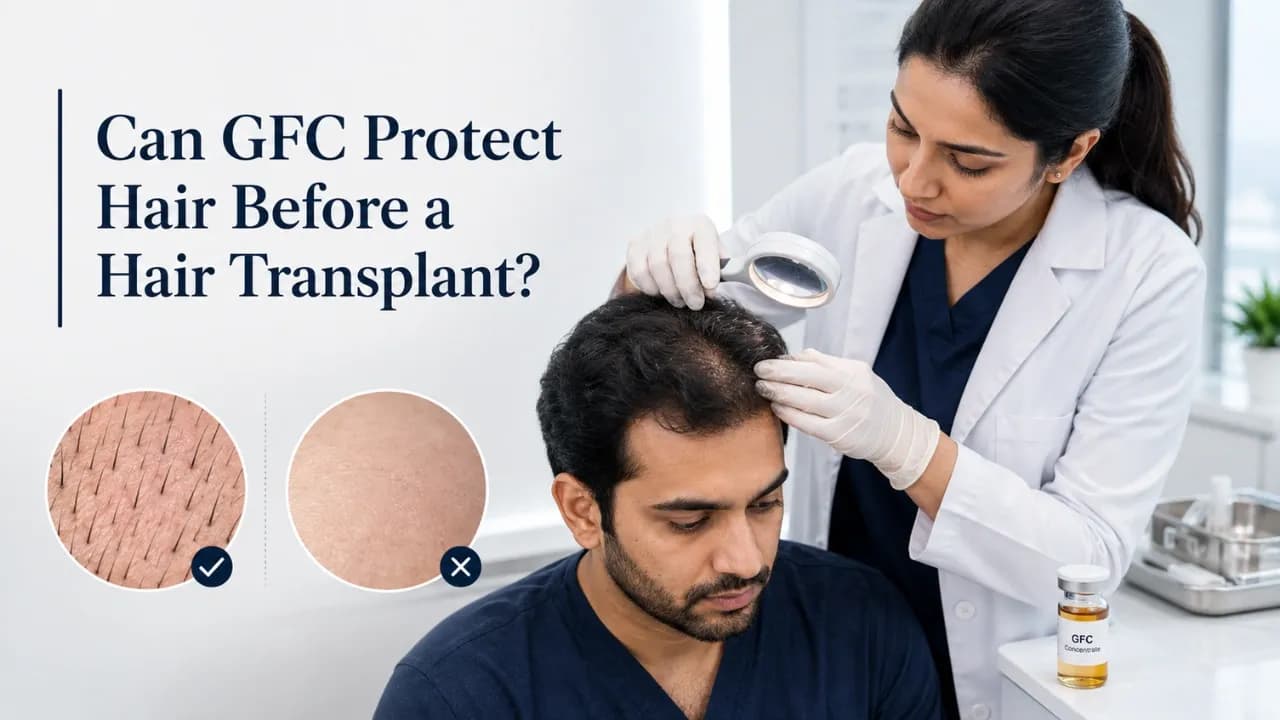
Yes, GFC (Growth Factor Concentrate) therapy may help support existing hair before a hair transplant, but its benefits are limited to hair follicles that are still alive.
If your board-certified hair transplant surgeon recommends GFC before surgery, the goal is usually to support viable native hair around the planned transplant area rather than regrow hair in completely bald areas. Whether it is beneficial depends on your hair loss pattern, scalp health, and overall treatment plan.
Think of GFC as a supportive treatment, not a guaranteed way to preserve hair before a transplant.
How Can GFC Help Protect Existing Hair Before Surgery?
GFC uses concentrated growth factors prepared from your own blood to support living, miniaturised hair follicles. While research is still evolving, these growth factors may help:
- VEGF (Vascular Endothelial Growth Factor): May improve blood vessel formation, helping deliver oxygen and nutrients to hair follicles.
- PDGF (Platelet-Derived Growth Factor): May support tissue repair and healthy hair follicle function.
- IGF-1 (Insulin-like Growth Factor-1): May help keep hair in its active growth (anagen) phase for longer.
- EGF (Epidermal Growth Factor): May promote scalp cell renewal and tissue repair.
What Does the Current Evidence Say About GFC Before Hair Transplant?
Research on GFC before hair transplantation is still limited. Most studies have evaluated GFC for androgenetic alopecia rather than as a routine preoperative treatment.
Current evidence suggests GFC may support viable, miniaturised hair follicles, improve hair density and thickness in some patients, and be used alongside medical treatments or hair transplantation as part of a personalised treatment plan. However, there is no strong evidence that GFC before surgery:
- Prevents shock loss.
- Protects existing native hair.
- Improves graft survival.
- Replaces finasteride, minoxidil, or a hair transplant.
A 2024 systematic review found promising results for androgenetic alopecia, but concluded that larger, high-quality clinical trials are still needed.
Who May Benefit From GFC Before a Hair Transplant?
Your board-certified hair transplant surgeon may recommend GFC before surgery if you still have viable hair follicles that could benefit from supportive treatment. You may be a suitable candidate if you:
- Have early-to-moderate hair loss with miniaturised hair follicles.
- Have diffuse thinning around the planned transplant area.
- Still have thinning but living native hair that may benefit from supportive treatment.
- Are advised by your board-certified hair transplant surgeon to stabilise your hair as part of a personalised treatment plan before surgery.
When to Choose a Hair Transplant Over GFC?
GFC can only support living hair follicles. If your hair loss has progressed beyond that stage, a hair transplant is often the more effective treatment.
Completely Bald Areas
GFC cannot regrow hair where hair follicles are no longer present. A hair transplant is usually needed to restore hair in completely bald areas.
Advanced Hair Loss
If you have significant hair loss with limited existing hair, transplanting healthy follicles generally provides more predictable results than GFC alone.
Follicle Replacement
When hair follicles have been permanently lost, replacing them through a hair transplant is more appropriate than trying to stimulate follicles that no longer exist.
GFC Before Hair Transplant: Myths vs Facts
If you're comparing GFC vs hair transplant or wondering whether GFC should be used before or after a hair transplant, it's important to separate common misconceptions from what current evidence supports.
While GFC is one type of regenerative treatment before a hair transplant, it is not necessary or suitable for everyone. The table below highlights some of the most common myths and the facts supported by current evidence.
| Myth | Fact |
|---|---|
| GFC can replace a hair transplant. | GFC supports living hair follicles but cannot replace hair in bald areas where follicles are no longer present. |
| GFC prevents shock loss after surgery. | There is currently no strong evidence that GFC prevents shock loss. |
| Everyone needs GFC before a hair transplant. | GFC is optional and may be recommended only for selected patients based on their hair loss pattern. |
| GFC works on completely bald areas. | GFC can only act on viable hair follicles and cannot regrow hair where follicles have been lost. |
| GFC alone can stop pattern hair loss. | GFC does not treat the underlying cause of androgenetic alopecia and is usually used alongside medical therapy when appropriate. |
Need a personalised plan to protect viable hair before surgery?
When Should You Get GFC Before a Hair Transplant?
There is no universally recommended timeline for getting GFC before a hair transplant. If your board-certified hair transplant surgeon recommends it, the timing will depend on your hair loss pattern, scalp condition, and overall treatment plan.
In some cases, GFC may be offered before surgery to support the viability of thinning hair around the transplant area. However, it is not a routine step for every patient, and current evidence does not show that everyone benefits from pre-transplant GFC.
If you're considering GFC, the best time to have it is when your surgeon feels it complements your overall hair restoration plan, rather than as a standalone treatment or a substitute for proven medical therapies.
Kibo Clinics' Perspective on GFC Before Hair Transplant
GFC before a hair transplant is not a routine treatment for every patient. The decision to include GFC should be based on your hair loss pattern, the presence of viable hair follicles, your long-term hair restoration goals, and your surgeon's clinical assessment.
Kibo Clinics believes in a personalised approach to hair restoration, where treatment recommendations are tailored to each patient's hair loss pattern, scalp condition, and overall treatment plan.
If you are considering GFC before a hair transplant or are unsure whether it is appropriate for you, consulting a Kibo Clinics hair specialist can help you understand your options and determine whether GFC has a role in your personalised hair restoration plan.
Ready to assess your existing hair and donor area?
Frequently Asked Questions
How can you protect existing hair before a hair transplant?
Protecting existing hair usually involves stabilising hair loss with treatments such as finasteride or minoxidil. In selected patients, your surgeon may also recommend GFC to support viable hair follicles before surgery.
Can you have a hair transplant after GFC treatment?
Yes. GFC does not prevent or delay a hair transplant. If your surgeon recommends it, GFC may be used before surgery as part of a personalised treatment plan for suitable patients.
Does GFC regrow hair permanently?
No. GFC is not considered a permanent solution for hair regrowth. It may support existing, viable hair follicles, but it does not reverse the underlying genetic cause of pattern hair loss or replace long-term medical treatment.
Can GFC delay the need for a hair transplant?
Possibly, in some people with early hair loss. By supporting viable hair follicles, GFC may help maintain existing hair, but it cannot replace a hair transplant when follicles have been permanently lost.
Is GFC necessary before a hair transplant?
No. GFC is optional and is not recommended for every patient. Your board-certified hair transplant surgeon will decide whether it may be beneficial based on your hair loss pattern and treatment goals.
Related Articles & Services
Hair Transplant
FUE Hair Transplant | Sapphire FUE | Direct Hair Transplant | Bio FUE | Corrective Hair Transplant
Hair Regrowth
PRP Therapy | Mesotherapy | Microneedling | Low-Level Laser Therapy | IV Hair Boosters
Must Read
Hair Transplant Results Timeline | Hair Transplant Side Effects | Hair Transplant Longevity | Norwood Scale
Relevant Blogs
GFC vs PRP After Hair Transplant | Hair Loss Types and Causes | Hair Density vs Thickness | GFC Therapy vs PRP
Medical Disclaimer : Information from Kibo Hair Clinics is for educational purposes only. It does not replace diagnosis, trichoscopy, blood test interpretation, prescription treatment, procedure advice, or side-effect counselling from a qualified dermatologist or hair restoration doctor.