

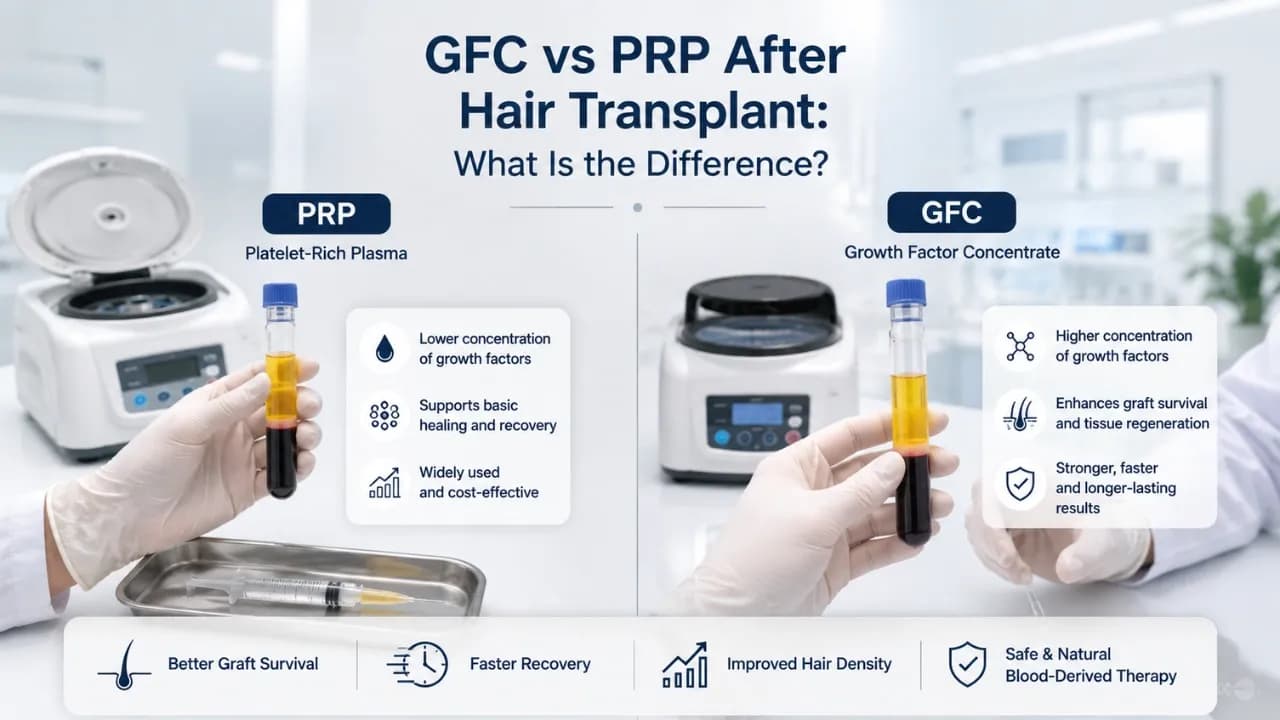
PRP (Platelet-Rich Plasma) and GFC (Growth Factor Concentrate) are both autologous regenerative treatments that may be used as optional adjuncts after a hair transplant. While both are prepared from your own blood, they differ in what is injected, how they are processed, and the amount of clinical evidence supporting their use after hair transplantation.
Currently, PRP has the stronger transplant-specific evidence base, whereas GFC is a newer treatment with promising but limited evidence. No robust head-to-head clinical trial has proven that one is universally better than the other after a hair transplant.
The right choice depends on factors such as your treatment goals, scalp condition, and the recommendations of a board-certified hair transplant surgeon, who can determine whether either treatment is appropriate based on your recovery and long-term hair restoration plan.
What Are the Key Differences Between GFC and PRP?
If you're deciding between GFC and PRP after a hair transplant, it's important to understand that they are not the same treatment.
Although both are prepared from your own blood, they differ in how they are prepared, the strength of evidence supporting their use, and their potential role after hair transplantation.
The following sections compare GFC and PRP across preparation, clinical evidence, graft survival, hair growth, healing, safety, sessions, and cost.
Preparation
If you're wondering how GFC and PRP differ, the biggest difference lies in how they are prepared and what is injected into your scalp. Although both treatments are prepared from your own blood, they use different processing methods to deliver platelet-derived growth factors.
Clinical Evidence
Current research supports PRP more strongly than GFC after a hair transplant. While PRP has been studied extensively as an adjunct to hair transplantation, evidence for GFC remains limited and is largely based on studies involving androgenetic alopecia (pattern hair loss) rather than transplant recipients.
Graft Survival
Graft survival refers to the percentage of transplanted hair follicles that heal successfully and continue growing in their new location. Current research supports PRP more strongly than GFC for improving graft survival, although final results also depend on factors such as surgical technique, graft handling, and post-operative care.
Hair Growth and Density
Hair growth and density are two of the main outcomes used to evaluate the effectiveness of regenerative treatments after a hair transplant. While both GFC and PRP aim to deliver platelet-derived growth factors to the scalp, the strength of evidence supporting them differs.
Healing and Shock Loss
Shock loss is the temporary shedding of transplanted or existing hair that can occur after a hair transplant as part of the scalp's normal healing response. Although both GFC and PRP may be used to support recovery after a hair transplant, the available evidence differs, and neither treatment can guarantee faster healing or prevent shock loss.
Research Insight (2026): Recent expert reviews continue to identify PRP as the regenerative therapy with the strongest evidence after hair transplantation, while evidence for newer therapies, including GFC, remains limited and requires further clinical trials.
Pain, Safety and Side Effects
Both GFC and PRP are generally considered safe because they are prepared from your own blood, reducing the risk of allergic reactions or disease transmission. Most side effects are mild, temporary, and resolve within a few days.
Sessions and Cost
There is no standard protocol for GFC or PRP after a hair transplant. The number of sessions and overall cost depend on your recovery, treatment goals, your surgeon's recommendations, and the clinic's protocol.
What Does a Side-by-Side Comparison of GFC vs PRP Look Like?
Both GFC and PRP are regenerative treatments prepared from your own blood, but they differ in how they are prepared, the strength of clinical evidence supporting them, and their potential role after hair transplantation.
The table below provides a side-by-side comparison of GFC and PRP based on their preparation, clinical evidence, potential benefits, safety, treatment sessions, and cost.
| PRP | GFC |
|---|---|
| Blood is centrifuged to concentrate platelets suspended in plasma. | Blood is processed using an activation system to release platelet-derived growth factors, producing a growth factor-rich, cell-poor concentrate. |
| Has the strongest transplant-specific clinical evidence, supported by systematic reviews and expert reviews. | Has limited transplant-specific clinical evidence. Most studies involve androgenetic alopecia rather than transplant recipients. |
| May support graft survival and early hair growth, although results vary. | Insufficient transplant-specific evidence to confirm improved graft survival. |
| May support earlier hair growth and modest improvements in density. | Promising results for androgenetic alopecia, but evidence after hair transplantation remains limited. |
| May support healing and reduce shock loss, although evidence remains mixed. | Limited transplant-specific evidence supporting these benefits. |
| Generally safe, with mild, temporary injection-site reactions being the most common side effects. | Similar safety profile. No robust evidence shows it is safer or less painful than PRP. |
| Better-established treatment protocols, although the number of sessions varies by treatment plan. | Usually requires multiple sessions. No evidence shows it consistently requires fewer treatments. Costs vary by clinic and protocol. |
Want a doctor-led recommendation based on your scalp, grafts and recovery?
How Do GFC and PRP Compare After a Hair Transplant?
If you prefer a quick summary, here's how GFC and PRP compare across the factors that matter most after a hair transplant.
- If you want to understand how they're prepared: Both treatments are prepared from your own blood, but they use different processing methods.
- If the strength of clinical evidence matters most to you: You may prefer PRP, as it has the strongest transplant-specific evidence.
- If you're looking for evidence on graft survival: You may prefer PRP, as it is better supported by current transplant-specific research.
- If your goal is to improve hair growth and density: You may prefer PRP, as it has stronger evidence after hair transplantation. GFC has shown promising results for androgenetic alopecia, but transplant-specific evidence remains limited.
- If you're considering healing and shock loss: You may prefer PRP, although the evidence remains mixed and GFC has limited transplant-specific evidence.
- If safety is your priority: You may consider either treatment, as both have similar safety profiles and there is no robust evidence that GFC is safer or less painful than PRP.
- If treatment sessions or cost are important to you: It depends. Neither treatment has a standard protocol, and the number of sessions and overall cost vary by clinic, treatment plan, and your surgeon's recommendations.
Kibo Clinics' Perspective on GFC vs PRP After Hair Transplant
There is no one-size-fits-all answer when choosing between GFC and PRP after a hair transplant. The right treatment depends on your recovery, the condition of your existing hair, your long-term hair restoration goals, and your surgeon's clinical assessment.
If you're considering GFC or PRP after a hair transplant, or are unsure which option is right for you, consulting a board-certified hair transplant surgeon at Kibo Clinics can help you understand the current evidence, the potential benefits and limitations of each treatment, and the most appropriate treatment plan for your recovery.
Need a personalised comparison before adding an optional treatment?
Frequently Asked Questions
Which is more painful, GFC or PRP?
There is no robust clinical evidence showing that GFC is less painful than PRP. Both treatments may cause mild, temporary discomfort during and after the injections.
Does GFC regrow hair permanently?
No. Current evidence does not show that GFC permanently regrows hair. It may support hair growth, but maintenance treatments may be needed for ongoing hair loss.
Can I skip PRP after a hair transplant?
Yes. PRP is an optional adjunct treatment, not a mandatory part of hair transplantation. Your surgeon will recommend it based on your recovery and goals.
Which is better after a hair transplant, PRP or GFC?
PRP currently has stronger transplant-specific evidence than GFC. The best choice depends on your recovery, treatment goals, and your surgeon's recommendations.
When will I start seeing results from PRP or GFC?
Evidence sources referenced by the in-house content team include published research indexed in PubMed and PubMed Central, a 2026 review in Frontiers in Medicine, and patient guidance from the International Society of Hair Restoration Surgery. Source links: Systematic review of regenerative therapies in hair transplantation | PubMed clinical research on PRP in hair transplantation | Frontiers review of adjunctive regenerative therapies | ISHRS patient guidance on PRP.
Related Articles & Services
Hair Transplant
FUE Hair Transplant | Sapphire FUE | Direct Hair Transplant | Bio FUE | Corrective Hair Transplant
Hair Regrowth
Mesotherapy | Microneedling | Low-Level Laser Therapy | IV Hair Boosters | PDO Threads
Must Read
Hair Transplant Guide | Results Timeline | Hair Transplant Side Effects | Hair Transplant Longevity
Relevant Blogs
GFC Before Hair Transplant | GFC Therapy vs PRP | PRP vs PRF | Hair Density vs Thickness
Medical Disclaimer : Information from Kibo Hair Clinics is for educational purposes only. It does not replace diagnosis, trichoscopy, blood test interpretation, prescription treatment, procedure advice, or side-effect counselling from a qualified dermatologist or hair restoration doctor.