
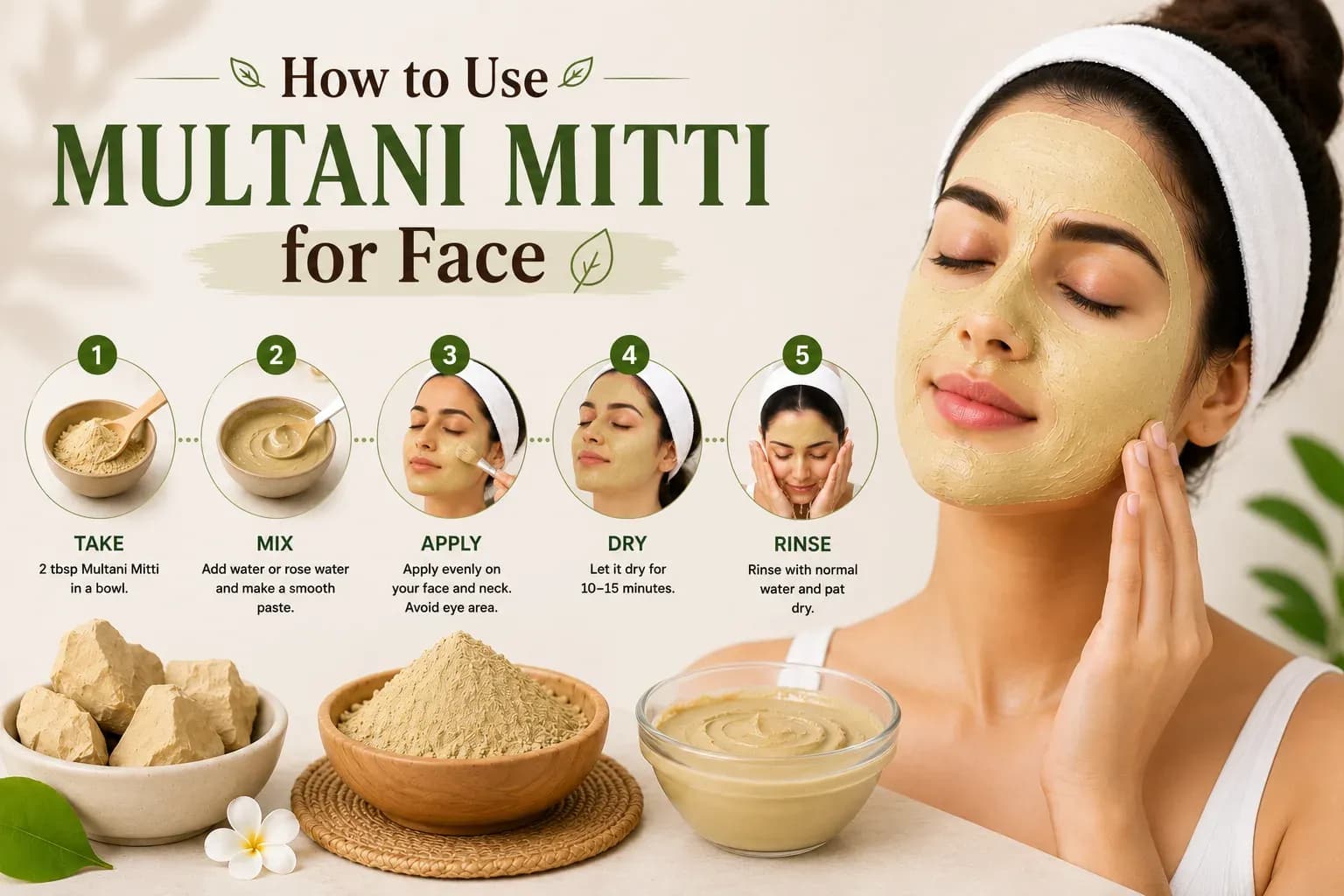
Quick Answer
To use Multani mitti on the face, mix 1 tablespoon of cosmetic-grade powder with enough plain water or fragrance-free aloe vera gel to make a smooth paste. Apply a thin layer to clean skin, avoid the eyes and lips, leave it on for about 8 to 10 minutes, and rinse while it is still slightly damp.
Moisturise immediately after rinsing and wear sunscreen during the day. Start with once-weekly use. Oily skin may tolerate it better, while dry, sensitive, irritated or eczema-prone skin may need to avoid it because the clay can increase tightness and dryness.
Multani mitti, also called Fuller’s earth, is an absorbent mineral clay commonly used in face packs. It can remove excess surface oil and loose buildup, which may make the skin feel cleaner and look temporarily more matte. The result depends on your skin type, the ingredients mixed with the powder, the contact time and how frequently the mask is used.
It is important to keep expectations realistic. Multani mitti cannot permanently change your natural skin colour, cure acne, shrink pores or erase a tan in one application. Used carefully, it can be an occasional cleansing mask. Used too often or allowed to crack completely, it can leave the skin dry, irritated and more prone to uneven pigmentation.
What Is Multani Mitti and How Does It Work on the Face?
Multani mitti is a fine clay that absorbs oil and binds to surface debris when mixed with water. This helps explain why the face may look less shiny after rinsing. The smoother or brighter appearance is mainly a short-term surface effect rather than a permanent change in pigmentation.
The clay does not distinguish between unwanted oil and the lipids that support the skin barrier. Leaving it on for too long can therefore remove more oil than the skin comfortably tolerates. A thin layer, short contact time and immediate moisturising are safer than a thick mask that becomes completely dry and cracked.
Multani Mitti Benefits for Face: How to Use It Safely
The search phrase “multani mitti benefits for face how to use” combines two important questions: what the clay can realistically do and how to apply it without over-drying the skin. Its most practical benefits relate to excess oil and surface cleansing rather than permanent whitening or medical treatment.
- Absorbs excess surface oil: It can temporarily reduce shine, especially across the forehead, nose and chin.
- Helps remove loose surface buildup: Gentle rinsing may leave the skin feeling cleaner without needing a physical scrub.
- May make pores look less noticeable for a short time: Clearing oil from the pore opening can improve their appearance, but it does not permanently reduce pore size.
- Can support an oily-skin routine: Occasional use may complement a simple routine, although it should not replace evidence-based acne care.
- May improve the look of dullness temporarily: Less surface oil and buildup can help light reflect more evenly from the skin.
- Allows simple customisation: Water, aloe gel or another gentle base can change the texture, but adding many kitchen ingredients increases irritation risk.
For a broader explanation of the benefits of Multani mitti, remember that the best outcome is usually cleaner-looking, less oily skin rather than a dramatic or permanent colour change.
How to Use Multani Mitti Powder for Face
What You Need
- 1 tablespoon of cosmetic-grade Multani mitti from a sealed, reputable source
- Plain water or fragrance-free aloe vera gel
- A clean bowl and spoon
- A gentle cleanser
- A fragrance-free moisturiser suitable for your skin type
- Broad-spectrum sunscreen for daytime
Step-by-Step Application
- Patch test the mixture. Apply a small amount to the inner arm or behind the ear and watch for itching, swelling, burning or rash. Do not use it on the face if the test area reacts.
- Cleanse without scrubbing. Remove makeup, sunscreen and sweat with a mild cleanser, then pat the skin dry.
- Mix a fresh paste. Add liquid gradually to 1 tablespoon of powder until the texture is smooth and spreadable. Do not store a wet homemade mixture for later use.
- Apply a thin layer. Keep it away from the eyelids, under-eye area, lips, nostril creases and broken skin.
- Wait for 8 to 10 minutes. Rinse before the mask becomes fully dry and cracked. Sensitive or dry skin should use a shorter contact time.
- Rinse gently. Use lukewarm water and fingertips. Do not rub the dried clay with a rough towel.
- Moisturise immediately. This helps reduce tightness and supports the skin barrier.
- Apply sunscreen in the morning. Multani mitti does not prevent tanning, and irritated skin can become more vulnerable to uneven pigmentation.
If your question is “multani mitti how to use for face care,” the safest starting point is a plain mixture, a short contact time and once-weekly use rather than a strong recipe with several active ingredients.
How to Use Multani Mitti on Face for Oily Skin
Oily skin usually tolerates Multani mitti better than dry skin, but more oil does not mean the mask should be used every day. Mix 1 tablespoon with plain water or a simple fragrance-free aloe gel, apply a thin layer mainly to oily areas, and rinse after 8 to 10 minutes.
Start once weekly. If the skin remains comfortable, with no flaking, burning or tightness, some people may use it up to twice weekly. Rebound oiliness after frequent masking can be a sign that the skin barrier is becoming dehydrated. A lightweight moisturiser should still be applied after rinsing.
How to Use Multani Mitti on Face for Pimples
For pimples, keep the formula simple. Mix the powder with water or fragrance-free aloe gel and apply it gently without rubbing. Do not use lemon juice, toothpaste, baking soda or strong essential oils. These additions can irritate inflamed skin and may leave darker post-acne marks.
Multani mitti may reduce surface oil, but it does not treat clogged pores, bacteria, hormones or inflammation in the same way as proven acne ingredients. Avoid applying a drying clay mask over picked pimples, open wounds or peeling skin. Guidance on using Multani mitti for acne-prone skin can help you separate temporary oil control from actual acne treatment.
How to Use Multani Mitti on Face for Glowing Skin
A “glow” after using Multani mitti usually comes from removing excess oil and surface residue. For a less drying pack, mix a small amount of clay with fragrance-free aloe vera gel and enough water to spread it easily. Keep the layer thin and rinse it before it hardens completely.
Long-term radiance depends more on daily sunscreen, adequate moisturising, gentle cleansing and treatment of any underlying pigmentation. You can compare other cautious home remedies for glowing skin, but avoid stacking several home remedies in one session because irritation can make the face look duller.
How to Use Multani Mitti on Face for Tan Removal
Multani mitti can remove oil and loose surface buildup, so a recent tan may look slightly less dull after use. However, it does not remove melanin from deeper layers of skin and cannot reliably reverse tanning by itself.
Use the basic water or aloe mixture once weekly, moisturise afterwards and apply broad-spectrum sunscreen every morning. Avoid lemon juice because acidity and sunlight exposure can cause irritation and patchy discolouration. Persistent tanning or pigmentation may respond better to dermatologist-guided skincare or professional treatments such as chemical peels for uneven skin tone, selected according to your skin type.
How to Use Multani Mitti for Face Whitening: What to Expect
The phrase “how to use Multani mitti for face whitening” is common, but whitening is not a realistic or healthy outcome. Multani mitti cannot permanently lighten your natural complexion. It may make oily or congested skin look temporarily brighter after cleansing, but this effect is different from treating melasma, post-acne marks or sun-induced pigmentation.
Repeatedly drying the face in an attempt to become lighter can have the opposite effect. Irritation may trigger inflammation and leave darker patches, particularly in deeper skin tones. Aim for an even, healthy-looking complexion rather than a change in natural colour.
Best Multani Mitti Face Pack by Skin Type
| Skin type | Suggested mixture | Contact time | Starting frequency |
|---|---|---|---|
| Oily | Multani mitti with plain water or fragrance-free aloe gel | 8 to 10 minutes | Once weekly |
| Combination | Apply only to the oily T-zone with water or aloe gel | About 8 minutes | Once weekly on oily areas |
| Normal | Multani mitti with aloe gel and a little water | 7 to 8 minutes | Every 7 to 10 days |
| Dry | Prefer a hydrating non-clay mask; if used, use a small amount with more aloe gel | Up to 5 minutes | Every 10 to 14 days or less |
| Sensitive or reactive | Usually avoid during irritation; patch test carefully | Up to 5 minutes | Occasional use only |
| Acne-prone | Water or simple aloe gel without fragranced add-ons | About 8 minutes | Once weekly alongside suitable acne care |
How to Use the Multani Mitti for Face When Skin Is Dry or Sensitive
Dry or sensitive skin does not usually need an oil-absorbing mask. If you still wish to try it, patch test first, use only a small amount, mix it with a simple fragrance-free aloe gel, and rinse within 5 minutes. Stop immediately if there is burning, itching or worsening redness.
Do not use the mask during eczema, dermatitis, sunburn, peeling, active allergy or after a strong exfoliating treatment. A hydrating mask or barrier-supporting moisturiser is often a better fit.
What Can You Mix with Multani Mitti?
| Ingredient | Possible role | Who may consider it | Caution |
|---|---|---|---|
| Plain water | Creates the simplest paste | Oily and combination skin | Can still feel drying if left on too long |
| Fragrance-free aloe vera gel | Adds slip and may reduce tightness | Normal, combination or mildly dry skin | Choose a product without perfume or drying alcohol |
| Colloidal oatmeal paste | May make the mixture feel gentler | Skin that tolerates oatmeal | A clay mask may still be unnecessary for very dry skin |
| A small amount of honey | Adds a humectant texture | Normal to dry skin without honey allergy | Do not store the mixture; rinse thoroughly |
| Rose water | Mainly adds scent and liquid | Only skin already known to tolerate the exact product | Fragrance can irritate sensitive skin |
Ingredients to Avoid
- Lemon or lime juice: Citrus juice can sting, irritate and react with sunlight.
- Baking soda: Its alkaline nature can disrupt the skin barrier.
- Toothpaste: It is not formulated for facial skin and can cause dermatitis.
- Undiluted apple cider vinegar: Its acidity is inconsistent and may cause chemical irritation.
- Essential oils or perfume: They increase the risk of contact allergy without adding a proven benefit.
- Coarse sugar, salt or nut particles: Scrubbing can worsen inflammation and pigmentation.
How Often Should You Use Multani Mitti on the Face?
Once weekly is a sensible starting point for most oily or combination skin. Normal skin may use it every 7 to 10 days. Dry or sensitive skin should use it rarely, if at all. Daily use is not recommended because repeated oil removal can lead to tightness, peeling, stinging and increased sensitivity.
Reduce the frequency or stop if the face becomes rough, flaky, unusually oily after masking, or uncomfortable when applying moisturiser. These can be signs of barrier disruption rather than proof that the mask is “working.”
Common Mistakes to Avoid
- Applying a thick layer and waiting until it cracks completely
- Using the mask every day to chase faster results
- Adding lemon, baking soda, toothpaste or undiluted acids
- Scrubbing the dry mask off the face
- Applying it over open pimples, cuts, sunburn or irritated skin
- Skipping moisturiser because the skin is oily
- Expecting permanent whitening, pore shrinking or scar removal
- Using loose or unlabelled powder that may be contaminated
What Results Can You Expect?
| Time | Realistic result | What not to expect |
|---|---|---|
| Immediately after rinsing | Less shine, a cleaner feel and temporary smoothness | Permanent whitening or pore removal |
| After several careful uses | More predictable oil control if the skin tolerates the mask | A cure for acne, melasma or scars |
| After four to eight weeks | Any improvement is more likely to come from the complete routine, especially sunscreen and moisturiser | Deep pigment removal from Multan... |
Medical Disclaimer : Information from Kibo Hair Clinics is for educational purposes only. It does not replace diagnosis, trichoscopy, blood test interpretation, prescription treatment, procedure advice, or side-effect counselling from a qualified dermatologist or hair restoration doctor.