
Quick Answer
Dermapen microneedling uses a motorised pen with fine needles to create controlled micro-injuries in the skin, triggering collagen and elastin production. It is commonly used for acne scars, enlarged pores, uneven texture, fine lines and selected pigmentation concerns. Most treatment plans involve 3–6 sessions spaced around four weeks apart, with temporary redness usually lasting 24–72 hours.
What Is the Dermapen Microneedling Procedure?
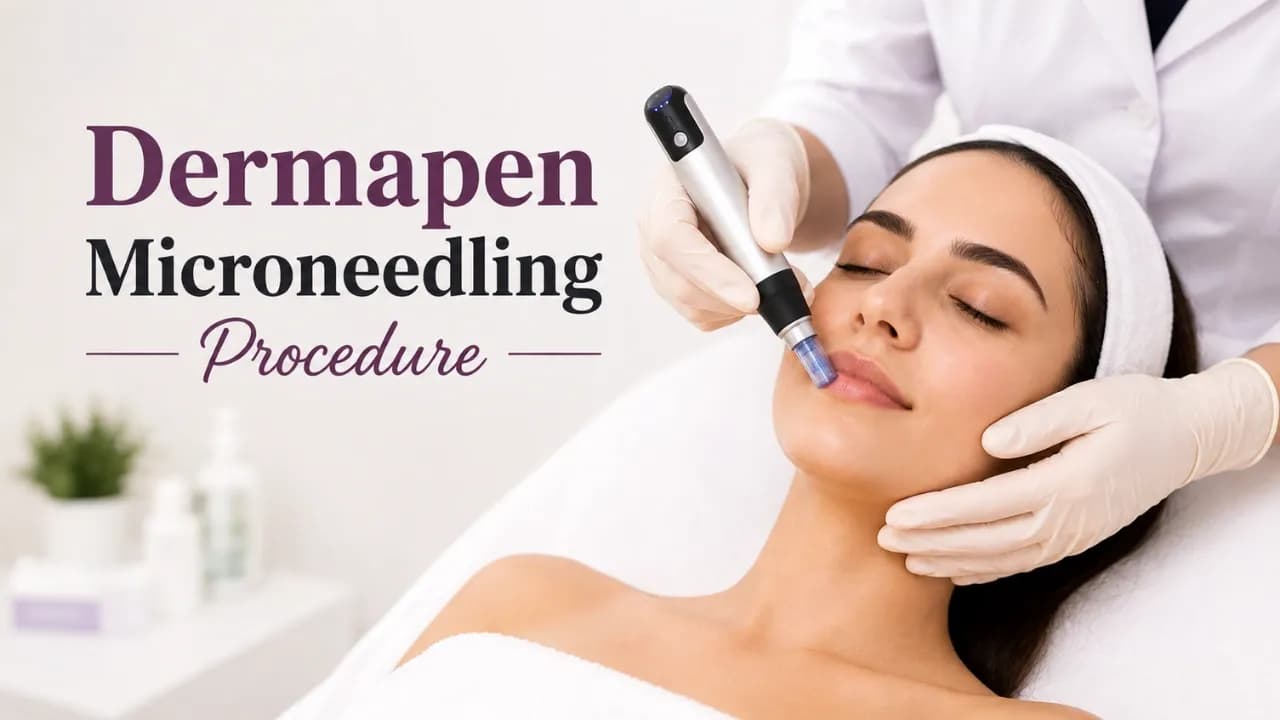
The Dermapen microneedling procedure is a professional collagen induction therapy (CIT) that delivers thousands of precise, vertical micro-punctures into the skin using an automated pen device. Unlike manual rollers, Dermapen's motorised mechanism allows consistent needle depth, typically between 0.25 mm and 2.5 mm, to be adjusted based on the treatment area and skin concern.
The procedure is used on the face, scalp, neck, and body. It is suitable for individuals looking to address acne scars, enlarged pores, uneven skin tone, fine lines, and early-stage skin laxity.
Key facts at a glance:
- Treatment duration: 30-60 minutes per session
- Needle depth range: 0.25 mm - 2.5 mm
- Recommended sessions: 3-6, spaced 4 weeks apart
- Downtime: 24-72 hours of redness
- Suitable skin types: Most skin types, including darker tones
According to the Kibo Skin clinic al team, the Dermapen microneedling procedure face protocol is one of the most requested treatments for patients seeking skin texture improvement without surgical downtime.
How the Dermapen Microneedling Procedure Works: The Complete Breakdown
The Dermapen microneedling procedure works because controlled physical injury activates the skin's wound-healing cascade, without causing lasting damage. Here is the mechanism, step by step:
Skin cleansing and numbing, The treatment area is cleaned and a topical anaesthetic cream is applied for 20-30 minutes. This minimises discomfort during needle penetration.
Needle depth calibration, The practitioner sets the Dermapen device to the appropriate depth. Superficial concerns (fine lines) require 0.25-0.5 mm; deeper scars may require 1.5-2.5 mm.
Micro-puncture delivery, The Dermapen device stamps the skin in a systematic grid pattern, creating approximately 1,300 micro-channels per second. Each channel is vertical, which reduces epidermal tearing compared to rolling devices.
Inflammatory phase (0-72 hours), The micro-injuries trigger an immediate inflammatory response. Platelets release growth factors including TGF-β (transforming growth factor beta), which signals fibroblasts to begin repair.
Proliferative phase (3-21 days), Fibroblasts produce new collagen (primarily Type I and III) and elastin fibres. New blood vessels form to support tissue regeneration.
Remodelling phase (21 days - 6 months), Collagen fibres reorganise and mature, progressively improving skin density, texture, and elasticity.
Optional serum infusion, The open micro-channels created during a microneedling facial treatment Dermapen procedure allow topical actives (hyaluronic acid, peptides, growth factors) to penetrate up to 80% deeper than standard topical application.
The Kibo Skin Clinic approach emphasises precise depth calibration at each session as the primary determinant of outcome quality.
Key Benefits of the Dermapen Microneedling Procedure: What You Actually Gain
The Dermapen microneedling procedure face protocol delivers both immediate and cumulative benefits. The most significant effects typically appear after 2-3 sessions.
Short-term benefits (within 1-4 weeks):
- Improved skin hydration due to deeper serum absorption
- Reduced dullness and improved radiance from surface skin renewal
- Mild tightening effect from initial inflammatory response
Long-term benefits (after 3-6 sessions):
- Scar reduction: Studies suggest up to 80% improvement in acne scar appearance after 4-6 sessions
- Collagen increase: Clinical histology shows a 400% increase in collagen and elastin at 6 months post-treatment
- Pore reduction: Visible reduction in pore diameter, particularly on the nose and cheeks
- Fine line softening: Perioral and periorbital fine lines typically respond within 3 sessions
- [Hyperpigmentation] improvement: Melanin distribution becomes more uniform with repeated treatments
- Skin tightening: Early-stage skin laxity on the jawline and neck may show measurable firmness improvement
- Hair loss applications: The microneedling Dermapen procedure on the scalp can improve minoxidil absorption by up to 4x, supporting hair regrowth protocols
| Benefit | Onset | Sessions Required |
|---|---|---|
| Improved radiance | 1–2 weeks | 1 |
| Pore reduction | 4–6 weeks | 2–3 |
| Scar improvement | 8–12 weeks | 3–6 |
| Skin tightening | 3–6 months | 4–6 |
| Hyperpigmentation correction | 6–12 weeks | 3–4 |
Kibo Skin Clinic practitioners note that patients with consistent 4-week treatment intervals typically report the most satisfying outcomes across all benefit categories.
Dermapen Microneedling Procedure Results: What to Expect and When
Results from the dermapen microneedling face procedure vary based on skin type, concern severity, needle depth, and aftercare compliance. The following timeline applies to a standard 3-session protocol for facial rejuvenation.
Is the Dermapen Microneedling Procedure Permanent? What to Expect Long-Term
Dermapen microneedling results are not permanent — but they are long-lasting when you follow a proper maintenance schedule. Here is the honest breakdown most clinics skip.
The collagen your skin produces during the treatment cycle matures over 3-6 months. That new collagen is real skin tissue — it does not disappear overnight. However, the normal ageing process continues after treatment. Collagen naturally degrades at approximately 1% per year after age 25, and lifestyle factors (UV exposure, smoking, poor nutrition) accelerate this.
Citable fact: Clinical studies show collagen density improvements from microneedling can persist measurably for 12-18 months following a completed treatment series.
How Long Do Dermapen Results Typically Last?
| Concern Treated | Expected Duration of Results | Recommended Maintenance |
|---|---|---|
| Fine lines and radiance | 6–12 months | 1–2 sessions/year |
| Acne scarring | 12–24 months | Annual review/top-up |
| Pore reduction | 6–12 months | 1–2 sessions/year |
| Skin tightening | 6–18 months | 1–2 sessions/year |
| Hyperpigmentation | Variable | Every 6–12 months |
| Scalp/hair protocol | Ongoing | Every 3–6 months |
Does Dermapen Give Permanent Results for Scarring?
For atrophic acne scars, results are closer to permanent than for any other indication. This is because the treatment physically fills the base of the scar with new collagen — the scar structure itself is remodelled. Studies show 40-80% improvement in atrophic scar appearance is typically maintained at 24-month follow-up without additional sessions.
However, new acne breakouts can create new scars. The structural improvement from microneedling addresses existing scars; it does not prevent future ones.
Maintenance Schedule After Your Initial Series
Most patients at Kibo Skin Clinic complete an initial series of 3-6 sessions spaced 4 weeks apart, then move to a maintenance schedule:
- General rejuvenation: 1-2 maintenance sessions per year
- Active scar revision: Annual review; additional sessions if new scarring occurs
- Scalp protocol: Every 3-6 months alongside topical treatment for hair thinning
- Anti-ageing maintenance: Every 6 months from age 40+ to counteract natural collagen decline
The cost of maintenance is significantly lower than the initial series because fewer sessions are required to maintain collagen levels once they have been elevated.
Month-by-Month Expectations
| Timeframe | What Typically Happens |
|---|---|
| Days 1–3 | Redness, mild swelling and tightness |
| Week 1–2 | Possible peeling; brighter appearance |
| Month 1 | Texture improvement begins |
| Month 2 | Scar softening and improved tone |
| Month 3 | Visible collagen remodelling |
| Month 4–6 | Peak results as collagen matures |
Factors That Affect Results
- Skin concern severity: Deeper scars require more sessions and greater needle depth
- Age: Younger skin typically responds faster due to higher cellular turnover
- Aftercare compliance: Sun protection and avoiding active skincare for 48 hours post-treatment is critical
- Treatment intervals: Sessions spaced less than 3 weeks apart may not allow full healing between appointments
- Adjunct serums: Use of growth factor or peptide serums during the dermapen microneedling procedure close up sessions can enhance outcomes
Clinically observed: In most patients receiving 3 sessions of the microneedling dermapen procedure at 4-week intervals, visible texture improvement is measurable by week 8.
Types of Dermapen Microneedling Procedure: Which Is Right for You?
Several variations of the dermapen microneedling procedure exist, each suited to different skin concerns and depths.
Standard Dermapen Microneedling (0.25-1.0 mm)
Used for general skin rejuvenation, fine lines, and product absorption. Suitable for first-time patients and maintenance sessions. Minimal downtime of 12-24 hours.
Deep Scar Revision Microneedling (1.5-2.5 mm)
Used for atrophic acne scars, deep wrinkles, and stretch marks. Requires professional delivery only. Downtime of 48-72 hours. Typically 4-6 sessions recommended.
RF Microneedling (Radiofrequency-Combined)
Combines Dermapen-style needling with radiofrequency energy delivered at the needle tip. Enhances collagen contraction and skin tightening. Preferred for skin laxity concerns. Higher cost per session.
Scalp Microneedling (Dermapen Hair Protocol)
The microneedling dermapen procedure adapted for the scalp uses 0.5-1.5 mm depth to stimulate follicular activity and improve topical treatment (such as minoxidil) absorption.
| Type | Depth | Best For | Sessions |
|---|---|---|---|
| Standard rejuvenation | 0.25–1.0 mm | Texture, glow, maintenance | 3–4 |
| Scar revision | 1.5–2.5 mm | Acne scars, deep lines | 4–6 |
| RF Microneedling | 1.0–3.5 mm | Skin laxity, tightening | 3–5 |
| Scalp protocol | 0.5–1.5 mm | Hair thinning, absorption | 4–8 |
Who Should Consider the Dermapen Microneedling Procedure?
The dermapen microneedling procedure is appropriate for a broad range of individuals, but is not suitable for all skin conditions.
| Ideal Candidates | Not Recommended For |
|---|---|
| Adults with acne scarring | Active acne breakouts or cystic acne |
| Fine lines and early laxity | Active skin infections or rosacea flares |
| Enlarged pores or uneven texture | Recent isotretinoin use |
| Hyperpigmentation or dull skin | Pregnancy or breastfeeding |
| Thinning hair for scalp protocol | Blood-clotting disorders or anticoagulant use |
| Fitzpatrick skin types I–VI | Keloid scarring history |
| Non-surgical skin improvement | Open wounds or recent sunburn |
The Kibo Skin Clinic consultation process assesses each of these factors before confirming suitability for a microneedling facial treatment Dermapen procedure.
Expert Tips for Getting the Best Dermapen Results
Getting the most from your dermapen microneedling procedure is as much about what you do before and after the treatment as what happens in the clinic.
Citable fact: Patients who follow pre-treatment skin preparation and post-treatment SPF protocols consistently report better outcomes than those who skip preparation steps.
8 Expert Tips for Maximising Dermapen Outcomes
- Prime your skin before your first session. In the 4-6 weeks before starting, use a basic retinol routine (0.25% or 0.5% retinol, 3 nights per week). Retinol pre-conditions fibroblasts to respond more actively to the wound-healing signal. Stop retinoids 5-7 days before the actual session.
- Do not start at the deepest needle depth. First sessions should use 0.5-1.0 mm for the face. Jumping straight to 1.5-2.0 mm without knowing how your skin responds can cause prolonged downtime and compromised healing. Depth should increase progressively across the series.
- Request a serum upgrade. The serum applied immediately post-needling matters significantly. Standard hyaluronic acid is a good baseline, but growth factor serums (containing EGF or FGF) and exosome serums (an emerging 2024-2025 protocol) have shown enhanced collagen stimulation in early clinical data. Ask your practitioner what serums they offer.
- Time your sessions with your social calendar. The redness window is 24-72 hours. Plan sessions on a Thursday if you need to look normal by Monday. Deep scar sessions (1.5+ mm) may need a 4-day buffer.
- Start SPF before your series, not after. Begin applying SPF 50 daily from 2 weeks before your first session. UV-damaged skin produces less collagen in response to microneedling stimulation. SPF is not just post-treatment protection — it is a pre-treatment preparation.
- Do not evaluate results too early. Collagen remodelling is at its peak between months 3 and 6. Patients who judge their results at month 1 underestimate their final outcome. The 'month-by-month expectations' table above is your reference point, not your friend's experience.
- Combine with the right topicals between sessions. Between sessions, a niacinamide serum (5%), peptide moisturiser, and daily SPF form the optimal maintenance stack. These ingredients support barrier function and reduce incidental inflammation that can slow healing.
- Complete the full series before deciding it is not working. Single-session evaluations are unreliable. The published clinical outcomes — 60-80% scar improvement, 400% collagen increase — are measured after 4-6 sessions. Incomplete courses produce incomplete results.
Dermapen Microneedling Aftercare: Your Complete Day-by-Day Guide
Most people focus entirely on the dermapen microneedling procedure itself — and completely underestimate aftercare. That's a mistake. What you do in the 72 hours after your session determines how much collagen your skin actually builds, how quickly redness resolves, and whether you end up with post-inflammatory hyperpigmentation or clear, even skin.
Dermapen aftercare protects the open micro-channels while your skin's repair cascade is active. Getting it wrong — by using the wrong products too soon, skipping SPF, or touching the skin — can undo the treatment entirely.
Citable fact: Freshly needled skin loses the stratum corneum barrier for up to 72 hours, making it up to 10× more sensitive to UV damage and irritant ingredients.
Day-by-Day Aftercare Protocol
Day 0 (Treatment Day)
- Do not apply water, makeup, or any skincare product for at least 6 hours post-procedure.
- If your practitioner applied a growth factor or hyaluronic acid serum immediately after needling, leave it on — do not rinse it off.
- Avoid touching your face. Bacteria transfer from hands is the primary cause of post-procedure breakouts.
- Sleep on a clean pillowcase. Elevate your head slightly to reduce overnight swelling.
Day 1-2 (Redness and Sensitivity Phase)
- Cleanse gently with a mild, non-foaming cleanser (no acids, no fragrance). Lukewarm water only.
- Apply a plain, fragrance-free moisturiser or the hyaluronic acid serum your clinic recommends.
- Apply SPF 30 or higher every morning — even if you are indoors. UV exposure during this window is the leading cause of post-procedure pigmentation.
- Avoid: AHAs, BHAs, retinoids, vitamin C serums, niacinamide above 5%, and any exfoliants.
- Avoid: saunas, steam rooms, intense exercise (sweat and heat increase inflammation and infection risk).
- Do not pick at any dry patches or micro-crusting — this is normal skin healing.
Day 3-5 (Peeling and Renewal Phase)
- Light peeling or flaking is normal. This is dead epidermal cells shedding as the skin renews.
- Continue gentle cleansing and fragrance-free moisturising twice daily.
- SPF remains non-negotiable.
- You may reintroduce a gentle vitamin C serum (L-ascorbic acid, 10% or lower) from Day 4 if your skin feels fully comfortable — but only if redness has fully subsided.
- Avoid retinoids and exfoliants for a full 5-7 days post-treatment.
Day 6-14 (Recovery Complete)
- Most patients' skin is fully recovered by Day 7. Some with deeper needle depths (1.5-2.5 mm) may take until Day 10.
- You may resume your full skincare routine, including retinoids, from Day 7 onwards.
- Continue daily SPF indefinitely — collagen remodelling is actively occurring for up to 6 months, and UV exposure slows this process.
What to Absolutely Avoid After Dermapen
- No active skincare for 48-72 hours: Retinoids, AHAs, BHAs, and vitamin C at high concentrations can cause chemical irritation on barrier-compromised skin.
- No makeup for 24 hours: Makeup contains preservatives and colourants that can enter micro-channels and cause reactions.
- No sun exposure without SPF: Post-inflammatory hyperpigmentation risk is highest in the 72 hours post-treatment.
- No gym for 24-48 hours: Sweat is mildly acidic and introduces bacteria to open micro-channels.
- No swimming for 48 hours: Pool chlorine is a significant skin irritant when the skin barrier is compromised.
When to Call Your Clinic
Contact Kibo Skin Clinic if you experience any of the following after your dermapen microneedling procedure:
- Redness, swelling, or pain that worsens after Day 3 (not improves)
- Yellow or green discharge from the treatment area
- Fever or flu-like symptoms within 48 hours of treatment
- Severe crusting or blistering beyond mild flaking
These symptoms are rare but require medical review.
Prerequisites and What You Need
Before your first dermapen microneedling procedure, confirm the following:
- A patch test or skin consultation with a qualified practitioner
- Discontinue retinoids 5-7 days prior to treatment
- Avoid sun exposure for at least 72 hours before the session
- Arrive with clean, product-free skin
Step-by-Step Process
Book a consultation, Discuss your skin concern, medical history, and treatment goals with a qualified practitioner. Kibo Skin Clinic recommends a 20-minute consultation before any first session.
Pre-treatment skin prep, Stop all active ingredients (AHAs, BHAs, retinoids) 5 days prior. Apply SPF daily in the week leading up to treatment.
Arrive with clean skin, No makeup, sunscreen, or serums on the day. The clinic will cleanse the skin again before treatment.
Numbing application, Topical anaesthetic is applied and left for 20-30 minutes. Most patients rate discomfort as 2-3 out of 10 post-numbing.
Dermapen treatment delivery, The practitioner glides the Dermapen device across the skin in overlapping passes. A single dermapen microneedling procedure face session typically takes 20-40 minutes depending on the treatment area.
Serum application, Immediately post-needling, a hyaluronic acid or growth factor serum is applied to leverage enhanced absorption through open micro-channels.
Post-treatment care briefing, You receive written aftercare instructions: avoid water for 6 hours, no active skincare for 48 hours, apply SPF daily.
Common Mistakes to Avoid
- Starting too aggressive: Beginning at deep depths (2.0+ mm) for the first session can cause prolonged redness and poor healing. Start shallow, adjust at session 2.
- Skipping SPF post-treatment: Freshly needled skin is highly photosensitive. UV exposure can trigger post-inflammatory hyperpigmentation.
- Using active ingredients too early: Applying retinoids or acids within 48 hours of treatment may cause irritation and compromise the healing barrier.
- Spacing sessions too close: Sessions closer than 3 weeks do not allow full collagen synthesis to occur between treatments.
Dermapen Microneedling vs. Alternatives: An Honest Comparison
The dermapen microneedling procedure is one of several skin improvement options. Each has a different mechanism, downtime profile, and ideal use case. Here is an objective comparison to help you choose.
| Feature | Dermapen Microneedling | Derma Roller | Chemical Peel | Laser Resurfacing |
|---|---|---|---|---|
| Mechanism | Motorised vertical needles | Manual rolling needles | Chemical exfoliation | Light/heat energy |
| Depth control | Precise | Limited | Depends on peel | Device dependent |
| Collagen induction | High | Moderate | Low–moderate | High |
| Downtime | 24–72 hours | 12–48 hours | 1–7 days | 5–14 days |
| Dark-skin suitability | Generally suitable with correct technique | Generally suitable | Requires caution | Requires caution |
| Scarring use | Strong option | Less consistent | Surface-level/moderate | Strong for selected cases |
| Typical India cost/session | ₹2,500–₹8,000 | ₹500–₹2,000 | ₹1,500–₹6,000 | ₹6,000–₹25,000 |
Dermapen Microneedling: Honest Pros and Cons
Pros:
- Precise depth calibration — no other non-surgical device matches it
- Safe for all skin tones, including Fitzpatrick IV-VI where laser carries pigmentation risk
- No systemic side effects (unlike oral medications)
- Stackable with serums (HA, PRP, growth factors) for enhanced outcomes
- Scalp protocol extends the treatment to hair thinning, making it a dual-purpose tool
- Downtime is short relative to the depth of biological change achieved
Cons:
- Requires 3-6 sessions for full results — not a one-and-done treatment
- 24-72 hours of visible redness after each session requires planning
- Results are not permanent; maintenance sessions needed every 6-12 months
- Clinical outcomes depend heavily on practitioner skill and device calibration
- Not suitable for active acne, certain skin conditions, or isotretinoin users
Who should choose Dermapen over alternatives? Dermapen is the strongest choice when you have: acne scarring (particularly atrophic/rolling scars), darker skin tone where laser is not recommended, a preference for minimal downtime, or an interest in combining skin rejuvenation with a scalp/hair protocol. Chemical peels work faster for surface pigmentation but carry more risk in darker skin. Laser resurfacing achieves similar collagen outcomes but requires significantly more downtime and is not suitable for all skin tones. For internal links, see also: Chemical Peel for Pigmentation and Derma Roller for Face.
Does Dermapen microneedling hurt?
How many Dermapen sessions are usually needed?
How much does Dermapen microneedling cost in India?
Can Dermapen be used on darker skin tones?
How long do Dermapen results last?
Medical Disclaimer : Information from Kibo Hair Clinics is for educational purposes only. It does not replace diagnosis, trichoscopy, blood test interpretation, prescription treatment, procedure advice, or side-effect counselling from a qualified dermatologist or hair restoration doctor.