
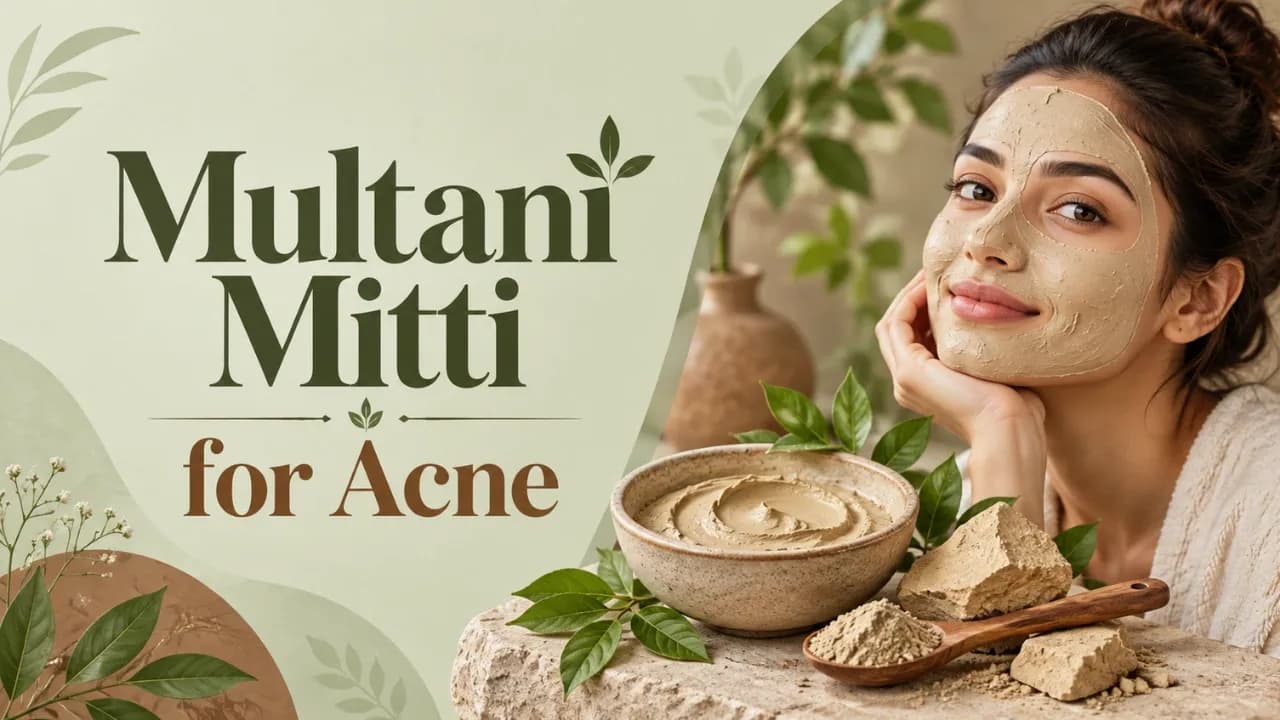
Quick Answer:
Multani mitti (fuller's earth clay) can help reduce acne by absorbing excess sebum, unclogging pores, and reducing surface inflammation. It works best for oily and combination skin types. Apply as a 10–15 minute face pack, 2–3 times per week, and remove while still slightly damp. Most users notice visibly less greasiness and fewer active breakouts within 2–4 weeks of consistent use. Always follow with a non-comedogenic moisturiser.
What Is Multani Mitti for Acne?
Multani mitti is a naturally occurring aluminium silicate clay, also called fuller's earth, that has been used in South Asian skincare for centuries. For acne, multani mitti acts as an absorbent agent, it draws out excess oil, pulls impurities from pores, and mildly reduces redness around active breakouts.
Multani mitti is particularly effective for acne caused by excess sebum production, which is one of the four primary triggers of acne alongside bacteria, dead skin cell buildup, and hormonal fluctuations.
Key Facts at a Glance
Primary action: Sebum absorption and pore cleansing
Skin types best suited: Oily, combination, acne-prone
Frequency recommended: 2–3 times per week
Form: Clay mask, spot treatment, or mixed pack
How Does Multani Mitti Work Against Acne?
A consistent skin care routine matters more than relying on a clay mask alone.
Multani mitti reduces acne through three distinct mechanisms:
Sebum absorption: Multani mitti has a high silica and magnesium content, giving it a strong negative ionic charge. This charge attracts positively charged sebum and impurities on the skin surface, pulling them out of the pore lining.
Pore decongestion: When applied as a mask, multani mitti swells as it absorbs moisture and oil. As it dries, it physically draws out debris lodged inside pores, reducing comedones (blackheads and whiteheads) that can progress into inflammatory acne.
Mild anti-inflammatory action: Studies on kaolin-type clays suggest that aluminium silicate compounds can reduce localised surface inflammation. This may explain why multani mitti helps calm redness around active pimples within 24–48 hours of application.
Why It Works: The Causal Chain
Excess oil clogs pores, bacteria multiply, inflammation follows, and acne appears. Multani mitti interrupts this chain at step one by removing the excess oil before it accumulates inside the follicle.
Key Benefits of Multani Mitti for Acne
Controls excess sebum: Absorbs up to 3–4 times its weight in oil, reducing the greasy surface environment where acne bacteria thrive.
Unclogs pores: Loosens and draws out oxidised sebum (blackheads) and debris from follicle openings.
Reduces surface inflammation: Cooling effect on application may reduce redness and swelling around active pimples.
Mild exfoliation: The fine clay particles provide gentle physical exfoliation, reducing dead skin cell accumulation, a secondary acne trigger.
Brightens post-acne marks: Regular use may help fade superficial hyperpigmentation left after pimples heal, typically visible over 6–8 weeks of use.
Low irritation profile: Unlike salicylic acid or benzoyl peroxide, multani mitti carries a low risk of skin barrier disruption when used at the correct frequency.
What Are Multani Mitti With Rose Water Benefits?
If you also use home remedies for glowing skin, avoid combining several irritating DIY ingredients in the same routine.
Mixing multani mitti with rose water is one of the most common traditional preparations for acne. Rose water contains phenylethanol and flavonoids that provide mild antibacterial and anti-inflammatory effects. Combined with multani mitti's oil-absorption, this pack addresses both sebum excess and bacterial activity simultaneously. This combination is especially suitable for sensitive acne-prone skin because rose water offsets the drying effect of the clay.
Short-Term vs. Long-Term Benefits
| Timeframe | Expected Benefit |
|---|---|
| Week 1–2 | Reduced surface oiliness and shine |
| Week 2–4 | Fewer new blackheads and calmer active pimples |
| Month 2–3 | Improved texture and fewer comedones |
| Month 3–6 | Gradual improvement in the appearance of flat post-acne marks |
Multani Mitti Formulations for Acne: Which Is Right for You?
Important Note
Which Formulation Should You Choose?
Oily skin with frequent breakouts: Multani mitti + neem paste targets both sebum and acne-causing bacteria (Cutibacterium acnes).
Sensitive skin with mild acne: Multani mitti + rose water or aloe vera is the least irritating combination.
Acne with hyperpigmentation: Multani mitti + turmeric addresses both active inflammation and post-acne marks.
Dry skin with occasional acne: Use multani mitti sparingly (once per week) mixed with aloe vera gel to minimise dehydration.
How to Use Multani Mitti for Acne: Step-by-Step Guide
Persistent flat post-acne marks may need options such as chemical peel for pigmentation after professional assessment.
Incorrect application, particularly leaving the mask on too long or using too frequently, is the most common reason users experience dryness and irritation.
What You Need
2 tablespoons multani mitti powder
Rose water, aloe vera gel, or plain water (as mixing liquid)
A clean bowl and spatula
Mild cleanser and moisturiser
Step-by-Step Application
Cleanse your face with a mild, non-comedogenic cleanser. Pat dry. Starting on clean skin ensures the clay contacts the pore directly, not surface debris.
Mix the pack in a clean bowl. Combine 2 tablespoons multani mitti with enough rose water or aloe vera gel to form a smooth paste, not too runny, not too thick. A thick paste is harder to spread evenly and may crack too quickly.
Patch test first (if new user). Apply a small amount behind the ear or on the inner arm. Wait 20 minutes. If no redness or itching, proceed to full application.
Apply evenly to the face, avoiding the eye area and lips. Use fingertips or a flat brush. A thin, even layer (approximately 2–3 mm) is sufficient.
Leave on for 10–15 minutes. Do not wait until the mask is completely dry and cracking. A semi-dry state is ideal, the mask is still absorbing oil without drawing moisture from the skin's deeper layers.
Rinse thoroughly with lukewarm water using gentle circular motions. Avoid hot water, which can strip the skin barrier further.
Moisturise immediately after rinsing. Multani mitti is highly absorbent, skipping this step can leave skin feeling tight and may trigger reactive oil production.
Common Mistakes to Avoid
Leaving the mask on for more than 20 minutes
Using daily on dry or combination skin
Skipping moisturiser after rinsing
Using cold or iced water to rinse (can cause pore contraction before all clay residue is removed)
Applying to broken or actively irritated skin
Multani Mitti vs. Other Acne Treatments: An Honest Comparison
| Treatment | Primary Action | Best For | Irritation Risk | Typical Use |
|---|---|---|---|---|
| Multani mitti | Oil absorption | Oily, mildly congested skin | Low if not overused | 2–3x/week |
| Salicylic acid (BHA) | Pore exfoliation | Blackheads/whiteheads | Moderate | Per product directions |
| Benzoyl peroxide | Antibacterial | Inflammatory acne | Moderate–high | Per product/clinician directions |
| Kaolin clay | Oil absorption | Oil control | Low | 1–2x/week |
| Niacinamide | Sebum/barrier support | Acne-prone skin | Very low | Daily if tolerated |
Bottom Line
Multani mitti is most appropriate as a supplementary acne management tool, particularly for sebum control and pore maintenance. For moderate-to-severe or cystic acne, combining multani mitti with evidence-based actives (salicylic acid or niacinamide) and consulting a qualified dermatologist is recommended.
Best Ingredients to Mix with Multani Mitti for Oily Skin
For daytime protection on acne-prone skin, the acne uv sunscreen guide may also be useful.
Multani mitti + neem: Addresses both excess sebum and bacterial overgrowth
Multani mitti + sandalwood powder: Controls oil and reduces surface heat from inflammation
Multani mitti + cucumber juice: Hydrates while controlling sebum, suitable for combination skin
What Results Can You Expect from Multani Mitti for Acne?
Can You Leave Multani Mitti on Pimples Overnight? The Honest Answer
Before an in-clinic peel, understand chemical peel side effects, especially if your skin develops PIH easily.
No — you should not leave multani mitti on pimples overnight. Leaving it on for more than 20 minutes draws moisture out of the skin's deeper layers, damages the skin barrier, and can cause the opposite of what you want: more redness, tightness, and reactive oil production by the next morning.
Why overnight application backfires:
Multani mitti's absorbency does not switch off after the oil is absorbed. Once it has drawn out the sebum from your pores (which takes roughly 10–15 minutes), it continues pulling water from the epidermal layer. Extended contact disrupts the skin's natural moisturising factor (NMF), and a compromised barrier is more — not less — prone to breakouts.
What About Spot Treatment Overnight?
A small number of people use a thicker multani mitti paste specifically on a single active pimple overnight. If you choose to do this, the rules are strict:
Apply only to the pimple, not the surrounding skin
Use a paste mixed with aloe vera gel (not rose water or plain water alone) to reduce the dehydrating effect
Do not do this on broken or bleeding skin
Follow with a non-comedogenic, barrier-repair moisturiser in the morning
Even then, this approach is generally not recommended by dermatologists. The 10–15 minute timed-rinse method consistently produces better results without barrier disruption.
How Long Should You Leave Multani Mitti on Your Face?
Leave multani mitti on the face for 10–15 minutes. Do not exceed 20 minutes. The clay continues to absorb moisture after the oil is removed, and extended application can disrupt the skin's natural moisture barrier, paradoxically triggering increased oil production as a compensatory response.
Realistic Timeline
| Period | What Typically Happens |
|---|---|
| Days 1–7 | Skin may feel less oily after application. |
| Weeks 2–4 | Oiliness and some congestion may improve. |
| Month 2–3 | Texture and breakout frequency may improve when excess oil is a major trigger. |
| Month 3–6 | Flat post-acne marks may gradually appear lighter; clay does not remove true acne scars. |
Factors That Affect Results
Skin type (oily skin responds fastest)
Acne severity (mild acne improves faster than moderate or cystic)
Consistency of application (irregular use delays results)
Diet and hydration levels
Hormonal fluctuations (may override topical treatment effects)
Is Multani Mitti for Acne Right for You?
Indented acne scars are different from flat marks; procedures such as dermapen microneedling may be considered after dermatologist assessment.
| Ideal For | Not Ideal For |
|---|---|
| Oily skin with frequent breakouts | Very dry or easily irritated skin |
| Combination skin with T-zone oiliness | Cystic or nodular acne requiring medical care |
| Mild comedonal acne / blackheads | Rosacea, eczema-prone or broken skin |
| Oil and shine management | Severe acne being treated with clay alone |
Is Multani Mitti Suitable for Dry Skin with Acne?
Multani mitti is generally not recommended as a regular treatment for dry skin with acne. Its high absorbency can strip residual moisture from already dehydrated skin, weakening the skin barrier and potentially worsening inflammation. If dry skin is present with occasional breakouts, limit multani mitti use to once per week and always follow with a non-comedogenic moisturiser.
Expert Tips
Use 2–3 times per week maximum, overuse dries out the skin and can increase oil production as a rebound effect.
Always moisturise after application, use a lightweight, non-comedogenic moisturiser immediately after rinsing to restore the moisture balance.
Mix with hydrating liquids, rose water or aloe vera gel are preferable to plain water as they add mild skin-calming benefits during application.
Apply at night, evening application allows skin to recover overnight without sun exposure affecting freshly cleansed pores.
Never apply to active wounds or popped pimples, clay can dry out broken skin and increase healing time.
Store mixed paste promptly, do not store prepared multani mitti paste for more than 30 minutes; it loses consistency and can introduce contamination.
Combine with a consistent skincare routine, multani mitti works most effectively as part of a routine that includes a gentle cleanser, non-comedogenic SPF (morning), and a barrier-supporting moisturiser.
Patch test seasonal changes, skin behaviour changes between summer and winter; retest your formulation at the start of each season.
Common Mistakes to Avoid
Using hot water to mix the paste (alters clay texture)
Applying a too-thick layer (takes longer to semi-dry, increases over-drying risk)
Combining with harsh acids (AHAs/BHAs) in the same routine step
Expecting overnight clearance, multani mitti is a management tool, not a cure
Where to Buy Multani Mitti and What It Costs
Multani mitti is one of the most affordable skincare ingredients available in India. A 200g pack costs approximately ₹30–₹80 at pharmacies, grocery stores, and general merchants — enough for 15–20 full-face applications at the recommended quantity.
Where to find it:
Pharmacies and chemists: Available at most local chemists under the name 'fuller's earth powder' or 'multani mitti powder'. Himalaya, Patanjali, and various unbranded sources are common.
Grocery and kirana stores: Widely stocked, particularly in North and West India.
Online: Available on Amazon, Nykaa, and Flipkart — check for food-grade or cosmetic-grade labelling to ensure purity.
What to look for on the label:
100% natural fuller's earth with no added fragrances
No silicone or filler additives
Fine-milled texture (coarser textures may cause micro-abrasions on acne-prone skin)
Is it worth it versus over-the-counter acne products?
At ₹30–₹80 per pack, multani mitti costs a fraction of most OTC acne treatments. Its limitation is that it addresses sebum and pore congestion only — it has no direct antibacterial action equivalent to benzoyl peroxide and no keratolytic effect equivalent to salicylic acid. For mild acne, it is excellent value. For moderate or severe acne, it should complement — not replace — evidence-based treatments.
Can Multani Mitti Cause or Worsen Acne?
Multani mitti itself does not cause acne — but three specific misuses can trigger or worsen breakouts.
Three ways misuse leads to more pimples:
- Using it daily on dry or normal skin. Over-stripping the skin's sebum triggers a compensatory rebound — the sebaceous glands produce more oil to replace what was lost, creating the same congested-pore environment that leads to acne. This is the most common cause of multani mitti-induced breakouts.
- Leaving it on too long. Extended contact (beyond 20 minutes) damages the skin barrier. A compromised barrier allows Cutibacterium acnes bacteria to enter more easily and increases trans-epidermal water loss (TEWL), making the environment more hospitable for inflammation.
- Skipping moisturiser after application. Post-rinse dehydration tightens pores artificially, but the underlying issue — a depleted moisture barrier — triggers reactive sebum production within hours. Skipping moisturiser after a multani mitti mask is directly linked to increased oiliness the following day.
When Should You Stop Using Multani Mitti?
Stop use and consult a dermatologist if:
You notice a consistent increase in breakouts after 2–3 weeks of use at the correct frequency
You develop persistent redness, burning, or flaking that does not resolve after 48 hours
You have been diagnosed with rosacea, eczema, or seborrhoeic dermatitis
When Should You See a Dermatologist?
See a qualified dermatologist if acne is painful, cystic, nodular, scarring, spreading, or not improving with a consistent routine. Stop multani mitti if it repeatedly causes burning, persistent redness, flaking, or worsening breakouts.
Is multani mitti good for acne-prone skin?
What is the best thing to mix with multani mitti for acne?
Can you leave multani mitti on pimples overnight?
Does multani mitti remove acne scars?
Can multani mitti cause more pimples?
Medical Disclaimer : Information from Kibo Hair Clinics is for educational purposes only. It does not replace diagnosis, trichoscopy, blood test interpretation, prescription treatment, procedure advice, or side-effect counselling from a qualified dermatologist or hair restoration doctor.