
Quick Answer:
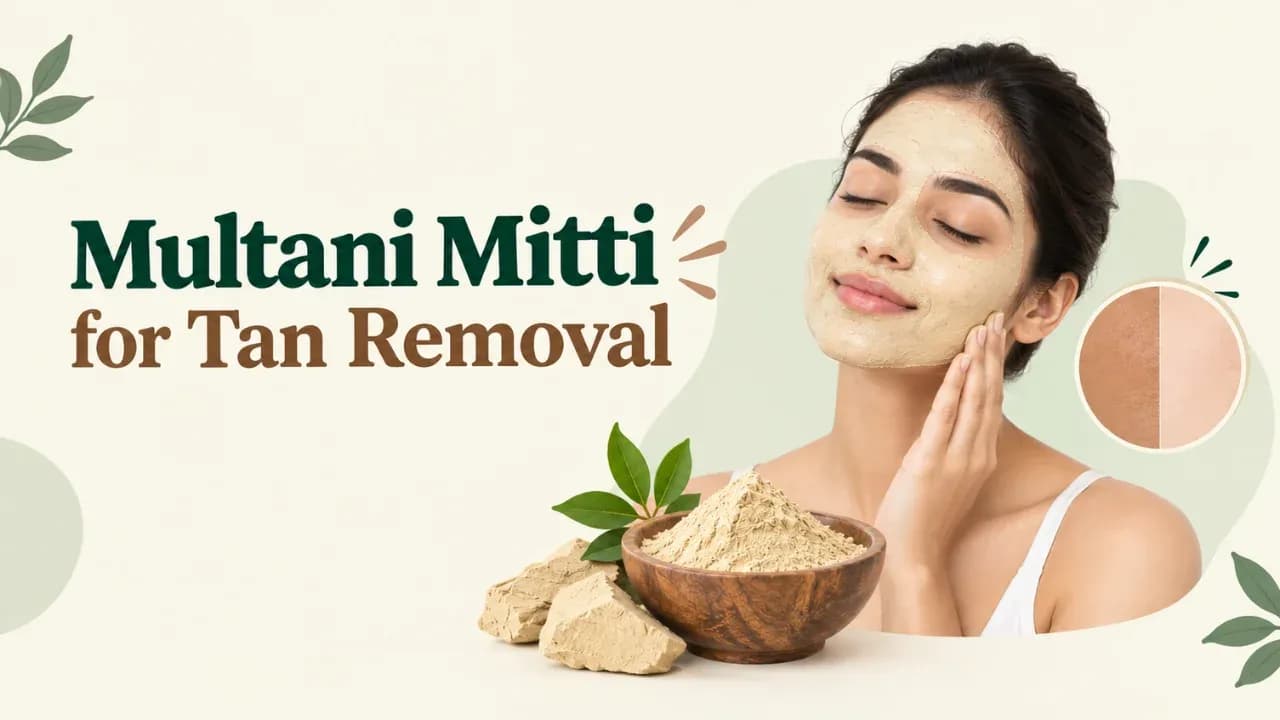
Multani mitti can visibly reduce surface-level sun tan within 4-8 weeks of consistent use. It works by gently exfoliating dead, tanned skin cells and absorbing the excess oil and buildup that makes tan look darker and more uneven. It is not a whitening agent and cannot reverse deep or prolonged sun damage, but for surface tan on the face, neck, arms, and legs, it is one of the most evidence-supported natural options available.
What Is Multani Mitti and Why Does It Help With Tan?
Multani mitti, also called Fuller's Earth, is a mineral-rich smectite clay that has been used in skincare for decades. In its natural form, it is a pale yellow-to-greenish-brown powder that forms a smooth paste when mixed with water or other liquids.
For tan removal specifically, multani mitti works through two simultaneous mechanisms:
- Adsorption: The clay's negatively charged particles attract positively charged impurities, dead skin cells, and oxidised surface debris, the same layer where surface tan accumulates most visibly.
- Gentle physical exfoliation: Multani mitti's fine particle size (typically 2-10 microns) provides mild exfoliation as the dried clay is rinsed away. This is significantly gentler than most scrubs (200-400 microns), making it safe for repeated use without micro-tearing the skin.
The result is a gradual, week-by-week lifting of the outermost tanned skin layer, revealing the clearer skin underneath. According to Kibo Skin Clinics' skincare team, multani mitti is best understood as a maintenance and exfoliation tool, not a depigmenting treatment.
How Multani Mitti Removes Tan: The Science Behind It
Multani mitti's ability to reduce tan is not folklore. There is a measurable physical and chemical basis for how it works on sun-damaged skin.
Oil absorption and surface clearing: Fuller's Earth has a cation exchange capacity (CEC) of 40-80 milliequivalents per 100 grams. A 2020 review published in the International Journal of Cosmetic Science confirmed that smectite-family clays reduce skin surface sebum by up to 50% within 20 minutes of application. Clearing excess oil and dead cell buildup from the surface makes tan appear significantly less pronounced, because tan looks darker when the skin surface is congested and dull.
Exfoliation of tanned dead skin cells: Surface tan is largely stored in the stratum corneum, the outermost layer of dead skin cells. Regular exfoliation with multani mitti accelerates the natural shedding of this layer, which turns over approximately every 14-28 days. By removing this tanned layer consistently, multani mitti helps reveal the newer, less-tanned skin underneath.
Mineral replenishment: As the clay dries, it deposits trace minerals back onto the skin:
| Mineral | Approximate Content | Skin Benefit |
|---|---|---|
| Silica (SiO₂) | 50-65% | Structural lattice; drives adsorption |
| Magnesium oxide | 3-8% | Anti-inflammatory; soothes sun-exposed redness |
| Calcium oxide | 1-5% | Supports skin-barrier mineral balance |
| Iron oxide | 1-4% | Mild antimicrobial; responsible for yellow-brown colour |
| Aluminium oxide | 10-18% | Increases clay's negative charge; enhances oil-pull |
These are naturally occurring minerals, not additives. They soothe the inflammation that often accompanies sun exposure, which in turn reduces post-tan redness and irritation.
Important boundary: Multani mitti works entirely at the surface level. It cannot penetrate the dermis, cannot treat deep pigmentation or melasma, and is not equivalent to a chemical peel or prescribed depigmenting agent. If your tan is prolonged, recurring, or accompanied by uneven patches that do not respond to surface care, a dermatologist assessment is the appropriate next step.
Which Body Areas Can Multani Mitti Help Decan?
Multani mitti for tan removal is not limited to the face. The same adsorption and exfoliation mechanism works wherever the clay is applied, and tan accumulates on multiple exposed body areas.
Face: The most common application. Regular use two to three times per week helps reduce tan on the forehead, cheeks, nose, and chin. Visible improvement in tone and clarity typically begins around weeks 3-4.
Neck: The neck is frequently sun-exposed but often skipped in skincare routines. Applying multani mitti to the neck during a face mask session helps manage the colour mismatch between the face and neck.
Arms and legs: Tan accumulates heavily on the forearms, upper arms, and lower legs, especially in the Indian climate. Multani mitti can be applied as a pre-shower body mask, left on for 15-20 minutes, and rinsed off. Results are visible on the body over a slightly longer timeline (6-10 weeks) since body skin is thicker than facial skin.
Elbows and knees: These areas accumulate both tan and rough, dead skin. The mild exfoliating action of multani mitti is particularly effective here. Mix with lemon juice or milk for additional brightening support.
Hands: The backs of the hands are highly sun-exposed. A thick paste applied for 15 minutes and rinsed with lukewarm water can gradually reduce visible hand tan over 6-8 weeks.
According to Kibo Skin Clinics, applying multani mitti to the body as a pre-shower ritual, covering exposed areas, letting it sit, and rinsing before bathing, is one of the most practical ways to manage body tan without a complex routine.
Best Multani Mitti Combinations for Tan Removal
Multani mitti powder is versatile, it can be combined with other ingredients that enhance its tan-removal effect. Choosing the right combination depends on your skin type and the severity of your tan.
Multani Mitti with Rose Water
Best for: Oily and combination skin with mild tan.
Rose water balances skin pH, calms post-sun inflammation, and adds light hydration to offset multani mitti's drying effect. This is the most classic combination, and the most practical for everyday use.
How to use: Mix 2 tablespoons of multani mitti powder with enough rose water to form a smooth paste. Apply to clean skin, leave for 15-20 minutes (10 minutes for sensitive skin), rinse with lukewarm water, splash with cold water, and moisturise.
Multani Mitti with Lemon Juice
Best for: Oily skin with moderate tan on the face, arms, or legs.
Lemon juice contains citric acid, which provides mild chemical exfoliation and has a known brightening effect. It enhances multani mitti's surface-clearing action. However, lemon can cause photosensitivity, always apply this combination in the evening, never before sun exposure, and follow with SPF the next morning.
How to use: Mix 2 tablespoons of multani mitti with 1 teaspoon of fresh lemon juice and enough rose water to form a paste. Apply for no more than 10-15 minutes. Do not use this combination on sensitive or dry skin.
Multani Mitti with Aloe Vera
Best for: Sensitive, dry, or sun-irritated skin with recent tan.
Aloe vera soothes sun-exposed skin, reduces redness and inflammation, and prevents the excessive drying that pure multani mitti can cause. This combination is gentler and suitable for people who find plain multani mitti too stripping.
How to use: Mix 2 tablespoons of multani mitti with 1-2 tablespoons of fresh or pure aloe vera gel. Apply for 10-15 minutes. Suitable for use on the face, neck, and arms.
Multani Mitti with Milk
Best for: Normal to dry skin with dullness and mild tan.
Milk contains lactic acid, a gentle alpha hydroxy acid, which provides light chemical exfoliation and brightening. The natural fats in milk counteract multani mitti's drying effect and leave skin soft. This combination is particularly effective for removing tan from the neck and hands, where skin tends to be drier.
How to use: Mix 2 tablespoons of multani mitti with enough raw or full-fat milk to form a smooth paste. Apply for 10-15 minutes. Rinse with lukewarm water and follow with moisturiser.
Multani Mitti with Tomato Pulp
Best for: Oily skin with noticeable sun tan on the face.
Tomato contains lycopene and vitamin C, which have mild antioxidant properties that support even skin tone. The natural acidity of tomato also provides light exfoliation. This combination is best suited to oily skin types, the pulp adds moisture without heaviness.
How to use: Blend or mash half a tomato and mix with 2 tablespoons of multani mitti. Apply for 15 minutes, rinse with lukewarm water.
Multani Mitti with Honey
Best for: Dry or combination skin needing hydration alongside tan removal.
Honey is a natural humectant that draws moisture into the skin and has mild antimicrobial properties. Adding honey to multani mitti makes the mask less drying and more suitable for people who find plain clay masks too tight after rinsing.
How to use: Mix 2 tablespoons of multani mitti with 1 teaspoon of raw honey and enough rose water to achieve a paste consistency. Apply for 10-15 minutes.
Multani Mitti for Tan Removal: Week-by-Week Timeline
One of the most common frustrations with multani mitti for tan removal is expecting results too quickly, or using it so inconsistently that results never build. Here is a realistic, week-by-week picture of what most people experience.
Week 1-2: Immediate Surface Changes
In the first two weeks, most people notice that their skin feels cleaner, smoother, and less oily after each session. Shine reduces within 20-30 minutes of rinsing off the mask. Tan reduction is minimal at this stage, what you will notice is that the skin looks less dull and congested, which can make tan appear slightly lighter by contrast.
What to expect:
- Reduced post-wash oiliness and shine
- Skin feels smoother immediately after each session
- Pores may temporarily appear tighter
- No significant tan reduction yet
Week 3-4: Texture and Early Tone Improvement
With consistent use two to three times per week, the natural cell turnover cycle begins to show results. Dead, tanned surface skin cells are being removed regularly, and the newer skin layer underneath becomes more visible. Most users begin to see a reduction in the uniformity of tan during this period.
What to expect:
- Tan starts to appear slightly more even and less patchy
- Skin texture improves noticeably
- Dullness reduces, skin looks brighter after each session
- Fewer blackheads and surface congestion in oily zones
Week 5-6: Visible Tan Lightening
By week five to six, most consistent users see a measurable improvement in surface tan, particularly on the face and neck. Areas of uneven tan, such as forehead lines and cheek patches, begin to even out. This is the stage where the accumulated effect of regular, gentle exfoliation becomes clearly visible.
What to expect:
- Noticeable lightening of surface tan on the face and neck
- Post-inflammatory marks from old sun damage begin to fade
- Overall skin clarity improvement
- Even tone in areas that were previously patchy
Week 7-8: Cumulative Results
By the six-to-eight week mark, regular users typically see the clearest results. Surface tan is significantly reduced, skin tone is more even, and the skin has a visible glow that comes from consistently clear, well-exfoliated skin. Arms and legs require a slightly longer timeline due to thicker skin, expect visible body results around weeks 8-10.
What to expect:
- Clear reduction in facial and neck tan compared to week one
- Mild tan reduction on arms and legs if applied there consistently
- Even, smooth skin texture
- Sustained results as long as sun protection is maintained alongside the routine
What Multani Mitti Cannot Do for Tan
- It will not treat deep pigmentation or melasma, those require prescribed agents like kojic acid, niacinamide, or hydroquinone under dermatologist guidance.
- It will not produce faster results with daily use, daily use causes dryness and a sebum rebound that actually slows results.
- It will not provide lasting tan removal if SPF is not applied every morning, without sun protection, tan continues to accumulate and offsets exfoliation gains.
- It will not correct structural or hormonal pigmentation, those require clinical assessment.
Multani mitti for tan removal is a 4 to 8 week process, not a single-session fix. Patience and consistency matter more than frequency.
How to Use Multani Mitti for Tan Removal: Step-by-Step
Follow this routine to get the maximum tan-removal benefit from multani mitti while avoiding the common mistakes that cause dryness or irritation.
Materials You Need
- 2 tablespoons of pure multani mitti powder
- A mixing bowl and spoon
- Your chosen liquid (rose water, milk, aloe vera gel, or plain water)
- An optional add-in based on your skin type (lemon juice, honey, tomato pulp)
- A gentle cleanser
- A lightweight moisturiser
Step-by-Step Process
Cleanse your face or the area to be treated. Applying multani mitti to clean skin ensures the clay works directly on the skin surface without having to cut through a layer of makeup, sunscreen, or dust first. Use a gentle, non-stripping cleanser and pat dry.
Mix the paste. Combine 2 tablespoons of multani mitti powder with enough liquid to form a smooth, lump-free paste. The consistency should be thick enough to stay on vertical skin (like your cheeks) without dripping. Too thin a paste slides off and dries too quickly; too thick a paste dries unevenly.
Apply an even layer. Using clean fingers or a face mask brush, apply the paste in an even layer to the target area. Avoid the skin immediately around the eyes and lips, these areas are too delicate for clay application. For body tan, apply in broad, even strokes and leave flat while the mask dries.
Wait the appropriate time for your skin type.
- Dry or sensitive skin: 8-10 minutes maximum
- Normal skin: 12-15 minutes
- Oily or combination skin: 15-20 minutes
- Do not wait for the mask to crack completely dry, this over-strips the skin. Rinse while the mask is still slightly damp on dry and sensitive skin types.
Rinse with lukewarm water. Use gentle circular motions as you rinse, this maximises the mild exfoliation effect as the clay particles lift awa...
Medical Disclaimer : Information from Kibo Hair Clinics is for educational purposes only. It does not replace diagnosis, trichoscopy, blood test interpretation, prescription treatment, procedure advice, or side-effect counselling from a qualified dermatologist or hair restoration doctor.