

What Is Genetic Hair Loss?
Genetic hair loss, also called hereditary or pattern hair loss, is a condition in which genetically susceptible hair follicles become smaller over time.
Medically known as androgenetic alopecia (AGA), it commonly affects the hairline, temples, and crown in men, while women often notice thinning along the central part and top of the scalp.
This condition is usually non-scarring, which means the follicles are not destroyed by the process. Instead, they produce progressively shorter, finer hairs as their growth cycle changes.
Although genetic hair loss can run in families, having relatives with the condition does not necessarily mean that you will develop it, too.
How Do Genetics and DHT Affect Hair Follicles?
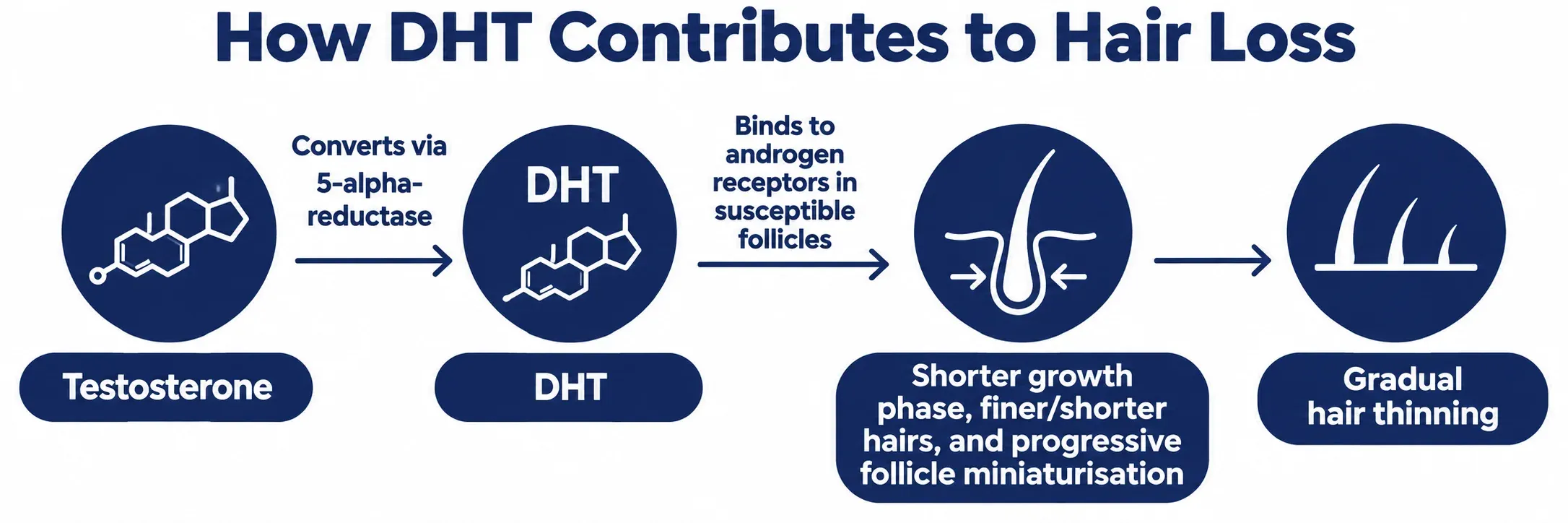
Your genes influence how your hair follicles respond to hormones. One of the hormones involved in this process is dihydrotestosterone (DHT), an androgen (a type of hormone) made from testosterone.
An enzyme called 5-alpha-reductase converts testosterone into DHT. In people with susceptible follicles, DHT interacts with androgen receptors and gradually changes the hair growth cycle. The active growth phase becomes shorter, and the follicles produce thinner, shorter hairs over time.
This explains why DHT-related hair loss is linked to inherited follicle sensitivity rather than simply having high DHT levels. This means your blood hormone levels could be normal even when your follicles respond strongly to DHT.
From Which Parent Can Baldness Be Inherited?
Baldness can be inherited from either parent. However, certain genetic factors have led researchers to pay particular attention to the maternal side.
The androgen receptor (AR) gene, which is linked to male-pattern hair loss, sits on the X chromosome. Since men inherit their X chromosome from their mother, maternal inheritance becomes slightly more relevant here.
But that is only one part of the picture. Other genetic variants linked to hair loss are located on autosomes (non-sex chromosomes) and can come from either parent. This is why the popular belief that baldness always comes from the maternal grandfather is misleading.
Family history can increase the likelihood of genetic hair loss, but it cannot reliably predict when it will begin, how quickly it will progress, or how severe it will become.
What Are the Early Signs of Genetic Hair Loss?
The early signs of genetic hair loss can differ between men and women. In both, the hair thins gradually as affected follicles shrink, rather than falling out suddenly in patches.
Early Signs of Genetic Hair Loss in Men
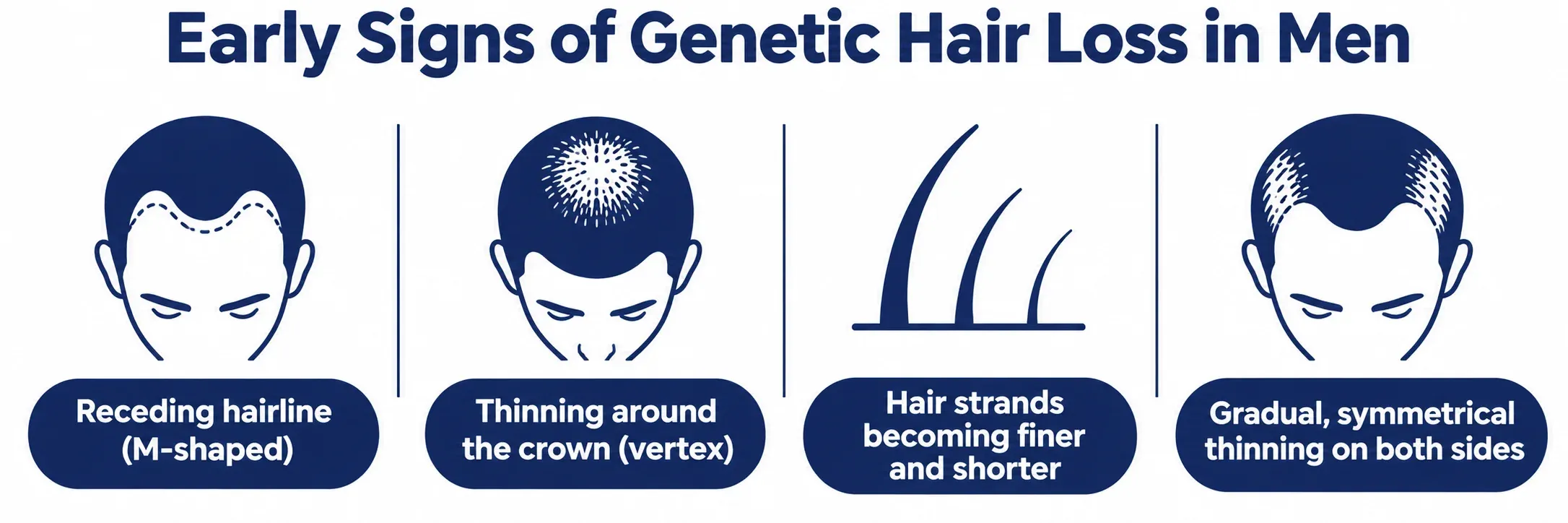
Male-pattern hair loss often begins with gradual changes around the temples and hairline. Common signs include:
- A receding hairline that gradually forms an M shape.
- Thinning around the crown or vertex (the upper back portion of the scalp).
- Hair strands becoming shorter and finer in affected areas.
- Gradual, often symmetrical thinning on both sides of the scalp.
Early Signs of Genetic Hair Loss in Women
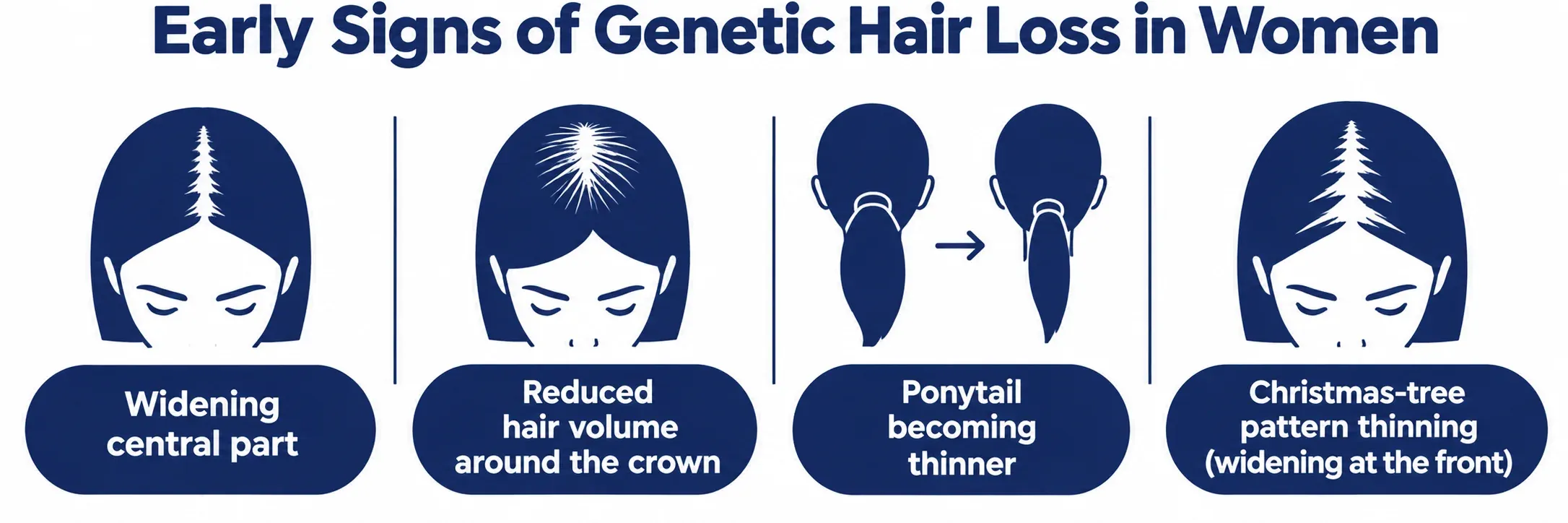
Female-pattern hair loss often affects the central part and top of the scalp rather than causing a clearly receding hairline. Signs may include:
- A widening central part.
- Reduced hair volume around the crown and middle of the scalp.
- A thinner ponytail or reduced ponytail circumference.
- A Christmas-tree or triangular pattern of hair thinning, where the central part widens towards the front of the scalp.
Complete baldness is uncommon in women with female-pattern hair loss. It is also important not to assume that thinning automatically means high testosterone. Hormone-related investigations depend on the symptoms and clinical findings.
Is All Hair Loss Hereditary?
Not all hair loss is hereditary. It can also be due to autoimmune disorders, inflammatory conditions, nutritional deficiencies, and hormonal imbalances.
The following table outlines some common causes of non-hereditary hair loss and their usual symptoms:
| Conditions | Possible Signs |
|---|---|
| Telogen effluvium | Diffuse shedding following illness, surgery, childbirth, significant weight loss, or medication changes. |
| Alopecia areata | Round or oval patches of hair loss. |
| Traction alopecia | Hair loss or broken hairs in areas exposed to repeated pulling from tight hairstyles. |
| Scarring alopecia | Inflammation, pain, redness, scaling, or loss of visible follicular openings. |
| Thyroid disorders | Diffuse hair thinning or increased shedding. |
| Nutritional deficiencies | Diffuse hair thinning or increased shedding. |
| Scalp infections | Patchy hair loss, scaling, itching, redness, or broken hairs, depending on the infection. |
Note: Some of these conditions can also occur alongside hereditary hair loss.
Disclaimer: Women with acne, excessive facial or body hair, irregular menstrual cycles, or rapidly progressive thinning may need an assessment for androgen excess, including conditions such as polycystic ovary syndrome (PCOS). However, most women with female-pattern hair loss do not have an underlying hormonal abnormality.
How Is Genetic Hair Loss Diagnosed?
A dermatologist usually diagnoses genetic hair loss by reviewing the pattern and duration of thinning, family history, medical history, and scalp condition. The assessment may also include a closer examination of the hair and follicles.
The diagnostic assessment may include:
- Trichoscopy: A non-invasive examination of the scalp using magnification to help identify follicle miniaturisation.
- Blood tests: These may be recommended when the history or examination suggests thyroid problems, iron or nutrient deficiencies, hormone imbalance, or infection.
- Scalp biopsy: Generally reserved for uncertain cases or suspected inflammatory and scarring conditions.
A blood test for DHT alone cannot confirm or rule out androgenetic alopecia. The way individual follicles respond to hormones is more relevant than a single circulating hormone measurement.
Can You Prevent Hereditary Hair Loss?
It is not entirely possible to prevent genetic hair loss, since current treatments cannot address the genetic susceptibility of hair follicles. However, early diagnosis and consistent treatment may slow hair loss progression.
If iron deficiency, thyroid disease, or another concurrent condition contributes to shedding, treating that problem may improve the additional hair loss, but cannot address the inherited pattern loss.
Likewise, eating a balanced diet can support normal hair growth, but it cannot prevent androgenetic alopecia.
Note: Vitamins, biotin, oils, and hair-growth shampoos are not proven ways to stop hereditary hair loss when you do not have a deficiency.
What Are the Treatment Options for Genetic Hair Loss?
Genetic hair loss treatment focuses on slowing progression, preserving existing hair, and improving density where possible. The right approach depends on the pattern of loss, medical history, sex, reproductive plans, and individual suitability.
The following table lists treatment options, each of which has different purposes and safety considerations:
| Treatment | Purpose | Important Considerations |
|---|---|---|
| Topical minoxidil | May reduce shedding and improve or maintain density. |
|
| Finasteride | Reduces DHT production by inhibiting type-II 5-alpha-reductase. |
|
| Dutasteride | Inhibits type-I and type-II 5-alpha-reductase, reducing DHT production. |
|
| Spironolactone | Antiandrogen; may be prescribed for selected women. |
|
| Low-dose oral minoxidil | An alternative that may be considered in selected patients. |
|
| Low-level light therapy (LLLT) | May improve hair density. |
|
| Platelet-rich plasma (PRP) | May improve hair density. |
|
Disclaimer: Hair-loss treatments can have potential side effects, and their suitability and effectiveness vary between individuals. Drug approvals and prescribing labels also differ between India and other countries. Consult a qualified dermatologist before starting, stopping, or changing any treatment.
A dermatologist can assess your medical history, existing conditions, pregnancy or breastfeeding status, and other medications to determine the most appropriate option. Do not self-medicate or change prescribed doses without medical guidance.
Can Hair Transplantation Treat Genetic Hair Loss?
A hair transplant may improve coverage in areas of permanent hair loss, provided the patient is a suitable candidate for surgery. The procedure moves follicles from a donor area, usually at the back or sides of the scalp, to areas with thinning or no visible hair.
Follicular unit extraction (FUE) and follicular unit transplantation (FUT) are two methods used for this purpose. However, a transplant does not stop genetic hair loss in the native hair (existing hair).
Hair loss can affect your native hair, because of which it may continue to thin around the transplanted follicles. Donor hair is also limited, so the procedure needs careful planning, particularly for younger people and women with diffuse thinning.
Fibres, wigs, styling, and scalp micropigmentation may also help camouflage visible thinning, but they do not treat the underlying condition.
When Should You See a Dermatologist?
Consider consulting a dermatologist if you notice gradual thinning, a receding hairline, or a widening part, or if you have a family history of pattern hair loss. An early assessment can help identify the cause before more follicles become miniaturised.
Seek prompt assessment if hair loss develops suddenly or progresses rapidly, appears in patches, or occurs with scalp pain, itching, scaling, pustules, or scarring. Eyebrow or body-hair loss, significant shedding, irregular periods with other signs of androgen excess, or other unexplained symptoms also warrant medical attention.
A clear diagnosis can help prevent unnecessary spending on supplements, procedures, or treatments that may not address the actual cause.
Kibo Clinics' Perspective on Genetic Hair Loss
Noticing gradual hair thinning, a receding hairline, or a widening part can be concerning, especially when there is a family history of hair loss. However, genetic hair loss can affect people differently, and its progression is not always easy to predict.
At Kibo Clinics, we believe that managing genetic hair loss starts with understanding its pattern and stage, and investigating for other underlying causes.
If you are experiencing genetic hair loss, a Kibo Clinics board-certified hair transplant surgeon can assess your hair and scalp, understand the pattern of hair loss, and discuss suitable treatment options based on your individual needs.
References
- MedlinePlus Genetics. (n.d.). Androgenetic Alopecia.
- Sadasivam, I. P., Sambandam, R., Kaliyaperumal, D., & Dileep, J. E. (2024). Androgenetic Alopecia in Men: An Update on Genetics. Indian Journal of Dermatology, 69(3), 282. DOI: 10.4103/ijd.ijd_729_23.
- Urysiak-Czubatka, I., Kmieć, M. L., & Broniarczyk-Dyła, G. (2014). Assessment of the Usefulness of Dihydrotestosterone in the Diagnostics of Patients with Androgenetic Alopecia. Postępy Dermatologii i Alergologii, 31(4), 207-215. DOI: 10.5114/pdia.2014.40925.
- Heilmann-Heimbach, S., Herold, C., Hochfeld, L. M., et al. (2017). Meta-analysis Identifies Novel Risk Loci and Yields Systematic Insights into the Biology of Male-Pattern Baldness. Nature Communications, 8, 14694. DOI: 10.1038/s41467-017-01490-8.
- Hagenaars, S. P., Hill, W. D., Harris, S. E., et al. (2017). Genetic Prediction of Male Pattern Baldness. PLOS Genetics, 13(2), e1006594. DOI: 10.1371/journal.pgen.1006594.
- DermNet. (n.d.). Female Pattern Hair Loss.
- MedlinePlus. (n.d.). Male-Pattern Baldness.
- American Academy of Dermatology Association. (n.d.). Finding the Right Treatments for Genetic Hair Loss.
- Ho, C.-Y., Chen, J. Y.-F., Hsu, W.-L., Yu, S., Chen, W.-C., Chiu, S.-H., Yang, H.-R., Lin, S.-Y., & Wu, C.-Y. (2023). Female Pattern Hair Loss: An Overview with Focus on the Genetics. Genes, 14(7), 1326. DOI: 10.3390/genes14071326.
- American Academy of Dermatology Association. (n.d.). Hair Loss: Diagnosis and Treatment.
- MedlinePlus. (n.d.). Female-Pattern Baldness.
- American Academy of Dermatology Association. (n.d.). Female-Pattern Hair Loss.
- U.S. Food and Drug Administration. (2015). Minoxidil Topical Solution: Prescribing Information.
- U.S. Food and Drug Administration. (2012). Propecia (Finasteride) Tablets: Prescribing Information.
- U.S. Food and Drug Administration. (2011). Avodart (Dutasteride) Capsules: Prescribing Information.
- Australian Prescriber. (n.d.). Male and Female Pattern Hair Loss.
- Gupta, A. K., Talukder, M., Shemer, A., Piraccini, B. M., & Tosti, A. (2023). Low-Dose Oral Minoxidil for Alopecia: A Comprehensive Review. Skin Appendage Disorders, 9(6), 423-437. DOI: 10.1159/000531890.
- Perez, S. M., Vattigunta, M., Kelly, C., & Eber, A. (2025). Low-Level Laser and LED Therapy in Alopecia: A Systematic Review and Meta-Analysis. Dermatologic Surgery, 51(2), 179-183. DOI: 10.1097/DSS.0000000000004442.
- Zhang, X., Ji, Y., Zhou, M., Zhou, X., Xie, Y., Zeng, X., Shao, F., & Zhang, C. (2023). Platelet-Rich Plasma for Androgenetic Alopecia: A Systematic Review and Meta-Analysis of Randomized Controlled Trials. Journal of Cutaneous Medicine and Surgery, 27(5), 504-508. DOI: 10.1177/12034754231191461.
- International Society of Hair Restoration Surgery. (n.d.). Androgenetic Alopecia.
- Harvard Health Publishing. (n.d.). Hereditary-Patterned Baldness.
- Cleveland Clinic. (n.d.). DHT (Dihydrotestosterone): What It Is, Function and Levels.
Hair Transplant Services
Surgical
- FUE Hair Transplant
- Sapphire FUE Hair Transplant
- Direct Hair Transplant (DHT)
- Corrective Hair Transplant
Non Surgical
Must Read
Can hair loss be hereditary?
What is androgenetic alopecia?
How do I know if hair loss is genetic?
Can genetic hair loss be reversed?
Do treatments for genetic hair loss need to continue?
Which parent is genetic hair loss inherited from?
Can a blood test confirm genetic hair loss?
Can a hair transplant treat genetic hair loss?
When should I see a dermatologist for hair loss?
Medical Disclaimer : Information from Kibo Hair Clinics is for educational purposes only. It does not replace diagnosis, trichoscopy, blood test interpretation, prescription treatment, procedure advice, or side-effect counselling from a qualified dermatologist or hair restoration doctor.