

What Is Frontal Fibrosing Alopecia?
Frontal fibrosing alopecia is considered a variant of lichen planopilaris, a scarring form of hair loss in which inflammation around the follicle destroys it and replaces it with fibrous tissue. It most often presents as a band-like recession of the frontal or frontotemporal hairline, and eyebrow loss is common and can appear before obvious scalp changes. Other possible signs include redness or scale around the follicle, isolated "lonely" hairs at the hairline border, small facial papules, itching or tenderness, eyelash loss, and less often body-hair involvement.
Because FFA is a scarring condition, it needs to be separated from androgenetic alopecia, traction alopecia, alopecia areata and other scarring alopecias, since more than one can be present in the same patient.
Can FFA Cause Permanent Hair Loss?
Yes. Once a follicle is replaced by scar tissue it cannot regrow hair on its own, and no topical, oral or cosmetic treatment can reverse that specific loss. A transplant can place new, undamaged follicles into or around an affected area, but it does not rebuild the original follicles and does not cure the inflammatory disease driving the condition.
Can a Hair Transplant Treat Frontal Fibrosing Alopecia?
A transplant may be considered strictly in patients whose FFA is clinically inactive and stable, who accept long-term monitoring and medical management when indicated, and whose donor supply and recipient tissue are judged suitable by the treating dermatologist. Stability lowers risk. It does not guarantee that FFA will stay inactive, and it does not guarantee that the transplanted grafts will survive long term.
Four ideas are often blurred together and need to stay separate:
- Disease control means the inflammatory process is actively managed, with no convincing evidence of current progression.
- Disease stability means the hairline, eyebrows or other affected areas have not continued to change over a clinically meaningful period, supported by examination and, where useful, trichoscopy and prior photographs.
- Scarring means follicles in that area have already been destroyed and replaced with fibrous tissue. A transplant places new follicles near the area; it does not restore what was lost.
- Candidacy requires control and stability, plus adequate donor hair, suitable recipient tissue, medical fitness and realistic expectations.
Why Active FFA Is Not Suitable for Routine Transplantation
Many routine hair transplant pages are written around androgenetic alopecia, where donor-area permanence is a reasonable assumption. FFA is different: it is an inflammatory disease with an unpredictable course, and a quiet-looking hairline on one visit does not prove the disease will never resume. Operating into actively inflamed tissue risks poor graft uptake and can provoke further activity, so surgery is generally deferred while FFA is active or progressing.
How Doctors Confirm Diagnosis and Disease Activity
Establishing the Diagnosis
A dermatologist examines the whole scalp, not only the hairline, and distinguishes FFA from androgenetic alopecia, traction alopecia, alopecia areata and other scarring alopecias, since more than one condition can coexist in the same patient.
Trichoscopy
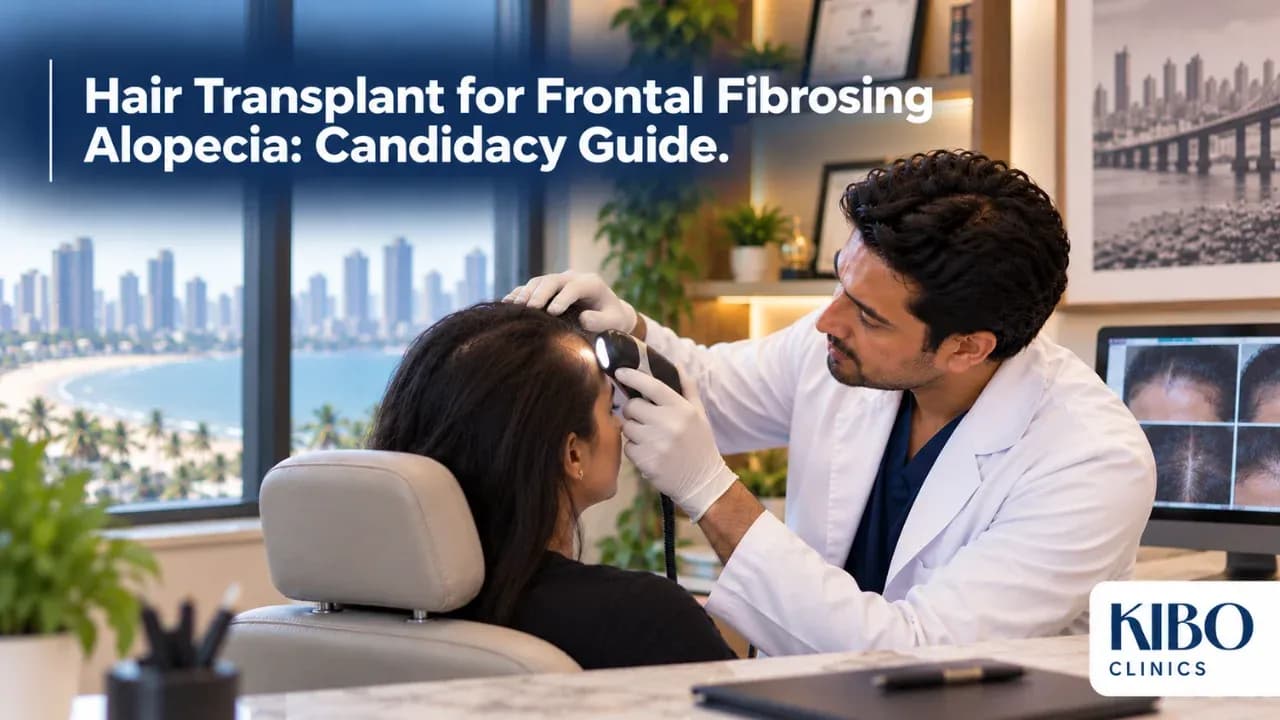
Trichoscopy, a non-invasive magnified examination of the scalp and hair, is central to assessment. In FFA, the clinician may look for loss of visible follicular openings, perifollicular redness or scale, isolated lonely hairs, hair casts and other disease-specific features. For a transplant consultation it serves two roles: confirming the pattern is genuinely FFA, and documenting whether inflammatory or progressive signs remain before and after surgery. A single trichoscopy image cannot prove permanent stability; stability is judged over time with history, serial photographs and repeated assessment.
When Biopsy May Be Needed
A scalp biopsy is not required for every patient. It may be recommended when the pattern is atypical, when FFA overlaps with another scarring alopecia, or when the result would change the treatment plan, not as a routine step for everyone.
How Long Should FFA Be Stable Before Surgery?
There is no single interval accepted across all published literature or practice. Some clinicians describe requiring around two years of documented stability, while published case series reflect stability periods ranging from under a year to more than three years. This range exists because the evidence is largely retrospective and case-based, and because clinical judgment reasonably varies with how a patient's disease has behaved. We don't present any single interval as a universal rule or a guarantee.
What matters more than any one number is how stability is assessed: no convincing new recession; no new or worsening eyebrow or body-hair loss attributable to FFA; no ongoing itch, pain or tenderness suggesting activity; no perifollicular redness, scale or hyperkeratosis on examination; stable serial photographs under comparable conditions; trichoscopic findings that do not suggest continuing activity; a treatment plan agreed with the dermatologist; and willingness to continue follow-up after transplantation. A calendar interval alone cannot prove candidacy.
Who May Be a Candidate?
A potential candidate may have a diagnosis confirmed through examination and, where needed, biopsy; no convincing current progression; no active perifollicular inflammation requiring disease control first; a dermatologist-directed medical plan; adequate donor density and acceptable donor-area health; recipient tissue that can potentially support grafts; a localized cosmetic goal that can be met conservatively; realistic expectations about density, sessions and long-term graft loss; and willingness to attend serial follow-up and continue treatment when prescribed.
A patient may be unsuitable or not ready if the disease is active or rapidly progressing; the diagnosis is uncertain; the donor area is affected by scarring or diffuse miniaturization; the recipient tissue is severely atrophic, hypertrophic or poorly vascularized; the patient wants a dense, low hairline the donor supply cannot support; the patient refuses necessary medical management or follow-up; there is a competing untreated inflammatory alopecia; or the patient expects the transplant to cure FFA or guarantee permanent coverage.
Recipient and Donor Assessment
Recipient Tissue
Scarred tissue does not behave like normal scalp. Scar thickness, atrophy, pliability, vascularity and prior inflammation can all influence graft insertion and survival. Large or poorly vascularized scars may not support high-density placement. A test-graft approach with an observation period can be discussed when the clinical team is uncertain about uptake, before committing to a larger procedure.
Donor Tissue
A transplant uses a limited supply of the patient's own follicles. The consultation should assess donor density, calibre, miniaturization, texture, curl, safe donor boundaries and possible future androgenetic loss, since FFA itself may involve areas beyond the frontal hairline. A donor follicle used in one procedure is not available for a later one, which makes conservative planning especially important when the affected area is broad or future progression cannot be excluded.
Hairline and Eyebrow Design
A transplanted frontal hairline should not be designed as though the original hairline can be recreated permanently; design should account for possible future recession and the limited donor reserve. Eyebrow transplantation requires separate counseling because eyebrow shape, direction and density are highly visible, scalp-derived hairs grow differently from native eyebrow hair, and FFA commonly involves the eyebrows. This should be supported by the operating surgeon's protocol, not presented as a standard guaranteed outcome.
FUE Versus FUT for FFA
FUE removes individual follicular units from the donor area and may suit a patient who wants to avoid a linear donor scar or is treating a small, localized area. It can still cause dot scarring, donor depletion or poor growth, and it does not remove the inflammatory risk in FFA.
FUT removes a strip of donor scalp and leaves a linear scar. It may provide an efficient harvest for certain donor patterns but requires adequate scalp laxity and creates a linear wound.
Neither method is universally superior for FFA. Method selection is secondary to disease stability, donor quality, recipient tissue, conservative design and long-term monitoring; both techniques carry scars and both can show poor or declining graft survival in a scarring alopecia.
Test Grafts and Staged Procedures
A test graft may be discussed when recipient tissue is scarred or long-term uptake is uncertain. It can give information about growth in a small area before a larger procedure, but it is not a guarantee for the whole scalp. A negative test graft may prevent a larger unsuccessful procedure; a positive early result does not eliminate later disease-related loss.
Staged surgery may be useful when the affected area is large, donor resources are limited, density must stay conservative, or the team wants to observe the first recipient response. Multiple sessions increase cumulative cost, scarring and donor use, which should be discussed before a plan is agreed.
Medical Treatment Before and After Surgery
Medical treatment is not optional "aftercare" in the ordinary cosmetic sense. FFA is an inflammatory disease, and treatment decisions should remain under a dermatologist's care. Continued medical treatment may be recommended to control the underlying disease and protect unaffected or transplanted areas, with follow-up frequency and escalation decided individually rather than from a fixed protocol.
No specific medication, dose or combination should be presented as universally indicated. Medication choice depends on diagnosis, sex, pregnancy potential, comorbidities, age, concurrent androgenetic alopecia, contraindications and the treating dermatologist's plan.
Results, Graft Survival and Realistic Expectations
Outcomes are best understood across several separate measures: hair growth, meaning follicles produced visible hair; graft survival, meaning the proportion of transplanted units viable at a specified time; density, measured by a defined method and area; cosmetic satisfaction, which is subjective; disease activity, meaning whether FFA progressed or reactivated; and complications such as infection, hypertrophic scarring, poor growth or unnatural direction.
Published reports often show favorable short-term results, while longer-term outcomes are less consistent. One multicenter review of 51 patients reported graft survival declining from approximately 87% at one year to 71% at two years, 60% at three years and 41% at five years, while 42 of 51 patients reported satisfaction. A meaningful cosmetic benefit and biological graft loss over time can both be true for the same group of patients. This is a cohort result, not an individual forecast, which is why we don't quote a single success rate on this page.
Risks and Limitations to Understand Before Consultation
Specific risks and limitations include recurrence or renewed FFA activity; loss of transplanted grafts over time; poor growth in scarred or poorly vascularized tissue; infection, bleeding, pain or prolonged inflammation; donor scarring and donor depletion, particularly with a later corrective procedure; unnatural direction, angle or density; visible mismatch between transplanted and surrounding hair; the need for a test procedure, staged surgery or repeat surgery; progression of untreated or non-transplanted areas; and dissatisfaction if the patient expects a permanent pre-disease hairline. A general awareness of transplant side effects and the factors that influence graft survival is a reasonable starting point before an FFA-specific discussion.
A transplant can camouflage loss FFA has already caused. It cannot remove the disease's immune mechanism, and it cannot guarantee that surrounding native hair will remain unchanged.
Alternatives When Surgery Is Not Suitable
Options include dermatologist-directed disease treatment and monitoring; wigs, hairpieces and medically appropriate scalp coverings; cosmetic camouflage fibres or sprays, with no claim that they treat FFA; scalp micropigmentation after medical evaluation; eyebrow cosmetics or prosthetic options; counseling or psychological support when visible loss affects daily life; and conservative hairstyle choices that avoid added traction. These are not inferior choices. For a patient with active or unstable FFA, a non-surgical option may be safer and more predictable than surgery.
Cost and Consultation Transparency
FFA transplant costs cannot be reduced to a generic price-per-graft figure. The quote depends on disease extent, graft number, donor method, scar quality, test grafting, staged surgery, medical follow-up and included services. A responsible treatment plan should state the working diagnosis and whether further dermatology review is advised; the evidence used to call the disease stable; the stability period and serial-photo or trichoscopy findings; the planned donor method and approximate graft count; whether a test graft or staged procedure is recommended; the realistic coverage goal; the expected need for continued medical treatment; the follow-up schedule and what signs should trigger urgent review; complications and the possibility of future graft loss; and all inclusions and exclusions in the quoted cost.
Bottom Line
A hair transplant for frontal fibrosing alopecia can be a reasonable option for carefully selected patients, but only once the disease is genuinely controlled and stable, confirmed through examination rather than appearance alone. Kibo's approach starts with disease assessment and planning before any discussion of grafts, backed by our No Ghost Surgery pledge and a 12-month care journey that continues well past the day of the procedure.
What is frontal fibrosing alopecia?
Can FFA cause permanent hair loss?
Can a hair transplant treat frontal fibrosing alopecia?
Is a transplant safe if FFA is active?
How long should FFA be stable before surgery?
Does two years of stability guarantee candidacy?
What signs suggest that FFA is still active?
Why is trichoscopy important before an FFA transplant?
Will I need a scalp biopsy?
Can FFA return after a hair transplant?
Can transplanted hair fall out years later?
Is FUE or FUT better for FFA?
Can I have an eyebrow transplant with FFA?
What is a test graft?
How many grafts will I need?
Will I need more than one session?
Do I need medical treatment after surgery?
What alternatives are available if I am not a candidate?
How much does an FFA transplant cost in India?
Can FFA coexist with androgenetic or traction alopecia?
Medical Disclaimer : Information from Kibo Hair Clinics is for educational purposes only. It does not replace diagnosis, trichoscopy, blood test interpretation, prescription treatment, procedure advice, or side-effect counselling from a qualified dermatologist or hair restoration doctor.