Discover expert insights on hair transplant procedures, FUE techniques, recovery tips, and hair restoration guides from Kibo's experienced team.

Many people frame the choice as scalp micropigmentation versus a hair transplant, but in real life these options are allies rather than rivals. A transplant relocates living follicles, which can give you new growth that you wash and style like your own hair. Scalp micropigmentation is a cosmetic tattoo that adjusts what the eye sees by softening contrast on the scalp. Used together, they create a calmer journey from the first days through the first year, especially in a busy city like Mumbai where bright light, humidity, and daily commutes put any plan to the test. This guide explains how each works, where they meet in practice, and how to plan timelines and everyday habits with support from trusted national health and dermatology patient pages listed in the references.
August 12, 2026 – 5 min read

Choosing between a hair transplant and a hair patch is really a choice between a lasting change to where your hair grows and a removable cover that changes what the eye sees. This guide explains how each option feels week by week, what maintenance genuinely looks like, and how to plan for Mumbai’s weather and pace. Recovery timing and basic care points are supported with patient pages from trusted health and dermatology organisations listed in the references.
August 12, 2026 – 5 min read

Choosing between a hair transplant and camouflage sprays is really a choice between a long term change in hair distribution and a day by day styling solution. This guide explains how each option works, what the next months typically look like, and how to plan habits that fit real life in Mumbai. Timelines and basic care are supported by trusted national dermatology and health pages listed in the references.
August 12, 2026 – 5 min read

Seeing extra hairs in the brush about a month after a hair transplant can feel unsettling, yet this stage is both common and expected. Most people pass through a period when moved hairs shed before fresh growth begins, and the scalp can look quiet until new sprouts gain length. This clear guide explains why the one month mark often brings more shedding, what usually happens next, and how to stay comfortable in Mumbai’s heat, humidity, and monsoon. Where we mention timelines or basic care, we draw from authoritative patient pages so you can trust the rhythm and focus on everyday life.
August 12, 2026 – 5 min read

In the early months after a hair transplant it is common to notice uneven growth, with some areas sprouting sooner and others looking quiet. This experience can feel confusing if you expect a uniform change week by week. The good news is that uneven growth is usually a normal stage in the journey. In this warm, practical guide we explain why it happens, how to read the timeline fairly, and which everyday habits make the months ahead easier in Mumbai. Where we mention recovery timing or basic care, we support the details with trusted national health and dermatology sources listed at the end.
August 12, 2026 – 5 min read

Months 1–4 bring the hair transplant ugly duckling phase hair may look worse before improving. Stay patient, as this stage leads to natural, lasting results.
August 12, 2026 – 5 min read

It is natural to hope that donor hair will quietly grow back after a transplant. The truth is simpler and kinder when explained clearly. A transplant moves follicles from one place to another, so the exact follicles that were removed do not regrow in the donor sites. Surrounding hairs can cover tiny marks as healing progresses, and careful planning keeps the donor looking even across years. In this warm guide, tuned for readers in Mumbai, we separate myths from realities, share practical habits, offer city wise tips, and use clear timelines from national and dermatology bodies so you know what to expect and when.
August 12, 2026 – 5 min read

A hair transplant can move healthy follicles to a thinning area, yet it does not switch off the natural process that affects your remaining native hair. This is why some people feel great in the first year, then notice new gaps later unless they plan for the long term. In this clear guide we explain why biology continues, how to read timelines fairly, and how to blend design, simple routines, and city wise habits so your result looks natural in Mumbai across seasons. Where we mention recovery timing or basic care, we support it with patient pages from trusted national health and dermatology organisations.
August 12, 2026 – 5 min read

Hair type changes how results look to the eye. Straight hair and curly hair can need different design choices, different styling habits, and slightly different photo rhythms to judge progress fairly. This friendly guide explains the key reasons behind those differences, from optics and direction to fibre thickness and everyday grooming, while keeping the core biology the same. We include Mumbai aware tips for heat, humidity, monsoon travel, and office light. Whenever we mention recovery timing or basic care, we support it with patient pages from national health and dermatology bodies so your plan stays clear and reassuring.
August 12, 2026 – 5 min read

Many people notice that the crown can seem slower to look full compared with the front. This is not a failure of planning, it is a feature of the crown’s shape, swirl, and the way light hits that area. In this guide we explain why the crown often needs more grafts to look equally dense, how to set fair expectations, and how to plan everyday care that suits Mumbai’s climate and commute. When we mention timelines or basic care, we support them with trusted patient pages from national health and dermatology organisations so your decisions stay grounded and calm.
August 12, 2026 – 5 min read
Social media has transformed how people learn about hair transplants. In minutes you can see videos of surgery rooms, time lapse growth clips, and personal diaries from around the world. This new access can be empowering, yet it can also compress expectations and blur the difference between cosmetic effects and biological timelines. In this guide we explain how social platforms changed patient awareness, how to read posts fairly, and how to match online impressions with real life in Mumbai. Where we mention timelines or basic care, we support it with trusted patient pages from national health and dermatology organisations so your decisions feel grounded.
August 12, 2026 – 5 min read

A calm record of your hair journey turns guesswork into perspective. Simple monthly photos, a few short notes, and light routines help you see progress clearly, especially when daily mirrors feel changeable. This guide shows you how to build a fair record, why it keeps expectations realistic, and how to adapt the method to Mumbai’s weather and commute. When we mention basic care or recovery timing, we refer to trusted patient pages so your plan stays grounded and reassuring.
August 12, 2026 – 5 min read
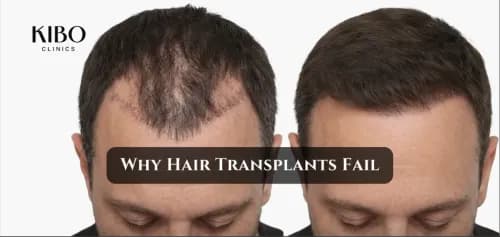
This guide replaces the binary word 'failed' with seven distinct categories (maturation, incomplete growth, poor planning, technical complications, aesthetic mismatch, progressive native loss, genuine failure), gives a full cause-to-repair matrix for 8 unfavorable findings, states clearly what corrective surgery can and cannot do, and is honest about when surgery should not be performed at all.
September 24, 2026 – 5 min read
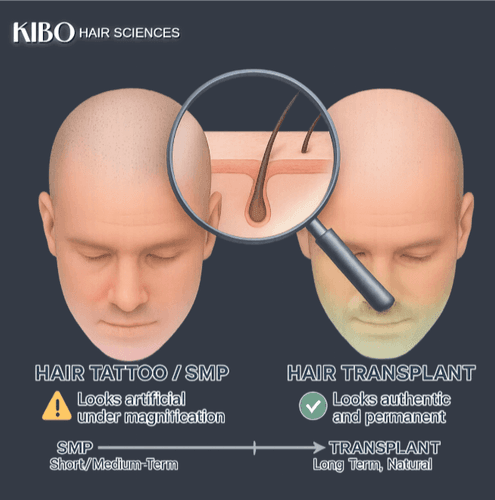
Many people in Mumbai explore both a hair transplant and scalp micropigmentation, sometimes called a hair tattoo, and wonder which will look and feel more natural in daily life and across the years. The honest answer is that they do different jobs. A transplant redistributes living follicles so new hairs grow and can be cut and styled as your own. Scalp micropigmentation places tiny pigment points in the upper skin to reduce the contrast between hair and scalp, which creates the impression of density or a close clipped look. This guide explains the differences in plain language, sets fair expectations for timelines and basic care with trusted references, and offers Mumbai aware planning so you can choose with confidence.
August 12, 2026 – 5 min read
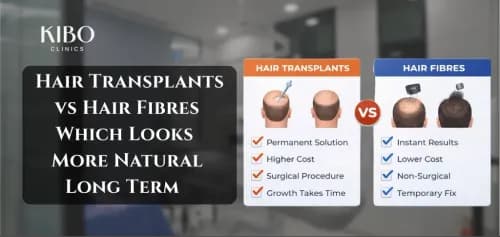
This article compares hair transplants and cosmetic hair fibres from a medical and long-term perspective. It explains how each option works, what results realistically look like over time, and how factors like donor hair quality, growth cycles, maintenance effort, and overall cost influence outcomes. The guide is based on clinical viewpoints from the medical leadership team at Kibo Clinics, where all procedures and consultations are conducted only by certified dermatologists and transplant surgeons.
August 12, 2026 – 5 min read
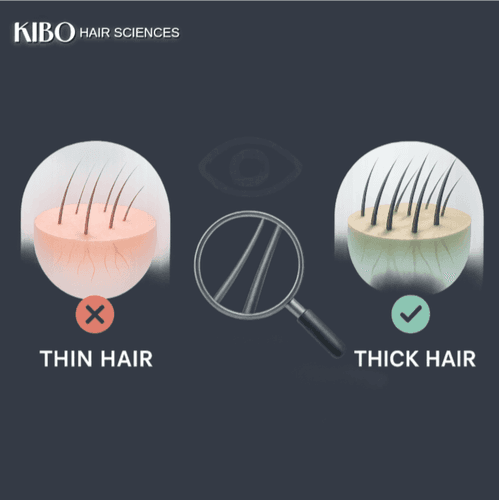
Why hair thickness shapes transplant results more than graft numbers and how fine, medium, or coarse strands change what Mumbai patients see at 6 and 12 months.
August 12, 2026 – 5 min read
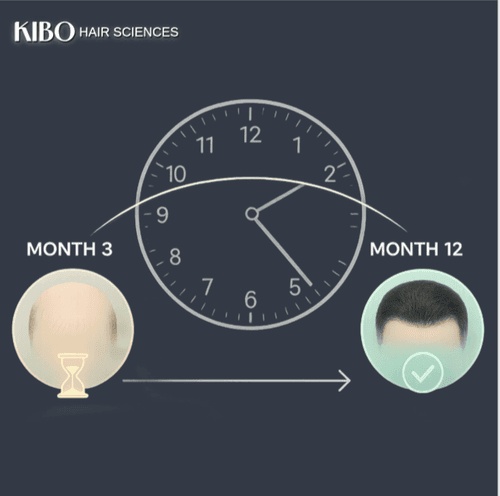
Many people hope to see quick results after a hair transplant, but the real transformation takes time. This guide explains why the twelve-month mark is the true milestone, what to expect during the early months, and how to plan practically if you are in Mumbai.
August 12, 2026 – 5 min read
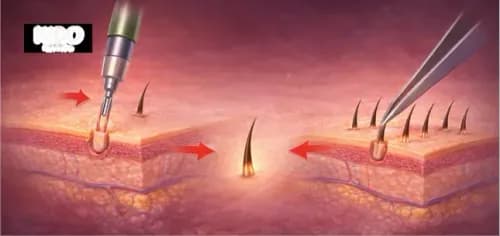
Follicular Unit Extraction (FUE) is a minimally invasive hair transplant technique that restores natural-looking hair by extracting and relocating individual follicular units without creating a linear scar, offering faster recovery and aesthetic flexibility compared to traditional strip-based methods. Success depends on surgical precision during extraction to prevent follicle damage, careful graft handling maintaining viability outside the body, meticulous recipient site creation determining final angle and direction, and realistic density planning that respects finite donor supply.
August 12, 2026 – 5 min read
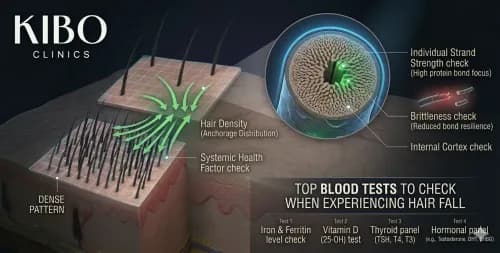
A complete diagnostic guide to blood tests for hair fall covering CBC, ferritin, thyroid panels, hormonal assessments, Vitamin D and B12, inflammation markers, and what each result means for your hair loss treatment plan.
August 12, 2026 – 5 min read
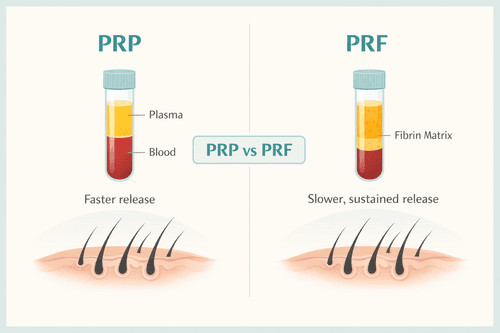
A clinical comparison of PRP and PRF for hair loss covering how each treatment works, key differences in growth factor release, cellular composition, session frequency, cost across Indian cities, and which option suits your hair loss stage and budget.
August 12, 2026 – 5 min read

This guide draws a hard biological line the brief insisted on: a fractured hair shaft cannot be repaired by any product, only cosmetically improved, while an intact follicle can still grow healthy new hair. It separates breakage from shedding and thinning with a 7-row diagnostic table, gives AAD-sourced washing/drying/detangling guidance instead of universal rules, covers real hair-shaft disorders, and is honest about biotin and PRP limits.
September 23, 2026 – 5 min read

For unexplained hair loss, a dermatologist is usually the safer first appointment because a dermatologist is a medical doctor who can diagnose disease and prescribe treatment. A trichologist can be useful for non-medical hair and scalp support, but the title does not by itself mean the person has a medical degree.
August 12, 2026 – 5 min read

A receding hairline, thinning around the crown zone, or patchy hair loss due to genetics, medication, or stress are quite common these days. However, these are no more unsolvable problems, thanks to advances in modern hair transplantation surgeries. While these are safe and effective procedures, recovery is the number-one concern for many people considering hair restoration treatment worldwide.
August 12, 2026 – 5 min read

This guide walks through the real hair transplant procedure step by step, FUE versus FUT, what actually happens on surgery day, a full recovery timeline, who is and isn't a good candidate, common risks and red flags, and what to ask a clinic before booking, all corrected against ISHRS, AAD, and peer-reviewed candidacy and complication data.
September 16, 2026 – 5 min read

DHI and FUE are both advanced hair transplant techniques, but they differ mainly in implantation.
August 12, 2026 – 5 min read
YOUR HAIR JOURNEY STARTS HERE