
Article Information
Reviewed By: Shritej Mali
Written By: Kibo Clinics Content Team
Sources Referenced: American Academy of Dermatology, NHS, MedlinePlus, Journal of Cutaneous and Aesthetic Surgery, ISHRS guidance, British Association of Dermatologists
Last Updated: May 2026
Reading Time: 20 minutes
Who This Is For: Anyone in India considering scalp micropigmentation, hair transplant surgery, or a combined approach for natural-looking coverage
This article is for education only. SMP and hair transplant suitability depend on hair-loss stage, scalp health, donor supply, skin type, and medical history. Always consult a qualified specialist before deciding.
Unsure whether SMP, transplant, or a combined plan is right for you? Board Certified Doctors can assess it properly.
Scalp Micropigmentation with Hair Transplant: Does the Combination Actually Work?
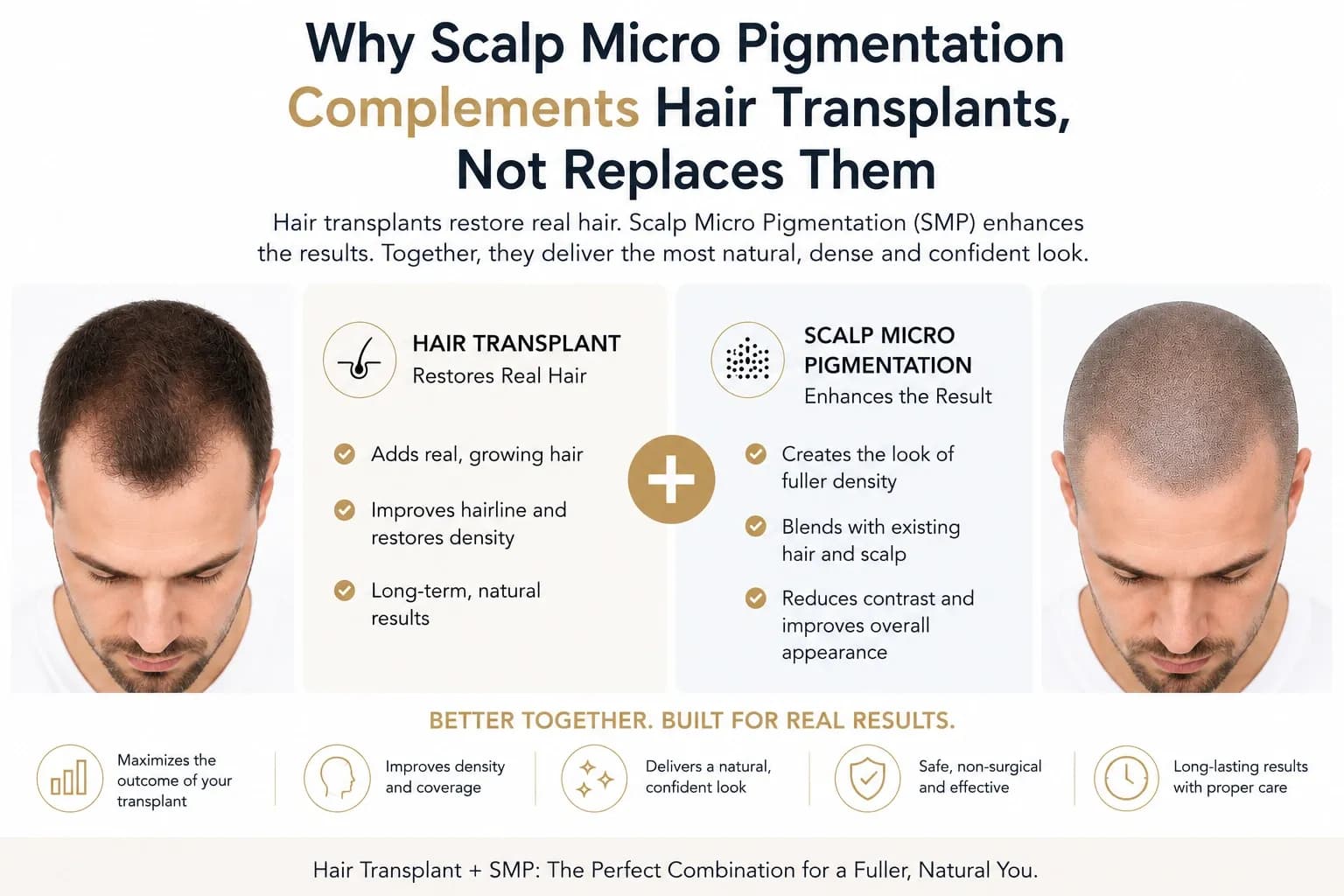
Not a competition, a collaboration. Scalp micropigmentation (SMP) combined with a hair transplant is one of the most practical dual-approach strategies in hair restoration: the transplant relocates living follicles that grow real, washable hair, while SMP places tiny pigment dots to reduce the visible contrast between hair and scalp. Most patients who use both see a calmer recovery journey, a less noticeable dormancy period, and a more natural long-term result than either procedure delivers alone.
SMP with hair transplant is not the same as choosing one over the other. Here is what the combination actually does:
- Hair transplant: Moves follicles from a donor zone, usually the back and sides of the scalp, to thinning areas. Results emerge over 9 to 12 months.
- Scalp micropigmentation: Deposits medical-grade pigment into the upper dermis to mimic the appearance of close-cropped hair follicles. Results are immediate.
- Combined approach: SMP bridges the visual gap during the transplant's dormancy period and refines the look once hair grows in.
Quick fact: According to patient guidance from the American Academy of Dermatology, hair transplant results are typically assessed at the 12-month mark, meaning patients benefit most from SMP as a visual support tool during months 2 to 8 while new hair is still emerging.
The sections below explain how each procedure works at the biological level, who the combination suits best, what a realistic month-by-month timeline looks like, and what you can expect to invest in India.
Why Combining SMP with a Hair Transplant Matters for Long-Term Results
Most people searching this topic have already decided they want to do something. They just want to know whether doing both makes sense, or whether it is over-engineering a solution.
The honest answer: the combination makes the most sense for patients who want to look natural during the 9 to 12 months their transplant takes to mature. Without SMP, the dormancy period, weeks 2 through 8, when transplanted hairs shed before new growth begins, can feel visually frustrating. With SMP, contrast at the crown and parting is reduced, and the look remains composed throughout.
Timelines also matter emotionally. Knowing that bandages come off within the first five days, that gentle washing begins around day six, that FUT stitches are typically removed between days 10 and 14, and that early new hairs usually emerge around month four makes the middle months calmer. SMP works on your timetable because it does not need to grow. It can soften contrast early, then be refined once hair gains length.
In practical city terms, think bright office corridors in BKC, humid commute days, and monsoon weeks. Micropigmentation keeps the parting and crown looking fuller by lowering contrast. As transplanted hairs gain length and overlap, styling becomes easier and reliance on camouflage naturally reduces.
Core Principles for Scalp Micropigmentation with Hair Transplants
A Transplant Adds Strands, Micropigmentation Edits Contrast
A transplant moves living follicles to areas that have thinned. Those follicles grow hair you wash, dry, and style. Micropigmentation places numerous tiny pigment points that mimic the look of short hair at the skin level. Think of the transplant as planting new trees and micropigmentation as thoughtful shading around them so the whole picture feels even.
Timelines Are Different, Which Is Why the Two Fit Well
Surgery follows a known rhythm. Bandages come off within the first few days. Gentle hand washing commonly begins around day six. If a strip closure was used, stitches are often removed between day ten and day fourteen. Many transplanted hairs shed in the weeks that follow. Early new hairs usually appear around month four, with blend improving through the middle months and a reasonable assessment near the one year mark. Micropigmentation works on your timetable, since it does not need to grow. It can soften contrast early, then be refined later when hair has length. The different paces make the pair useful together.
Micropigmentation Is Cosmetic Tattooing, So Skin Comfort Matters
Micropigmentation is a form of tattooing. Patient pages from dermatology organisations explain that tattooed skin may react with redness, itch, or less often allergy, and that care of tattooed skin includes sun sense and gentle moisturising. It is sensible to choose an experienced professional, discuss pigment choice, and plan patch testing or small test areas when appropriate. If your skin is easily irritated, early discussion helps you avoid surprises.
Use Each Tool Where It Shines
Transplants shine at the front edge, mid scalp, and crown when you want hair that behaves like your own. Micropigmentation shines in small gaps along a hairline, in the crown where spacing is naturally visible, and in discreet blending of a thin scar. It also helps if you keep your hair very short. Matching each tool to its best job gets you more for your time and energy.
Documentation Keeps You Fair to Yourself
Daily mirrors change with light and mood. Monthly photos at the same distance tell the truth. After a transplant, take front, both temples, top, and crown in honest light. These show the quiet early stage, the first sprouting, and the later blend. Micropigmentation benefits from photos too. Before and after images in the same corridor light show whether the dot size and tone feel right. Documentation reduces second guessing and keeps adjustments calm.
Sun Protection Is Part of Scalp Care
When coverage is thin, the scalp is exposed skin. National patient pages remind us that exposed skin, including the head when hair is thin, deserves shade and sunscreen. This is true after surgery when the scalp can be sensitive, and it remains true if you have micropigmentation because ultraviolet light can fade pigment over time. Shade and sensible protection keep comfort high and photographs honest.
Mumbai Logistics Influence Design and Aftercare
Design is not just about drawings. It is also about how you live. A hairline that looks perfect under studio lights but needs heavy product every morning may not suit a long commute from Andheri to BKC. A crown that relies only on styling may be challenged by monsoon showers at short notice. A plan that blends transplant design with discreet micropigmentation gives you a look that survives your real week with less effort.
A Blend Makes Future Planning Easier
Your native hair can continue to change across the years. A conservative transplant paired with micropigmentation gives you breathing room, since you can adjust pigment work later without rushing into more surgery. The blend also protects your donor area for the long view while keeping your day-to-day look steady.
Less Is More for a Believable Result
Whether you are adjusting hair direction with a comb or guiding dot density with pigment, restraint is your friend. Softer density at the front edge with gradually richer texture just behind reads as natural. The eye trusts a gentle gradient far more than a hard line. Less is more is the rule that keeps both tools believable.
Partnership Over Rivalry Keeps You in Control
When you treat transplant and micropigmentation as partners, you are free to use a little of one and a little of the other as your needs change. That is the quiet power of a combined plan. It respects your month-to-month life and your year-to-year goals.
How Scalp Micropigmentation and Hair Transplants Work
Understanding why the two procedures complement each other requires understanding how each one works at a biological level, not just what they do, but why they do it.
How a Hair Transplant Works
A hair transplant works because hair follicles in the donor zone, typically the occipital scalp, are genetically resistant to the hormone dihydrotestosterone (DHT), which causes follicle miniaturisation in androgenetic alopecia. When these resistant follicles are relocated to a thinning recipient area, they retain their DHT resistance and continue to produce hair in their new location.
Two primary techniques are used in India. FUE extracts individual follicular units one by one, leaving tiny circular scars that heal within days. FUT removes a strip of scalp skin from the donor zone, dissects it into follicular units, and implants those units. This produces a linear scar but can allow a larger graft number in one sitting. DHI is a variant of FUE in which a specialised implanter pen places grafts directly without creating recipient-site incisions separately.
After transplantation, newly placed follicles go through a shock-shedding phase from weeks 2 to 8 before entering a new anagen growth phase. This biological reset is the reason a transplant takes 9 to 12 months to show its full result. It is not poor technique, but normal follicle biology.
How Scalp Micropigmentation Works
Scalp micropigmentation works by depositing pigment into the upper dermis, the papillary dermis layer, approximately 1 to 2 mm deep, using a specialised needle. Because the pigment sits above the deep vascular layer, the procedure causes minimal bleeding and typically requires no anaesthesia beyond a topical numbing cream.
The pigment dots are designed to replicate the appearance of a shaved hair follicle at the skin surface. When done well, this creates the optical illusion of greater hair density by reducing the contrast between the scalp and existing hair. SMP does not grow hair. It changes the light-to-dark ratio the eye perceives.
This is precisely why SMP is most effective as a complement to a transplant rather than a standalone treatment for patients who want to maintain length: it fills the visual gap while follicles are in their dormancy period.
Why the Two Work Better Together
The combination works because the two procedures operate on different timescales and different mechanisms. A transplant changes the biological reality of the scalp over 12 months. SMP changes the visual perception of the scalp immediately. Together, they mean the patient does not have to go through a prolonged period of looking noticeably thin while waiting for the transplant result to mature.
SMP vs Hair Transplant: Which Is Right for You?
The question most people ask, SMP or hair transplant, reveals a false choice. The more useful question is: which combination of tools matches your hair-loss stage, lifestyle, and goal?
| Factor | Hair Transplant | Scalp Micropigmentation | Combined Approach |
|---|---|---|---|
| What changes | Actual follicles are relocated and real hair grows | Pigment dots reduce visual contrast | Real growth plus optical density |
| Result timeline | First signs at month 4; full assessment at 12 months | Immediate; final look within 2 to 3 sessions | Immediate SMP support plus 12-month transplant result |
| Hair loss stage suited | Norwood 2 to 6 | Any stage; often useful for NW 5 to 7 as sole option or NW 1 to 4 as complement | NW 2 to 5 seeking maximum naturalness |
| Maintenance | Ordinary washing and styling once healed | Periodic refresh every 3 to 5 years | Both regimens; low overall effort |
| Scar visibility | FUE: minimal circular scars; FUT: linear scar | Can camouflage both scar types | Transplant creates coverage; SMP blends scar edge |
| Approximate India cost | Rs 40,000 to Rs 2,00,000+ depending on graft count and technique | Rs 15,000 to Rs 60,000 for full scalp | Rs 55,000 to Rs 2,50,000+ combined |
| Best for | Patients who want real, styleable hair | Patients who keep hair very short or want scar coverage | Patients who want the most natural possible result across all lighting |
Who Should Choose a Combined SMP and Transplant Approach?
Ideal candidates include patients who are at Norwood stage 2 to 5 with defined areas of thinning, want to maintain a natural hairline under office lighting and outdoor conditions, have a strip scar they want to conceal in the donor area, live in cities like Mumbai or Delhi where bright corridor and outdoor light makes spacing more visible, and prefer to reduce daily styling effort while results mature.
The combination is typically not recommended for patients who are in active phases of hair loss without medical stabilisation, have skin conditions such as active scalp psoriasis, eczema, or folliculitis at the SMP treatment site, or expect transplant-level density from SMP alone. SMP creates the illusion of density, but it does not add hair volume.
One-line fact: SMP is a visual bridge, not a biological fix. It works best when a transplant is building real density in parallel.
Practical Checklist for Scalp Micropigmentation with Hair Transplants
- Write one sentence about your aim, for example, I want a natural frame in bright office light without a heavy daily routine.
- Read a trusted hair transplant results timeline so you know when bandages are usually removed, when gentle washing commonly begins, when stitches from a strip method are often removed, when early shedding may occur, and when early new hairs usually start to appear.
- Book time for a design conversation. Map your hairline in calm light. Decide how conservative the line should be, and where micropigmentation could quietly support it in the first months.
- Ask about dot size and tone for micropigmentation. Photographs in the same light help you see what looks balanced on your skin.
- If you have sensitive skin or a history of reactions, discuss pigment choices and aftercare in advance.
- Plan honest monthly photos after your transplant. Take front, both temples, top, and crown in the same place and distance. Add one set after micropigmentation to check balance.
- Protect scalp skin in bright hours while it is sensitive and coverage is thin. Shade for midday errands is a simple start.
- During monsoon weeks, carry a soft cloth to blot rain rather than rub. Gentle blotting after a sudden shower keeps any recent work comfortable and keeps hair sitting well.
- For two-wheeler commutes, keep a clean cotton helmet liner. Wash it often so salt and friction do not irritate skin.
- Keep tools simple. Gentle shampoo, a soft towel, and a wide-tooth comb are often all you need. Early on, avoid heavy products at the front edge.
- Review calmly. Small refinements in pigment tone or density are easier than big changes. Leave space for your new hair to grow before you judge the blend fully.
Planning for Mumbai Life: Light, Heat, Rain, and Commute
Mumbai tests every hair plan. You move from humid platforms to air-conditioned lobbies, and the look needs to hold in both environments.
Light: Bright office corridors and lift lobbies show scalp texture more than bedroom lamps do. Design your hairline to read naturally in white fluorescent light. A soft edge with slightly higher density just behind it is more convincing than a dense, hard front line.
Heat and humidity: On humid afternoons, fine hair presses flat against the scalp. SMP reduces the contrast that becomes visible when hair sits flatter than expected. As transplanted hairs gain length from month 4 onward, they overlap more and resist humidity's visual effect.
Rain: Keep a compact umbrella for short walks between buildings. If caught in a shower, blot with a soft cloth rather than rub. Patting dry maintains SMP dot clarity and keeps transplanted hairs sitting well.
Commutes: Two-wheeler rides compress hair under a helmet. A clean cotton liner reduces friction and sweat. After arriving, allow two minutes of air time, then set the hairline once with a wide-tooth comb. Wash the liner every three to four days.
Scheduling: Book transplant review appointments in early morning or late evening to avoid peak commute times. For SMP sessions, choose unhurried days. Assessing pigment tone in different lights before leaving the clinic is worth the extra 15 minutes.
Month-by-Month Timeline: What to Expect When You Combine SMP with a Hair Transplant
One of the most searched questions about this combination is when to schedule SMP relative to a hair transplant. The answer depends on which SMP application you need: pre-transplant camouflage, post-transplant framing, or donor-area scar concealment.
| Time After Transplant | What Typically Happens | Recommended SMP Action |
|---|---|---|
| Days 1 to 5 | Bandages removed; scalp tender and sensitive | No SMP. Scalp needs to heal. |
| Days 6 to 14 | Gentle washing permitted; FUT stitches removed around day 10 to 14 | No SMP. Still in acute recovery. |
| Weeks 2 to 8 | Transplanted hairs shed; scalp can look sparse | SMP session 1 can begin, with light dot work at crown and parting. |
| Month 2 to 3 | Scalp normalises; new follicles enter anagen phase beneath the skin | SMP refinement session to adjust tone and dot density. |
| Month 4 to 5 | First new hairs emerge; texture starts to build | Assess whether framing needs refinement as real hair density increases. |
| Month 6 to 9 | Overlap improves; styling becomes easier | Minor touch-up if needed. |
| Month 10 to 12 | Fair assessment of transplant result | Full review. Adjust if the SMP gradient no longer matches hair density. |
| Year 3 to 5 | SMP pigment begins to soften naturally | Periodic refresh session to maintain even tone. |
What Affects Results?
Graft survival rate: This is influenced by surgeon experience, storage time of grafts, and recipient site design. Studies in the Journal of Cutaneous and Aesthetic Surgery report survival rates of 85 to 98% in experienced hands.
Skin type and pigment retention: Melanin-rich skin, common across Indian skin tones, retains SMP pigment well but requires careful tone matching to avoid pigment appearing too blue or grey over time.
Ongoing hair loss: If androgenetic alopecia is not medically managed, native hair around transplanted grafts may continue to thin, requiring future sessions. Patients often discuss finasteride after hair transplant or minoxidil with their dermatologist as part of maintenance planning.
Sun exposure: Ultraviolet light degrades SMP pigment. SPF protection on exposed scalp skin matters, particularly in the first 6 months post-procedure...
Medical Disclaimer : Information from Kibo Hair Clinics is for educational purposes only. It does not replace diagnosis, trichoscopy, blood test interpretation, prescription treatment, procedure advice, or side-effect counselling from a qualified dermatologist or hair restoration doctor.