
Quick Answer:
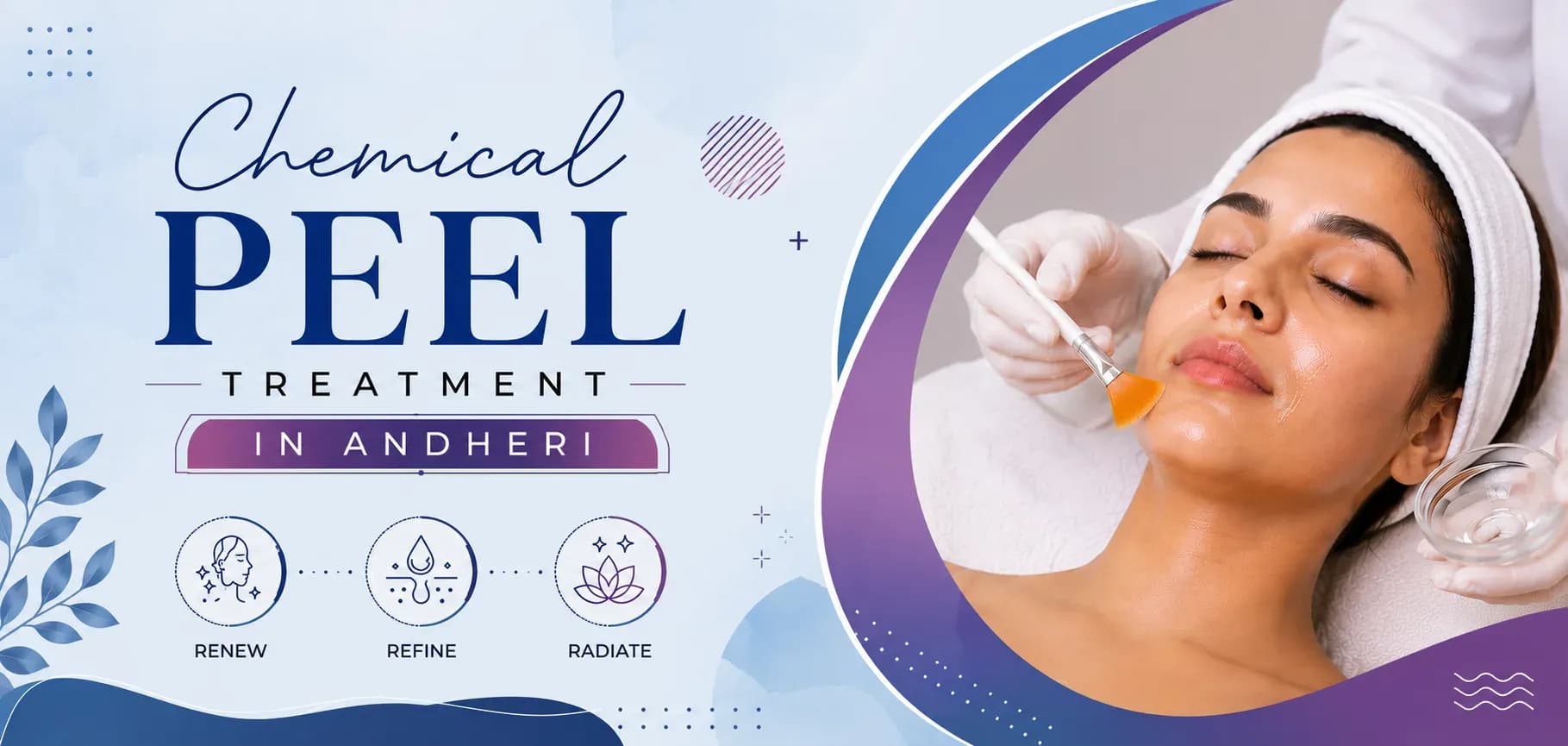
Chemical peel treatment in Andheri is a clinically performed skin resurfacing procedure using acid solutions to remove damaged outer skin layers, revealing smoother, clearer skin underneath. It is suitable for acne, pigmentation, dullness, fine lines, and uneven skin tone. Most patients in Andheri can access superficial to medium-depth peels at certified skin clinics with minimal downtime.
What Is Chemical Peel Treatment in Andheri?
Chemical peel treatment in Andheri is a dermatologist-performed procedure in which a chemical solution, typically containing glycolic acid, salicylic acid, lactic acid, or TCA (trichloroacetic acid), is applied to the skin to exfoliate and remove damaged surface layers. As the outer layers shed, the skin regenerates with improved texture, tone, and clarity.
The treatment addresses a wide range of skin concerns:
- Active acne and comedones
- Post-acne marks and hyperpigmentation
- Melasma and sun damage
- Fine lines related to photoageing
- Enlarged pores and uneven skin tone
Chemical peel treatment in Andheri is appropriate for both men and women. The acid type, concentration, and contact time are customised based on individual skin type and concern.
Why chemical peels are particularly relevant in Andheri: Mumbai's climate, high humidity, intense UV exposure, and sustained pollution, accelerates skin damage and pigmentation. Chemical peels offer a clinically validated, cost-effective method to reverse this damage, with results typically visible within 1-3 sessions.
Key terms used throughout this guide:
- Superficial peel: Targets the epidermis only; uses low-concentration AHAs or BHAs
- Medium peel: Reaches the upper dermis; uses TCA at 20-35% concentration
- Deep peel: Penetrates deeper dermal layers; uses phenol; rarely performed in routine outpatient practice
- Peeling agent: The active chemical solution applied during the procedure
- PIH (post-inflammatory hyperpigmentation): Darkening of the skin triggered by inflammation, the most common risk in Indian skin tones
- Downtime: The recovery period during which skin may flake or appear red
How Does Chemical Peel Treatment in Andheri Work?
Chemical peel treatment in Andheri works by applying an acidic solution to the skin, which disrupts the bonds between dead and damaged skin cells, causing controlled exfoliation. The skin responds to this controlled injury by accelerating cell turnover and collagen production, producing clearer, firmer skin over subsequent weeks.
Step-by-Step Process
Consultation and skin assessment, The dermatologist evaluates skin type using the Fitzpatrick scale, identifies active conditions, and reviews treatment history. This step determines the appropriate peel type and strength.
Pre-peel skin preparation (2-4 weeks before), A preparatory regimen, typically retinoids or a depigmenting cream, may be prescribed to prime the skin and reduce PIH risk.
Before choosing peel strength, patients should understand possible chemical peel side effects, especially on Indian skin tones.
For patients focused mainly on marks and melasma, a chemical peel for pigmentation may be planned with gentler acids and strict sunscreen use.
Cleansing and degreasing, On treatment day, the skin is cleaned and degreased with acetone or alcohol to ensure even acid penetration.
Application of the peeling agent, The chemical solution is applied evenly using a brush or gauze. The dermatologist monitors timing carefully, typically 1-5 minutes for superficial peels and up to 15 minutes for medium peels.
Neutralisation, For certain acids such as glycolic acid, a neutralising agent (sodium bicarbonate) halts the reaction. Salicylic acid self-neutralises.
Post-peel soothing and sun protection, A calming serum and broad-spectrum SPF 50+ sunscreen are applied immediately. The patient receives a written home-care protocol.
After the session, following proper chemical peel post treatment care can reduce irritation and pigmentation risk.
Peeling and recovery phase, Skin begins to flake or peel between days 2-5 post-treatment, which is the active cellular renewal phase.
Patients can also review the chemical peel process day by day to understand normal redness, flaking, and healing stages.
Why Chemical Peels Work: The Core Mechanism
Chemical peel treatment in Andheri triggers three simultaneous biological responses:
- Corneocyte desquamation, Acid dissolves the desmosomes holding dead skin cells together, accelerating exfoliation
- Keratinocyte proliferation, New skin cells are stimulated to replace shed layers faster than the natural 28-40 day turnover cycle
- Collagen remodelling, Medium and deep peels stimulate fibroblast activity, increasing collagen and elastin production in the dermis
Common Misconceptions
- "The skin must visibly peel for the treatment to work", Superficial peels may cause minimal visible peeling while still delivering measurable cellular renewal
- "Chemical peels thin the skin", When performed correctly, peels stimulate collagen production and can improve skin thickness over time
- "One session is sufficient", Most concerns require a course of 3-6 sessions spaced 2-4 weeks apart
What Are the Benefits of Chemical Peel Treatment in Andheri?
Chemical peel treatment in Andheri delivers measurable improvements in skin texture, tone, and clarity, typically within 3-6 sessions for moderate concerns. According to Kibo Skin Clinic's clinical team, the following benefits are consistently observed across patient profiles.
Short-Term Benefits (Within 1-2 Sessions)
- Improved skin texture, Surface roughness is reduced as dead skin cells are removed
- Brighter complexion, Dullness caused by dead cell buildup is visibly reduced within days of peeling
- Reduced active acne, Salicylic acid peels reduce active breakouts by clearing sebaceous follicles and reducing P. acnes bacterial load
- Minimised appearance of open pores, Exfoliation reduces the look of enlarged pores, particularly on the nose and chin
Long-Term Benefits (After 3-6 Sessions)
- Reduced hyperpigmentation and melasma, Studies suggest glycolic acid peels at 30-70% concentration can reduce the melanin index by up to 30-40% after a series of 6 sessions
- Faded acne scars and post-inflammatory marks, A regular peel series accelerates the natural fading of PIH by 2-4x compared to untreated skin
- Collagen stimulation, Medium-depth TCA peels have been shown to increase dermal collagen density measurably within 3 months
- Reduced fine lines, Superficial peels improve the appearance of fine lines related to photoageing, particularly around the eye and mouth area
Who Benefits Most from Chemical Peels in Andheri?
- Patients with acne-prone or oily skin
- Individuals with post-acne hyperpigmentation
- Adults aged 20-50 concerned about early photoageing
- Patients with melasma, with appropriate peel selection and strict sun protection
- Those seeking a non-laser, lower-cost skin rejuvenation option
What Are the Types of Chemical Peel Treatment in Andheri?
Chemical peel treatment in Andheri is available in three primary depth categories, superficial, medium, and deep, each suited to different skin concerns, skin types, and tolerance levels. A dermatologist may recommend peel selection based on a structured skin assessment rather than patient preference alone.
Superficial Peels (Light Peels)
Superficial peels use low-concentration acids, glycolic acid 20-50%, salicylic acid 20-30%, lactic acid, or mandelic acid, to exfoliate the outermost epidermal layer only. Downtime is minimal: typically 1-3 days of mild flaking. These peels are suitable for all skin types, including darker Fitzpatrick skin tones (IV-VI), and can be done as a monthly maintenance treatment.
Best for: Acne, mild pigmentation, dullness, oily skin
Medium-Depth Peels
Medium peels use TCA at 20-35% concentration, sometimes combined with glycolic acid or Jessner's solution, to penetrate the upper dermis. They produce more visible peeling over 5-7 days and carry a slightly higher risk of PIH in darker skin tones. Results are more pronounced and longer-lasting than superficial peels.
Best for: Moderate pigmentation, acne scars, fine lines, sun damage
Deep Peels
Deep peels (phenol-based) penetrate the reticular dermis and produce dramatic resurfacing. They require sedation, longer downtime (up to 14-21 days), and careful patient selection. Deep peels are rarely performed in routine outpatient dermatology in Mumbai and are generally reserved for severe photoageing in lighter skin tones.
Best for: Severe photoageing, deep wrinkles (specialist indication only)
Comparison Table: Chemical Peel Types in Andheri
| Feature | Superficial Peel | Medium Peel | Deep Peel |
|---|---|---|---|
| Common acids used | Glycolic, Salicylic, Lactic, Mandelic | TCA 20-35%, Jessner's | Phenol |
| Depth of penetration | Epidermis | Epidermis + upper dermis | Deep dermis |
| Downtime | 1-3 days | 5-7 days | 14-21 days |
| Sessions required | 4-6 | 2-3 | Usually 1 |
| Suitable for dark skin tones | Yes | With caution | Generally not recommended |
| Best concerns | Acne, mild pigmentation, dullness | Scars, moderate pigmentation | Severe photoageing |
| Approximate cost per session (Andheri) | ₹1,500-₹4,000 | ₹4,000-₹10,000 | ₹15,000-₹30,000+ |
Is Chemical Peel Treatment Safe for Indian Skin Tones?
Yes, chemical peel treatment in Andheri is safe for Indian skin tones, but the peel type and concentration must be matched carefully to the patient's Fitzpatrick skin type to avoid post-inflammatory hyperpigmentation (PIH). This is the single most important safety consideration for patients seeking treatment in Andheri.
Most people in Mumbai fall into Fitzpatrick Types III-V. These skin tones carry a higher baseline risk of PIH compared to lighter skin types, meaning that an incorrectly selected peel, or a medium peel applied to unprepared skin, can cause dark patches that are harder to treat than the original concern.
Why Darker Skin Tones React Differently to Chemical Peels
Skin in Fitzpatrick Types III-VI produces more melanin and responds more aggressively to inflammation or skin barrier disruption. A peel that causes minimal redness in a Type II patient may trigger a significant inflammatory response, and therefore post-peel darkening, in a Type IV or V patient.
This does not mean peels are off-limits. It means:
- Superficial peels (glycolic acid 20-35%, mandelic acid, lactic acid) are generally well-tolerated across all Indian skin tones
- Salicylic acid peels are particularly suitable for oily, acne-prone South Asian skin because the acid self-neutralises and carries anti-inflammatory properties
- Medium-depth TCA peels require a mandatory 2-4 week pre-peel preparatory regimen (retinoid plus depigmenting agent) before proceeding
- Phenol deep peels are generally not recommended for Fitzpatrick Types V-VI
One clinically noted fact: Mandelic acid is specifically favoured for Indian and South Asian skin tones because its larger molecular size results in slower, more even penetration, reducing PIH risk compared to glycolic acid at equivalent concentration.
The Role of Pre-Peel Preparation
For darker skin tones, pre-peel preparation is not optional, it is the clinical standard that separates a safe outcome from a PIH complication. A 2-4 week preparatory course of low-strength retinoid or hydroquinone-based cream primes melanocytes to respond more evenly to acid exposure.
Skipping this step is one of the most common reasons patients experience unexpected darkening after a peel, particularly at clinics that omit the preparation protocol to reduce cost or turnaround time.
Ideal Candidates vs. Those Who Should Exercise Caution
| Ideal Candidates in Andheri | Should Proceed with Caution / Not Ideal |
|---|---|
| Fitzpatrick Types III-V with oily or acne-prone skin | Active inflammatory acne without prior stabilisation |
| Adults aged 18-55 with post-acne marks or uneven tone | Isotretinoin (Accutane) users within the last 6 months |
| Patients with mild-to-moderate melasma seeking adjunct therapy | Pregnant or breastfeeding patients |
| Those who can commit to daily SPF 50+ post-treatment | Patients with active cold sores, eczema flares, or open wounds |
| Patients with dull, pollution-damaged skin from Mumbai's environment | Those unable to avoid sun exposure for 7-10 days post-treatment |
How Much Does Chemical Peel Treatment Cost in Andheri?
Chemical peel treatment cost in Andheri typically ranges from ₹1,500 to ₹10,000 per session for superficial and medium-depth peels, the most commonly performed types. Deep phenol peels are rarely done in routine practice and are priced separately on consultation.
For wider city pricing, compare chemical peel treatment cost Mumbai before deciding on a full course.
The cost varies based on three factors: peel depth and acid type, the dermatologist's experience level, and whether a preparatory or post-peel product regimen is included in the package price.
Approximate Cost Per Session in Andheri
| Peel Type | Per Session | Recommended Course | Estimated Course Cost |
|---|---|---|---|
| Superficial peel (glycolic, salicylic, lactic) | ₹1,500-₹4,000 | 4-6 sessions | ₹6,000-₹24,000 |
| Medium-depth peel (TCA 20-35%) | ₹4,000-₹10,000 | 2-3 sessions | ₹8,000-₹30,000 |
| Combination peel (Jessner's + TCA) |
Medical Disclaimer : Information from Kibo Hair Clinics is for educational purposes only. It does not replace diagnosis, trichoscopy, blood test interpretation, prescription treatment, procedure advice, or side-effect counselling from a qualified dermatologist or hair restoration doctor.