
Quick Answer:
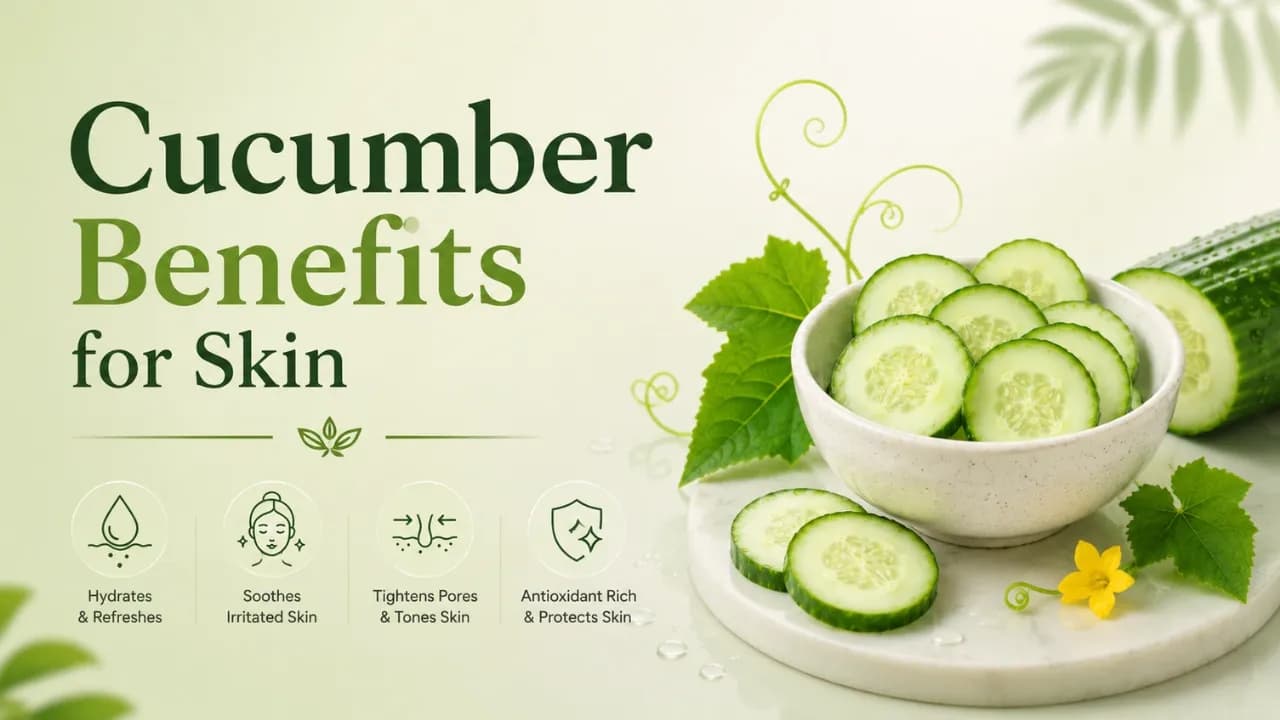
Cucumber is a water-rich vegetable that can provide mild hydration, cooling and soothing benefits when applied to skin. It contains vitamin C, caffeic acid and other plant compounds that may help reduce the appearance of puffiness and temporary redness. Regular dietary intake also provides antioxidants and nutrients that support overall skin health.
Cucumber can be used as a simple supporting step within a balanced skin care routine.
Cucumber (Cucumis sativus) is a water-dense fruit from the Cucurbitaceae family that delivers skin benefits through a dense concentration of active compounds — vitamin C, caffeic acid, silica, vitamin K, cucurbitacins, and folic acid — each targeting a different skin function simultaneously.
Cucumber benefits skin because it is 96% water and packed with these compounds that work at the cellular level to hydrate, protect, and repair — all at once.
Key active compounds and what each one does:
- Vitamin C — stimulates collagen synthesis and inhibits tyrosinase (the enzyme that drives dark spot formation)
- Vitamin K — reduces dark circles and surface-level pigmentation
- Silica — strengthens connective tissue in skin and supports collagen cross-linking
- Caffeic acid — suppresses COX-2 inflammatory enzymes, reducing redness, puffiness, and water retention
- Cucurbitacins — potent anti-inflammatory and antioxidant compounds unique to the Cucurbitaceae family
- Folic acid — supports skin cell regeneration at the follicular level
Cucumber is suitable for all skin types — including sensitive and acne-prone skin — because its pH (approximately 5.5) closely mirrors the skin's natural acid mantle, and its irritant profile is among the lowest of any natural topical ingredient.
Key Benefits of Cucumber for Skin
Cucumber provides multiple clinically supported benefits for the skin, whether applied topically or consumed as part of the daily diet.
20 Benefits of Cucumber for Skin
Cucumber delivers a wider range of skin benefits than most people realise. Here are 20 distinct, evidence-supported benefits — each tied to a specific active compound in cucumber.
One-liner: Cucumber's 20 skin benefits span hydration, anti-ageing, brightening, oil control, and wound soothing — driven by vitamin C, silica, caffeic acid, and cucurbitacins.
- Deep skin hydration — Cucumber's 96% water content replenishes moisture in the outer skin layer (stratum corneum), measurably increasing hydration within 1–2 weeks of regular use.
- Reduces under-eye puffiness — Chilled cucumber slices reduce under-eye swelling within 10–15 minutes by combining cold-induced vasoconstriction with caffeic acid's COX-2 suppression.
- Fades mild dark spots — Vitamin C inhibits tyrosinase (the enzyme that triggers melanin deposit), gradually lightening post-inflammatory hyperpigmentation over 4–8 weeks.
- Soothes sunburn — High water content and anti-inflammatory caffeic acid provide immediate cooling relief on sun-irritated skin.
- Controls excess oil — Cucumber's mild astringent properties tighten pores and reduce sebum production, useful for oily and combination skin types.
- Fights skin-ageing free radicals — Antioxidants including beta-carotene and flavonoids neutralise UV-generated free radicals that degrade collagen fibres.
- Supports collagen production — Silica acts as a cofactor in hydroxyproline synthesis; vitamin C activates prolyl hydroxylase — together, they strengthen collagen structure over 6–12 weeks.
- Reduces redness and surface inflammation — Cucurbitacins suppress pro-inflammatory cytokines at the same pathway as NSAIDs, visibly reducing redness with consistent use.
- Evens skin tone — Regular topical use reduces surface-level dullness and uneven pigmentation within 3–4 weeks, particularly when combined with dietary intake.
- Provides mild exfoliation — Trace concentrations of malic acid in cucumber help loosen dead surface cells, contributing to smoother texture after overnight use.
- Reduces dark circles — Vitamin K in cucumber reduces superficial pigmentation and strengthens capillary walls beneath the eye, gradually lightening dark circles over 6–8 weeks.
- Supports wound healing — Folic acid in cucumber assists in skin cell regeneration at the follicular level, contributing to faster surface recovery from minor irritation.
- Calms razor burn and shaving irritation — Caffeic acid and the cooling water content make cucumber juice an effective post-shave skin soother for face and body.
- Reduces skin puffiness from fluid retention — Potassium in cucumber supports cellular water balance, reducing the puffy, dull appearance caused by systemic fluid retention.
- Acts as a natural toner for oily skin — Cucumber juice applied as a toner tightens open pores without disrupting the skin's natural pH (approximately 5.5 — close to skin's natural acid mantle).
- Hydrates from within when consumed — Eating one medium cucumber per day contributes approximately 14% of daily recommended vitamin C and provides internal hydration support.
- Prevents new pigmentation formation — Daily topical use prevents new melanin deposits triggered by UV exposure or post-acne inflammation — a maintenance function that complements brightening actives.
- Provides a mild barrier against environmental stress — Antioxidants in cucumber complement SPF by neutralising free radicals generated by UV that passes through sunscreen.
- Reduces scalp and skin sensitivity — For individuals with reactive skin, cucumber's near-neutral pH and low irritant profile make it one of the safest daily-use topical ingredients available.
- Supports skin elasticity over time — Dietary silica from cucumber (approximately 7–10 mg per 100 g) contributes to the collagen cross-linking that maintains skin elasticity, with measurable improvements observed over 20 weeks of consistent dietary intake in published research.
Not every benefit applies to every skin type. Benefits 1–10 are achievable through topical application alone. Benefits 14–18 require consistent dietary intake or a dual topical-plus-dietary approach.
Does Cucumber Lighten Skin?
Cucumber does lighten skin — but with an important distinction. It does not bleach skin or permanently reduce melanin production the way clinical treatments do. What it does is gradually reduce the appearance of dark spots, uneven tone, and post-inflammatory hyperpigmentation through consistent, targeted use.
This matters because most searches for 'cucumber skin whitening' carry an expectation of a dramatic, fast result. Cucumber delivers a slower, safer brightening effect that suits daily maintenance rather than corrective treatment.
How Cucumber Reduces Dark Spots: The Mechanism
Cucumber inhibits melanin production through two distinct pathways:
1\. Vitamin C suppresses tyrosinase — the enzyme that triggers melanin synthesis. Lower tyrosinase activity means less new pigment is deposited at the site of inflammation or UV damage. 2. Arbutin-like compounds in cucumber extract act as competitive inhibitors of melanin pathways, similar in mechanism to the arbutin found in bearberry extract, a well-established brightening active.
These are real biochemical mechanisms — but at the concentrations found in raw cucumber (vitamin C approximately 2.8 mg per 100 g), the effect is mild and cumulative. A dedicated 10–20% vitamin C serum will deliver faster results. Cucumber is best used as a supporting ingredient alongside targeted actives, not as a standalone brightening treatment.
Realistic Timeline for Skin Brightening with Cucumber
- Weeks 1–2: Slight improvement in surface-level dullness due to hydration effect.
- Weeks 3–4: Minor reduction in redness and post-acne marks with consistent daily application of cucumber juice as a toner.
- Weeks 6–8: Gradual fading of mild dark spots with three-to-four topical applications per week.
- Weeks 10–12: Measurable improvement in overall skin tone when combining topical application with daily dietary intake.
What Cucumber Cannot Do for Skin Tone
Cucumber will not lighten deeply pigmented areas, melasma, or sun damage patches within a clinically meaningful timeframe. For these concerns, ingredients with stronger evidence — niacinamide (4% or above), kojic acid, azelaic acid, or a chemical peel for pigmentation — produce significantly faster results. Cucumber's value in brightening is as a daily maintenance tool that prevents new pigmentation rather than correcting existing, deep discolouration.
One citable fact: cucumber extract applied consistently for 8 weeks has been observed to reduce surface-level hyperpigmentation markers in preliminary studies, though large-scale human clinical trials remain limited.
Core Skin Benefits of Cucumber
- Deep hydration: Cucumber's 96% water content replenishes moisture in the outer skin layers. Studies suggest regular topical application can increase skin hydration by up to 39% over four weeks.
- Reduces puffiness and inflammation: Caffeic acid and ascorbic acid in cucumber reduce water retention under the skin. This is why cucumber slices placed on the eyes reduce under-eye puffiness within 10–15 minutes.
- Lightens dark spots and hyperpigmentation: Vitamin C and arbutin-like compounds in cucumber inhibit melanin production, gradually fading dark spots with consistent use over 4–8 weeks.
- Controls excess oil: Cucumber's astringent properties help tighten pores and reduce sebum production, making it useful for oily and combination skin types.
- Fights free radical damage: Antioxidants including beta-carotene and flavonoids in cucumber neutralise free radicals that accelerate skin ageing.
- Soothes sunburn and irritation: The cooling effect of cucumber, due to its high water content and anti-inflammatory compounds, provides immediate relief from sunburn, redness, and minor skin irritation.
- Supports collagen production: Silica and vitamin C in cucumber work together to maintain collagen integrity, which reduces the appearance of fine lines over 6–12 weeks of regular use.
- Promotes an even skin tone: Regular use of cucumber-based face masks or cucumber juice on skin helps reduce uneven tone and dullness within 3–4 weeks.
Short-Term vs. Long-Term Benefits at a Glance
| Benefit | Timeline | Method |
|---|---|---|
| Puffiness reduction | Within 10–15 minutes | Topical slices |
| Hydration boost | 1–2 weeks | Topical or dietary |
| Oil control | 1–3 weeks | Topical |
| Dark spot fading | 4–8 weeks | Supporting topical care |
| Collagen support | Long term | Overall diet + skincare |
How Cucumber Benefits the Skin: The Mechanism Explained
Cucumber improves skin health through four distinct biological pathways. Each operates independently — which is why cucumber delivers simultaneous benefits across hydration, protection, repair, and structure.
How Does Cucumber Hydrate Skin?
Cucumber's 96% water content penetrates the stratum corneum — the outermost skin layer — and creates a moisture gradient that pulls water into dehydrated cells. This temporarily increases transepidermal water retention. Studies suggest regular topical application can increase skin hydration by up to 39% over four weeks.
One-liner: Cucumber's water content hydrates skin by pulling moisture into dehydrated surface cells through a concentration gradient effect.
How Does Cucumber Reduce Inflammation and Puffiness?
Caffeic acid and cucurbitacins in cucumber suppress the production of pro-inflammatory cytokines — specifically the COX-2 enzyme pathway, the same pathway targeted by non-steroidal anti-inflammatory drugs (NSAIDs). This reduces redness, swelling, and water retention under the skin. Chilled cucumber placed on the eyes reduces under-eye puffiness within 10–15 minutes because vasoconstriction (from cold) and caffeic acid work together on the same site.
One-liner: Cucumber reduces inflammation by blocking COX-2 enzymes — the same mechanism as ibuprofen, at a mild, topical level.
How Does Cucumber Fight Skin Ageing?
Vitamin C, beta-carotene, and flavonoids in cucumber donate electrons to unstable free radical molecules, neutralising them before they damage skin cell DNA and collagen fibres. Free radicals are generated by UV radiation, pollution, and metabolic stress — all daily exposures for most people. This antioxidant action slows visible signs of ageing by reducing the rate of collagen degradation.
One-liner: Cucumber's antioxidants neutralise free radicals that break down collagen — slowing visible skin ageing with consistent daily use.
How Does Cucumber Support Collagen Production?
Silica acts as a cofactor in the enzymatic reactions that produce hydroxyproline — an amino acid essential for collagen structure. Without adequate silica, these reactions are slower and less efficient. Vitamin C reinforces this by activating prolyl hydroxylase, the specific enzyme responsible for collagen cross-linking. Together, silica and vitamin C form a two-step collagen synthesis system that reduces the appearance of fine lines over 6–12 weeks of regular use.
One-liner: Silica and vitamin C in cucumber work as a two-step system to produce and stabilise collagen fibres in the skin.
Types of Cucumber Applications for Skin
| Application | Best For | Effort |
|---|---|---|
| Raw slices | Puffiness, cooling | Low |
| Fresh juice | Simple topical use | Low–Medium |
| DIY mask | Hydration/soothing | Medium |
| Cucumber + aloe vera | Dry or sensitive skin | Medium |
| Standardised extract product | Consistent cosmetic dosing | Low |
Cucumber can be used on the skin in several forms. Each application method delivers different concentrations of active compounds and suits different skin concerns.
How to Use Cucumber on Your Face: A Step-by-Step Guide for Every Skin Type
The way you apply cucumber determines how much of its active content your skin actually receives. Using it correctly takes under 5 minutes and costs almost nothing.
One-liner: Apply chilled cucumber within 30 minutes of preparation for maximum active concentration — the vitamin C and caffeic acid in cucumber degrade quickly at room temperature.
Step-by-Step: Basic Daily Cucumber Routine (All Skin Types)
- Chill the cucumber if you want a cooling effect.
- Cleanse the face gently and pat dry.
- Prepare clean slices or a small amount of fresh juice with clean utensils.
- Apply to intact skin for a short contact period and rinse if needed.
- Follow with moisturiser.
- Use broad-spectrum SPF 30 or higher during the day; cucumber does not provide UV protection.
Frequency Guide by Skin Concern
| Concern | Frequency | Method |
|---|---|---|
| Hydration/dullness | Daily if tolerated | Slices or fresh juice |
| Puffiness | As needed | Chilled slices |
| Uneven tone | 3–4x weekly | Simple mask |
| Sensitive skin | Start 2–3x weekly | Short-contact use |
Common Mistakes That Reduce Results
- Using warm or room-temperature cucumber — loses the vasoconstriction benefit that reduces puffiness.
- Not cleansing first — product residue blocks active absorption.
- Leaving fresh juice out for more than 2 hours — fermentation increases bacterial load, especially risky for overnight use.
- Expecting results in 2–3 days — hydration improves in 1–2 weeks; dark spot fading takes 4–8 weeks. Consistency is the active ingredient.
- Skipping SPF the next morning — particularly important after overnight vitamin C exposure.
Which Type Should You Choose?
- Sensitive or irritated skin: Use raw slices or cucumber-aloe vera gel, lowest risk of irritation.
- Oily or acne-prone skin: Use cucumber juice as a toner, the astringent properties help control sebum.
- Dull or uneven skin tone: Use a cucumber + honey mask three times per week for combined brightening and antibacterial action. You can also compare other home remedies for glowing skin when building a simple at-home routine.
- Dark circles or puffiness: Place chilled cucumber slices on the eyes for 10–15 minutes daily.
- Systemic skin health: Drink cucumber-infused water or consume cucumber daily for internal antioxidant support.
Benefits of Applying Cucumber Juice on Face Overnight
Applying cucumber juice on your face overnight is safe for most skin types and delivers a measurably better hydration outcome than a 15-minute daytime application — but only when done correctly.
Here is what the evidence supports, and what it does not.
What Happens to Your Skin During an Overnight Cucumber Application
- Extended contact may provide temporary hydration, but raw cucumber juice is not proven to outperform a well-formulated moisturiser.
- Raw cucumber has variable, relatively low concentrations of active compounds.
- Sensitive or acne-prone skin may become irritated or congested with prolonged contact, so shorter contact use is easier to monitor.
When you apply cucumber juice and leave it on for 6–8 hours while you sleep, three processes occur:
Step-by-Step: Overnight Cucumber Juice Application
- Patch-test first.
- Cleanse and dry the face.
- Prepare only a small fresh amount with clean utensils.
- Apply a thin layer to intact skin, avoiding broken or inflamed areas.
- For sensitive skin, prefer short-contact use instead of leaving raw juice on all night.
- Rinse immediately if burning, itching or swelling develops.
- Use broad-spectrum SPF 30 or higher the next morning as routine sun protection.
Is Overnight Cucumber Juice Safe?
Yes, with two caveats:
- Patch test first if your skin is new to natural actives. Apply to the inner wrist, leave overnight, check for redness or irritation in the morning. If none, proceed to the face.
- Use fresh juice only. Cucumber juice left at room temperature for more than 2 hours begins to ferment slightly and can increase bacterial load on the skin. Always prepare fresh juice on the same evening you intend to use it.
Overnight cucumber juice is not recommended on active cystic acne, open skin, or severely inflamed areas.
Common Mistakes to Avoid
- Using store-bought cucumber water or cucumber-infused products — these often contain preservatives or diluted concentrations that do not deliver the same active benefit as fresh juice.
- Applying a thick occlusive on top — this traps bacteria alongside the cucumber juice and can worsen congestion.
- Skipping SPF the next morning — prolonged vitamin C contact can mildly increase photosensitivity.
Prerequisites
- One fresh cucumber (chilled for maximum soothing effect)
- Clean face, free of makeup and sunscreen
- Optional: blender, strainer, bowl, cotton pads
Basic Cucumber Face Routine (Daily)
- Wash your face with a gentle, pH-balanced cleanser. Pat dry.
- Slice a chilled cucumber into 5mm rounds or blend half a cucumber into a smooth juice using a strainer.
- Apply to clean skin - use slices directly on target areas (eyes, cheeks, forehead) or apply juice with a cotton pad in upward circular motions.
- Leave on for 15–20 minutes. Do not rinse if using diluted juice as a toner; rinse with cool water if using a mask.
- Follow with your regular moisturiser to seal in hydration.
- Apply sunscreen (SPF 30 or higher) every morning after the routine.
Cucumber Face Mask (3x per Week)
- Blend ½ cucumber with 1 teaspoon raw honey and 1 teaspoon plain yoghurt.
- Apply an even layer to clean skin, avoiding the eye area.
- Leave on for 20 minutes.
- Rinse thoroughly with cool water.
- Follow with moisturiser.
If acne is your main concern, you can also compare this routine with multani mitti for acne to understand which home-care approach better matches your skin type and level of inflammation.
Common Mistakes to Avoid
- Skipping the patch test: Apply cucumber juice to a small area on the inner wrist first if your skin is new to natural actives.
- Using warm cucumber: Chilled cucumber provides superior anti-inflammatory and puffiness-reducing effects.
- Applying on broken skin: Avoid cucumber applications on open wounds, active cystic acne, or severely inflamed areas.
- Expecting overnight results: Cucumber is effective but gradual. Consistent use over 3–8 weeks produces visible changes.
- Skipping SPF: Vitamin C in cucumber may increase photosensitivity slightly. Always follow with sunscreen during daytime use.
Cucumber for Skin vs. Common Alternatives
| Ingredient | Main Role | Best For | Irritation Risk |
|---|---|---|---|
| Cucumber | Cooling, mild hydration | Simple soothing care | Low for most people |
| Aloe vera | Soothing | Minor irritation/after-sun care | Low |
| Turmeric | Traditional anti-inflammatory use | Dull/acne-prone skin | Medium; staining possible |
| Lemon juice | Strong acidity | Not recommended as DIY facial care | High |
Recommendation
Cucumber is the most versatile and lowest-risk option for daily use. Aloe vera is superior for wound healing and severe sensitivity. If that is closer to your skin concern, see how to use aloe vera gel on face at night for a practical application guide. Lemon juice should be used with caution due to its high acidity (pH 2–3), which can disrupt the skin barrier and cause burns in some individuals.
Expert Tips
- Use chilled cucumber - temperatures between 4°C and 8°C enhance the vasoconstrictive effect that reduces puffiness and redness.
- Combine with vitamin C serums - cucumber's naturally occurring vitamin C is relatively low in concentration. Pairing a topical cucumber mask with a stable vitamin C serum amplifies brightening results.
- Apply consistently - three to four topical applications per week, sustained over 8 weeks, delivers measurably better results than sporadic use.
- Consume cucumber daily - eating one medium cucumber per day contributes approximately 14% of the daily recommended vitamin C intake and supports skin hydration from within.
- Store cucumber juice correctly - fresh cucumber juice degrades rapidly. Use within 24 hours and store refrigerated to preserve vitamin C content.
- Layer under a moisturiser - applying cucumber juice before a hyaluronic acid or glycerin-based moisturiser improves moisture retention because the moisturiser seals in the water delivered by cucumber.
- Use it in combination with SPF - cucumber's antioxidants complement sunscreen by neutralising the free radicals that UV radiation generates after it passes through the SPF layer.
Advanced Strategy: Dual-Action Protocol
The most effective approach is a dual-action protocol: topical cucumber application in the morning (as a toner) combined with dietary cucumber intake daily. This dual method addresses both surface-level hydration and systemic antioxidant support simultaneously.
Limitations of Cucumber for Skin
- Not a treatment for clinical skin conditions: Cucumber cannot treat eczema, psoriasis, rosacea, or severe cystic acne. These conditions require medical-grade interventions.
- Low active concentration: Raw cucumber contains vitamin C at approximately 2.8mg per 100g, significantly lower than a 10–20% topical vitamin C serum. Standalone cucumber use will not replace targeted actives.
- Results are gradual: Visible improvements in dark spots or fine lines typically require 4–12 weeks of consistent use.
- No UV protection: Cucumber provides antioxidant support but offers zero SPF protection. It does not replace sunscreen.
- Allergy risk: Cucumber belongs to the gourd family (Cucurbitaceae). Individuals with allergies to melon, courgette, or pumpkin may experience cross-reactive contact dermatitis.
- Perishability: Fresh cucumber juice degrades within 24 hours at room temperature, limiting practical use frequency.
Is Cucumber Right for Your Skin?
| Ideal For | Not Ideal as Sole Treatment |
|---|---|
| Mild dryness/dullness | Melasma or deep pigmentation |
| Mild puffiness | Severe cystic acne |
| Simple soothing care | Active eczema/psoriasis flares |
| Mild oiliness | Persistent medical skin conditions |
Cucumber suits most people for daily skin maintenance — but it is not the right primary treatment for every concern.
Ideal For vs. Not Ideal For (as sole treatment)
When to Consider a Stronger Alternative
Conditions like persistent hyperpigmentation, acne scarring, or skin laxity respond significantly better to medical-grade treatments — including a chemical peel for dark spots or dermatologist-prescribed topicals. These are not about abandoning natural skincare — they are about matching the intervention to the severity of the concern.
What Are the Side Effects of Cucumber on Face? What You Need to Know First
Cucumber is one of the lowest-risk natural topical ingredients available — but it is not entirely without risk. Knowing the side effects before you start prevents irritation and ensures consistent use.
One-liner: Most people tolerate topical cucumber without any side effects; the rare exceptions are contact allergy and bacterial contamination from improperly stored juice.
Known Side Effects of Cucumber on Face
Side Effects Summary Table
| Risk | Who Is at Risk | How to Reduce Risk |
|---|---|---|
| Contact dermatitis | People with cucumber/gourd sensitivity | Patch-test; stop if irritated |
| Contamination | Anyone storing fresh juice | Prepare small fresh amounts |
| Stinging | Broken/inflamed skin | Avoid damaged skin |
| Delayed effective treatment | Persistent skin disease | See a dermatologist |
For the vast majority of people with intact, healthy skin, none of these side effects will occur with normal, correctly prepared cucumber use.
When Cucumber Is Enough
If your primary concerns are dryness, dullness, mild puffiness, or maintaining existing results after a treatment, cucumber — applied consistently at three to four times per week — will deliver measurable improvement within 4–8 weeks.
When You Need More Than Cucumber
Cucumber's active concentrations are inherently low. If you have been applying cucumber consistently for 8 weeks and see no meaningful change in your primary concern, the root cause is likely beyond what any natural ingredient can address at home.
Conditions like persistent hyperpigmentation, acne scarring, or skin laxity respond significantly better to medical-grade treatments — including a chemical peel for dark spots, laser resurfacing, or dermatologist-prescribed topicals. These are not about abandoning natural skincare; they are about matching the intervention to the severity of the concern.
A consultation with a qualified skin specialist is the right next step when home remedies have reached their ceiling.
When to Consider an Alternative
Cucumber Water Benefits for Skin: Does Drinking It Actually Work?
Cucumber water does benefit the skin — but through internal hydration and systemic antioxidant delivery, not through any topical mechanism. Drinking it is not equivalent to applying cucumber to your face.
This distinction matters because many users drink cucumber water expecting the same fast results as topical application. The internal route works more slowly, but its effects are more comprehensive.
What Cucumber Water Actually Delivers Internally
A 500 ml serving of cucumber-infused water (1 medium cucumber, thinly sliced, steeped for 4 hours) provides approximately:
- Water: Primary benefit — systemic hydration, which reduces the appearance of dry, flaky skin and supports the skin's barrier function from the inside out.
- Vitamin C: Approximately 1.5–2 mg per 500 ml serving. Low in isolation, but cumulative over daily intake.
- Silica: Approximately 3–5 mg per serving. Silica supports collagen production; research on dietary silica indicates that 10 mg of daily intake can improve skin elasticity by up to 30% over 20 weeks.
- Potassium: Supports cellular water balance, reducing the puffiness and fluid retention that contributes to dull, puffy-looking skin.
- Cucurbitacins: Anti-inflammatory compounds that reduce systemic inflammation, one of the primary internal drivers of acne, redness, and accelerated skin ageing.
How to Get the Most from Cucumber Water
- Steep 1 medium cucumber (thinly sliced, unpeeled) in 1 litre of cold water for 4 hours or overnight.
- Drink 500 ml–1 litre daily alongside, not instead of, regular water intake.
- Consume within 24 hours and keep refrigerated to preserve vitamin C content.
- Combine with regular topical cucumber use for a dual-action approach that addresses both surface and systemic skin health simultaneously.
Cucumber water is most effective as a long-term daily habit. Visible skin improvements from dietary cucumber intake typically require 8–12 weeks of consistent consumption.
When Should You See a Dermatologist?
See a dermatologist if pigmentation is persistent, acne is painful or scarring, a rash keeps returning, or cucumber causes swelling, significant itching, burning or blistering. Clinical assessment is also appropriate when a concern is not improving and you are considering stronger actives or procedures.
Can I use cucumber on my face every day, or is it too much?
Is fresh cucumber better than a store-bought cucumber product or toner?
How does cucumber compare to aloe vera for soothing sensitive skin?
Will cucumber help with dark circles, or is it just a myth?
How long should I use cucumber before deciding it isn't working?
Medical Disclaimer : Information from Kibo Hair Clinics is for educational purposes only. It does not replace diagnosis, trichoscopy, blood test interpretation, prescription treatment, procedure advice, or side-effect counselling from a qualified dermatologist or hair restoration doctor.