Quick Answer:
Face laser treatment in India costs between ₹1,500 and ₹25,000 per session. A full treatment course of 3-8 sessions typically totals ₹10,000 to ₹1,20,000. The laser type, skin concern, and city are the three variables that drive this range.
What Is Face Laser Treatment?
Face laser treatment is a clinical procedure that uses specific wavelengths of concentrated light energy to target and treat defined skin concerns — including acne scars, pigmentation, melasma, fine lines, and facial hair — by triggering a controlled healing response in the skin.
The key word is 'specific'. Different skin concerns require different wavelengths. Pigmentation responds to short, high-energy pulses that shatter melanin clusters. Collagen remodelling for scars requires sustained thermal energy at a deeper level. Water-based resurfacing needs a wavelength absorbed primarily by tissue water. This is why face laser treatment is not a single procedure — it is a category of treatments matched to specific problems.
Three broad types exist:
- Ablative laser: Removes the outer skin layer; highest efficacy for scars and deep wrinkles; requires 5–10 days of downtime
- Non-ablative laser: Works beneath the skin surface without removing the outer layer; minimal downtime of 24–48 hours; results are more gradual
- Fractional laser: Treats a fraction of skin per session, leaving surrounding tissue intact; balances efficacy with a recovery time of 3–5 days
One citable fact: The most common and costly mistake in face laser treatment is selecting a procedure based on price before confirming it is matched to the skin concern and Fitzpatrick skin type.
Face Laser Treatment Cost in India: Full Pricing Breakdown
Face laser treatment cost in India ranges from ₹1,500 to ₹25,000 per session. This range reflects differences in laser technology, clinic tier, dermatologist experience, and geographic location.
City-Wise Face Laser Treatment Price in India: 2025 Update (Including South India and Tier 2 Cities)
Laser treatment costs in India are not uniform. The same CO2 fractional session that costs ₹18,000 in South Mumbai costs ₹10,000–₹12,000 in Kochi or Coimbatore and ₹7,000–₹9,000 in a Tier 2 city like Nagpur or Mysore. The machine is often identical — a DEKA or Lumenis platform — because these devices are purchased at similar prices across India. What varies is the clinic's operating cost, the dermatologist's consultation fee, and demand-driven pricing.
Updated city-wise pricing table (mid-range certified dermatology clinic, per session):
| City | Laser Toning (Nd:YAG) | Q-switched (Pigmentation) | CO2 Fractional (Scars) | Laser Hair Removal | |---|---|---|---|---| | Mumbai | ₹3,500–₹7,000 | ₹4,000–₹8,000 | ₹12,000–₹25,000 | ₹3,000–₹6,000 | | Delhi / NCR | ₹3,000–₹6,500 | ₹3,500–₹8,000 | ₹10,000–₹22,000 | ₹2,500–₹5,500 | | Bengaluru | ₹2,500–₹6,000 | ₹3,000–₹7,000 | ₹9,000–₹20,000 | ₹2,500–₹5,000 | | Hyderabad | ₹2,000–₹5,000 | ₹2,500–₹6,000 | ₹8,000–₹18,000 | ₹2,000–₹4,500 | | Chennai | ₹2,000–₹5,000 | ₹2,500–₹6,000 | ₹7,000–₹16,000 | ₹2,000–₹4,500 | | Pune | ₹2,000–₹4,500 | ₹2,500–₹5,500 | ₹7,000–₹15,000 | ₹1,800–₹4,000 | | Kochi / Kerala | ₹2,000–₹4,500 | ₹2,500–₹5,500 | ₹8,000–₹16,000 | ₹2,000–₹4,000 | | Ahmedabad | ₹1,800–₹4,000 | ₹2,000–₹5,000 | ₹6,000–₹14,000 | ₹1,800–₹3,500 | | Kolkata | ₹1,800–₹4,000 | ₹2,000–₹5,000 | ₹6,000–₹12,000 | ₹1,800–₹3,500 | | Coimbatore / Tier 2 South | ₹1,500–₹3,500 | ₹2,000–₹4,500 | ₹5,000–₹12,000 | ₹1,500–₹3,000 | | Nagpur / Jaipur / Tier 2 | ₹1,500–₹3,500 | ₹1,800–₹4,000 | ₹5,000–₹10,000 | ₹1,500–₹3,000 |
2025 pricing context: Clinic pricing for laser procedures in India has increased 10–15% since 2022, driven primarily by the import cost of laser handpieces and consumables (which are priced in USD/EUR) and increased demand post-pandemic. Premium clinics in Mumbai and Delhi have seen the steepest increases. Tier 2 city pricing has remained more stable. If a clinic's quoted price is significantly below the lower end of the above ranges, ask specifically which machine and laser type they are using — older, less-maintained equipment is the most common explanation for unusually low prices.
City-Wise Cost Per Session (Estimated)
City Entry-Level Mid-Range Premium Clinic Mumbai ₹3,000 ₹8,000-₹15,000 ₹20,000-₹25,000 Delhi ₹2,500 ₹7,000-₹14,000 ₹18,000-₹25,000 Bengaluru ₹2,500 ₹6,000-₹12,000 ₹15,000-₹22,000 Hyderabad ₹2,000 ₹5,000-₹10,000 ₹14,000-₹20,000 Chennai ₹2,000 ₹5,000-₹10,000 ₹12,000-₹18,000 Pune ₹1,500 ₹4,500-₹9,000 ₹12,000-₹18,000 Smaller cities ₹1,500 ₹3,000-₹7,000 ₹10,000-₹15,000
Mumbai and Delhi clinics typically charge 20-30% more than smaller cities for equivalent procedures.
Cost by Laser Treatment Type (Per Session)
Laser Treatment Type Cost Range (India) Sessions Typically Needed Laser toning / skin brightening ₹1,500-₹5,000 4-8 CO2 fractional resurfacing ₹8,000-₹25,000 3-5 Q-switched Nd:YAG (pigmentation) ₹2,000-₹8,000 4-6 Laser hair removal (face) ₹1,500-₹6,000 6-8 Erbium laser resurfacing ₹6,000-₹20,000 2-4 Pulsed dye laser (redness/rosacea) ₹5,000-₹15,000 3-5
Is Face Laser Treatment Covered by Insurance in India?
Face laser treatment for cosmetic concerns , pigmentation, acne scars, anti-aging , is generally not covered by health insurance in India. If the procedure is medically indicated for a specific dermatological condition, partial coverage may be possible. Always confirm with your insurer before booking.
Does the Quoted Price Include Aftercare?
In most clinics, the session price does not include aftercare products. Sunscreen, healing creams, and prescribed serums are typically billed separately and may add ₹500-₹2,000 per treatment cycle. Request a fully itemised written quote before starting treatment.
Total Course Cost of Face Laser Treatment in India: What You Will Actually Spend
Per-session prices tell only half the story. The table below shows the realistic total spend per skin concern at mid-range certified dermatology clinics in Tier 1 Indian cities.
Skin Concern Laser Used Sessions Needed Per Session (Mid-Range) Estimated Total Cost Acne scars (moderate) CO2 Fractional 3-5 ₹10,000-₹18,000 ₹30,000-₹90,000 Melasma / pigmentation Q-switched Nd:YAG 4-8 ₹3,000-₹6,000 ₹12,000-₹48,000 Dark spots / sunspots Q-switched Nd:YAG 3-5 ₹3,000-₹6,000 ₹9,000-₹30,000 Fine lines / anti-aging Fractional CO2 / Erbium 3-4 ₹8,000-₹15,000 ₹24,000-₹60,000 Facial hair removal Diode / Nd:YAG 6-8 ₹2,000-₹5,000 ₹12,000-₹40,000 Skin toning / brightening Nd:YAG laser toning 4-6 ₹2,500-₹5,000 ₹10,000-₹30,000 Rosacea / redness Pulsed dye laser 3-5 ₹5,000-₹12,000 ₹15,000-₹60,000
Budget clinics may quote 30-40% lower. Premium clinics in South Mumbai or South Delhi may quote 40-60% higher.
Face Laser Treatment Cost for Dark Spots and Pigmentation: What to Expect
Dark spots on the face — including post-acne marks, sun spots, and melasma — are the most common reason people search for face laser treatment in India. The cost depends on which type of dark spot you have, because different pigmentation sits at different depths in the skin.
Why depth changes price: Surface-level sunspots respond to Q-switched Nd:YAG laser in 3–5 sessions at ₹3,000–₹6,000 per session. Melasma, which is deeper and hormonally driven, requires a more cautious approach — typically 6–8 sessions at lower fluence settings — because overtreatment causes post-inflammatory hyperpigmentation, which makes melasma worse, not better. This is why a good dermatologist will not simply run the highest-powered setting and charge less per session.
Dark spot treatment cost by type:
| Dark Spot Type | Laser Used | Sessions | Per Session | Total Estimated Cost | |---|---|---|---|---| | Post-acne dark marks (PIH) | Q-switched Nd:YAG | 3–5 | ₹3,000–₹5,000 | ₹9,000–₹25,000 | | Sunspots / liver spots | Q-switched Nd:YAG | 3–4 | ₹3,000–₹6,000 | ₹9,000–₹24,000 | | Melasma | Q-switched Nd:YAG (low fluence) | 6–10 | ₹2,500–₹5,000 | ₹15,000–₹50,000 | | Fordyce spots | CO2 / Erbium | 2–3 | ₹5,000–₹12,000 | ₹10,000–₹36,000 | | Diffuse pigmentation (uneven tone) | Laser toning | 4–6 | ₹2,000–₹4,500 | ₹8,000–₹27,000 |
One thing most articles do not tell you: Melasma almost always recurs if the underlying hormonal trigger (sun exposure, contraceptive pills, pregnancy) is not addressed. The laser cost is therefore not a one-time spend — most dermatologists will recommend maintenance sessions every 6–12 months. Factor this into your total cost calculation.
> Note: Fordyce spots (₹18,000 impressions at position 5.3 in GSC) are a distinct condition — small sebaceous glands visible on the lips or face — and CO2 or Erbium laser is the standard treatment. If you are researching this specifically, confirm with your dermatologist that the diagnosis is accurate before proceeding.
What Is Typically NOT Included in a Quoted Session Price
Pre-treatment topical anaesthetic cream: ₹200-₹500
Post-treatment medicated sunscreen or healing serum: ₹500-₹2,000 per cycle
First-visit consultation fee: ₹500-₹1,500
Follow-up review appointments
Pre-treatment prescription medications (hydroquinone, retinoids) where required
A clinic that cannot provide a written, itemised quote covering the full course , not just a per-session figure , is a red flag.
On EMI and financing: Several certified clinics in India now offer no-cost EMI for laser packages above ₹15,000. Ask your clinic directly before assuming you must pay upfront.
How Face Laser Treatment Works: The Step-by-Step Mechanism
Face laser treatment works because specific wavelengths of light are absorbed by target chromophores in the skin , melanin for pigmentation, haemoglobin for redness, and water for resurfacing. This selective absorption creates controlled thermal injury, activating the skin's healing response.
Consultation and skin analysis: A dermatologist assesses your Fitzpatrick skin type, skin concern, and required treatment depth. This determines laser type and energy settings.
Pre-treatment preparation: The face is cleansed and a topical anaesthetic cream is applied 30-45 minutes before the session.
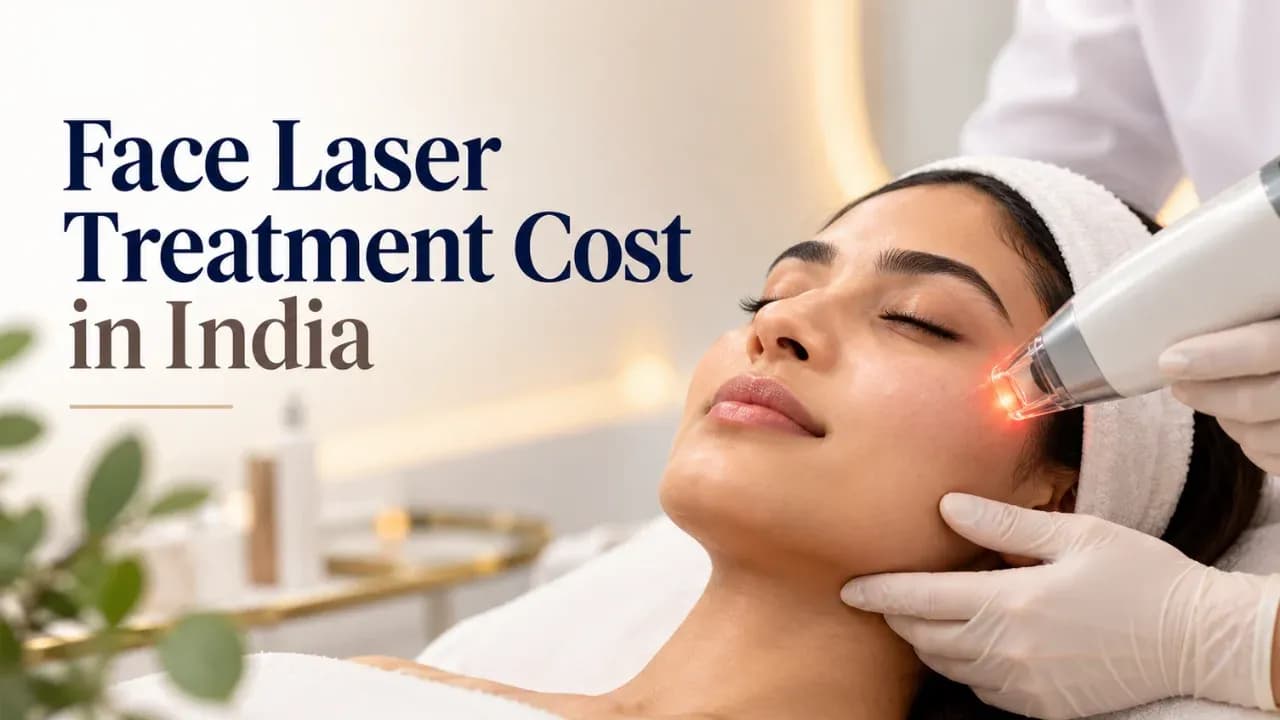
Laser application: The handpiece delivers pulses of laser energy to the target area. Each pulse lasts milliseconds. Session duration ranges from 15 to 45 minutes depending on the area.
Immediate skin response: The skin may appear red, mildly swollen, or warm. This typically resolves within 24-72 hours for non-ablative treatments and 5-10 days for ablative procedures.
Collagen remodelling phase: Over 4-12 weeks, the skin produces new collagen and elastin. This is when visible improvement in texture, tone, and scarring becomes apparent.
Follow-up sessions: Most concerns require multiple sessions spaced 3-6 weeks apart for cumulative results.
Why Multiple Sessions Are Needed
A single session targets only a percentage of the affected cells. Spacing sessions allows the skin to heal fully between treatments and ensures consistent depth of penetration without overexposure.
Types of Face Laser Treatments: Which One Is Right for You?
Matching the laser type to the specific skin concern is more important than choosing based on cost. The following classification explains how different laser categories are generally matched to common skin concerns.
Is Face Laser Treatment Safe for Indian Skin? Who Should (and Should Not) Get It
Face laser treatment is generally safe for Indian skin — but the word 'generally' is doing significant work in that sentence. Indian skin spans Fitzpatrick types III to VI, and procedures that are low-risk for lighter skin tones carry meaningful risk of post-inflammatory hyperpigmentation (PIH) for darker tones if the wrong laser, wavelength, or energy setting is used.
Why this matters for cost: Clinics that charge less often use older machines with limited wavelength control. A Q-switched Nd:YAG laser set at the wrong fluence on a Fitzpatrick type V skin can leave a dark patch worse than the one you came in to treat. The ₹2,000 you save per session is not worth the risk.
Who is a good candidate for face laser treatment:
- Adults with stable, non-inflamed skin concerns (acne scars, sun damage, pigmentation)
- People who can follow post-treatment sun avoidance strictly for 4–6 weeks
- Those who have had a proper Fitzpatrick skin type assessment by the treating dermatologist
- People who are not on photosensitising medications (certain antibiotics, retinoids, and antifungals)
Who should approach with caution or avoid:
| Condition | Guidance | |---|---| | Active acne or open breakouts | Delay laser until skin is stable | | Pregnancy or breastfeeding | Contraindicated for most laser types | | Fitzpatrick type V–VI skin | Only with experienced dermatologist using safe wavelengths (Nd:YAG) | | Keloid-prone skin | High risk — discuss extensively with dermatologist | | Recent isotretinoin (Accutane) use | Wait at least 6 months after completing course | | Very recent sun exposure / active tan | Increases PIH risk significantly | | Herpes simplex history | Ablative laser can trigger an outbreak — prophylactic antivirals needed |
An ethical clinic will decline to treat patients who fall into high-risk categories. If a clinic offers you laser treatment without asking about your medical history, skin type, or current medications, walk away.
Ablative Lasers (CO2, Erbium)
Ablative lasers remove the outer skin layer. They are the most effective option for deep acne scars, pronounced wrinkles, and textural irregularities. CO2 lasers penetrate deepest and require 5-10 days of downtime. Erbium lasers are gentler with 3-5 days of recovery.
Cost per session: ₹6,000-₹25,000
Choose if: You have moderate-to-deep acne scars or significant sun damage and can accommodate downtime
Non-Ablative Lasers (Nd:YAG, Diode)
Non-ablative lasers work beneath the skin surface without removing the outer layer. They stimulate collagen production with minimal downtime of 24-48 hours of redness. Results are more gradual and typically require more sessions.
Cost per session: ₹2,000-₹8,000
Choose if: You have pigmentation, early signs of ageing, or redness and need a low-downtime option
Fractional Lasers (Fraxel, CO2 Fractional)
Fractional lasers treat a fraction of the skin per session, leaving surrounding tissue intact for faster healing. They offer a balance between efficacy and recovery time, typically 3-5 days.
Cost per session: ₹5,000-₹20,000
Choose if: You want meaningful results with manageable downtime
Q-Switched Lasers
Q-switched lasers deliver energy in extremely short pulses of nanoseconds, making them highly effective for melanin-based concerns such as melasma, sunspots, and post-acne dark marks.
Cost per session: ₹2,000-₹8,000
Choose if: You have pigmentation, melasma, or post-acne dark marks
Laser Type Comparison Table
Full Face Laser Treatment Price: Package vs Per-Session Costs
A full-face laser session covers the entire face — forehead, cheeks, nose, chin, and jaw — rather than targeting one isolated area. Clinics price full-face sessions differently from spot treatments, and understanding this distinction prevents sticker shock at checkout.
Full-face laser treatment price in India (per session):
| Treatment Type | Spot / Small Area | Full Face | |---|---|---| | Laser toning / brightening | ₹1,500–₹3,000 | ₹3,500–₹8,000 | | Q-switched Nd:YAG (pigmentation) | ₹2,000–₹4,000 | ₹4,000–₹8,000 | | CO2 Fractional resurfacing | ₹5,000–₹12,000 | ₹12,000–₹25,000 | | Laser hair removal | ₹1,500–₹3,000 (upper lip / chin) | ₹3,500–₹7,000 |
Full-face package deals: Many clinics offer bundled packages for 4–8 sessions at a 15–25% discount versus per-session pricing. A package for 6 sessions of laser toning (full face) in a mid-range Tier 1 clinic typically costs ₹18,000–₹35,000. Ask for the package price in writing and confirm whether the discount applies if you miss a session or need to pause treatment.
What 'laser facial' means vs laser resurfacing: A 'laser facial' (sometimes called a Hollywood facial or carbon laser peel) is a superficial treatment using Nd:YAG laser with a carbon lotion layer. It costs ₹2,500–₹6,000 per session and requires no downtime. It is a maintenance and brightening treatment — not a corrective treatment for deep scars or melasma. Laser resurfacing (CO2 or Erbium) is a deeper, corrective procedure costing ₹8,000–₹25,000 per session with 3–10 days of recovery. These are two very different procedures that are often conflated in online searches.
Laser Skin Resurfacing Cost in India: Is It Worth It?
Laser skin resurfacing is the term for procedures that use laser energy to physically remove or remodel the outer layers of skin — primarily to treat acne scars, deep wrinkles, sun damage, and uneven texture. It is a higher-investment procedure than superficial laser treatments because the results are more significant and the recovery is longer.
Laser skin resurfacing cost in India (per session):
| Resurfacing Type | Depth | Cost per Session | Downtime | Sessions Needed | |---|---|---|---|---| | CO2 Fractional | Deep | ₹10,000–₹25,000 | 5–10 days | 3–5 | | CO2 Full Ablative | Deepest | ₹15,000–₹30,000 | 10–14 days | 1–2 | | Erbium Fractional | Medium | ₹6,000–₹18,000 | 3–5 days | 3–4 | | Erbium Full Ablative | Medium-deep | ₹8,000–₹20,000 | 5–7 days | 2–3 |
Is laser skin resurfacing worth the cost? For moderate-to-severe acne scars, clinical evidence indicates that CO2 fractional laser produces measurable improvement in scar depth and skin texture in 70–80% of patients after 3 sessions [1]. No topical product or superficial peel achieves equivalent depth of remodelling. The cost-per-outcome ratio is therefore favourable for the right candidate — someone with established scarring, not someone with mild surface-level concerns.
Who it is NOT worth it for: People with very mild concerns, Fitzpatrick skin types V–VI (higher risk of post-inflammatory hyperpigmentation with ablative lasers), or those unable to take 5–10 days away from sun exposure and social obligations. For these cases, non-ablative alternatives offer better risk-adjusted value.
[1] Chapas AM et al., 'Efficacy of ablative and fractional ablative resurfacing', Journal of the American Academy of Dermatology, 2012.
Face Laser Treatment vs Alternatives: Chemical Peel, Microneedling, and IPL Compared
Laser treatment is not the only route to clearer skin. Before committing to a laser course, it is worth understanding how it compares to the main alternatives — because in some cases, a less expensive option delivers equivalent results for a specific concern.
| Treatment | Best For | Cost per Session (India) | Downtime | Sessions Needed | Key Limitation | |---|---|---|---|---|---| | Face Laser (Q-switched) | Pigmentation, melasma, dark spots | ₹2,000–₹8,000 | 24–48 hrs | 4–8 | Melasma may recur | | CO2 Fractional Laser | Deep acne scars, resurfacing | ₹10,000–₹25,000 | 5–10 days | 3–5 | Higher cost, more downtime | | Chemical Peel (medium) | Surface pigmentation, mild scars | ₹1,500–₹5,000 | 3–7 days | 3–6 | Cannot treat deep scars | | Microneedling (RF) | Acne scars, skin laxity | ₹4,000–₹12,000 | 2–4 days | 4–6 | Less precise than laser | | IPL (Intense Pulsed Light) | Redness, rosacea, light pigmentation | ₹3,000–₹8,000 | 24 hrs | 4–6 | Not suitable for dark skin tones | | Dermal fillers | Volume loss, deep lines | ₹15,000–₹40,000 (per area) | None | 1 (then maintenance) | No pigmentation benefit |
The honest comparison:
- For dark spots and mild pigmentation, medium-depth chemical peels cost less and can deliver comparable results — but only for surface-level pigmentation.
- For acne scars with depth, no peel or microneedling device matches the collagen remodelling depth of CO2 fractional laser. The higher cost reflects genuine additional efficacy.
- For redness and rosacea, pulsed dye laser outperforms IPL in clinical evidence, though IPL is cheaper per session.
- For darker skin tones (Fitzpatrick IV–VI, common in India), Q-switched Nd:YAG laser is safer than IPL and many ablative options — which is why it dominates Indian dermatology clinics.
The bottom line: Laser is not always the best choice, and it is not always the most expensive choice. The right treatment is the one your dermatologist selects after evaluating your specific concern, skin type, and realistic downtime tolerance.
How to Prepare for Face Laser Treatment: Step-by-Step Guide
Knowing what to do — and what not to do — before your session directly affects your results and reduces the risk of side effects. Most clinics send you home with a leaflet after the consultation. Read it before, not after.
2–4 weeks before your session: 1. Stop retinoids and exfoliating acids. Retinol, tretinoin, AHAs, and BHAs increase skin sensitivity. Discontinue at least 2 weeks before ablative treatments and 1 week before non-ablative. 2. Avoid deliberate sun exposure. Tanned skin increases PIH risk. Use SPF 50 daily and avoid midday sun. 3. Disclose all medications. Certain antibiotics (doxycycline), antifungals, and herbal supplements make skin photosensitive. Your dermatologist needs a full list. 4. Do not wax or thread the treatment area. Mechanical trauma to the skin before laser increases irritation risk.
On the day of your session: 1. Arrive with clean, product-free skin. No makeup, moisturiser, or SPF on the treatment area. 2. Arrive 30–45 minutes early if topical anaesthetic is needed. The numbing cream requires time to work. 3. Wear loose, comfortable clothing if treating areas beyond the face. 4. Arrange transport. Do not drive after procedures that involve periorbital (around-eye) treatment or sedation.
After your session (the week that matters most):
- Apply only the prescribed healing cream and SPF — nothing else.
- Do not pick, peel, or rub treated skin. Peeling is part of healing; disrupting it causes scarring.
- Avoid swimming pools, saunas, and heavy gym sessions for 5–7 days.
- Use SPF 50 every morning without exception. UV exposure in the first 4 weeks post-laser is the primary cause of PIH in Indian skin.
- Return for your scheduled review appointment even if the skin looks fine — your dermatologist checks for early signs of complications at this visit.
Common mistake: Applying home-remedy oils (coconut oil, vitamin E oil) to post-laser skin. These are not sterile and can introduce bacteria to compromised skin. Use only what your dermatologist prescribes.
Face Laser Treatment Results: What to Expect and When
The most common frustration after face laser treatment is expecting visible results within days. Here is what actually happens at each stage — and why patience is not optional.
Results timeline after non-ablative laser (e.g., Q-switched Nd:YAG, laser toning):
| Time After Session | What You Will See | |---|---| | Hours 1–24 | Mild redness, warmth, possible mild swelling — resolves within 24 hours | | Days 2–7 | Skin may look slightly darker in pigmented areas (the pigment is rising to the surface before shedding) | | Weeks 2–4 | Gradual lightening of treated spots, smoother texture | | After 3–4 sessions | Cumulative improvement in tone and brightness becomes clearly visible | | After 6 sessions | Most patients see 50–70% reduction in surface pigmentation [1] |
Results timeline after ablative laser (CO2 Fractional):
| Time After Session | What You Will See | |---|---| | Days 1–3 | Significant redness, swelling, and crusting — normal part of the healing process | | Days 4–7 | Skin begins to peel; underlying new skin is pink and sensitive | | Weeks 2–4 | Redness fades; skin appears smoother and more even | | Months 2–3 | Collagen remodelling continues; scar depth visibly reduced | | Month 6 | Full results visible — research shows 60–80% improvement in scar appearance after 3 CO2 sessions [2] |
Why results vary between patients:
- Skin type and Fitzpatrick classification affect healing speed
- Adherence to post-treatment sun protection is the single biggest predictor of final outcome
- The underlying cause of the skin concern (hormonal melasma will recur without treating the hormonal trigger)
- The skill of the treating dermatologist in selecting appropriate energy settings
Realistic expectation: Laser treatment improves — it does not erase. Most patients see a 50–80% improvement in their primary concern over a full course of treatment. Complete removal of deep acne scars or established melasma in one course is not a realistic expectation.
[1] Gold MH et al., 'Q-switched Nd:YAG laser in the treatment of melasma: a systematic review', Journal of Drugs in Dermatology, 2019. [2] Chapas AM et al., Journal of the American Academy of Dermatology, 2012.
Frequently Asked Questions About Face Laser Treatment Cost
Q1: Face laser treatment me kitna kharcha aata hai? | फेस लेजर ट्रीटमेंट में कितना खर्च आता है?
Face laser treatment India mein ₹1,500–₹25,000 per session ho sakta hai. Total course ka cost laser type, skin concern aur city par depend karta hai.
Q2: Laser treatment for dark spots — ek session mein result aayega ya nahi? | Dark spots ke liye ek session kaafi hai?
Aksar nahi. Dark spots ke liye 3–5 sessions aur melasma ke liye zyada sessions lag sakte hain. Results individual skin response par depend karte hain.
Q3: Can face laser treatment make dark spots worse on Indian skin?
Yes. Incorrect laser settings can cause post-inflammatory hyperpigmentation, especially in darker skin tones. A dermatologist should assess your skin type first.
Q4: Kya face laser treatment ka price insurance mein cover hota hai? | क्या बीमा में कवर होता है?
Usually nahi. Cosmetic laser treatment generally insurance mein covered nahi hota. Medically necessary procedures ke liye insurer se confirm karein.
Q5: How do I know if a clinic's laser price is fair or inflated?
Compare the laser brand/model, the dermatologist's qualifications, and an itemised quote covering sessions, consultation, aftercare and follow-up.
Q6: Kya laser treatment ke side effects hote hain? | Side effects kya hain?
Haan. Redness, swelling aur temporary darkening ho sakti hai. Rare risks include pigmentation changes, infection and scarring.
Q7: Laser treatment ke results kitne time tak rahenge? How long do laser results last?
Scar improvements may be long-lasting, but pigmentation can recur. Maintenance depends on the concern and sun protection.
Q8: Kya ghar pe laser treatment karna safe hai? Are at-home laser devices worth it?
At-home IPL devices are not equivalent to clinical lasers and cannot reliably treat deep scars or melasma. Darker skin needs professional guidance.
Medical Disclaimer : Information from Kibo Hair Clinics is for educational purposes only. It does not replace diagnosis, trichoscopy, blood test interpretation, prescription treatment, procedure advice, or side-effect counselling from a qualified dermatologist or hair restoration doctor.