
Boney Kapoor Hair Transplant: Bollywood Producer's Inspiring Transformation at 68
Published on Tue Mar 31 2026
Introduction: The Boney Kapoor Hair Restoration Landmark
Boney Kapoor, the veteran Bollywood producer behind blockbusters like Mr. India and Wanted, has become a prominent face for modern hair restoration. Unlike many celebrity cases that remain speculative, Kapoor's transformation is a documented success story. In early 2024, he chose to address his advanced hair loss, proving that age is no barrier to achieving a fuller head of hair. This guide explores the technical details of his procedure, the specific challenges of Grade 7 baldness, and why his case is a significant milestone for the industry.
The Story Behind the Transformation: Rejuvenating a Legacy
For decades, Boney Kapoor was known as the powerhouse producer working behind the scenes of Indian cinema. However, his 2023 acting debut in Tu Jhoothi Main Makkaar at age 69 brought him back into the intense glare of high-definition cameras. Facing the most advanced stage of male pattern baldness (Norwood Grade 7), Kapoor decided it was time for a change. His journey wasn't just about aesthetics; it was about matching his outward appearance with his enduring professional energy.
The decision to undergo a transplant at 68 required careful planning. Most clinics hesitate with Grade 7 cases due to limited donor hair, but Kapoor opted for a specialized approach. Following his procedure in January 2024, he didn't hide the results. Instead, he became a vocal advocate, sharing his joy on social media: "My head is covered with hair now! I feel younger." His transparency has inspired other industry veterans, including director Anees Bazmee, to seek similar solutions, shifting the narrative around hair loss in the senior demographic.
Timeline of a Confirmed Transformation
Boney Kapoor's hair restoration is one of the most transparently documented cases in Bollywood. The following timeline outlines the key milestones of his journey from advanced thinning to full restoration.
The Technique: Why DHT was Chosen for Boney Kapoor
Boney Kapoor's procedure utilized the Direct Hair Transplant (DHT) technique, an advanced modification of the standard Follicular Unit Extraction (FUE). In DHT, follicles are extracted and implanted simultaneously, significantly reducing the time the grafts spend outside the body. This "real-time" implantation is crucial for older patients as it maximizes graft survival rates, which is essential when dealing with a limited donor supply in Grade 7 cases.
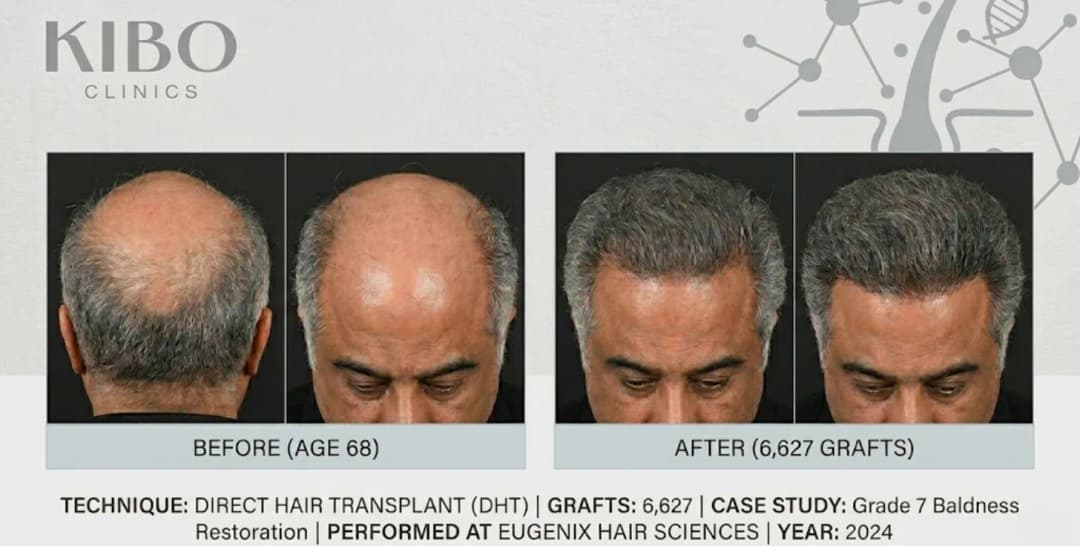
For Kapoor, the surgeons extracted 6,627 grafts entirely from his scalp donor area. This is a massive number for a single session, especially at age 68. The DHT method allowed for high-density placement across the frontal zone and temples, creating a natural-looking frame for his face that had been missing for years. This approach is often compared to corrective hair transplant strategies used to restore severe depletion.
Challenges of Norwood Grade 7 Restoration
Restoring hair for a Norwood Grade 7 patient is one of the most difficult tasks in trichology. Grade 7 represents the final stage of the Norwood Scale, where only a thin band of hair remains at the back and sides. The primary challenge is the "supply vs. demand" imbalance: there is a vast area of baldness to cover but a very limited donor pool.
In Boney Kapoor's case, the success relied on:
- Donor Management: Carefully harvesting 6,627 grafts without over-thinning the donor area.
- Strategic Placement: Prioritizing the hairline and mid-scalp to create the maximum visual impact.
- Graft Survival: Using DHT to ensure nearly every extracted follicle successfully took root.
Frequently Asked Questions
Did Boney Kapoor really have a hair transplant?
Yes, Boney Kapoor's hair transplant is fully confirmed. He underwent the procedure on January 28, 2024, and has since made multiple public statements and social media posts celebrating his new look.
Which technique was used for Boney Kapoor's hair?
He underwent a Direct Hair Transplant (DHT), an advanced version of FUE where extraction and implantation happen simultaneously to ensure maximum graft survival.
How many grafts did Boney Kapoor receive?
A total of 6,627 grafts were transplanted in a single session. All grafts were harvested from his scalp donor area to cover his Grade 7 baldness.
Is it safe to get a hair transplant at age 68?
As Boney Kapoor's case demonstrates, it is safe if the patient is in good overall health. Modern techniques like DHT are minimally invasive, making them suitable for older adults seeking to restore their appearance.
Can Grade 7 baldness be fully cured?
While "cured" may not be the medical term, Grade 7 baldness can be significantly restored. Kapoor's case is a prime example of how 6,000+ grafts can provide excellent coverage even for the most severe hair loss.
Who were the doctors for Boney Kapoor's transplant?
The procedure was performed by Dr. Pradeep Sethi and Dr. Arika Bansal at Eugenix Hair Sciences, a clinic well-known for handling high-profile celebrity cases.
Key Takeaways
Boney Kapoor's hair transplant journey offers three vital lessons: first, advanced age is not a disqualifier for hair restoration; second, even Norwood Grade 7 baldness can be successfully managed with high graft counts; and third, the DHT technique offers superior survival rates for complex cases. His transformation stands as a testament to the life-changing potential of modern hair sciences.
Why Kibo Clinics
At Kibo Clinics, we specialize in providing evidence-based hair restoration solutions. Whether you are inspired by celebrity transformations like Boney Kapoor's or are seeking a personal evaluation for your own hair health, our team is dedicated to clinical excellence and natural-looking results. We combine advanced technology with personalized care to help you achieve your restoration goals at any stage of life.
Related Articles & Services
Hair Transplant
FUE Hair Transplant | Sapphire FUE | Bio FUE | Direct Hair Transplant | Corrective Transplant
Hair Regrowth
PRP Therapy | GFC Therapy | Mesotherapy | IV Hair Boosters | LLLT
Must Read
Complete Hair Transplant Guide | Norwood Scale Explained | Results Timeline | Male Pattern Baldness FUE | Recovery Guide
Relevant Blogs
Virat Kohli Hair Transplant | MS Dhoni Hair Transplant | Hardik Pandya Hair Transplant | Celebrity Hair Transplant Mumbai