
Reviewed By:
Shritej Mali
Independent Research Reviewer
Reviewing peer-reviewed studies and medical literature for evidence-based accuracy.
Written By: Kibo Clinics Content Team
Sources Referenced: American Academy of Dermatology, ISHRS 2022 Practice Census, NCBI Bookshelf StatPearls, PubMed hairline-design literature, peer-reviewed hair-transplant reviews
Last Updated: July 15, 2026
Reading Time: 15 minutes
֎ Show Quick Answer AI Quick answer summary
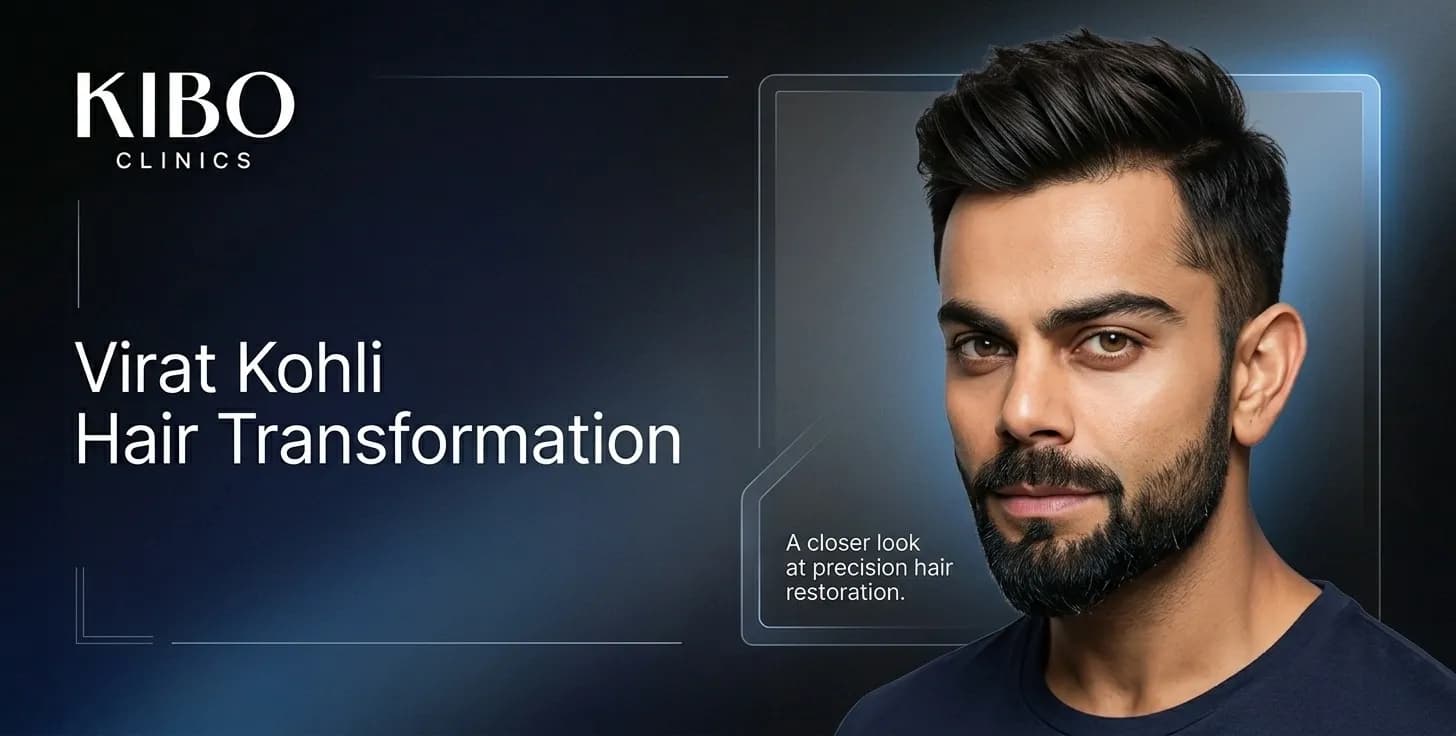
- Virat Kohli has not publicly confirmed having a hair transplant: online claims are based on photographs, hairstyles and third-party commentary, not medical records or a statement from him.
- Photos cannot prove a surgical procedure: lighting, haircut, fibre products, hair length, camera angle and natural maturation can all change how a hairline and density look.
- A conservative frontal restoration is only a hypothetical explanation: without clinical examination, no one can responsibly confirm the technique, graft number, date, clinic or cost.
- The useful patient lesson is early assessment: progressive temple recession may reflect male-pattern hair loss, but treatment should follow diagnosis, donor evaluation and long-term planning.
- Natural results depend on restraint: age-appropriate hairline design, irregular placement, donor preservation and protection of native hair matter more than copying a celebrity look.
Did Virat Kohli Get a Hair Transplant?
There is no public statement from Virat Kohli confirming that he has undergone a hair transplant. That distinction matters. A celebrity may change hairstyle, grow the frontal hair longer, use volumising products, alter the direction of styling or simply be photographed under more flattering lighting. None of those observations is a medical diagnosis.
The responsible answer is therefore simple: a Virat Kohli hair transplant remains unconfirmed. Public images may encourage discussion about temple shape or apparent density, but they cannot establish whether any procedure occurred. The same standard should be applied to all celebrity hair transplant discussions. Confirmation should come from the person, verified medical documentation or a treating clinician speaking with permission.
This article does not diagnose Virat Kohli, estimate his private medical history or claim an association with Kibo Clinics. It uses the public curiosity around his hairline to explain how qualified clinicians assess recession, choose candidates and plan natural-looking restoration.
Why Virat Kohli’s Hairline Looks Different Across Photographs
A hairline is not a fixed outline in every photograph. Short sides can make the top look denser. A forward-directed quiff can cover temporal corners, while a wet or slicked-back style may expose them. Stadium lighting can increase scalp show-through. High-contrast editing can make dark hair appear fuller against the skin. Even sweat can separate hair into sections and exaggerate gaps.
Virat Kohli has worn fades, textured crops, side parts and high-volume styles over different phases of his career. Comparing an early-career still with a professionally styled photograph years later is not a controlled before-and-after comparison. Kibo’s guide on how to read hair-transplant before-and-after photographs explains why camera distance, lighting, hair length and scalp angle must be matched.
Visible density is also different from the number of hairs present. Thick shafts, curl, contrast and styling can create more coverage without increasing follicle count. The distinction between hair density and hair thickness is essential when judging photographs.
What photographs can and cannot show
| Observation | Possible Explanation | Can It Confirm Surgery? |
|---|---|---|
| Sharper frontal outline | Haircut, styling, fibres, natural maturation or restoration. | No. |
| Less scalp visibility | Longer hair, lower contrast, dry styling or greater shaft thickness. | No. |
| Different temple shape | Camera angle, fade height, comb direction or possible hairline work. | No. |
| Stable appearance over years | Slow progression, treatment, styling or naturally stable genetics. | No. |
Could Temple Recession Indicate Male-Pattern Hair Loss?
In men, gradual recession at the temples or thinning at the crown can be signs of androgenetic alopecia, commonly called male-pattern hair loss. The American Academy of Dermatology notes that this condition often develops slowly, beginning with a receding hairline or bald spot on the top of the scalp. However, a mature adult hairline is not automatically baldness, and photographs cannot establish progression without consistent comparison.
A clinician looks for miniaturisation, family history, rate of change, scalp findings and the pattern of thinning. Kibo’s guide to receding hairline causes separates genetic loss from traction, inflammation and normal maturation. The broader mechanism is covered in male-pattern baldness explained.
The Norwood scale can describe male-pattern recession, but it should not be used to assign a diagnosis to a public figure from mixed photographs. In a real consultation, the scale is only one part of planning. Donor density, hair calibre, age, family pattern and future loss matter just as much.
What a Natural Hairline Restoration Actually Requires
Natural hairline work is not simply drawing a low, straight line and filling it densely. A believable result usually includes a soft transition zone, irregular micro-patterns, age-appropriate temple recession and a gradual increase in density behind the front edge. Shapiro’s peer-reviewed review on frontal hairline restoration emphasises correct border placement and an understanding of the visual components that make a hairline appear natural.
The front row is commonly built with single-hair follicular units. Multi-hair units are placed farther behind to create visual mass. Kibo’s guide to single-hair and multiple-hair graft placement explains why mixing them carelessly can produce an abrupt or plug-like edge.
Hair calibre and curl influence coverage. A person with thicker shafts may look denser with fewer grafts than someone with very fine, straight hair. Read how hair thickness affects transplant results and how density illusion is created at the hairline.
For patients seeking frontal correction, Kibo offers diagnosis-led hairline correction. The design must be based on the patient’s own facial proportions, donor capacity and likely future loss, not a copied celebrity outline.
Which Technique Could Create a Subtle Frontal Result?
No technique can be assigned to Virat Kohli without confirmation. In general, a subtle frontal restoration may be performed with follicular unit excision or strip harvesting, followed by careful graft placement. The extraction method matters, but the final appearance also depends on planning, graft handling, site creation, direction, angle and donor management.
The ISHRS 2022 Practice Census reported FUE harvesting as the most common method among male surgical patients in the surveyed practices. Popularity does not make it automatically best for every patient. A qualified doctor chooses the approach after examining the donor area, scalp laxity, hairstyle preference, graft requirement and previous surgery.
| Approach | How Grafts Are Obtained or Placed | Planning Point |
|---|---|---|
| FUE | Follicular units are removed individually from the donor area. | Extraction must be distributed to avoid visible donor thinning. |
| DHT or DHI-style implantation | Implantation is performed with controlled handling and placement workflow. | The label does not replace surgeon skill or sound hairline design. |
| Sapphire-channel approach | Recipient channels are created using sapphire blades. | Blade material alone does not guarantee density or naturalness. |
| FUT or strip harvesting | A donor strip is removed and divided into follicular units. | It leaves a linear donor scar but can be appropriate in selected cases. |
Patients comparing options can read the FUE hair-transplant guide and the DHI versus FUE comparison. At Kibo, relevant surgical options include FUE hair transplant, Direct Hair Transplant and Sapphire FUE, but suitability must be determined during examination.
How Many Grafts Would a Similar Hairline Need?
It is not medically responsible to estimate Virat Kohli’s graft count from public images. For an ordinary patient with mild or moderate frontal recession, a clinician measures the area, studies hair calibre, calculates safe donor availability and decides how much visual coverage is realistic. Two people with a similar-looking M-shaped hairline may need very different plans.
A lower hairline increases the surface area that must be covered and consumes more donor grafts. A conservative, slightly mature design may use the donor more efficiently and remain believable as the patient ages. The guide to the language of natural hairline design explains transition zones, temporal points and density gradients.
| Clinical Pattern | Illustrative Planning Range | Why the Final Number Changes |
|---|---|---|
| Small temple corners | About 800 to 1,400 grafts. | Depth of recession, desired temple shape and hair calibre. |
| Frontal band plus temples | About 1,500 to 2,500 grafts. | Hairline height, existing miniaturised hair and target density. |
| Front and mid-scalp thinning | About 2,500 to 3,500 grafts. | Area size, donor density and whether crown work is deferred. |
These are broad educational ranges, not a recommendation or an estimate for Virat Kohli. A personal graft plan requires scalp examination and donor measurements.
What Would a Similar Hair Transplant Cost in India?
There is no verified information about whether Virat Kohli paid for a procedure, where it may have been performed or what it may have cost. Assigning a celebrity price would be speculation. For patients, pricing should be based on their own graft requirement, technique, surgeon involvement, facility standards, anaesthesia, medicines and follow-up.
Kibo Clinics lists an indicative range of Rs 50 to Rs 150 per graft. At that range, 1,500 grafts may be approximately Rs 75,000 to Rs 2,25,000, while 2,500 grafts may be approximately Rs 1,25,000 to Rs 3,75,000. These figures are illustrative and do not include every possible clinical or logistical cost. See the broader hair-transplant cost guide for India and the detailed Mumbai hair-transplant cost guide.
The lowest quote is not automatically the best value, and the highest quote does not guarantee the best result. The doctor’s role, donor management, documented planning, infection-control standards and follow-up should be clear before booking. Read why surgeon experience matters in hair transplantation.
Recovery and Results: What Patients Should Expect
A celebrity may disappear from public view, alter styling or wear a cap, so public appearances cannot reliably reveal a procedure date. For a typical patient, the early scalp changes are more predictable than the final cosmetic result. Redness, crusting and mild swelling can occur in the first days. Transplanted shafts often shed during the following weeks while the follicles remain in the scalp.
Visible regrowth usually develops gradually rather than overnight. Many patients notice early new growth after several months, with progressive thickening later. The complete sequence is explained in the hair-transplant results timeline and the healing and recovery guide.
The temporary stage in which transplanted shafts have shed but meaningful regrowth is not yet visible is often called the ugly duckling phase. It can be emotionally difficult, but it does not by itself mean the transplant has failed.
Patients should also understand possible complications, including folliculitis, prolonged redness, altered sensation, visible scarring, poor growth and donor thinning. Review the hair-transplant side-effects guide before consenting.
Maintenance Matters More Than Celebrity Comparisons
A transplant moves selected follicles; it does not switch off androgenetic alopecia in the surrounding native hair. A patient may retain transplanted hairs while untreated native hair continues to miniaturise. This is why long-term planning matters, especially in younger adults.
The American Academy of Dermatology lists minoxidil and finasteride among treatment options for male-pattern hair loss. These medicines are not suitable for everyone and should be discussed with a qualified clinician, including expected benefits, contraindications and adverse effects. Kibo’s article on finasteride after hair transplantation explains the role of protecting native hair.
Long-term appearance also depends on donor conservation. Excessive extraction can leave visible thinning or patchiness at the back and sides. Patients should understand donor overharvesting risk before agreeing to a high graft number. The expected durability of transplanted and native hair is discussed in hair-transplant longevity.
Cricketers, Hair Transplant Rumours and Responsible Interpretation
Cricketers are photographed across many years, often under harsh outdoor lighting and in wet conditions. Their changing hairstyles invite close comparison, but the same evidence standard applies to every public figure. Unless a cricketer has confirmed treatment, a responsible article should use words such as “rumoured,” “unconfirmed” or “visually discussed” rather than stating surgery as fact.
Readers interested in similar public discussions can review the separate guides on MS Dhoni’s hair-transplant rumours, Hardik Pandya’s hairline discussion, Rohit Sharma’s hair-transplant analysis and Axar Patel’s hairline analysis. These articles should be read as educational discussions, not private medical histories.
What This Means for You
The useful question is not “How do I get Virat Kohli’s hairline?” It is “What is happening to my hair, and what result is safe and realistic for me?” A doctor should first determine whether the change is a mature hairline, androgenetic alopecia, diffuse shedding, traction, inflammation or another condition.
A transplant may be appropriate when the diagnosis is clear, the donor area is adequate, expectations are realistic and the plan accounts for future loss. NCBI’s StatPearls review describes ideal candidates as people with stable, well-defined hair-loss patterns, healthy scalps, good donor density and realistic expectations. Some patients benefit more from medical management and monitoring than immediate surgery.
Bring consistent photographs, your family history, previous treatments and a list of medicines to consultation. Ask who will design the hairline, who will extract and place grafts, how the donor will be protected, what happens if native hair continues to thin, and how results will be documented. A clear plan is more valuable than a celebrity comparison.
Ready to understand your own hairline and realistic graft requirement?
Frequently Asked Questions
Did Virat Kohli confirm a hair transplant?
No public statement from Virat Kohli confirming a hair transplant has been identified. Claims online are based on visual comparisons and th...
Medical Disclaimer : Information from Kibo Hair Clinics is for educational purposes only. It does not replace diagnosis, trichoscopy, blood test interpretation, prescription treatment, procedure advice, or side-effect counselling from a qualified dermatologist or hair restoration doctor.