
Minoxidil 5% vs 10%: Is Higher Concentration Always Better?
Published on Fri Mar 27 2026
The Stronger Isn't Always Better Paradox
You've been losing hair for months. You start minoxidil 5%, but after six months, results plateau. Your dermatologist mentions 10%. But is stronger really better? The answer might surprise you- it could save you money and side effects.
Hair loss affects millions of people worldwide, and minoxidil remains one of the most clinically validated topical treatments available. However, confusion persists about whether higher concentrations deliver better results. This comprehensive guide compares minoxidil 5% and 10%, examining clinical evidence, side effects, and practical considerations to help you make an informed decision.
Quick Comparison: Minoxidil 5% vs 10% at a Glance
Understanding Minoxidil: Mechanism and Concentration
Minoxidil is a vasodilator originally developed as an oral medication for hypertension. Researchers discovered that topical application stimulated hair growth, leading to FDA approval for treating androgenetic alopecia (male and female pattern baldness). The medication works by increasing blood flow to hair follicles and prolonging the anagen (growth) phase of the hair cycle.
The Surprising Truth: Clinical Evidence on Effectiveness
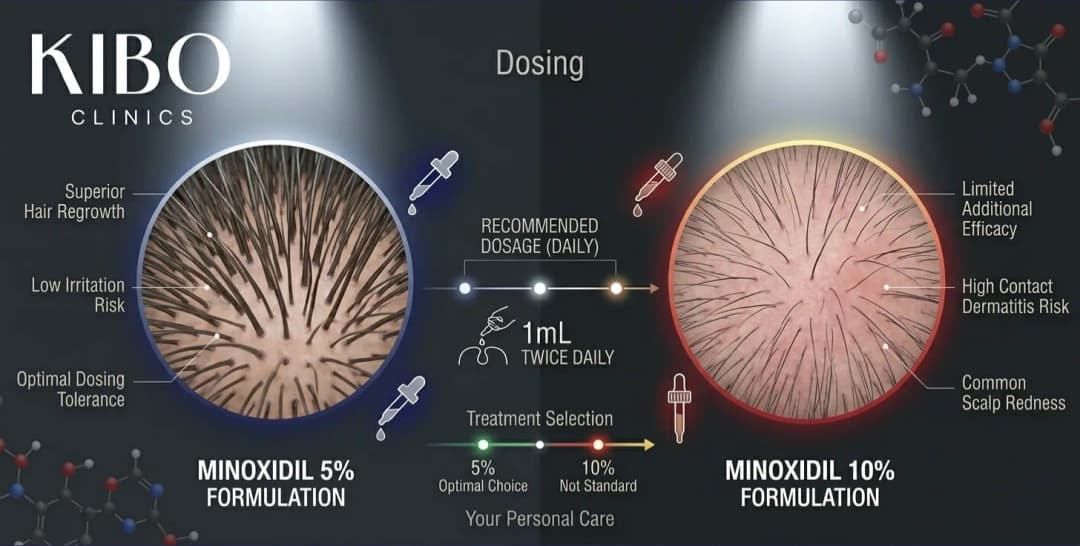
One of the most counterintuitive findings in hair loss research is that minoxidil 5% often outperforms 10% in clinical trials. A landmark study published in a peer-reviewed dermatology journal found that 5% minoxidil was moderately superior to 10% minoxidil in increasing hair regrowth. This surprising result contradicts the assumption that higher concentrations automatically produce better outcomes.
Research from the International Society of Hair Restoration Surgery (ISHRS) indicates that 5% minoxidil solution was judged very effective in stimulating new hair growth by 7.5% of men, effective by 55%, and moderately effective by 31.3%. These results demonstrate that 5% delivers substantial benefits for the majority of users without requiring higher concentrations.
FDA Approval: A Critical Distinction
Minoxidil 5% is FDA-approved for treating male pattern baldness, while minoxidil 10% is not. This distinction carries significant weight in clinical practice. FDA approval means that 5% has undergone rigorous testing for safety and efficacy, with documented evidence of benefit. The approval process requires comprehensive clinical trials demonstrating that the medication is safe and effective for its intended use.
Side Effects: Understanding the Risk Profile
Both 5% and 10% minoxidil can cause side effects, but the incidence and severity increase with concentration. Common side effects of minoxidil include scalp dryness, itching, flaking, redness, and a burning sensation at the application site. These local effects typically occur in 5-10% of users and are usually mild and manageable.
Higher concentrations like 10% increase the frequency and severity of these local side effects. Users report more pronounced scalp irritation, which can lead to reduced compliance and treatment discontinuation. In some cases, excessive irritation may cause contact dermatitis or allergic reactions.
Women using minoxidil 10% face an additional concern: increased risk of facial hair growth (hypertrichosis). This side effect is more common with higher concentrations and can be cosmetically distressing for some users. For this reason, 2% or 5% minoxidil is typically recommended for women.
Who Should Use Minoxidil 5%?
Minoxidil 5% is the appropriate choice for most users, including those experiencing early to moderate androgenetic alopecia, receding hairlines, crown thinning, or those beginning topical hair loss treatment for the first time. The FDA approval, superior clinical efficacy, and favorable side effect profile make 5% the evidence-based first-line treatment.
Individuals with sensitive scalps, women with pattern hair loss, and those concerned about side effects should strongly consider 5% as their starting point. With consistent use, many users notice reduced shedding within 2-3 months and visible regrowth between 4-6 months. The combination of 5% minoxidil with other treatments like DHT blockers can enhance results for some patients.
When to Consider Minoxidil 10%
Minoxidil 10% may be considered in specific clinical situations, but only under dermatological supervision. These situations include poor response to 5% minoxidil after 12 months of consistent use, aggressive hair thinning patterns, strong family history of baldness, or cases where combination therapy is being explored. Even in these scenarios, medical supervision is essential because scalp tolerance varies significantly between individuals.
Foam vs. Liquid: Formulation Matters
Minoxidil is available in both foam and liquid formulations, and both can be effective when used correctly. Foam formulations are easier to apply, dry faster, and are less messy than liquids. They are particularly convenient for users with longer hair or those who prefer minimal product residue. Liquid formulations may have slightly better penetration in some cases and are often less expensive.
The choice between foam and liquid should be based on personal preference, lifestyle, and hair characteristics. Both formulations deliver comparable efficacy when applied consistently and correctly. What matters most is adherence to the treatment regimen, regardless of formulation type.
Application Best Practices for Maximum Effectiveness
Proper application technique is critical for minoxidil effectiveness. Always apply minoxidil to a clean, dry scalp. Wet scalp reduces absorption and dilutes the medication. Use the recommended dose-typically 1 milliliter twice daily for 5% solutions. Applying more than the recommended dose does not improve results and increases the risk of side effects.
- Target the scalp, not the hair. Apply directly to affected areas where hair loss is occurring.
- Avoid applying to the hairline or eyebrows, as minoxidil can cause unwanted hair growth in these areas.
- Allow the solution to dry completely before styling or applying other products.
- Establish a daily routine - morning and night applications work best for most users.
Consistency is paramount. Minoxidil requires daily use to maintain results. Skipping applications or inconsistent use significantly reduces effectiveness. Many users see better results when they establish a daily routine, such as applying minoxidil immediately after showering in the morning and before bed at night.
Timeline and Realistic Expectations
Understanding the minoxidil timeline helps set realistic expectations and maintain motivation during treatment. In the first 1-2 months, some users experience increased shedding, known as "minoxidil shedding" or "telogen effluvium." This is actually a positive sign, indicating that minoxidil is pushing old, miniaturized hairs out to make room for new, thicker hairs. This shedding phase can be psychologically challenging, but it typically resolves within 2-3 months.
- Months 1-2: Increased shedding (normal - old hairs being replaced)
- Months 3-4: Stabilization phase - shedding decreases, hair loss slows
- Months 5-6: Visible regrowth - new hairs emerge, existing hairs thicken
- Months 7-12: Full results - improved hairline definition and crown density
Full results typically become apparent after 12 months of consistent use. However, some individuals may see significant improvement as early as 6 months, while others may require 12-18 months. Patience and consistency are essential. Discontinuing treatment before 6 months is unlikely to produce meaningful results.
Combination Therapy: Enhancing Results
Minoxidil can be combined with other hair loss treatments to enhance results. The most common combination is minoxidil with DHT blockers like finasteride or dutasteride. This combination addresses hair loss through two different mechanisms: minoxidil stimulates growth while DHT blockers prevent further miniaturization. Studies show that combination therapy produces better results than either treatment alone.
Other complementary treatments include PRP therapy, which uses platelet-rich plasma to stimulate hair follicles, and mesotherapy for hair regrowth, which delivers growth factors directly to the scalp. GFC therapy (Growth Factor Concentrate) is another advanced option that can be combined with minoxidil for enhanced results.
Scalp health is also important. Maintaining a clean, healthy scalp through proper scalp detox and product buildup removal can improve minoxidil absorption and effectiveness. Some users benefit from combining minoxidil with dermatologist-recommended shampoos for hair loss to maintain optimal scalp conditions.
Cost-Benefit Analysis: 5% vs 10%
From a financial perspective, minoxidil 5% offers better value. Generic 5% minoxidil is widely available and typically costs $20-40 per month (₹1,650-3,300 INR). Brand-name formulations like Rogaine cost $30-50 per month (₹2,475-4,125 INR). Minoxidil 10%, being off-label and less commonly prescribed, is often more expensive and may not be covered by insurance.
- Minoxidil 5%: $240-600 per year (₹19,800-49,500 INR)
- Minoxidil 10%: $400-800+ per year (₹33,000-66,000+ INR)
- Savings with 5%: $160-200 annually (₹13,200-16,500 INR), which can be invested in complementary treatments
Given that 5% often produces comparable or superior results, the cost-benefit analysis strongly favors 5%. The money saved by using 5% can be invested in combination therapies or professional treatments that may enhance results.
Special Considerations for Women
Women experiencing hair loss have specific considerations when choosing minoxidil concentration. The FDA-approved minoxidil for women is 2% or 5%, not 10%. Higher concentrations increase the risk of facial hair growth and other systemic side effects.
Women should start with 2% or 5% minoxidil and only consider higher concentrations under strict medical supervision. Hormonal factors, pregnancy, and breastfeeding status should be discussed with a dermatologist before starting treatment. Women with PCOS-related hair thinning or menopause-related hair loss may benefit from combination therapies that address underlying hormonal factors.
Frequently Asked Questions
Q: Is 10% minoxidil stronger than 5%?
While 10% contains twice the concentration of minoxidil, "stronger" does not necessarily mean more effective. Clinical studies show 5% often produces better results, likely because higher concentrations increase scalp irritation, reducing compliance and effectiveness. The relationship between concentration and efficacy is not linear-more is not always better in topical medications.
Q: Can I switch from 5% to 10% minoxidil?
Yes, you can switch from 5% to 10%, but only under medical supervision. Most dermatologists recommend trying 5% for at least 12 months before considering 10%. If you experience poor response after a year, your doctor may suggest upgrading to 10% or exploring combination therapies. Never increase concentration without professional guidance.
Q: How long does minoxidil take to show results?
Most users notice reduced shedding within 2-3 months. Visible hair regrowth typically appears between 4-6 months of consistent use. Some people may take up to 12 months to see significant results. Patience and consistency are critical for success. Discontinuing treatment before 6 months is unlikely to produce meaningful results.
Q: Is 10% minoxidil safe for daily use?
While 10% minoxidil can be used daily, it carries higher risks of side effects including scalp irritation, dryness, and systemic absorption. Daily use should only occur under dermatological supervision. Most experts recommend starting with 5% due to its better safety profile and superior clinical efficacy.
Q: Can women use minoxidil 10%?
Women can use minoxidil 10%, but it is not typically recommended as a first-line treatment. The FDA-approved minoxidil for women is 2% or 5%. Higher concentrations increase the risk of side effects like facial hair growth. Consult a dermatologist before using 10% minoxidil, especially if you are pregnant or breastfeeding.
Q: What happens if I stop using minoxidil?
Minoxidil results are not permanent. If you stop using it, hair regrowth typically reverses within 3-6 months as follicles return to their previous state. This is why consistent, long-term use is necessary to maintain results. Think of minoxidil as a maintenance treatment rather than a cure.
Q: Can I use minoxidil with other hair loss treatments?
Yes, minoxidil can be combined with other treatments like DHT blockers, PRP therapy, and mesotherapy. Combination therapy often produces better results than monotherapy. Always consult your dermatologist before combining treatments to avoid adverse interactions and ensure safety.
Q: Does minoxidil work for all types of hair loss?
Minoxidil is most effective for androgenetic alopecia (male and female pattern baldness). It may help with other types of hair loss like telogen effluvium, but is less effective for alopecia areata or scarring alopecia. A dermatologist can determine if minoxidil is appropriate for your specific condition.
Q: What is the difference between minoxidil foam and liquid?
Minoxidil foam is easier to apply, dries faster, and is less messy than liquid. Liquid may have slightly better absorption in some cases and is often less expensive. Both formulations are equally effective when used correctly. Choose based on personal preference and lifestyle.
Q: When should I see a dermatologist about minoxidil?
See a dermatologist if you experience severe scalp irritation, chest pain, dizziness, or rapid heartbeat while using minoxidil. Also consult if you see no improvement after 12 months, or if you want to switch from 5% to 10%. Regular check-ups ensure safe and effective treatment.
Key Takeaways: Making Your Decision
The evidence overwhelmingly supports minoxidil 5% as the first-line treatment for androgenetic alopecia. It is FDA-approved, clinically superior to 10%, and has a favorable side effect profile. For most users, 5% delivers excellent results when used consistently over 4-6 months.
Minoxidil 10% may be considered in specific clinical situations after 12 months of unsuccessful 5% treatment, but only under dermatological supervision. The higher concentration increases side effects without guaranteeing better results. Cost-benefit analysis strongly favors 5%, which is more affordable and more effective for the majority of users.
Success with minoxidil depends on consistency, proper application technique, and realistic expectations. Combine minoxidil with other treatments like DHT blockers or PRP therapy for enhanced results. Work with a dermatologist to develop a comprehensive hair loss treatment plan tailored to your specific needs and hair loss pattern.
Why Kibo Clinics for Hair Loss Treatment?
Many patients choose Kibo Clinics for minoxidil guidance and comprehensive hair loss treatment because our approach addresses both immediate symptom control and long-term hair restoration planning. We begin with a thorough scalp assessment, hair and follicle analysis, and detailed lifestyle and environmental review to understand your specific hair loss pattern.
Our No Ghost Surgery pledge ensures the consulting surgeon personally performs your entire procedure, maintaining consistent quality throughout the session. We don't delegate critical steps to technicians, giving you confidence that your care is in expert hands.
The Kibo Hair Analysis (scalp and follicle assessment) is the first step in understanding your specific condition. We provide education, guidance, and support without guarantees, exaggerated claims, or miracle cure promises. Our approach is evidence-based and realistic.
Our 12-month monitoring and support plan helps track treatment response, hair density changes, and scalp condition over time. Adjustments are made based on how your scalp behaves, not guesswork. Whether minoxidil 5% is your solution or you need combination therapy with PRP, mesotherapy, or other treatments, we develop a personalized plan tailored to your needs.
If you're confused about minoxidil concentration, concerned about side effects, or unsure whether 5% or 10% is right for you, our dermatologists can evaluate your hair loss and recommend the evidence-based approach that works best for your situation.
Related Articles & Services
Hair Transplant
FUE Hair Transplant | Sapphire FUE | Direct Hair Transplant | Bio FUE | Corrective Transplant
Hair Regrowth
PRP Therapy | GFC Therapy | Mesotherapy | Microneedling | IV Hair Boosters
Must Read
GFC Therapy vs PRP | Minoxidil vs Redensyl | Hair Loss Types & Causes | DHT Blockers Guide | Hair Loss in Women