
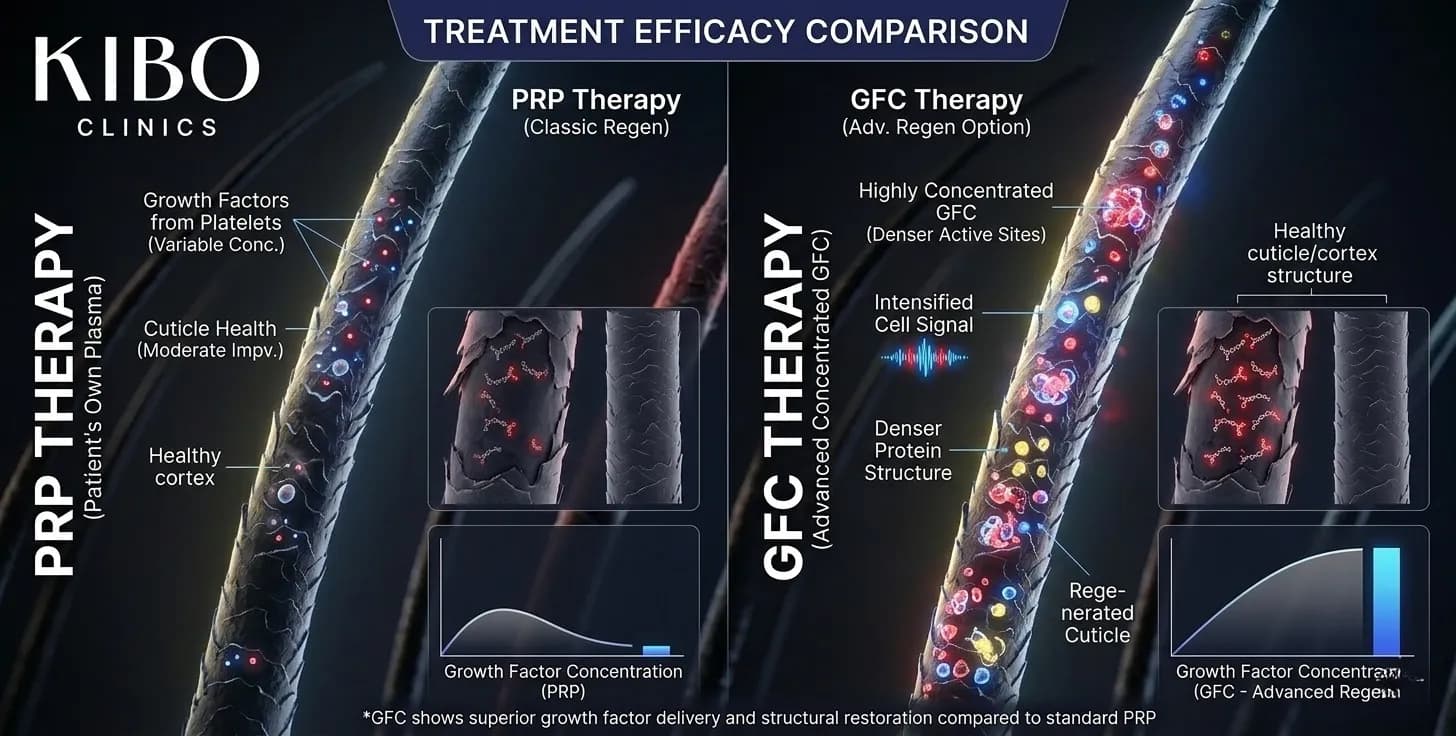
You run your fingers through your hair and notice thinning that wasn’t there a year ago. It’s frustrating and confusing. Both PRP and GFC therapy aim to reduce hair fall and support regrowth, but GFC is a more refined form of growth factor treatment that delivers higher concentration and consistency, which is why many consider it the new gold standard.
Hair thinning does not happen overnight. It builds slowly due to stress, hormonal shifts, nutritional gaps, and scalp health changes. Many people search “PRP vs GFC for hair loss” or “which is better for hair regrowth?” because they want a treatment that is safe, effective, and long lasting. Understanding the science behind both options helps you make a confident decision instead of guessing.
A Real Story: From PRP Sessions to GFC Therapy
Rohit, 34, from Hyderabad, noticed gradual thinning around his crown. He first tried oils and supplements. When that didn’t help, he started PRP therapy after reading about it online.
For six months, he attended regular PRP sessions. Hair fall reduced slightly, but density improvement was slow. His doctor explained that PRP quality can vary depending on platelet concentration and preparation method.
After evaluation, he shifted to GFC therapy. Within a few sessions, shedding reduced more noticeably and baby hairs began appearing in the thinning zone. His experience reflects what many patients report: GFC feels like a more targeted, consistent upgrade over traditional PRP.
What Is the Difference Between PRP and GFC Therapy?
Both treatments use your own blood. The difference lies in processing and concentration.
PRP stands for Platelet-Rich Plasma. Blood is drawn, spun in a centrifuge, and the plasma rich in platelets is injected into the scalp. Platelets release growth factors that support follicle repair and stimulate hair growth.
GFC stands for Growth Factor Concentrate. It is a more advanced process where specific growth factors are isolated and concentrated in a controlled way. Instead of injecting whole platelet plasma, GFC delivers a purified and standardized dose of growth factors.
Stepwise logic explains the impact:
Healthy scalp allows better blood flow.
Better blood flow supports follicle function.
Strong follicles respond better to growth signals.
Growth factors activate dormant follicles and strengthen weak ones.
Hormonal imbalance, stress, and poor lifestyle reduce follicle activity. Concentrated growth factors can help restart the growth cycle more effectively.
How Is Processing Different?
In PRP, platelet concentration can vary depending on technique. Not all PRP preparations are equal.
In GFC, growth factors are extracted and activated in a controlled system. This often results in a higher and more stable concentration of active proteins that directly signal hair follicles to grow.
Why Is GFC Considered the New Gold Standard?
Consistency is one major reason.
PRP results may vary because platelet yield differs from person to person. GFC reduces this variability by isolating and concentrating the most effective components.
Purity is another factor.
GFC removes many unwanted components like red blood cells and inflammatory elements. This can reduce post-procedure swelling and discomfort in some patients.
Fewer sessions may be needed.
While PRP may require multiple frequent sessions, some patients experience comparable or better response with fewer GFC sessions. However, this depends on severity and individual biology.
Predictability matters.
When treating early-stage hair thinning, predictable stimulation of follicles improves long-term planning. GFC offers more controlled dosing of growth signals.
How Does GFC and PRP Work in Men and Women?
Hair loss patterns differ between genders, and response can vary.
| Factor | Men | Women |
|---|---|---|
| Common Pattern | Receding hairline, crown thinning | Diffuse thinning, widened parting |
| Hormonal Role | DHT sensitivity dominant | Thyroid, PCOS, postpartum shifts |
| Response to Growth Factors | Works best in early to mid stages | Effective in stress or hormonal thinning |
In men with androgenetic alopecia, both PRP and GFC aim to slow miniaturization caused by DHT.
In women, especially those with stress-related or hormonal thinning, growth factor therapies help improve hair density and reduce shedding when combined with correction of underlying causes.
What Daily Habits Make Hair Regrowth Better or Worse?
Chronic stress increases cortisol, which disrupts the hair growth cycle.
Poor sleep reduces repair signals that follicles depend on.
Frequent chemical treatments inflame the scalp and reduce treatment response.
Crash dieting deprives follicles of protein and iron, weakening results from both PRP and GFC.
Helpful habits include balanced protein intake, iron and vitamin monitoring, scalp hygiene, and managing stress.
Mistake to avoid: expecting injections alone to fix untreated thyroid imbalance or severe nutritional deficiency.
What Helps First? (Relief Steps)
First, identify the type of hair loss through scalp analysis.
Second, correct nutritional gaps such as low ferritin or vitamin D.
Third, start medical-grade topical or oral support if advised.
Then begin PRP or GFC sessions as recommended.
Most patients notice reduced shedding within 4–6 weeks.
Visible density improvement usually appears after 3–4 months.
Full assessment of response takes about 6 months.
When to Meet a Hair Specialist
Hair fall lasting more than three months needs evaluation.
Rapid shedding after illness or childbirth requires assessment.
Sudden bald patches may indicate alopecia areata.
Severe itching, scaling, or scalp pain suggests inflammatory scalp disorders.
Family history of early baldness combined with active thinning calls for early intervention.
Common Myths About GFC and PRP
Myth 1: PRP and GFC are the same.
They both use blood-derived components, but GFC is more refined and concentrated.
Myth 2: Results are permanent after one session.
Hair loss is progressive. Maintenance sessions are often needed.
Myth 3: These treatments work in complete bald areas.
Completely inactive follicles cannot be revived by growth factors alone.
Myth 4: They are painful and unsafe.
When performed under sterile conditions, discomfort is usually mild and temporary.
Why Kibo Clinics for GFC Therapy and PRP
Many patients choose Kibo Clinics for hair thinning treatments because our approach addresses both hair restoration and long-term planning. We begin with comprehensive scalp assessment, hair and follicle analysis, and thorough lifestyle and environmental review.
Our No Ghost Surgery pledge ensures the consulting surgeon personally performs your entire procedure, maintaining consistent quality throughout the session. We don't delegate critical steps to technicians.
The Kibo Hair Analysis (scalp and follicle assessment) is the first step in understanding your specific condition. We provide education, guidance, and support without guarantees, exaggerated claims, or miracle cure promises.
We also provide structured follow-up for up to 12 months to monitor shedding patterns, density improvement, and maintenance needs. Adjustments are made based on real progress, not assumptions.
---
If you are confused between PRP and GFC therapy, a detailed scalp evaluation can clarify which option suits your stage of hair thinning.
---
Frequently Asked Questions
Is GFC better than PRP for hair loss?
GFC delivers a higher concentration of purified growth factors compared to standard PRP. Many patients experience more consistent results. However, outcomes still depend on age, severity of hair loss, and overall health. It is not a cure for advanced baldness.
How many sessions of GFC are needed?
Most patients require 3–4 initial sessions spaced a few weeks apart. Maintenance sessions may be advised yearly. The exact number depends on scalp condition and response rate.
Does PRP hurt more than GFC?
Both involve scalp injections, so mild discomfort is expected. Pain levels are similar. Numbing methods are used to reduce discomfort. Temporary swelling or redness may occur.
Can GFC regrow hair on a completely bald scalp?
No. Growth factor therapies work on existing but weakened follicles. Areas where follicles are permanently inactive may require hair transplant instead.
Is there downtime after these treatments?
Most people resume normal activity the same day. Mild tenderness may last 1–2 days. Heavy sweating or chemical treatments should be avoided briefly.
Are the results permanent?
Results can slow hair thinning and improve density, but underlying genetic or hormonal causes may continue. Maintenance and lifestyle correction are important.
Is GFC safe for women with PCOS?
It can be used in women with PCOS-related thinning. However, hormonal imbalance must also be managed. Treating only the scalp without correcting hormones limits results.
Which is more cost-effective in the long run?
PRP may seem less expensive per session, but if more sessions are needed, overall cost may increase. GFC may require fewer sessions in some cases, but pricing varies by clinic and protocol.
Disclaimer
This content is for informational purposes only and does not substitute personalized medical advice. Hair loss causes and treatment responses vary between individuals. Neither PRP nor GFC guarantees permanent regrowth. A qualified hair specialist should evaluate scalp condition, medical history, and expectations before starting treatment.
Hair Transplant
Sapphire FUE | Direct Hair Transplant | Bio FUE | Corrective Transplant
Hair Regrowth
Mesotherapy | Microneedling | IV Hair Boosters
Must Read
Hair Transplant Guide | FUE Complete Guide | Procedure Steps | Results Timeline | Norwood Scale
Relevant Blogs
Hair Myths Busted | Protective Hairstyles | Hair Breakage Guide | DHT Blockers | Kibo Experience
---
Medical Disclaimer : Information from Kibo Hair Clinics is for educational purposes only. It does not replace diagnosis, trichoscopy, blood test interpretation, prescription treatment, procedure advice, or side-effect counselling from a qualified dermatologist or hair restoration doctor.