
What Happens if You Don't Take Finasteride After a Transplant?
Published on Fri Apr 10 2026
You run your hand through your newly transplanted hair and feel hopeful. But months later, thinning starts behind the new hairline. If you don’t take finasteride after a hair transplant, the transplanted grafts usually stay, but your existing natural hair may continue to thin due to DHT, affecting overall density and long-term results.
A hair transplant redistributes strong donor hair to thinning areas. It does not stop the hormonal process that caused hair loss in the first place. Finasteride is often prescribed to slow or control that process. Many patients wonder if it is truly necessary, what happens if they skip it, and whether the results will last without medication. The answer depends on your age, pattern of loss, and long-term hair goals.
Rohan’s Story: A Common Post-Transplant Question
Rohan, 32, from Pune, underwent a hair transplant to correct his receding hairline. The first year looked great. His hairline was fuller, and he felt more confident in meetings and family events.
His surgeon advised finasteride to protect the native hair behind the transplanted zone. Rohan hesitated after reading online discussions about side effects. He decided to skip the medication.
Two years later, the transplanted hairline was still intact. However, the hair just behind it had thinned significantly. This created a “patchy” look. He required additional medical treatment and began considering a second transplant to restore balance.
What Does Finasteride Actually Do After a Transplant?
Hair loss in both men and some women is often driven by DHT (dihydrotestosterone). DHT shrinks genetically sensitive hair follicles over time.
Here is the stepwise process:
Scalp health supports healthy follicles.
Healthy follicles produce thick, visible hair shafts.
In androgenetic alopecia, DHT binds to sensitive follicles and gradually miniaturizes them.
Miniaturized follicles produce thinner hair until growth stops.
Lifestyle factors like stress, poor nutrition, smoking, and lack of sleep can worsen this cycle.
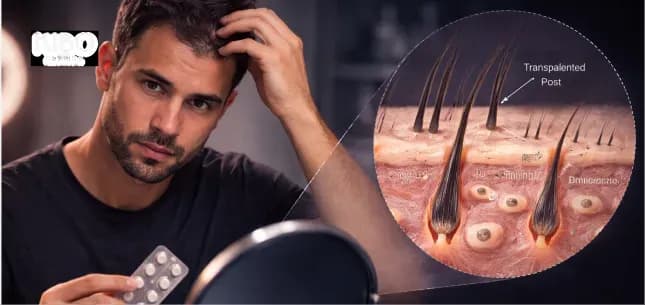
A hair transplant moves DHT-resistant follicles from the donor area to balding areas. These transplanted hairs are usually permanent because they retain resistance to DHT. However, the native hair around them may still be vulnerable.
Finasteride reduces DHT levels in the scalp. Lower DHT slows down miniaturization of existing hair. This helps maintain overall density and protects the cosmetic result.
Does Finasteride Affect Transplanted Hair?
Transplanted hairs are generally resistant to DHT. Finasteride mainly protects the non-transplanted, native hair. However, maintaining surrounding density improves the overall visual outcome.
What Happens If You Skip Finasteride Completely?
If you do not take finasteride after a transplant, several scenarios are possible.
Your transplanted grafts will usually continue to grow normally.
Your existing native hair may continue to thin over time.
The contrast between thick transplanted hair and thinning natural hair may become noticeable.
You may need additional treatments or a second transplant in the future.
Progression is not immediate. It may take 1–5 years depending on age, genetic strength, and pattern of loss.
| Factor | With Finasteride | Without Finasteride |
|---|---|---|
| DHT Levels | Reduced | Remain High |
| Native Hair Protection | Slows miniaturization | Continued thinning likely |
| Long-Term Density | Better maintained | May reduce over years |
| Need for Second Procedure | Less likely early | Higher chance |
How Does Hair Loss Progress Without DHT Control?
Without DHT suppression, the natural balding process continues.
In younger patients under 35, progression can be faster.
In advanced Norwood stages, mid-scalp and crown thinning may become visible even if the hairline looks stable.
In some cases, a strong donor area masks early changes, but density gradually drops behind the transplant.
The transplant itself does not “fail.” The surrounding hair changes.
How Does Finasteride Show in Men and Women?
In men, finasteride is commonly prescribed for androgenetic alopecia. It helps stabilize hair loss and maintain density after transplant.
In women, oral finasteride is not routinely used in premenopausal women due to safety concerns. In selected postmenopausal women, it may be considered under supervision. Female hair loss often has hormonal and nutritional components beyond DHT, so treatment plans differ.
Both men and women benefit from early evaluation and tailored treatment plans rather than copying online advice.
What Daily Habits Make It Better or Worse?
Certain habits influence how your hair behaves after transplant.
Chronic stress increases cortisol, which can worsen shedding.
Smoking reduces scalp blood flow, affecting follicle support.
Crash dieting lowers protein and iron levels, weakening hair shafts.
Ignoring dandruff or scalp inflammation disrupts follicle environment.
Helpful habits include:
Balanced protein intake.
Regular sleep cycles.
Managing stress through exercise or meditation.
Following prescribed medical therapy consistently.
A common mistake is stopping medication too early because results look stable. Hair loss is gradual, so stopping suddenly may restart progression.
What Helps First? (Relief Steps)
If you choose not to take finasteride, consider alternatives discussed with your specialist.
Topical DHT blockers may offer mild support.
PRP therapy can stimulate follicle activity.
Low-level laser therapy may improve scalp circulation.
IV nutritional support may help if deficiencies are present.
Expected timeline:
0–3 months: Shedding phase settles after transplant.
6–12 months: Visible growth improves.
1–3 years: Native hair stability depends on DHT control.
No option fully replaces medical DHT suppression, but combined approaches may slow progression.
When to Meet a Hair Specialist
Consult your specialist if you notice:
Sudden thinning behind transplanted hair.
Rapid crown widening.
Increased daily hair shedding beyond 3–4 months.
Itchy, inflamed scalp not responding to care.
Family history of aggressive early baldness.
Early review allows medical adjustment before major density loss occurs.
Common Myths About Finasteride After Transplant
Finasteride is mandatory for everyone.
Not true. Some older patients with stable baldness patterns may manage without it.
Transplanted hair will fall out without finasteride.
False. Transplanted hair is usually DHT-resistant.
Finasteride gives instant results.
It works gradually over months and mainly maintains existing hair.
Stopping finasteride causes worse hair loss than before.
Hair loss usually returns to its natural progression, not worse than your genetic pattern.
Natural supplements can fully replace finasteride.
Most supplements have limited evidence compared to DHT blockers.
Why Kibo Clinics for Post-Transplant Planning
Many patients choose Kibo Clinics for post-transplant planning because our approach addresses both density preservation and long-term hairline design. We begin with comprehensive scalp assessment, hair and follicle analysis, and thorough lifestyle and environmental review.
Our No Ghost Surgery pledge ensures the consulting surgeon personally performs your entire procedure, maintaining consistent quality throughout the session. We don't delegate critical steps to technicians.
The Kibo Hair Analysis (scalp and follicle assessment) is the first step in understanding your specific condition. We provide education, guidance, and support without guarantees, exaggerated claims, or miracle cure promises.
Our 12-month monitoring protocol tracks growth, density stability, and surrounding native hair health. Adjustments are made if thinning progresses, helping patients make informed decisions about medication, PRP, or future procedures.
---
Worried about thinning after your transplant? Get a personalized long-term hair plan.---
Frequently Asked Questions
Can a hair transplant survive without finasteride?
Yes, transplanted grafts usually survive because they are DHT-resistant. However, native hair around them may continue thinning. Over time, this can affect density balance. Long-term planning becomes important.
Will I lose my transplanted hair if I stop finasteride?
In most cases, transplanted hair remains. Stopping finasteride mainly affects the non-transplanted hair. Hair loss progression may resume according to your genetics.
How long should I take finasteride after a transplant?
Many patients take it long term to maintain results. Some may use it for a few years depending on age and pattern stability. The duration should be individualized with medical supervision.
Are there alternatives to finasteride after transplant?
Options include topical treatments, PRP therapy, laser therapy, and nutritional correction. These may support hair health but may not reduce DHT as effectively as finasteride.
Is finasteride necessary for older patients?
Patients above 45 with stable baldness patterns may not always require it. Risk of further rapid progression is lower in some cases. Assessment is essential before deciding.
Does finasteride improve transplant growth speed?
No, it does not directly speed up graft growth. It mainly protects existing hair and supports overall density.
Can women take finasteride after hair transplant?
In select cases such as postmenopausal women, it may be prescribed under supervision. It is not commonly used in premenopausal women. Female hair loss often needs a broader hormonal and nutritional approach.
What happens if I start finasteride years after transplant?
It may still help slow ongoing miniaturization of native hair. However, hair already lost may not fully return. Early intervention generally offers better preservation.
Disclaimer
This content is for informational purposes only and does not substitute personalized medical advice. Hair loss progression varies by genetics, age, hormonal profile, and lifestyle. Response to finasteride or alternative treatments differs among individuals. Treatment decisions should be made after consultation with a qualified hair specialist. No outcomes are guaranteed.
Hair Transplant
Sapphire FUE | Direct Hair Transplant | Bio FUE | Corrective Transplant
Hair Regrowth
GFC Therapy | Mesotherapy | Microneedling | IV Hair Boosters
Must Read
Hair Transplant Guide | FUE Complete Guide | Procedure Steps | Results Timeline | Norwood Scale
Relevant Blogs
Hair Myths Busted | Hair Breakage Guide | Kibo Experience
---