
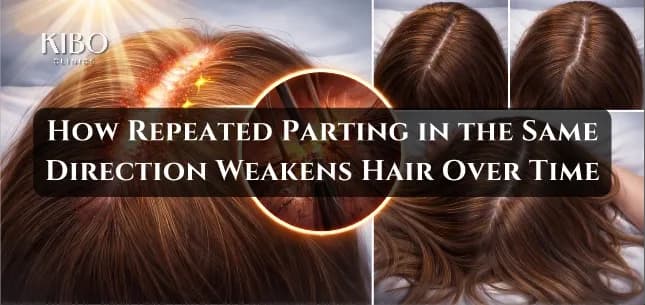
How Repeated Parting in the Same Direction Weakens Hair Over Time

Repeated hair parting causing scalp stress and thinning

Published on Sun Mar 22 2026

If you have been parting your hair in exactly the same place for years, that parting line is most likely wider, more visible, and weaker than it was when you started. This is not genetic hair loss. This is chronic mechanical stress combined with direct environmental exposure on a narrow strip of your scalp that never gets a break. Every single day, you are pulling the hair on either side of that part away from each other, exposing the scalp beneath to UV radiation, pollution, dryness, and friction. The hair immediately along the parting line takes the most tension as it is pulled in opposite directions. The scalp along that line gets the most sun exposure because it is never covered by hair lying flat over it. Over months and years, this creates a visible thinning pattern that runs in a perfectly straight line exactly where you part your hair every morning. The fix is simpler than you think, but first you need to understand why this happens and why switching up your part every few weeks can completely prevent it.

You Have Been Parting Your Hair the Same Way Since You Were a Teenager

Think about your morning routine. You wash your hair, towel dry it, maybe blow dry it, and then you run a comb or your fingers down the same line on your scalp that you have been using for as long as you can remember. Left side part. Right side part. Center part. Whichever one you chose years ago, you have probably stuck with it because it feels natural, it suits your face shape, and changing it feels weird.

But here is what you might not have noticed. That parting line has gotten wider over the years. When you look down at your scalp in the mirror or in photos, you can see more scalp showing along that line than you used to. The hair on either side of the part looks fine, but the part itself looks sparse, thin, almost like a road cutting through your hair. You might have blamed it on aging, stress, or early signs of pattern hair loss. And while those things can contribute, the real culprit is often much simpler. You have been stressing the exact same strip of scalp and hair follicles every single day for years without giving them any recovery time.

This is a completely preventable form of hair damage and breakage that happens slowly enough that most people do not connect it to their parting habits until someone points it out.

The Real Problem: Your Scalp Cannot Protect What Is Always Exposed

Hair exists to protect your scalp. When hair lies flat across your scalp, it shields the skin beneath from UV radiation, temperature extremes, pollution, and physical abrasion. When you create a part, you intentionally expose a narrow line of scalp by pulling the hair away from it in two directions. That exposed line now has no protection from anything.

If you change your part location regularly, the exposure rotates across different areas of your scalp and no single zone takes sustained damage. But if you part your hair in the exact same place every day, that one strip of scalp gets hit with direct sunlight, air conditioning, pollution, and environmental stress every single day for years while the rest of your scalp stays covered and protected. This chronic exposure weakens the follicles along that line, dries out the scalp skin, and creates an environment where hair growth is compromised.

On top of environmental exposure, you are also creating mechanical tension along the parting line. The hair on either side of the part is being pulled in opposite directions every time you comb, brush, or style. The follicles right at the edge of the part experience the highest tension load because they are the pivot point where the directional pull changes. Over time, this repeated tension weakens those follicles and can lead to a form of traction stress that looks very similar to early traction alopecia, except it is concentrated in a perfectly straight line rather than around the hairline or crown.

What Is Actually Happening Along Your Parting Line

The hair follicles along your chronic parting line are dealing with two simultaneous stressors: environmental exposure and mechanical tension. Neither one alone would necessarily cause visible thinning, but the combination compounds the damage significantly.

UV radiation from sunlight damages the scalp skin along the exposed parting line. Chronic UV exposure breaks down collagen in the scalp dermis, which is part of the structural support system that keeps follicles anchored and healthy. It also creates oxidative stress at the follicle level, which can push more follicles into the resting phase of the hair growth cycle prematurely. This means fewer follicles are actively producing hair at any given time along that line compared to areas of the scalp that stay covered.

The mechanical tension component adds follicle stress on top of the UV damage. When you comb your hair into a part, you are pulling the hair shafts in opposite directions away from the parting line. The follicles right at the parting line are being tugged sideways every time you style or adjust your hair. This is not dramatic pulling like you would get from a very tight ponytail, but it is consistent low-level tension applied to the same follicles every single day for years. Chronic low-level tension is actually more damaging to follicles than occasional high tension because the follicles never get recovery time between stress events.

The hair shafts along the parting line also experience increased friction and breakage because they are constantly being pulled, combed, and repositioned to maintain the part. Every time you run your fingers or a comb through your hair to redefine the part, you are creating a friction event right at that line. Over months and years, this leads to a concentration of shorter broken hairs along the part that makes the line look even wider and more sparse than it actually is.

Understanding how hair follicle anchoring works helps you see why this kind of chronic directional stress matters. Follicles are not designed to handle sustained pulling in one direction for years. They adapt to the load by weakening their anchor, which eventually shows up as visible thinning and easier shedding along that line.

Early Signs People Miss

The earliest sign is not hair loss. It is a visible widening of the parting line itself. When you look at your part in the mirror, you can see more scalp than you used to. The line looks broader, more defined, almost like a road cutting through your hair. This happens before you notice actual thinning or shedding, because what you are seeing initially is just the scalp skin becoming more visible due to the hair being pulled further apart on either side.

Another early sign is scalp sensitivity or mild discomfort right along the parting line. If you press your finger along your part and it feels tender, sore, or more sensitive than the surrounding scalp, that is an early warning signal that the follicles along that line are under stress. This sensitivity often shows up before any visible thinning because the follicle inflammation and stress happens beneath the surface before it affects the hair shafts visibly.

Look closely at the hair along your parting line compared to hair a few centimeters away from it. Does the hair right at the part look shorter, finer, or more broken than the hair on either side? If you see a concentration of shorter hairs with blunt ends rather than tapered tips along the part, that is direct evidence of breakage from mechanical stress and friction. These broken hairs make the part look even wider because they stand up at odd angles instead of lying flat.

Pay attention to whether one side of your part looks thinner than the other. If you part your hair on the left and always comb the right section over the top of your head, the right side often takes more tension and shows more thinning than the left. This asymmetry within the parting zone itself tells you that mechanical tension is playing a significant role alongside the environmental exposure.

If you find yourself needing to redefine your part multiple times throughout the day because the hair keeps falling back toward the center, that is another sign that the follicles along the part have weakened and are not holding the directional pull as well as they used to. Healthy, well-anchored follicles maintain the part angle throughout the day with minimal adjustment. Weakened follicles lose the angle quickly and require constant re-combing. This is exactly the kind of pattern you learn to recognize when building effective protective hairstyle habits.

Daily Habits Making It Worse

Using a fine-tooth comb to create a sharp, precise part every single day maximises the mechanical stress on the follicles along that line. The finer the comb, the more concentrated the pulling force on each individual follicle as you drag the comb through to separate the hair. Switching to a wider-tooth comb or using your fingers to create a softer, less precise part reduces the tension load significantly.

Spending a lot of time outdoors with your parting line exposed to direct sunlight accelerates the UV damage component. If you work outside, exercise outside, or spend significant time in the sun, the parting line gets hours of direct UV exposure every day while the rest of your scalp stays covered. Adding a hat or changing your part location for outdoor activities makes a real protective difference.

Blow drying your hair in the same parted direction every time compounds the damage because heat styling along a chronic parting line dries out both the hair shafts and the exposed scalp skin. The combination of heat, tension from the brush, and directional airflow all concentrate along that same narrow line. If you must blow dry, at least vary the part location slightly from day to day so the heat exposure rotates across different areas.

Tying your hair back in a ponytail or bun immediately after creating a part locks the tension in place for the entire duration you wear the style. The hair is pulled tightly away from the parting line on both sides and held in that position for hours. This sustained tension is far more damaging than the brief pulling that happens when you initially create the part. People who combine a chronic center part with a daily high ponytail often develop the most severe parting line thinning because they are layering multiple tension sources on the same follicles. Understanding which hair accessories cause the least tension becomes critical when you are already stressing a parting line.

Using heavy styling products along the parting line to keep the hair in place adds weight and can create buildup on the exposed scalp, clogging follicles and creating an additional barrier to healthy growth. If you need to use product, focus it on the lengths and ends rather than applying it directly along the part itself.

What Helps in Real Life

  • Change your part location every two to three weeks. This is the single most effective thing you can do. You do not need to change it every day. Just shift it a few millimeters to one side or the other every couple of weeks so that no single strip of scalp is constantly exposed and under tension. Even small shifts make a big difference because they distribute the UV exposure and mechanical stress across a wider area of scalp rather than concentrating it on one line.
  • Alternate between a side part and a center part. If you normally part on the left, try a center part for a month, then switch to a right side part for a month, then back to the left. This rotation gives each zone several weeks of recovery time between exposure periods. You will notice within a few months that the chronic thinning along your original part starts to fill in as those follicles get rest and protection.
  • Use your fingers instead of a comb to create your part. Fingers create a softer, less precise part that puts less mechanical stress on individual follicles. The part might look slightly less sharp, but the reduction in daily tension is worth the aesthetic trade-off if you are dealing with visible thinning along your parting line.
  • Wear a hat when spending extended time in the sun. If you cannot or do not want to change your part, at least protect it from UV damage by covering it when outdoors. A hat shields the exposed scalp from direct sunlight and dramatically reduces the environmental stress component of the damage even if you keep the same part location.
  • Apply sunscreen to your scalp along the parting line. If wearing a hat is not practical, using a scalp-safe sunscreen or a leave-in spray with UV protection directly on the exposed skin along your part reduces the UV damage significantly. Focus the application on the visible scalp rather than the hair itself to avoid product buildup on the shafts.
  • Avoid tight hairstyles that lock your part in place. If you tie your hair back, do it loosely and avoid styles that pull the hair tightly away from the parting line in opposite directions. A loose low ponytail or braid is far less damaging than a tight high ponytail when you are already stressing a chronic part. This is particularly important if you are someone who already deals with tension damage from daily styling.
  • Give your scalp a break by wearing your hair down more often. If you always style your hair with a defined part, try wearing it down and unstyled on weekends or days off to give the parting line complete rest from both tension and exposure. Even one or two days a week of no defined part makes a measurable difference over time.

When Lifestyle Changes Are Not Enough

Most people who catch parting line thinning early and start rotating their part location see visible improvement within three to six months. The hair along the old parting line gradually fills in as the follicles recover from the chronic stress and the scalp heals from the UV damage. The widened part narrows, the broken hairs grow out, and the overall density along that line evens out with the surrounding hair.

However, if you have been parting your hair in the same place for many years, particularly if you also have genetic predisposition to androgenetic hair loss, the follicle damage along that line may be more advanced than simple mechanical stress and UV exposure. In some cases, chronic parting in one location can accelerate the miniaturisation process in follicles that were already genetically susceptible, creating a very visible thinning line that does not fully recover even after you stop stressing it.

If you have rotated your part, protected it from sun, reduced styling tension, and given it several months to recover, but the line is still visibly thin or widening, a professional scalp assessment will tell you whether you are dealing with pure mechanical damage or whether there is a genetic or hormonal component that needs different treatment. Building a complete low-stress hair care routine alongside any professional treatment gives you the best shot at recovery. For people managing multiple sources of daily hair stress, reading about comprehensive hair protection strategies helps you address everything at once rather than fixing one issue while another continues.

Why Kibo Clinics

When you come to us concerned about a thinning parting line, we do not assume anything. We use trichoscopy to examine the actual condition of the follicles along that line, the scalp skin health, the presence of miniaturisation, and whether the pattern matches mechanical stress, genetic thinning, or a combination of both. Because the treatment approach is completely different depending on what is actually happening beneath the surface.

For patients where the thinning is purely mechanical and environmental, the solution is often as simple as habit modification, targeted scalp care, and maybe some temporary follicle support through treatments like PRP therapy to accelerate the recovery process. PRP delivers growth factors directly into the stressed follicles, helping them rebuild strength and resume normal hair production faster than they would on their own.

For patients where chronic parting has been layered on top of genetic susceptibility, we look at a combination approach. We address the mechanical habits to stop making it worse, and we use treatments like GFC therapy or mesotherapy to support the follicles that are dealing with both genetic miniaturisation and mechanical stress simultaneously. This is particularly common in patients who have been center-parting for years and also have a family history of female pattern hair loss along the midline.

We also work with you on practical styling changes that fit your actual preferences. If you hate the way you look with a side part, we are not going to tell you to force it. We will find solutions that work with your style while still protecting your scalp. Our 12-month care approach means we track how your parting line responds over time and adjust the plan if the initial changes are not producing the results we expected. You deserve a plan that is built around your life, not a generic checklist.


Get a call back to understand your hair loss stage and the best next step by certified doctor.


Frequently Asked Questions

Can parting your hair in the same place cause hair loss?

Parting your hair in the same place for years does not cause true follicle-level hair loss in most cases, but it does cause visible thinning along the parting line through a combination of chronic UV exposure, mechanical tension, and shaft breakage. The exposed scalp along the part gets direct sun damage that weakens follicles over time. The hair on either side of the part experiences constant directional pulling that stresses the follicles at the pivot point. The result is a widened, visibly thinner parting line that looks like hair loss but is actually a mix of weakened follicles, broken shafts, and exposed scalp skin.

How often should I change my hair part?

Changing your part every two to three weeks is ideal for preventing chronic stress on any single area of your scalp. You do not need to change it daily. Even shifting it a few millimeters to one side every couple of weeks distributes the UV exposure and mechanical tension across a wider area rather than concentrating it on one line. If you alternate between a left part, center part, and right part on a rotating schedule, each zone gets several weeks of recovery time between exposure periods.

Will my thinning parting line grow back if I change where I part my hair?

In most cases, yes. If the thinning is purely from mechanical stress and UV exposure rather than genetic pattern hair loss, rotating your part location and protecting the scalp from sun will allow the follicles along the old parting line to recover over three to six months. The visible widening will narrow, broken hairs will grow out, and density will improve. However, if the thinning is a combination of chronic parting stress and genetic susceptibility, full recovery may require professional treatment alongside habit changes.

Does the direction I part my hair matter?

The direction itself matters less than the consistency. Whether you part on the left, right, or center is not the issue. The problem is parting in the exact same spot for years without variation. That said, people who part on one side and always comb the hair over the top of their head in the same direction often see more thinning on the side that experiences the most tension from the directional pull. Rotating between left, right, and center parts over time prevents this asymmetric stress pattern.

Can sunscreen on my scalp really help prevent parting line thinning?

Yes, significantly. UV radiation is one of the two major stressors on chronic parting lines, alongside mechanical tension. Applying a scalp-safe sunscreen or a leave-in spray with UV protection directly to the exposed skin along your part reduces the oxidative stress, collagen breakdown, and follicle damage that comes from daily sun exposure. This is particularly important if you spend a lot of time outdoors or live in a high UV environment. Even if you do not change your part location, protecting it from UV makes a measurable difference.

Is a center part worse for hair than a side part?

A center part is not inherently worse, but it does expose the scalp along the midline where hair is often naturally finer and where genetic female pattern hair loss tends to show up first. This means a chronic center part can make early genetic thinning more visible and can accelerate the appearance of widening if there is underlying genetic susceptibility. For people without genetic predisposition, a center part is no more damaging than a side part as long as it is rotated regularly. The key is variation, not the specific direction.


Hair Transplant

FUE Hair Transplant | Sapphire FUE Hair Transplant | Direct Hair Transplant (DHT) | Corrective Hair Transplant | Hairline Correction

Hair Regrowth

PRP Therapy | GFC Therapy | Mesotherapy for Hair Regrowth | Microneedling for Hair Regrowth | Low Level Laser Therapy (LLLT)

Must Read

Hair Breakage Causes and Treatments | Hair Loss Types, Symptoms and Causes | Tension-Based Hair Damage During Styling | Hair Extensions and Traction Alopecia Risk | Understanding Hair Follicle Anchoring

Relevant Blogs

Best Hairstyles to Minimise Stress on Hair Follicles | Hair Ties vs Scrunchies vs Clips | Daily Hair Protection for Active Lifestyles | Low-Stress Hair Care for Busy Professionals | How Tight Headgear Affects Hair Follicle Health

FAQs
Hair transplant procedure can take up to 6-10 hours depending on the number of grafts and extent of the surgery. Gigasessions more than 4000 grafts can take up to 8-12 hours divided over two days for patient convenience.
Hair transplant surgery done by the FUE method is done under local anesthesia. Minimal pain and discomfort is expected during the surgery but it can be managed intraoperatively by using microinjections and vibrating devices. Mild discomfort during recovery is also expected but can be managed with post surgery prescription medications.
Most people can return to work within 7 days but healing takes a minimum of 3 weeks. During this time, scabs and swelling subside and the skin heals completely accepting grafts and making them secure for further growth. However, you might see some initial shedding starting from the first month onwards, the hair growth will start appearing from the 3rd month onwards.. Final results may take 12-18 months to become completely noticeable.
Yes, when performed by experienced surgeons, transplanted hair looks natural and blends seamlessly with existing hair. Your surgeon will decide factors like hairline placement, graft density and angle and direction of the transplanted hair in a detailed discussion before the surgery which will be then imitated to achieve the natural and desirable results.
Hair transplant is generally considered to provide long-term results. However, you may continue to lose non-transplanted hair over time or due to your lifestyle changes, making follow-up treatments necessary for some.
Hair transplants are generally safe, but some risks include minor swelling, bleeding, temporary numbness in the scalp, pain, itching, crusting, rarely infection or shock loss. Most side effects are temporary and usually mild when performed by a qualified surgeon.
Initial shedding of transplanted hair is normal. New growth begins around 3-4 months, with full results visible within 12-18 months.
Get a Call Back

YOUR HAIR JOURNEY STARTS HERE

Repeated Hair Parting: Does It Damage Your Follicles