
Traction Alopecia from Tight Hairstyles: How Your Daily Ponytail Causes Hair Loss
Published on Thu Apr 02 2026
Quick Summary
Traction alopecia from tight hairstyles is one of the most preventable yet most commonly missed causes of permanent hair loss. Wearing the same tight ponytail, bun, or braid in the exact same position every day applies sustained mechanical force to the same follicles repeatedly and unlike the acute pull of a single brushing session, this chronic directional tension triggers a degenerative remodeling process that progressively weakens the follicle's anchoring structure, reduces blood supply, and eventually impairs the stem cells responsible for new hair growth.
The damage starts invisibly, advances through scalp tenderness and hairline recession, and can cross into permanent thinning within months to years depending on tension magnitude and daily frequency. What makes it particularly dangerous is how ordinary it looks — a simple daily ponytail, worn for years, can create the same pattern as advanced androgenetic hair loss.
The Daily Routine That Created a Pattern
Anjali wore her hair the same way every single day for five years. High ponytail, same position, same tight elastic band. It was efficient, professional-looking, and kept hair completely out of her face during long workdays. She never thought about it as anything more than a practical styling choice. Her hair was thick and healthy, so why would a simple ponytail be a problem?
Then one morning while putting her hair up, she noticed something. The hair along her temples seemed thinner than before. Not dramatically, just slightly less dense. She dismissed it initially maybe just her imagination. But three months later, the difference was undeniable. Her hairline had visibly receded at the temples. The frontal hairline where the elastic pulled tightest had started to thin noticeably.
When she finally consulted a specialist, the diagnosis was immediate: traction alopecia from chronic mechanical stress. The exact same ponytail position, the exact same pulling force, every single day for five years had progressively damaged the follicles in the high-tension areas. What seemed like a harmless styling choice had created sustained biomechanical stress that her follicles could not tolerate long-term.
How Mechanical Force Transfers From Styling to Follicle Damage
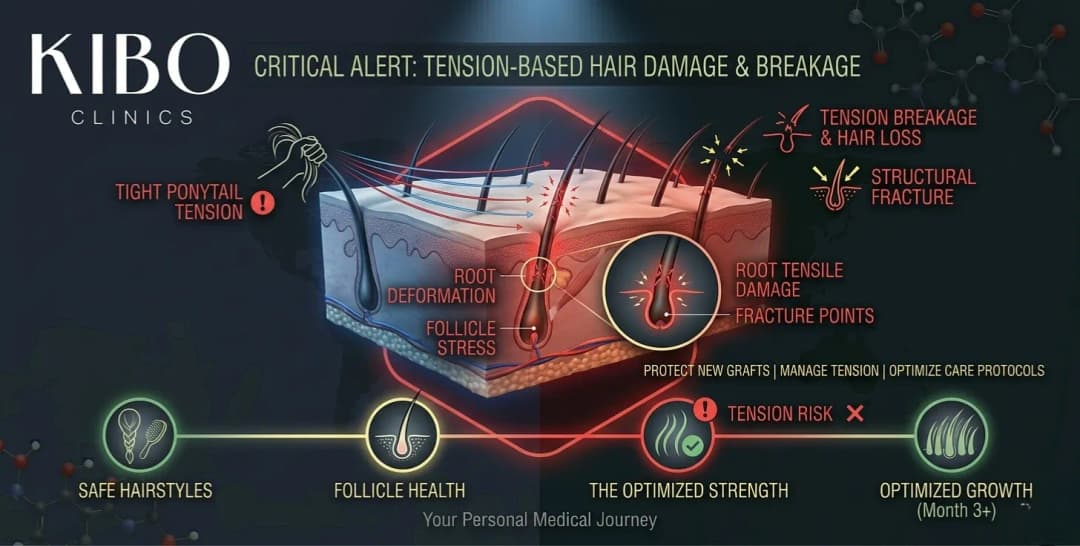
When you pull hair into any style that creates tension, the force does not stop at the visible hair shaft. It travels down the entire length of each hair, through the scalp surface, to the follicle root embedded in the dermis layer of your skin. The follicle anchors each hair through a complex attachment system involving the dermal papilla, the root sheath, and surrounding connective tissue.
Under normal circumstances, this anchoring system is remarkably strong. Individual follicles can hold 50 to 100 grams of weight before the hair pulls out. But that strength measurement applies to acute, temporary force. Chronic, sustained tension creates an entirely different stress pattern that the follicle anchoring system was not designed to handle continuously.
When tension is applied and maintained over hours, the follicle experiences sustained deformation. The pulling force creates directional stress on the follicle structure, attempting to pull it toward the surface in the direction of the tension. The dermal papilla and root sheath attachment points resist this force initially, but sustained pressure triggers a biological response the follicle begins adapting to the chronic mechanical stress through structural remodeling.
This remodeling process is not protective. It is degenerative. The follicle structure gradually weakens. The blood supply to the follicle can become compressed or distorted, reducing nutrient delivery. The stem cells in the follicle bulge responsible for generating new hair experience altered signaling. Over time, these changes progress from reversible functional stress to irreversible structural damage.
Tension Damage Variables How Each Factor Compounds the Risk
| Variable | Low Risk | High Risk | Why It Matters |
|---|---|---|---|
| Force magnitude | Loose, low ponytail — distributed across many follicles | Tight, high ponytail — concentrated force at hairline and crown | Higher tension = faster follicle anchoring degeneration per session |
| Duration per day | 1–2 hours — follicles recover when released | 8–12 hours — chronic stress, no adequate recovery time | Sustained deformation triggers degenerative remodeling; brief tension does not |
| Frequency | Occasional — days or weeks between stress events | Daily — follicles experience chronic stress with minimal recovery | Same tight style once a week is harmless; daily makes it cumulative damage |
| Location consistency | Varied — different positions rotate stress across different follicle groups | Same position daily — same follicles bear all the stress continuously | Location consistency is the single most critical factor for permanent traction patterns |
| Hair state when styled | Dry — structural bonds intact, distributes force normally | Wet — hydrogen bonds broken, stretches more, greater root stress per pull | Wet hair under the same tension creates disproportionately more follicle damage |
| Fastener type | Wide scrunchie — distributes tension across large surface area | Thin metal elastic — concentrates tension into narrow contact zone | Narrower fasteners create localized high-stress zones even at the same overall tension |
Why Some Tension Patterns Cause Permanent Damage While Others Do Not
A ponytail worn for two hours once a week applies minimal cumulative stress. The same ponytail worn for twelve hours daily in the exact same position creates chronic biomechanical stress in specific follicle populations that compounds over months and years.
Force magnitude matters because higher tension creates greater stress on follicle anchoring. A loose, low ponytail distributes tension across many follicles with minimal force on any individual one. A tight, high ponytail concentrates significant force on the follicles along the hairline and at the crown.
Duration determines how long follicles remain under continuous stress without recovery time. Tension applied for one to two hours allows follicles to recover when released. Tension maintained for eight to twelve hours daily creates chronic stress where follicles never get adequate recovery periods.
Frequency compounds cumulative stress. Wearing a tight style occasionally — even quite tight — gives follicles days or weeks of recovery between events. Wearing the same tight style daily means follicles experience chronic stress with minimal recovery. This is why the same hairstyle can be harmless when worn occasionally but damaging when it becomes a daily routine.
Location consistency is perhaps the most critical factor for permanent damage. When you vary your hairstyle position and type, you distribute tension stress across different follicle populations on different days. No single group of follicles experiences chronic stress. When you wear the exact same style in the exact same position daily, the same follicles experience all the tension stress continuously — creating the classic traction alopecia patterns along hairlines, at temples, and at crown areas.
Early Biomechanical Warning Signs Before Visible Thinning
The first sign of tension hair loss is not thinning. It is tenderness. If your scalp feels sore or sensitive in the areas where your hairstyle pulls tightest, particularly after removing the style, that is active inflammation from mechanical stress. The follicles and surrounding tissue are responding to sustained tension with an inflammatory response — your early warning system.
Other early signals to watch for:
- Tension headaches specifically when wearing certain tight styles that resolve when you take your hair down — neurological responses to sustained pulling force on the scalp fascia affecting surrounding structures
- Hair breaking or popping sounds when removing elastics or pins — the mechanical stress exceeded the hair shaft's breaking point; the type of fastener matters significantly, but any style causing breakage during removal is applying too much tension
- Increasing short hairs around your hairline or temples — these can be hairs shed prematurely due to follicle stress or broken hairs from mechanical stress at the scalp surface; an increase in very short hairs in high-tension areas often indicates follicles are being pushed into early shedding
- Widening of your natural part line — if you consistently style hair pulled back from the same part, sustained tension can cause gradual widening over months as follicles along the part line experience chronic directional pulling
- Hairline recession at temples that was not present before you started a particular daily styling routine — this is the clearest indicator that tight hairstyle hair loss has progressed beyond surface damage
Daily Styling Habits That Create Chronic Biomechanical Stress
Wearing the exact same hairstyle in the exact same position every day is the single most damaging tension-related habit. Even if the style itself is not extremely tight, daily repetition in the exact same location compounds mechanical stress over time to damaging levels.
Sleeping in tight styles extends tension duration to include the entire night in addition to daytime wear. Follicles experience sustained tension for potentially twenty or more hours daily with minimal recovery time. This chronic continuous tension is particularly damaging because follicles never get adequate stress-free periods for repair.
Using tight elastics with metal components or very narrow bands concentrates tension force at specific points along the hair shaft. The narrower the elastic or fastener, the more concentrated the tension force becomes on the hairs it grips, increasing both breakage risk and follicle stress. Wide, fabric-covered elastics or scrunchies distribute tension over a larger surface area, reducing concentrated stress points.
Pulling hair back tightly when it is wet compounds mechanical stress because wet hair is structurally weaker and more elastic. Tension force on wet hair creates more stretching and deformation than the same force on dry hair, potentially causing both shaft breakage and greater stress on follicle anchoring. Always allow hair to dry substantially before applying sustained tension through tight styles.
Adding weight through clips, decorative elements, or hair extensions amplifies the pulling force gravity exerts on the follicles. A ponytail experiences downward pulling from its own weight. Adding heavy accessories or extensions multiplies this gravitational force, creating sustained downward tension on follicles throughout the day — sometimes exceeding follicle tolerance even when the initial styling tension alone would be manageable.
What Actually Protects Follicles From Tension Damage
Vary your hairstyle position and type daily or every few days to distribute mechanical stress across different follicle populations. One day a low ponytail, the next day a braid, the following day leave hair down or in a loose clip. This rotation prevents any single group of follicles from experiencing chronic concentrated stress.
Use the comfort test for tension assessment. If the style feels tight, pulls on your scalp, or creates any discomfort, it is applying excessive tension. Protective styles should feel secure but comfortable with no scalp pulling sensation. You should be able to slide a finger under the elastic without significant resistance.
Implement tension-free days regularly where you wear your hair completely down or in very loose, minimal-tension styles. Aim for at least two to three days per week where follicles experience minimal mechanical stress. Weekend days off from tight styling can provide significant cumulative protection over months and years.
Choose fasteners that distribute tension broadly. Wide scrunchies, fabric-covered elastics, and large clips spread tension force over more surface area and more individual hairs, reducing stress on any single follicle. Avoid thin elastics, metal bands without coating, and very small clips that concentrate tension into narrow zones.
Practice tension release throughout the day if you must wear secured styles for long periods. Every few hours, loosen the style slightly or temporarily remove the fastener and massage your scalp to restore circulation before restyling. Even brief tension breaks significantly reduce long-term damage risk.
Start styles slightly loose and allow natural settling rather than pulling hair extremely tight from the beginning. Hair naturally settles into position through movement. Starting moderately loose and allowing this settling achieves a secure style with less initial mechanical stress than forcing hair into position with extreme tension.
When Tension Damage Becomes Follicle-Level and Requires Intervention
If you have developed visible thinning in a pattern that matches your typical hairstyle tension points — particularly along the hairline, at the temples, or at the crown — follicle-level traction damage has occurred. Early intervention by completely eliminating tight styling in affected areas gives some follicles the opportunity to recover function.
Signs that tension damage has progressed to require professional assessment:
- Hair feels less firmly anchored and comes out more easily during gentle brushing or washing, even after stopping tight styles — the follicle anchoring system has been weakened and may need months to rebuild
- Scalp tenderness or inflammation persists for more than a few days after stopping tight styling — suggests a sustained inflammatory state requiring intervention rather than spontaneous recovery
- Visible scalp showing through previously thick areas in specific zones matching your styling patterns — follicle function has been impaired enough to affect overall hair production
- Follicles entering prolonged resting phases or producing miniaturised hairs — indicates progressive damage that needs treatment support
If traction stress has continued for years creating established thinning patterns, some follicles may have sustained permanent damage. In these cases, medical treatment or hair transplantation may be needed to restore growth in permanently affected areas.
Why Kibo Clinics
When you come to us concerned about thinning that seems related to your hairstyling habits, we do not just tell you to stop pulling your hair tight. We perform detailed examination to determine the extent of follicle damage, whether the thinning pattern is purely traction-related or whether underlying androgenetic factors are being accelerated by mechanical stress, and what recovery potential exists for the affected follicles.
We use magnified scalp imaging to assess follicle density, hair caliber variability, and inflammation patterns in both affected and unaffected areas. This comparison helps determine whether follicles are temporarily suppressed and likely to recover with tension elimination, or showing signs of permanent follicle scarring where hair restoration would require transplantation rather than medical stimulation.
For patients with early-stage traction stress, the treatment plan focuses on complete elimination of tension in affected areas, anti-inflammatory treatments to resolve ongoing inflammation, and topical treatments to support follicle recovery. Most people see improvement within four to six months as stressed follicles gradually resume normal function.
For patients with established traction alopecia where some follicles have sustained permanent damage, we provide realistic assessment of which areas can recover naturally versus which may require FUE hair transplant to restore density. We also address the critical importance of correcting styling habits before any transplant procedure, because transplanted follicles can also be damaged by chronic tension if the mechanical stress patterns continue after surgery.
We help you develop protective styling strategies that achieve the practical and aesthetic results you need without creating damaging mechanical stress. Whether that is learning alternative securing techniques, identifying appropriate accessories, or finding completely different styling approaches that work for your lifestyle, the goal is sustainable hair health that does not require choosing between having the style you want and maintaining the hair you want to keep.
Get a call back to understand how tension from your hairstyles affects follicle health and receive personalized care guidance by certified doctors.
Frequently Asked Questions
Q: How tight is too tight when styling my hair? If the style creates any scalp pulling sensation, discomfort, or tenderness during wear or after removal, it is too tight. Protective styles should feel secure but comfortable with no awareness of scalp tension. A good test is whether you can easily slide a finger under the elastic or between the secured hair and your scalp without significant resistance. If you feel relief when you take the style down, the mechanical stress exceeds safe levels and will create cumulative follicle damage with repeated wear.
Q: Can wearing a ponytail every day cause permanent hair loss? Yes, wearing a ponytail in the exact same position every day, especially if tight or high, can cause permanent hair loss through traction alopecia. The sustained mechanical stress on the same follicles daily creates progressive damage to the follicle anchoring system and triggers inflammatory responses that impair follicle function. The timeline varies based on individual follicle resilience and tension magnitude, but chronic daily tension in consistent locations can create visible thinning patterns within six months to two years.
Q: Why do I get headaches from tight hairstyles? Tension headaches from tight hairstyles result from sustained pulling force on the scalp fascia and surrounding connective tissue. The mechanical stress creates tissue tension affecting pain receptors in the scalp and can trigger neurological responses including headache. Very tight styles can also compress blood vessels, reducing scalp circulation and contributing to vascular headache development. If you consistently get headaches from certain styles that resolve when you take your hair down, the mechanical tension is significant and likely creating follicle-level stress as well.
Q: Is it better to wear hair up or down to prevent damage? Neither is inherently better. The key is variation and tension management. The damaging pattern is wearing hair in the exact same tight style in the exact same position daily. For optimal follicle health, vary between up and down styles, change the position and type of updos regularly, ensure up styles use minimal tension, and give follicles regular tension-free days. This rotation prevents the concentrated chronic stress on specific follicle populations that creates progressive traction patterns.
Q: How long does it take for hair to recover from traction damage? For early-stage traction stress, visible improvement typically begins within three to four months after eliminating the mechanical stress, with continued improvement over six to twelve months. For moderate damage where follicles have entered prolonged resting phases, it may take four to six months for them to transition back to active growth. For severe established traction alopecia with permanent follicle damage, natural recovery may not occur without medical intervention, and some cases require hair transplantation to restore density in permanently affected areas.
Q: Can scrunchies really prevent hair damage compared to regular elastics? Yes, scrunchies provide measurable protection by distributing tension force over a larger surface area and more individual hairs. Thin elastics concentrate tension into a narrow band, creating localized high stress that increases both shaft breakage risk and follicle stress. However, scrunchies do not eliminate tension damage if the overall style is too tight. A very tight ponytail secured with a scrunchie still creates excessive follicle stress. The scrunchie reduces one damage mechanism but does not compensate for overall excessive tension.
Q: What is the difference between traction alopecia and normal hair loss? Traction alopecia creates a specific pattern of thinning that matches the areas of highest mechanical stress from hairstyling — typically along the frontal hairline, at the temples, around the ears, or at the nape depending on style type. The pattern is usually asymmetric if styling tension is not perfectly even. Normal androgenetic hair loss follows genetic patterns, typically affecting the crown and frontal scalp in men or creating overall thinning in women. Traction alopecia can be identified by its mechanical pattern matching styling habits, often includes scalp tenderness or small bumps in affected areas, and in early stages improves significantly when tension stops.
Key Takeaways
- Traction alopecia from tight hairstyles develops through a specific biomechanical pathway — not from occasional pulling but from chronic sustained tension on the same follicles, day after day
- Location consistency is the most critical risk factor — the same follicles bearing all the tension daily creates concentrated progressive damage that varied styling would spread harmlessly across different zones
- Does tight ponytail cause hair loss? Yes — daily high tight ponytails are one of the most common preventable causes of hairline recession and temple thinning in women
- Early warning signs come before visible thinning: scalp tenderness after removing the style, tension headaches, and increasing short hairs at the temples are all signals to change habits immediately
- For early-stage traction damage, stopping tight styling gives most follicles three to six months to recover — but years of established traction may require medical treatment or transplantation
- Vary style position daily, use wide scrunchies or fabric elastics, never style wet hair tight, and take at least two tension-free days per week
Hair Transplant
FUE Hair Transplant | Sapphire FUE Hair Transplant | Direct Hair Transplant (DHT) | Corrective Hair Transplant | Hairline Correction
Hair Regrowth
PRP Therapy | GFC Therapy | Mesotherapy for Hair Regrowth | Microneedling for Hair Regrowth | Low Level Laser Therapy (LLLT)
Must Read
Hair Breakage Causes and Treatments | Hair Loss Types, Symptoms and Causes | Best Hairstyles to Minimise Stress on Hair Follicles | Hair Follicle Anchoring Strength | Scalp Sensitivity and Hair Pull Tolerance
Relevant Blogs
Hair Ties vs Scrunchies vs Clips | Wet Hair Styling Root Vulnerability | Hair Growth Cycle and Mechanical Shedding | Hair Elasticity and Stress Resistance | Repeated Hair Parting Damage