

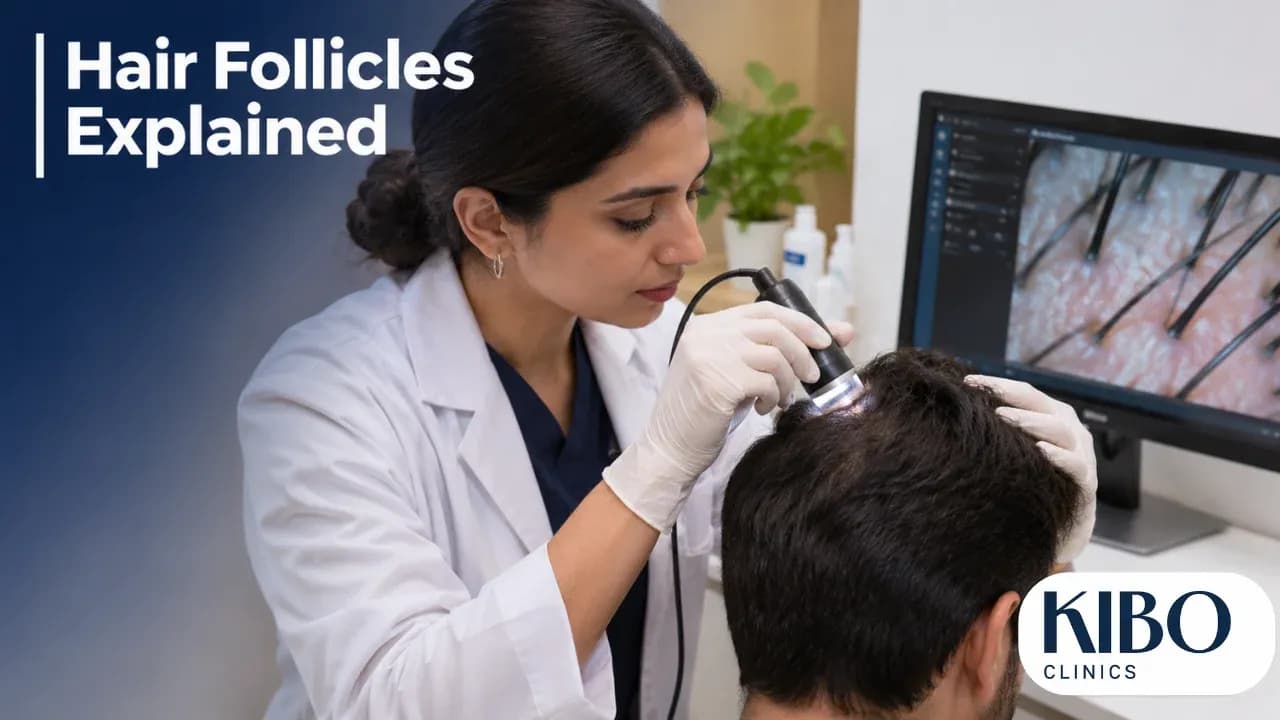
What Are Hair Follicles?
Hair follicles are small, tube-like structures in the skin that produce hair. Each follicle grows a strand in repeated cycles of growth, rest, and shedding.
These cycles do not occur at the same time across all follicles. Each follicle follows its own growth schedule, so while some hairs are growing, some are resting or shedding. This is why normal shedding does not usually leave large bald patches.
A hair follicle is part of the pilosebaceous unit, which also includes the sebaceous gland and arrector pili muscle.
The sebaceous gland produces sebum (oil), which helps keep the hair and skin lubricated. The arrector pili muscle pulls the hair upright, which is why small bumps appear on the skin when you get goosebumps.
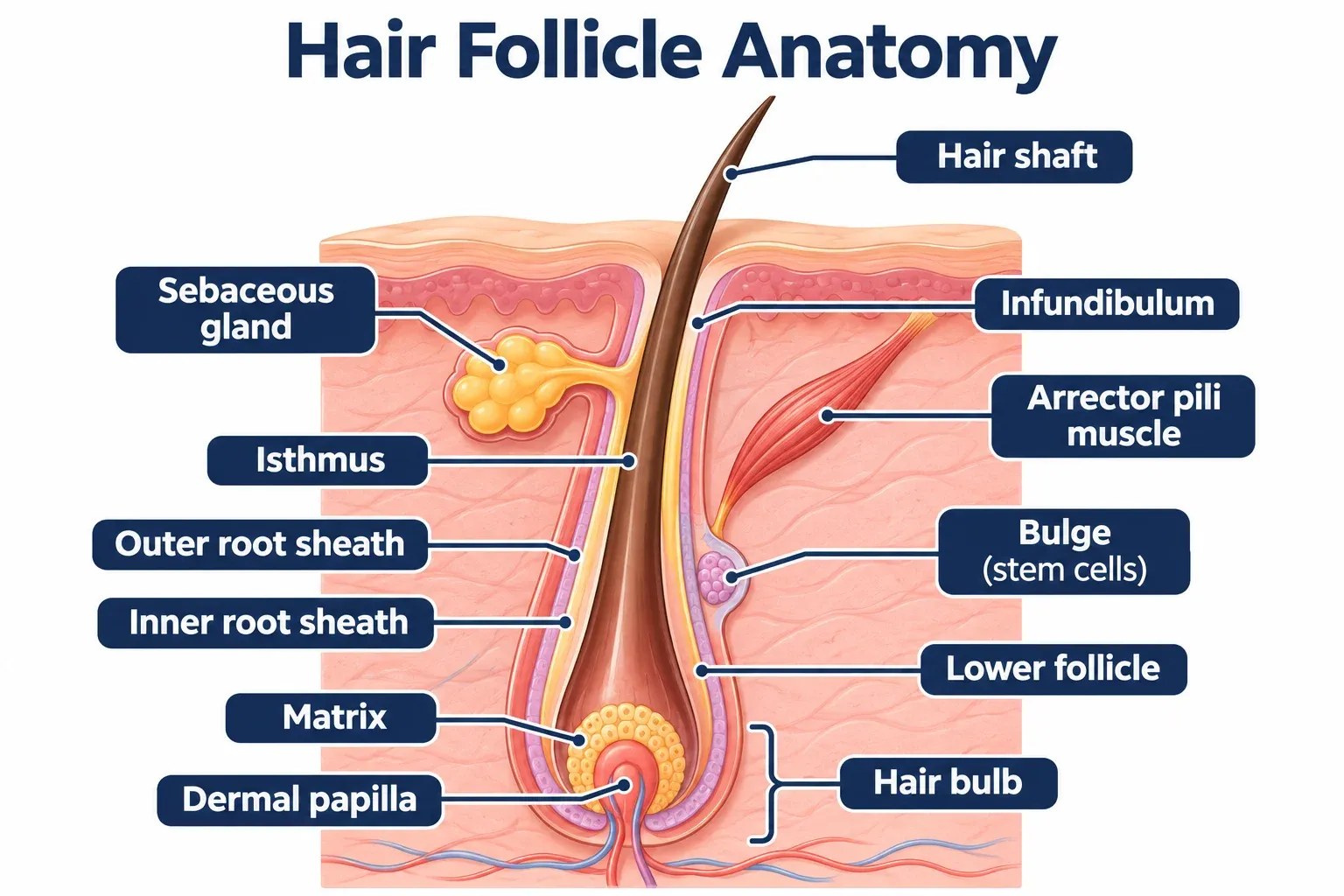
Hair Follicle Anatomy: Key Parts and Their Functions
The hair follicle is generally divided into three sections: the upper part near the skin's surface (infundibulum), the middle part (isthmus), and the lower part.
It also contains several specialised structures that work together to support hair growth, regulate the growth cycle, and help the follicle regenerate. These include:
- Hair bulb: The hair bulb is present at the base of an actively growing follicle. It is an enlarged, rounded structure that surrounds the dermal papilla and contains the matrix, where new hair cells are produced.
- Dermal papilla: Located at the base of the hair bulb, the dermal papilla is a cluster of cells that sends signals to surrounding follicular cells. These signals help regulate hair growth and transitions between different stages of the hair cycle.
- Matrix: Found within the hair bulb, the matrix contains rapidly dividing cells that multiply to form the hair shaft and inner root sheath.
- Bulge: The bulge of the hair follicle is a region that contains stem cells. These cells contribute to follicular regeneration and help initiate new growth cycles.
- Inner root sheath: This is the innermost layer of the hair follicle, surrounding the developing hair shaft. It helps shape and guide the hair strand as it grows upwards through the follicle.
- Outer root sheath: The outer root sheath is the outer epithelial layer that surrounds the follicle and gives it structural support. It also contains cells that contribute to follicular regeneration.
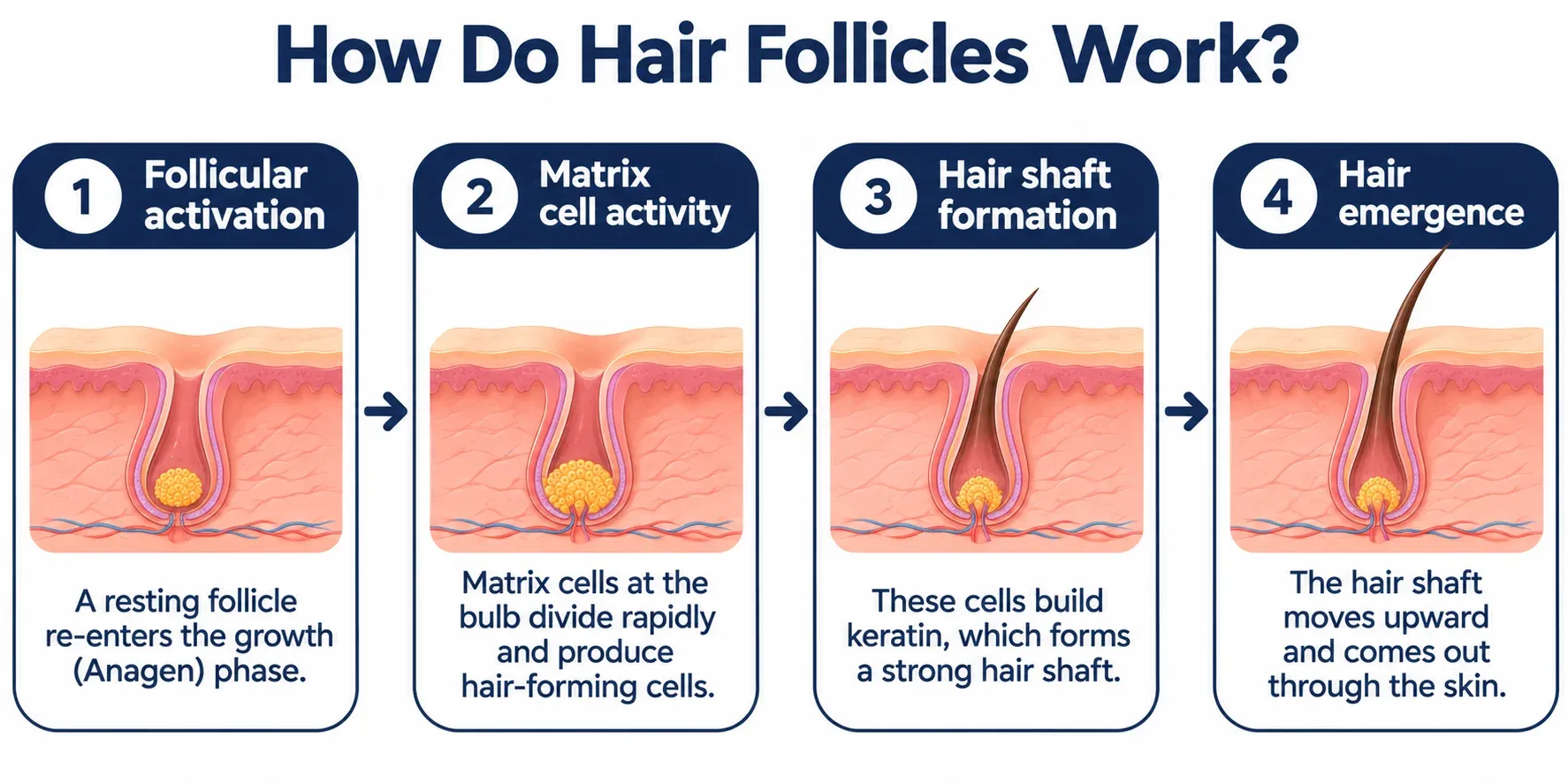
How Do Hair Follicles Work?
Hair follicles work through coordinated signalling between stem cells, the dermal papilla, and the matrix. When a new growth phase begins, signals activate follicular cells. Matrix cells then multiply to form the hair shaft, which gradually grows towards and beyond the skin surface.
Here is how the process works:
- Step 1: Follicular activation. Signals within the follicle help initiate a new growth phase. Stem cells in the bulge contribute to follicular regeneration.
- Step 2: Matrix cell activity. Matrix cells multiply to form the hair shaft and inner root sheath.
- Step 3: Hair shaft formation. As the cells develop, they produce keratin and become part of the hair fibre.
- Step 4: Hair emergence. The new fibre moves through the follicle and emerges from the skin.
The visible hair shaft is made largely of keratinised tissue. It does not contain living cells that actively produce more hair. The biological activity responsible for hair production takes place inside the follicle.
While blood supply to the follicle is essential for hair growth, it alone does not control the growth process. Communication between follicular cells and the dermal papilla also plays an important role in regulating it.
What Is the Hair Follicle Growth Cycle?
Every hair follicle goes through a repeating cycle of growth, transition, rest, and shedding. These stages are called anagen, catagen, telogen, and exogen.
| Phase | Stage | What Happens |
|---|---|---|
| Anagen | Active growth | The follicle produces a hair shaft. |
| Catagen | Short transition | The lower follicle starts to shrink. |
| Telogen | Resting | The hair stops growing and stays in place while the follicle rests. |
| Exogen | Shedding | The existing hair fibre is released, and a new hair begins to grow in its place. |
Anagen Phase: Anagen is the stage when your hair actively grows. Cells in the matrix multiply and form the hair shaft. The follicle also extends deeper into the skin. This phase commonly lasts several years on the scalp, although the duration differs between people.
Catagen Phase: During catagen, the follicle starts to shrink. Matrix cell activity stops, and the lower part of the follicle begins to regress. This is a short stage that prepares the follicle for rest.
Telogen Phase: Telogen is the resting stage of the hair cycle. The follicle is not actively producing a growing hair shaft, but it is not necessarily permanently inactive. It can enter another growth phase later.
Exogen Phase: Exogen is when the existing hair fibre is released. It is often described alongside telogen or as part of the resting stage. Shedding during this phase is a normal part of the hair cycle and does not mean that the follicle has been destroyed.
What Are Dormant Hair Follicles?
The term "dormant hair follicles" usually refers to follicles that are resting, particularly during telogen. It is a consumer-friendly expression, and not a specific medical diagnosis. A resting follicle can re-enter the growth phase, so dormancy does not automatically mean that the follicle is permanently inactive.
A resting follicle should not be confused with a permanently destroyed follicle. Similarly, not every follicle that appears inactive is blocked or waiting to be activated by a topical product. If hair growth has reduced or stopped, the underlying reason needs to be assessed.
What Are Damaged Hair Follicles?
"Damaged hair follicles" is a broad term and not a single medical diagnosis. It can refer to temporary changes in follicle activity, inflammation, miniaturisation, repeated physical injury, or permanent scarring.
These conditions do not affect the follicle in the same way, so the possibility of recovery depends on the cause.
| Type of Follicle Change | Effect on the Follicle | Can the Follicle Recover? |
|---|---|---|
| Temporary functional disturbance | A temporary factor, such as an illness, disrupts the growth cycle | Usually, once the factor resolves |
| Inflammation | Ongoing inflammation disturbs the growth cycle | Often, with timely medical treatment |
| Miniaturisation | The follicle gradually shrinks and produces thinner hair | Progression can be slowed |
| Traction or repeated injury | Repeated pulling or injury damages the follicle | Often, if caught early |
| Scarring alopecia | Follicle structure is destroyed and replaced with scar tissue | No, the hair loss is usually permanent |
Note: Not all hair damage starts at the follicle. Heat styling, chemical treatments, and rough handling can damage the hair shaft without necessarily harming the follicle beneath the skin.
Can Hair Follicles Regrow?
Healthy hair follicles can produce new hair repeatedly as part of their normal growth cycle. However, whether a damaged follicle can recover depends on what caused the damage and whether the follicular structure is still intact. If scarring has permanently destroyed a follicle, it cannot simply be revived.
To understand whether hair can grow back, it is important to look at the difference between normal follicular regeneration and recovery after damage.
- Normal shedding: The existing hair falls out, but a healthy follicle can produce another strand during a later cycle.
- Temporary disruption: Some follicles may recover when the factor affecting their activity is resolved.
- Miniaturisation: A follicle becomes smaller but may continue to produce hair. The new strands are often shorter and finer.
- Permanent destruction: In scarring alopecia, inflammation can destroy the follicle and replace it with scar tissue. A destroyed follicle cannot regenerate in the usual way.
Therefore, the possibility of regrowth depends on the follicle's condition. Treatments such as PRP therapy or GFC therapy may help support a weakened follicle in some cases, but no product can be assumed to restore every damaged or miniaturised follicle.
What Is Hair Follicle Miniaturisation?
Hair follicle miniaturisation is the progressive reduction in follicle size, which causes it to produce shorter and finer hair shafts. It is commonly associated with androgenetic alopecia, also known as pattern hair loss or genetic hair loss. In this condition, genetically susceptible follicles respond to androgen-related signalling and gradually become smaller.
Miniaturisation explains why hair can become thinner before it stops growing altogether. A miniaturised follicle may still produce hair, but the strands become finer and shorter over time.
Over time, this can reduce overall hair density and make the scalp more visible. The extent of miniaturisation can vary for different areas of the scalp. This is why pattern hair loss often affects particular areas rather than causing uniform thinning from the beginning.
A dermatologist may use clinical examination and trichoscopy, a magnified assessment of the scalp and hair, to identify signs of miniaturisation. Some miniaturised follicles may respond to treatment, but not every miniaturised follicle can be restored to its previous size. For follicles that have miniaturised beyond recovery, see the hair transplant results timeline for what a realistic surgical restoration timeline looks like.
What Can Affect Hair Follicle Cycling?
Several factors, including genetics, hormonal signals, age, inflammation, nutrition, general health, medications, and scalp conditions, can influence how hair follicles move through their growth cycles.
- Genetics: Inherited factors can contribute to androgenetic alopecia and other hair disorders.
- Hormonal signals: Androgens can affect follicles that are genetically susceptible to them.
- Age: Hair growth and regeneration patterns can change with age.
- Inflammation: Ongoing inflammation can disturb the hair cycle and contribute to certain hair-loss conditions.
- Nutrition and general health: Nutritional deficiencies and systemic stress can affect hair cycling in some people.
- Medications: Certain medicines can change the balance between the growth and resting phases.
- Scalp conditions: Inflammatory or infectious scalp disorders can affect follicular health.
Note: These factors do not explain every case of hair loss. If you notice persistent shedding or changes in your scalp, a dermatologist can help identify the possible cause. Do not assume that a nutritional issue, hormonal change, or damaged follicle is responsible without an assessment.
Hair Follicle Health at Kibo Clinics
Noticing more hair fall, thinner strands, or reduced hair density can make you worry that your hair follicles are damaged or no longer active.
However, these changes do not always mean that the follicles have been permanently damaged. Some may be resting, while others may be affected by miniaturisation, inflammation, or scarring.
At Kibo Clinics, we believe that understanding the condition of the hair follicles is an important part of assessing hair loss. Rather than assuming that inactive or thinning follicles can be revived with a product or treatment, it is essential to identify the underlying cause and determine whether the follicular structures remain intact.
If you are concerned about persistent hair thinning or shedding, a Kibo Clinics board-certified hair transplant surgeon can assess your hair and scalp, evaluate the pattern of hair loss, and discuss suitable options, from FUE hair transplant for stable pattern hair loss to corrective hair transplant where scarring has affected a previous procedure, based on your individual needs.
References
- Hoover, E., Alhajj, M., & Flores, J. L. (2023). Physiology, Hair. StatPearls. StatPearls Publishing.
- Martel, J. L., Miao, J. H., Badri, T., & Fakoya, A. O. (2024). Anatomy, Hair Follicle. StatPearls. StatPearls Publishing.
- Cuevas-Diaz Duran, R., Martinez-Ledesma, E., Garcia-Garcia, M., Bajo Gauzin, D., Sarro-Ramirez, A., Gonzalez-Carrillo, C., Rodriguez-Sardin, D., Fuentes, A., & Cardenas-Lopez, A. (2024). The Biology and Genomics of Human Hair Follicles: A Focus on Androgenetic Alopecia. International Journal of Molecular Sciences, 25(5), 2542.
- Tan, C. T., Lim, C. Y., & Lay, K. (2024). Modelling Human Hair Follicles, Lessons from Animal Models and Beyond. Biology, 13(5), 312.
- Natarelli, N., Gahoonia, N., & Sivamani, R. K. (2023). Integrative and Mechanistic Approach to the Hair Growth Cycle and Hair Loss. Journal of Clinical Medicine, 12(3), 893.
- Asfour, L., Cranwell, W., & Sinclair, R. (2023). Male Androgenetic Alopecia. Endotext. MDText.com, Inc.
- Lin, X., Zhu, L., & He, J. (2022). Morphogenesis, Growth Cycle and Molecular Regulation of Hair Follicles. Frontiers in Cell and Developmental Biology, 10, 899095.
- Yang, C.-C., & Cotsarelis, G. (2010). Review of Hair Follicle Dermal Cells. Journal of Dermatological Science, 57(1), 2-11.
Hair Transplant Services
Surgical
- FUE Hair Transplant
- Sapphire FUE Hair Transplant
- Direct Hair Transplant (DHT)
- Corrective Hair Transplant
Non Surgical
Must Read
Do hair follicles die with normal hair shedding?
Can dormant hair follicles become active again?
Can damaged hair follicles be repaired?
What is hair follicle miniaturisation?
How long do scalp hair follicles grow?
What is the difference between a resting follicle and a dead follicle?
Does every thinning follicle mean permanent hair loss?
What role does the dermal papilla play in hair growth?
Can nutrition alone fix follicle damage?
Medical Disclaimer : Information from Kibo Hair Clinics is for educational purposes only. It does not replace diagnosis, trichoscopy, blood test interpretation, prescription treatment, procedure advice, or side-effect counselling from a qualified dermatologist or hair restoration doctor.