
Article Information
Reviewed By: Shritej Mali
Written By: Kibo Clinics Content Team
Sources Referenced: American Academy of Dermatology, National Psoriasis Foundation, DermNet NZ, NIH, NCBI Bookshelf, Journal of Clinical and Investigative Dermatology, BNF NICE
Last Updated: May 2026
Reading Time: 22 minutes
Who This Is For: Anyone dealing with scalp flakes, itching, redness, thick scales, dandruff that keeps returning, or flaking along with hair fall
This article is for education only. Scalp psoriasis, seborrhoeic dermatitis, dandruff, fungal scalp issues, and inflammatory scalp conditions can overlap. A clinical assessment is recommended if symptoms persist or hair loss appears with flaking.
Not sure whether your flakes are dandruff, dry scalp, or psoriasis? A scalp and follicle assessment can help identify the cause.
Scalp Psoriasis vs Dandruff: How to Tell the Difference
Not all scalp flakes are dandruff, and using the wrong treatment can make the real problem worse.
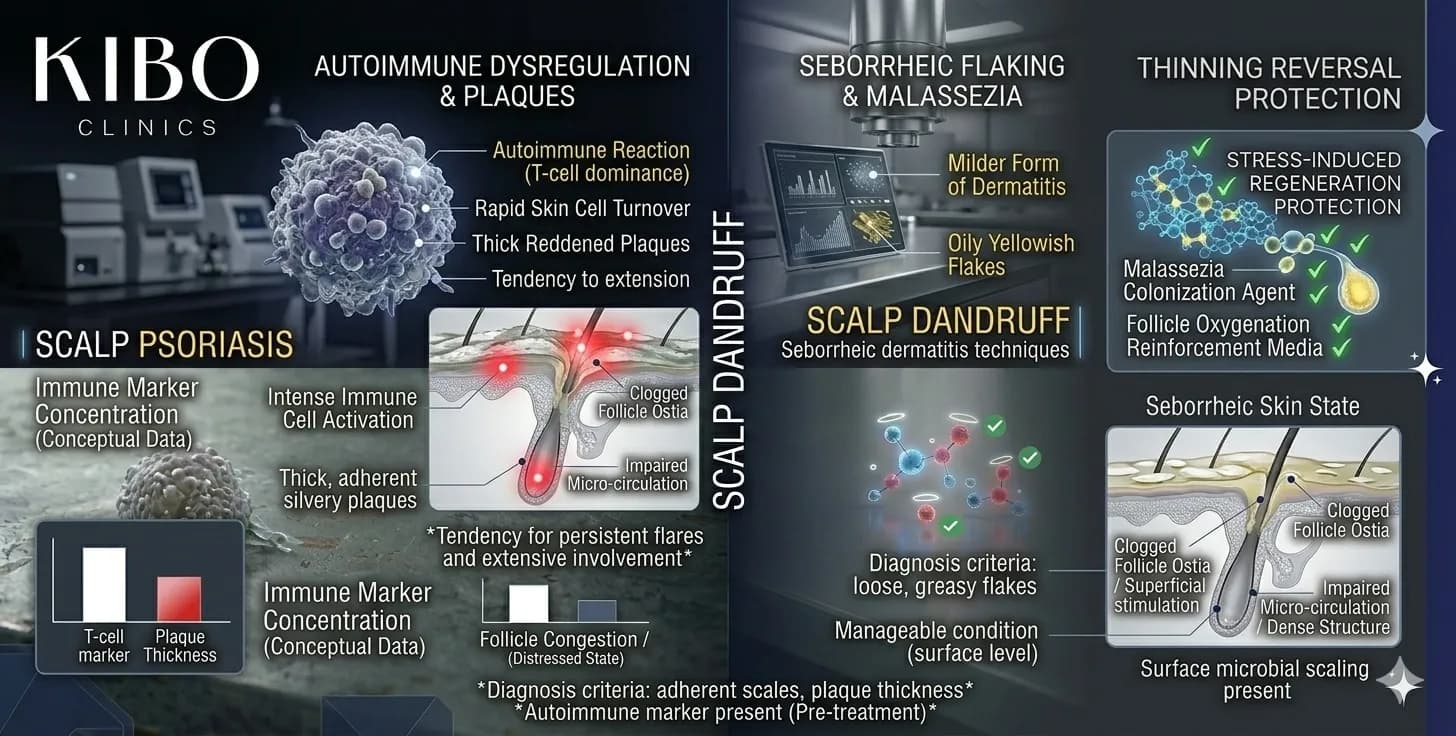
Scalp psoriasis and dandruff both cause flaking and an itchy scalp, but they are fundamentally different conditions with different causes, different appearances, and very different treatment paths. Dandruff is linked to Malassezia yeast, scalp oil, and irritation. Scalp psoriasis is an immune-driven condition where skin cell turnover speeds up, creating thick, silvery plaques. Mistaking one for the other is common, and it can delay the right treatment.
This guide walks you through exactly how to tell them apart, what causes each, how they are treated, and when to see a specialist. If your main worry is whether dandruff itself can lead to hair fall, this separate guide on dandruff and hair loss explains that connection in more detail.
What Is Scalp Psoriasis and What Is Dandruff?
Scalp psoriasis is a chronic immune-driven skin condition. The immune system sends signals that speed up the skin cell production cycle from the normal 28 to 30 days to as fast as a few days in affected areas. This rapid turnover causes cells to pile up on the scalp surface, forming thick, dry, silvery-white plaques with a red or inflamed base underneath.
Dandruff, also called seborrhoeic dermatitis when more severe, is a non-autoimmune scalp condition. It is associated with Malassezia yeast, sebum, and scalp sensitivity. Malassezia species live on many healthy scalps, but in sensitive individuals, their interaction with scalp oils can trigger irritation and faster shedding of skin cells. This produces the soft, white or yellowish flakes most people recognise.
The essential difference: Psoriasis is driven by immune overactivity. Dandruff is driven mainly by yeast, oil, and the scalp's inflammatory reaction to them.
Both conditions can cause visible flaking, itching, repeated flare-ups, and stress-related worsening. But they look different, feel different, spread differently, and respond to different treatments. If flaking is paired with ongoing shedding, it is also worth checking whether a broader issue like hair loss types and symptoms is involved.
What Does Scalp Psoriasis Look Like Compared to Dandruff?
The appearance of flakes is often the first clue. The differences become clearer when you know what to look for.
Scalp Psoriasis: What to Look For
- Flakes are thick, dry, and silvery-white, often described as scales rather than loose flakes.
- Red or pink plaques sit beneath the flakes with a clearly defined border against normal skin.
- Flakes are powdery and may lift off in chunks rather than falling freely.
- It can extend beyond the scalp into the hairline, behind the ears, on the back of the neck, and sometimes the forehead.
- Itching can be severe. The skin may feel sore or tender, not just itchy.
- Scalp skin may look thickened and inflamed in affected patches.
DermNet NZ describes scalp psoriasis as well-defined, red, thickened patches or plaques with overlying silvery-white scales. The American Academy of Dermatology also notes that scalp psoriasis can look like dandruff, but unlike dandruff, it often has dry scale and a silvery sheen.
Dandruff or Seborrhoeic Dermatitis: What to Look For
- Flakes are soft, flat, and may look oily or yellowish.
- The scalp may appear mildly red but usually without thick plaque-like build-up.
- Flakes often scatter freely onto clothing and shoulders.
- It is mainly confined to the scalp, though it can sometimes affect the eyebrows, sides of the nose, and behind the ears.
- Itching is usually moderate. The scalp may feel tight or uncomfortable after washing.
- The scalp skin does not thicken in the same way psoriasis does.
If your symptoms look more like greasy scale and repeated flaking around oily areas, this guide on seborrheic dermatitis and scalp flaking may help you compare patterns.
Flakes Side by Side
| Feature | Scalp Psoriasis | Dandruff |
|---|---|---|
| Flake texture | Thick, dry, silvery | Soft, oily, white-yellow |
| Flake attachment | Adheres to scalp | Falls freely |
| Scalp appearance | Red plaques, defined edges | Diffuse redness, no thick plaques |
| Spread beyond scalp | Common around hairline, ears, neck, forehead | Less common |
| Skin thickening | Often present | Absent |
| Soreness or tenderness | Common | Uncommon |
If your flakes are thick, powdery, and attached to a clearly defined red patch, psoriasis is more likely. If your flakes are loose, greasy, and scattered, dandruff is the more probable cause.
What Causes Scalp Psoriasis vs Dandruff?
Understanding the cause matters because it directly determines what treatment will actually work.
Why Dandruff Happens
Dandruff occurs when Malassezia yeast, scalp oil, barrier sensitivity, and inflammation interact. Malassezia is normally present on the scalp, but in some people, its interaction with scalp sebum irritates the skin and speeds up shedding of surface cells. That excess shedding appears as white or yellowish flakes.
Factors that can worsen dandruff include:
- Oily scalp, because more sebum can support yeast activity.
- Irregular washing, which allows oil, product residue, and dead skin cells to build up.
- Stress, which can influence oil production and inflammation.
- Seasonal changes, especially cold or dry weather that disrupts the scalp barrier.
- Heavy oils or conditioners applied directly to the scalp.
A consistent scalp hygiene routine matters. If product residue, oil, sweat, or pollution build-up is part of the problem, read about why scalp hygiene matters and scalp detox for product build-up.
Why Scalp Psoriasis Happens
Scalp psoriasis happens because the immune system becomes overactive and speeds up skin cell production. Instead of shedding gradually, skin cells accumulate quickly on the scalp surface and form thick, scaly plaques. NIAMS describes psoriasis as a chronic disease in which the immune system becomes overactive, causing skin cells to multiply too quickly.
Known triggers for psoriasis flare-ups include:
- Genetic predisposition or family history of psoriasis.
- Immune activation events, including infections.
- Psychological stress.
- Scalp trauma from cuts, abrasions, or aggressive scratching.
- Some medications in susceptible individuals.
- Alcohol and smoking, which are associated with more difficult inflammatory disease control in many patients.
The key distinction is simple: dandruff responds to antifungal and oil-control treatment because yeast and sebum are important drivers. Psoriasis does not respond meaningfully to antifungals alone because the main driver is immune overactivity. It usually needs treatments such as corticosteroids, vitamin D analogues, coal tar, scale softeners, or specialist-managed medication depending on severity.
Scalp Psoriasis vs Dandruff vs Dry Scalp
Dry scalp is a third condition that is frequently confused with both dandruff and psoriasis. All three can produce flakes, but their causes and treatments differ significantly.
| Feature | Dandruff | Dry Scalp | Scalp Psoriasis |
|---|---|---|---|
| Primary cause | Malassezia, oil, inflammation | Moisture loss or barrier disruption | Immune overactivity |
| Flake appearance | Soft, oily, yellowish | Small, dry, white | Thick, powdery, silvery |
| Scalp appearance | Slightly oily-red | Tight, flaky, not usually inflamed | Red plaques with defined borders |
| Itch level | Moderate | Mild to moderate | Moderate to severe |
| Scalp oiliness | Often oily | Often dry or normal | Variable |
| Spreads beyond scalp | Rarely | No | Often, especially hairline, ears, neck, forehead |
| Treatment approach | Antifungal shampoo and maintenance | Gentle shampoo and hydration | Scale softeners, anti-inflammatory medication, specialist care |
A quick self-check: if your scalp feels tight and your flakes are small and dry rather than oily, dry scalp is more likely than dandruff or psoriasis. Dry scalp often improves with a gentler shampoo and scalp hydration. If it does not improve in 2 to 4 weeks, a dermatologist evaluation is sensible.
Do I Have Psoriasis or Dandruff? A Self-Check Guide
This checklist will not replace a clinical diagnosis, but it can help you understand which condition is more likely before you see a specialist.
Answer yes or no:
- Are the flakes thick, powdery, and silvery-white rather than soft and oily?
- Do the affected areas show a clearly defined red border between patchy skin and normal scalp?
- Does the flaking extend to your hairline, back of neck, or behind your ears?
- Does the itching sometimes feel like burning or soreness, not just surface irritation?
- Do you have a family member with psoriasis or another autoimmune condition?
- Has regular dandruff shampoo used correctly for 4 or more weeks had no noticeable effect?
- Have you noticed similar patches elsewhere, such as elbows, knees, lower back, or nails?
How to read your answers:
- 3 or more yes answers: Scalp psoriasis is a strong possibility. A dermatologist or scalp specialist consultation is recommended.
- 1 to 2 yes answers: You may have a mixed or atypical presentation, or seborrhoeic dermatitis. A clinical assessment can clarify.
- All no answers: Dandruff or dry scalp is more likely. Start with a suitable anti-dandruff approach for four weeks. If there is no improvement, get a professional opinion.
Important: Only a dermatologist or trained scalp specialist can confirm psoriasis. Dermoscopy or biopsy may sometimes be needed when conditions overlap. If you are unsure who to consult, this comparison of trichologist vs dermatologist can help you decide the right next step.
Types of Scalp Psoriasis
Scalp psoriasis is not always one uniform condition. Several forms can appear on the scalp, each with slightly different patterns.
Plaque Psoriasis
This is the form most people mean when they say scalp psoriasis. It produces well-defined, raised, thick silvery-white plaques on a red base. It can range from one small patch to coverage across much of the scalp. Plaque psoriasis is the most common form of psoriasis overall.
Sebopsoriasis
Sebopsoriasis is an overlap pattern where features of seborrhoeic dermatitis and psoriasis appear together. It may produce greasy, yellowish scales on a reddened scalp, which makes it easy to confuse with heavy dandruff. Treatment may need to address both the seborrhoeic and psoriatic components.
Pustular Psoriasis
This is less common on the scalp than plaque psoriasis. It can produce small pustules surrounded by red skin and may appear during flare-ups triggered by infection or medication changes. This requires specialist evaluation.
Guttate Psoriasis
Guttate psoriasis causes small, drop-shaped lesions that may appear on the scalp and body, often after infections such as a sore throat. It may resolve or evolve into a more chronic pattern, so medical evaluation is useful.
How Is Scalp Psoriasis Treated vs Dandruff?
Treatment diverges sharply here. Using only dandruff shampoo on true psoriasis rarely gives meaningful long-term results, while psoriasis medication is usually unnecessary for simple dandruff.
Treating Dandruff
Dandruff treatment targets Malassezia yeast, oil build-up, and scalp inflammation. Common first-line options include ketoconazole shampoo, zinc pyrithione shampoo where available, selenium sulphide shampoo, and other anti-dandruff formulations recommended by a clinician. A dermatologist-recommended cleanser may help when ordinary cosmetic shampoos fail, especially if you have recurring flakes, itch, and oiliness. This guide on dermatologist-recommended shampoo explains how shampoo choice fits into broader scalp health.
What to expect: With consistent use of the right medicated shampoo, dandruff often improves within a few weeks. Maintenance is usually needed because Malassezia is naturally present on the scalp and can recur when treatment stops.
Treating Scalp Psoriasis
Psoriasis treatment targets immune-related inflammation and rapid skin cell turnover. Treatment options can include coal tar shampoos, salicylic acid scale softeners, topical corticosteroid solutions or foams, vitamin D analogues such as calcipotriol, and specialist-managed systemic or biologic therapy for severe disease.
AAD and NICE-linked treatment guidance both list topical therapies such as corticosteroids, coal tar preparations, vitamin D analogues, and scale-softening options as common treatments for psoriasis. The best choice depends on severity, location, thickness of scale, previous response, pregnancy status, age, and other medical factors.
What to expect: Mild scalp psoriasis may improve with over-the-counter medicated shampoos or scale softeners. Moderate to severe psoriasis usually needs prescription treatment and ongoing management. The goal is control and remission, not a one-time permanent cure.
Side-by-Side Treatment Comparison
| Treatment | Best For | Typical Role | Available OTC? |
|---|---|---|---|
| Ketoconazole shampoo | Dandruff and seborrhoeic dermatitis | Targets Malassezia yeast | Some strengths OTC, stronger forms may need prescription |
| Zinc pyrithione shampoo | Dandruff maintenance | Reduces yeast and flaking | Depends on local availability |
| Coal tar shampoo | Mild psoriasis and overlap cases | Slows excessive skin cell turnover | Often OTC |
| Salicylic acid scalp preparation | Thick psoriasis scale | Softens and lifts scale | Often OTC |
| Topical corticosteroid | Moderate to severe scalp psoriasis | Reduces inflammation and immune activity | Prescription |
| Vitamin D analogue | Moderate psoriasis | Regulates skin cell production | Prescription |
| Biologic or systemic therapy | Severe or refractory psoriasis | Targets immune pathways | Specialist only |
What Daily Habits Make Scalp Psoriasis or Dandruff Better or Worse?
What you do every day significantly affects how well either condition is controlled. Several habits work against you without you realising it.
Habits That Worsen Dandruff
- Washing hair too infrequently, which leads to oil and residue build-up.
- Applying heavy oils or leave-in conditioners directly on the scalp.
- Using very hot water, which can disturb the scalp barrier.
- Not rinsing shampoo, conditioner, or styling product fully.
- Ignoring sweating, pollution, and seasonal scalp changes.
Mumbai humidity, sweat, helmets, and pollution can worsen build-up and itching. If weather triggers your scalp symptoms, these guides on humidity and hair texture, hair fall in monsoon, and Mumbai air pollution and hair protection may be useful.
Habits That Worsen Scalp Psoriasis
- Scratching the scalp aggressively. Trauma can trigger new psoriatic lesions in susceptible people.
- Stopping prescription treatment suddenly without medical advice.
- Alcohol use in patients whose psoriasis flares with it.
- Poor sleep and chronic psychological stress.
- Using harsh products that irritate already inflamed scalp skin.
Stress can worsen both dandruff and psoriasis through different pathways. If shedding appears after stress, illness, or lifestyle disruption, read more about
Medical Disclaimer : Information from Kibo Hair Clinics is for educational purposes only. It does not replace diagnosis, trichoscopy, blood test interpretation, prescription treatment, procedure advice, or side-effect counselling from a qualified dermatologist or hair restoration doctor.