
Chemical Peel for Acne Scars Cost: Prices, Sessions & Results
Published on Mon Jul 20 2026
Quick Answer
Chemical Peel for Acne Scars Cost in India usually ranges from ₹1,500 to ₹15,000 per session. The final price depends on peel depth, scar type, treatment area, city, and number of sessions. Superficial peels are mainly used for post-acne marks and mild texture, while deeper scars may need medium peels or combination treatments such as microneedling, subcision, or laser.
Chemical peels for acne scars in India typically cost between ₹1,500 and ₹15,000 per session, depending on the peel depth, clinic location, and scar severity. Most patients require 3–6 sessions to see visible improvement. Choosing the right peel type for the scar pattern, skin tone, and treatment goal is one of the most important factors affecting both outcomes and total cost.
What Is a Chemical Peel for Acne Scars? A Complete Overview
A chemical peel for acne scars is a dermatological procedure in which a chemical solution, typically an acid, is applied to the skin to remove damaged outer layers and stimulate collagen production in deeper layers. The new skin that forms is smoother, more evenly textured, and less visibly scarred.
Chemical peels work because controlled skin injury triggers the body's natural wound-healing response. As the top layers peel away, fibroblasts in the dermis produce fresh collagen, which gradually fills in shallow scars and reduces the appearance of chemical peel for pigmentation (PIH).
Key terms defined:
- Superficial peel: Targets only the epidermis (outermost layer)
- Medium peel: Reaches the upper dermis
- Deep peel: Penetrates into the mid-dermis; highest efficacy, highest recovery time
- PIH (Post-Inflammatory Hyperpigmentation): Dark marks left behind after acne heals
- Atrophic scars: Depressed scars such as icepick, boxcar, and rolling types
Chemical peels are most effective for shallow atrophic scars and PIH. A dermatologist consultation is recommended to assess scar depth before a treatment plan is created.
Chemical Peel for Acne Scars Cost in India: Pricing Tiers, Plans & What You Get
The chemical peel cost in India varies significantly based on peel depth, the number of sessions, the treating clinic's tier, and geographic location.
Pricing Tier Table
| Peel Type | Cost Per Session (India) | Sessions Typically Needed | Total Estimated Cost |
|---|---|---|---|
| Superficial Peel (Glycolic / Lactic / Mandelic) | ₹1,500 – ₹3,500 | 4–6 | ₹6,000 – ₹21,000 |
| Medium Peel (TCA 20–35%) | ₹4,000 – ₹8,000 | 2–4 | ₹8,000 – ₹32,000 |
| Deep Peel (TCA 50% / Phenol) | ₹8,000 – ₹15,000 | 1–2 | ₹8,000 – ₹30,000 |
| Chemical Peel for Back Acne Scars | ₹3,500 – ₹10,000 | 3–6 | ₹10,500 – ₹60,000 |
Note: Chemical peel for back acne scars cost is generally higher per session than facial peels because the treatment area is larger and may require more solution volume.
What Factors Affect the Cost of Chemical Peel Treatment for Acne Scars?
The cost of chemical peel for acne scars is not fixed. Several variables influence what you will pay:
- Peel depth: Deep peels cost 3–5× more per session than superficial peels
- Scar type and severity: Ice-pick and deep boxcar scars may require medium or deep peels, increasing per-session cost
- Treatment area: Full face vs. targeted spots vs. back or chest treatments vary in price
- Clinic location: Metro cities (Mumbai, Delhi, Bengaluru) charge 30–50% more than Tier-2 cities on average
- Dermatologist experience: Senior dermatologists at accredited clinics typically charge a premium of ₹1,000–₹3,000 per session
- Pre- and post-care products: Prescription-grade sunscreens and retinoids may add ₹1,500–₹4,000 to total cost
- Number of sessions in a package: Bundled packages of 4–6 sessions may offer 10–20% savings versus individual bookings
Is Chemical Peel for Acne Scars Worth the Cost?
For patients with mild-to-moderate atrophic scars or PIH, the chemical peel treatment cost is generally considered good value. Studies suggest superficial peels improve PIH in up to 75% of patients after 4–6 sessions. Medium peels show measurable improvement in rolling and boxcar scars in approximately 60–70% of cases. Earlier assessment may help identify a suitable treatment plan before scars become more established, although the number of sessions still varies between individuals.
Key Benefits of Chemical Peels for Acne Scars: What You Actually Gain
Chemical peels for acne scars offer both immediate and progressive benefits. Visible improvement is usually gradual and may become more noticeable after several sessions, depending on scar type and peel depth.
Short-Term Benefits (Within 1–4 Weeks)
- Reduced PIH: Dark marks from healed acne fade as the top pigmented layer is removed
- Smoother skin texture: Surface irregularities diminish after the first 1–2 peels
- Reduced active acne: Many peel acids (salicylic, glycolic) are also comedolytic, they unclog pores and reduce breakouts
- Brighter skin tone: Exfoliation removes dull, dead cells, improving luminosity
Long-Term Benefits (After 3–6 Sessions)
- Collagen remodelling: Medium and deep peels stimulate new collagen, gradually filling shallow atrophic scars over 3–6 months
- Scar depth reduction: Clinical observations show up to 40–60% reduction in shallow scar depth with consistent medium-peel protocols
- Even skin tone: Serial superficial peels reduce melanin deposits from PIH by up to 75% in darker skin tones when combined with appropriate pre-treatment
- Long-lasting results: With annual maintenance sessions, results from a full chemical peel course can persist for 12–24 months
Who Benefits Most from Chemical Peels for Acne Scars?
- Patients with Fitzpatrick skin types I–IV and shallow atrophic scars
- Individuals with active PIH or uneven skin tone post-acne
- Those seeking a lower-cost alternative to laser resurfacing
- Patients who cannot afford downtime from ablative laser procedures (superficial peels have minimal downtime)
Types of Chemical Peel for Acne Scars: Which Is Right for You?
Chemical peels for acne scars are generally grouped into three categories based on penetration depth. Each type is suited to different scar profiles.
Superficial Peels
- Acids used: Glycolic acid (20–70%), lactic acid, mandelic acid, salicylic acid (20–30%)
- Depth: Epidermis only
- Best for: PIH, mild textural irregularities, active acne alongside scarring
- Downtime: Minimal, mild redness for 1–3 days
- Sessions needed: 4–6, spaced 2–4 weeks apart
- Cost in India: ₹1,500–₹3,500 per session
Medium-Depth Peels
- Acids used: TCA (Trichloroacetic Acid) at 20–35%, Jessner's solution + TCA
- Depth: Epidermis into upper dermis
- Best for: Shallow-to-moderate boxcar and rolling scars, persistent PIH
- Downtime: 5–10 days (significant peeling and redness)
- Sessions needed: 2–4, spaced 4–8 weeks apart
- Cost in India: ₹4,000–₹8,000 per session
Deep Peels
- Acids used: TCA 50%+, phenol-based formulations
- Depth: Mid-dermis
- Best for: Moderate-to-severe atrophic scars, deep rolling scars
- Downtime: 10–21 days; requires medical supervision
- Sessions needed: 1–2
- Cost in India: ₹8,000–₹15,000 per session
- Caution: Deep peels carry higher risk of hypopigmentation in darker skin types (Fitzpatrick IV–VI). These should only be considered after a thorough skin-type assessment.
Comparison Table: Chemical Peel Types for Acne Scars
| Factor | Superficial | Medium | Deep |
|---|---|---|---|
| Scar types treated | PIH, mild texture | Boxcar, rolling (shallow) | Deep atrophic scars |
| Downtime | 1–3 days | 5–10 days | 10–21 days |
| Risk level | Low | Moderate | High |
| Cost per session | ₹1,500–₹3,500 | ₹4,000–₹8,000 | ₹8,000–₹15,000 |
| Skin type suitability | All types | I–IV preferred | I–III safest |
| Results timeline | 4–6 weeks | 6–12 weeks | 3–6 months |
How Chemical Peels for Acne Scars Work: The Complete Mechanism
A chemical peel for acne scars works by creating a controlled, graded injury to the skin layers. This triggers two key biological processes: exfoliation of damaged tissue and neocollagenesis (new collagen synthesis).
Step-by-Step Process
Skin preparation (2–4 weeks before): A dermatologist may prescribe a pre-peel regimen that includes retinoids or pigment-control products, depending on the skin type and treatment plan. This thins the skin's stratum corneum, ensuring even acid penetration, and pre-treats PIH to reduce post-procedure darkening risk.
Cleansing and degreasing: On the day of treatment, the skin is cleansed and defatted with acetone or alcohol to remove oils. This step ensures uniform acid absorption, uneven defatting is a common cause of patchy results.
Acid application: The chemical solution is applied in thin layers using gauze or a brush. Superficial peels self-neutralise or are neutralised with a sodium bicarbonate solution; medium and deep peels cause a visible white "frosting" reaction when the acid denatures proteins in the skin.
Frosting and endpoint assessment: The degree of frosting (level I, II, or III) tells the dermatologist how deeply the peel has penetrated. Level III frosting indicates full-thickness epidermal destruction and signals the endpoint for medium peels.
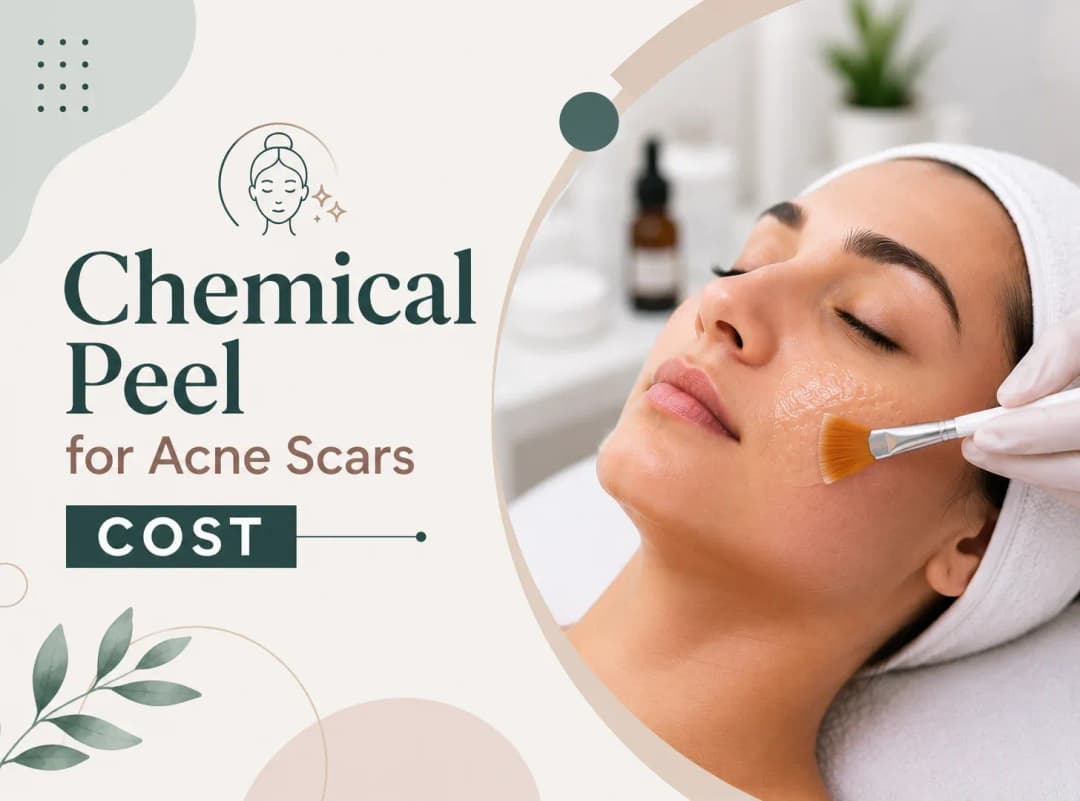
Neutralisation and soothing: The acid is neutralised and removed. A barrier ointment or cooling mask is applied to manage the inflammatory response.
Peeling phase (days 3–7): The outer damaged layers visibly peel away. This is the exfoliation phase, new, healthier skin is forming underneath. Picking or forcibly removing peeling skin can cause new scarring.
Remodelling phase (weeks 2–12): Collagen remodelling continues beneath the surface. Fibroblasts produce new collagen fibres that gradually smooth atrophic depressions. This is why full results from a medium or deep peel are not visible for 2–3 months.
Why it works: The controlled injury bypasses the skin's normal slow-renewal cycle. By forcing rapid cell turnover and triggering the wound-healing cascade, chemical peels achieve in weeks what would otherwise take months or years of passive regeneration.
How to Get Started with Chemical Peel Treatment for Acne Scars: Step-by-Step Guide
Prerequisites Before Your First Peel
- Dermatologist consultation: A trained dermatologist must assess your scar type, depth, and skin tone (Fitzpatrick type) before selecting a peel
- Active acne status: Active, inflamed acne should be controlled before beginning peel treatment; peeling over active pustules can spread bacteria
- Current medications: Isotretinoin use within the past 6–12 months is a contraindication for medium and deep peels
- Sun exposure history: Recent sunburn or significant tan increases the risk of PIH post-peel
Step-by-Step: Starting Your Chemical Peel Treatment
- Book a skin assessment with a qualified dermatologist or aesthetic physician, not a salon therapist. TCA-based peels should be performed under the supervision of a qualified dermatologist or trained medical professional.
- Complete the pre-treatment protocol (typically 2–4 weeks): apply prescribed retinoids nightly and use SPF 50+ sunscreen daily. This primes skin for even penetration.
- Confirm your treatment plan: the number of sessions, the peel type, the interval between sessions, and the total chemical peel for acne scars cost should be agreed upon and documented before you begin.
- Attend your first session: the procedure takes 15–45 minutes depending on peel depth and area covered.
- Follow post-peel aftercare strictly: moisturise 2–3 times daily, avoid all exfoliants for 7–14 days, and apply SPF 50+ every morning without exception.
- Attend follow-up sessions at the prescribed intervals (every 2–4 weeks for superficial, every 4–8 weeks for medium peels).
- Photograph your progress at each session to track improvement objectively.
Common Mistakes to Avoid
⚠️ Do not apply chemical peels at home without professional guidance, incorrect acid concentrations or timing cause chemical burns and permanent hypopigmentation.
⚠️ Do not skip sunscreen post-peel, UV exposure on freshly peeled skin can cause severe PIH, particularly in Fitzpatrick types III–VI.
⚠️ Do not peel the skin manually during the shedding phase, this creates open wounds and risks new scarring.
Chemical Peel for Acne Scars vs. Alternatives: An Honest Comparison
Several procedures treat acne scars. The right choice depends on scar type, skin tone, budget, and downtime tolerance. Chemical peels may be considered as a cost-conscious option for pigmentation and mild scarring before procedures such as laser or microneedling.
Side-by-Side Comparison Table
| Treatment | Cost in India (per session) | Best For | Downtime | Skin Type Risk | Sessions Needed |
|---|---|---|---|---|---|
| Chemical Peel (Superficial) | ₹1,500–₹3,500 | PIH, mild scars | 1–3 days | Low | 4–6 |
| Chemical Peel (Medium/Deep) | ₹4,000–₹15,000 | Moderate atrophic scars | 5–21 days | Moderate | 1–4 |
| Microneedling (Dermaroller/RF) | ₹3,000–₹10,000 | Atrophic scars, all depths | 2–5 days | Low | 4–6 |
| Fractional CO₂ Laser | ₹8,000–₹25,000 | Deep atrophic scars | 7–14 days | High (PIH risk in dark skin) | 2–4 |
| Dermal Fillers | ₹15,000–₹40,000 | Deep rolling scars | Minimal | Low | 1–2 (not permanent) |
Which Treatment Is Best for Your Case?
- Budget-conscious patients with PIH or mild scars: Superficial chemical peels offer the lowest chemical peel treatment for acne scars cost and are effective with consistent sessions
- Moderate atrophic scars (boxcar, rolling): Medium-depth TCA peels or microneedling, both are comparable in outcome; peels carry more downtime but lower cost per session
- Deep ice-pick scars: Neither peels nor microneedling alone are sufficient; fractional CO₂ laser or punch excision may be required alongside peels
- Darker skin tones (Fitzpatrick IV–VI): Superficial peels with mandelic or lactic acid are safest; fractional CO₂ laser carries higher PIH risk in darker skin
What Results to Expect from Chemical Peel for Acne Scars:
Results depend on scar type, peel depth, skin tone, treatment consistency, and whether other procedures are included. Chemical peels usually improve colour and surface texture more predictably than deep depressions.
Typical Results Timeline
- First 3–7 days: Redness, dryness, tightness, and visible flaking may occur. The skin can look temporarily darker before peeling.
- Weeks 2–4: chemical peel for dark spots, and the surface can feel smoother. Deep scars usually show little change at this stage.
- After 3–6 sessions: Pigmentation and mild textural irregularities may improve more noticeably. Shallow rolling or boxcar scars may soften, but complete removal is unlikely.
- Over 2–6 months: Collagen remodelling may continue after medium-depth treatment. Final results are easier to assess once the skin has fully healed between sessions.
What Chemical Peels Can and Cannot Improve
- They can help fade post-inflammatory hyperpigmentation and uneven tone.
- They may smooth mild surface irregularities and shallow scars.
- They can support acne control when salicylic or glycolic acids are selected appropriately.
- They are less effective for deep ice-pick scars, tethered rolling scars, and sharply defined deep boxcar scars.
- They do not guarantee scar-free skin, and combination treatment is often required for established scarring.
Chemical Peel Aftercare for Acne Scars
chemical peel aftercare because freshly treated skin is more sensitive to irritation and pigmentation. Keep the routine simple until the skin barrier has recovered.
- Use a gentle cleanser and fragrance-free moisturiser.
- Apply broad-spectrum SPF 50 sunscreen every morning and reapply when outdoors.
- Avoid retinoids, scrubs, exfoliating acids, benzoyl peroxide, and harsh actives until advised.
- Do not pick, rub, or pull peeling skin.
- Avoid waxing, threading, facials, steam, swimming, and intense exercise for the period recommended by the clinician.
- Use only prescribed soothing or pigment-control products.
- Contact the clinic if you develop severe swelling, blistering, increasing pain, pus, or persistent darkening.
Possible Side Effects and Risks
chemical peel side effects. Risk increases when stronger acids are used, the skin is not prepared correctly, or aftercare is ignored.
- Post-inflammatory hyperpigmentation: More likely in deeper skin tones, especially after excessive irritation or sun exposure.
- Hypopigmentation: Loss of pigment can occur after overly aggressive or deep peels.
- Chemical burns: Incorrect acid concentration, uneven application, or excessive contact time may injure the skin.
- Infection: Uncommon, but possible if the skin is picked or aftercare is poor.
- Scarring: Rare when peels are performed correctly, but risk rises with deep peels or delayed treatment of complications.
- Acne flare: Temporary breakouts may occur during healing in some people.
Who Should Avoid or Postpone a Chemical Peel?
- People with active skin infections, open wounds, or severe inflammatory acne in the treatment area.
- Anyone with chemical peel for tan removal, or a damaged skin barrier.
- People with a history of poor wound healing, keloids, or uncontrolled medical conditions.
- Those who are pregnant, breastfeeding, or using medicines that may affect skin sensitivity, unless cleared by a doctor.
- People who have recently used isotretinoin or undergone another resurfacing procedure, depending on medical advice.
- Anyone expecting complete removal of deep scars from a peel alone.
How to Choose a Safe Clinic for Acne Scar Peels
The lowest quoted price is not always the safest or most cost-effective option. A clinic should first identify the scar pattern and decide whether a peel is appropriate before discussing packages.
- Confirm that a qualified dermatologist or trained medical professional assesses your skin.
- Ask which acid, concentration, and peel depth will be used and why.
- Request a clear estimate of the number of sessions and total expected cost.
- Check whether pre-peel preparation and aftercare are included.
- Avoid clinics that promise complete scar removal in one session.
- Ask how complications such as burns or pigmentation will be managed.
- Ensure the clinic uses hygienic application tools and provides written aftercare instructions.
Final Thoughts
Chemical Peel for Acne Scars Cost in India varies because no single peel suits every scar. Superficial peels may be useful for post-acne marks and mild texture, while deeper or tethered scars often need combination procedures. A personalised assessment can help you understand the likely sessions, downtime, and total budget before treatment begins. For an individual skin and scar assessment, book a consultation with Kibo Skin Clinic.
Frequently Asked Questions
How much does a chemical peel for acne scars cost in India?
The cost usually ranges from ₹1,500 to ₹15,000 per session. The exact amount depends on peel depth, treatment area, clinic location, and the number of sessions required.
How many sessions are needed for acne scars?
Superficial peels may require four to six sessions, while medium peels may need fewer sessions with longer recovery intervals. Deep scars may need combination treatment.
Can chemical peels completely remove acne scars?
No. Chemical peels can improve pigmentation and mild surface irregularities, but deep ice-pick, rolling, or boxcar scars may require procedures such as subcision, microneedling, TCA CROSS, or laser.
Which peel is best for acne scars?
The right peel depends on the scar type and skin tone. Salicylic, glycolic, mandelic, lactic, Jessner's, and TCA peels may be considered in different situations after assessment.
Are chemical peels safe for darker Indian skin tones?
They can be safe when the acid, concentration, contact time, and aftercare are selected carefully. Darker skin tones have a higher risk of post-inflammatory pigmentation after aggressive treatment.
Is the treatment painful?
Superficial peels usually cause mild tingling or stinging. Medium and deep peels can cause stronger discomfort and require closer medical supervision.
How long is the downtime?
Superficial peels may cause one to three days of redness or flaking. Medium peels can require five to ten days, while deeper peels may need two weeks or more.
Can I use skincare products after a peel?
Use only a gentle cleanser, moisturiser, sunscreen, and products approved by your dermatologist until the skin has healed. Avoid scrubs, retinoids, and exfoliating acids during recovery.
Disclaimer: This article is for general educational purposes and does not replace a consultation with a qualified dermatologist. Treatment suitability, cost, sessions, and results vary by skin type, scar pattern, medical history, and clinic.