
Can Hair Recover From DHT-Related Hair Loss?
Published on Thu Jul 09 2026
Reviewed By:
Shritej
Mali
Independent Research Reviewer
Reviewing peer-reviewed studies and medical
literature for evidence-based accuracy.
Written By: Kibo Clinics Content Team
Last
Updated: July 9, 2026, 2:45 PM IST
Reading Time: 11 minutes
֎ Show Quick Answer AI Quick answer summary
- DHT-related hair loss can improve when follicles are still alive: treatment can slow shedding, thicken miniaturised hairs, and improve coverage in early-to-moderate cases.
- It is harder to recover long-standing bald areas: once follicles stop producing visible hair for a long time, medicines and PRP may not bring back dense growth.
- Finasteride works by lowering DHT activity: it is usually discussed for male pattern hair loss, but it needs doctor review, time, and ongoing use if it suits you.
- PRP is a support treatment, not a DHT blocker: it may help active weak follicles respond better, especially when combined with medical therapy in suitable patients.
- The right plan depends on stage: early thinning may need medical treatment, moderate thinning may need combination therapy, and advanced baldness may need transplant planning.
Not sure whether your DHT-related hair loss is still recoverable?
Can Hair Recover From DHT-Related Hair Loss?
Yes, DHT-related hair loss can recover partly in many people, but the honest answer depends on how much follicle miniaturisation has already happened. If the follicle is still producing fine, short, weak hair, treatment may help thicken that hair and slow further loss. If the area has been smooth, shiny, or completely bald for a long time, recovery from medicines or injections alone is much less likely.
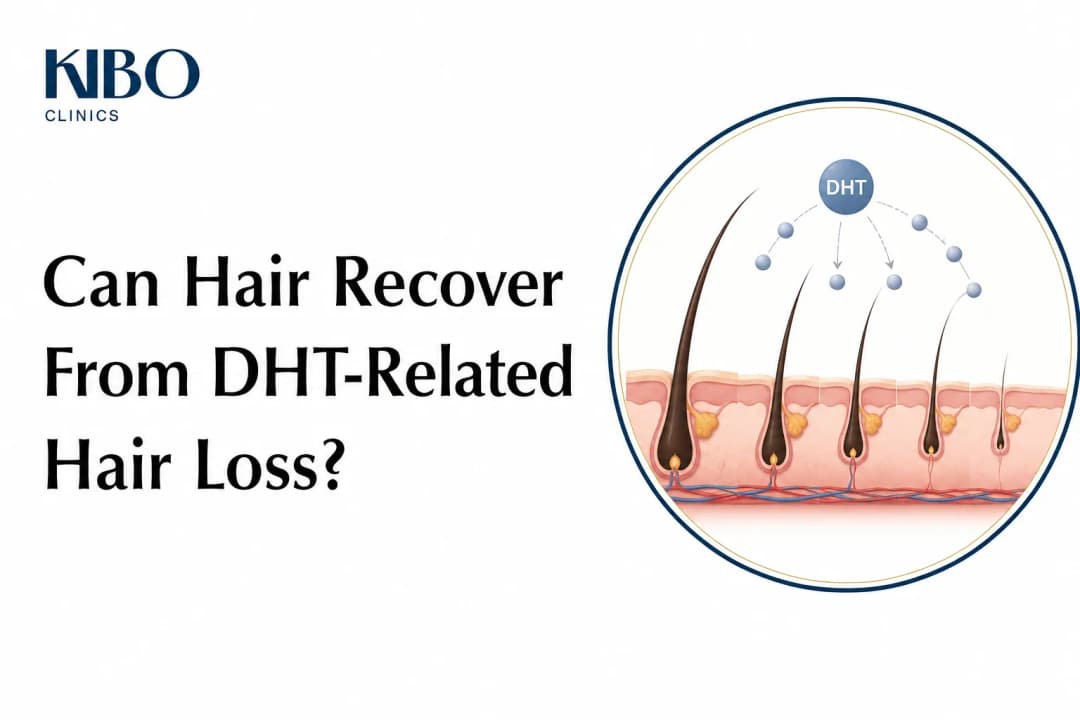
DHT-related hair loss usually refers to androgenetic alopecia, also called male pattern hair loss or female pattern hair loss. In genetically sensitive follicles, DHT can gradually shorten the growth phase and shrink the follicle. The hair does not disappear overnight. It becomes thinner, shorter, softer, and less visible over repeated cycles.
This is why timing matters. Early treatment is not just about stopping today’s hair fall. It is about saving follicles before they become too miniaturised to produce cosmetic density. A person with visible thinning at the crown may have a very different recovery chance from a person with a long-standing bald crown.
A doctor-led diagnosis is important because DHT-related hair loss can overlap with dandruff, stress shedding, low iron, thyroid imbalance, PCOS, postpartum shedding, medication-related shedding, or hair breakage. If the diagnosis is wrong, the treatment timeline will also be wrong.
What DHT Actually Does to Hair Follicles
DHT stands for dihydrotestosterone. It is made from testosterone with the help of the 5-alpha reductase enzyme. DHT is not automatically harmful. The problem begins when certain scalp follicles are genetically sensitive to it.
In those sensitive follicles, the growth phase can become shorter. The follicle slowly produces thinner strands. This process is called miniaturisation. Over time, thick terminal hair may become fine vellus-like hair. That is why DHT-related hair loss often looks like a widening part, crown thinning, temple recession, or reduced hairline density rather than sudden patchy loss.
This is also why shampoo alone cannot reverse true DHT-related hair loss. Shampoo may support scalp hygiene or reduce inflammation, but DHT sensitivity happens deeper in the follicle. If the problem is androgen-driven miniaturisation, treatment usually has to address the follicle environment, the DHT pathway, or both.
| Stage | What You See | What May Be Happening | Recovery Chance |
|---|---|---|---|
| Early thinning | Hairline looks lighter, crown density is slightly lower, but hair is still present. | Follicles may be miniaturising but still active. | Best chance to stabilise and improve thickness. |
| Moderate thinning | Scalp is clearly visible in the crown, parting, or temples. | Many follicles are miniaturised, but some may still respond. | Combination treatment may help, but density may not fully return. |
| Advanced baldness | Area is smooth or has very few visible hairs. | Follicles may no longer produce cosmetic hair. | Medical regrowth is limited; transplant evaluation may be needed. |
Finasteride for DHT-Related Hair Loss: What It Can and Cannot Do
Finasteride is one of the main prescription treatments doctors discuss for male pattern hair loss. It works by reducing conversion of testosterone into DHT. Lower DHT activity can help slow miniaturisation and may allow some weakened follicles to produce thicker hair again.
The most important expectation is time. Finasteride is not a styling product and it is not a 30-day fix. Some people notice reduced shedding first. Visible thickening usually takes months. If it works, the result generally needs continued use because the underlying genetic sensitivity does not disappear.
Finasteride is not suitable for everyone. It can have side effects, it is not casually used during pregnancy risk, and the decision should be made with a qualified doctor. Some patients also need a broader plan that includes scalp care, minoxidil, PRP, or transplant planning, depending on stage.
| Question | Practical Answer |
|---|---|
| Can finasteride regrow hair? | It may improve density when follicles are miniaturised but still active. It cannot create dense hair in areas where follicles no longer produce visible strands. |
| How long does it take? | Many patients judge early response after a few months, with better assessment around 6 to 12 months under medical follow-up. |
| What happens if you stop? | The DHT pathway can become active again, so maintained results may gradually reduce after stopping. |
| Is it enough alone? | Sometimes, especially in early cases. Moderate or advanced cases often need combination planning. |
Where PRP Fits in DHT-Related Hair Loss Recovery
PRP is different from finasteride. It does not block DHT. It uses platelet-rich plasma prepared from your own blood and injected into thinning scalp areas to support follicle activity, blood- supply signalling, and growth-factor exposure.
For DHT-related hair loss, PRP therapy usually makes the most sense when there are still active follicles. It may reduce shedding and improve thickness in early-to- moderate androgenetic alopecia, especially when paired with a medical plan. It is less likely to restore a fully bald area on its own.
A common mistake is treating PRP like a one-time rescue. Hair grows in cycles, so results need time. Many protocols use an initial series followed by maintenance, but the exact schedule should be personalised after scalp assessment.
| Treatment | Main Role | Best Fit | Key Limitation |
|---|---|---|---|
| Finasteride | Reduces DHT pathway activity. | Male pattern thinning under doctor supervision. | Needs ongoing use and side-effect discussion. |
| Minoxidil | Supports growth signalling and hair-cycle activity. | Men or women with suitable pattern thinning. | Does not directly block DHT. |
| PRP | Supports weak active follicles with growth factors. | Early-to-moderate thinning and combination plans. | Not a DHT blocker and not a cure for advanced baldness. |
| Hair transplant | Moves resistant donor follicles to bald or thin areas. | Stable advanced loss or low-density areas with donor availability. | Does not stop native hair from future DHT-related thinning. |
Want to know whether you need medicine, PRP, or transplant planning?
Recovery Timeline: What to Expect Month by Month
DHT-related hair loss recovery is slow because follicles work in cycles. A correct treatment plan may reduce shedding before it visibly increases density. This can frustrate patients because the scalp may feel unchanged while the cycle is already improving beneath the surface.
The timeline below is a practical expectation guide, not a promise. Response varies by age, stage, genetics, treatment consistency, scalp inflammation, nutrition, hormonal status, and whether miniaturised follicles are still active.
| Timeframe | What May Happen | How to Judge It |
|---|---|---|
| 0 to 3 months | Shedding may reduce, continue, or temporarily fluctuate. PRP soreness, if done, should settle quickly. | Do not judge final density yet. Focus on adherence and scalp comfort. |
| 3 to 6 months | Early thickening or reduced fall may become noticeable in responders. | Compare monthly photos under the same lighting. |
| 6 to 12 months | Better assessment of stabilisation and cosmetic density is possible. | Doctor may continue, combine, adjust, or discuss transplant planning. |
| 12 months+ | Maintenance becomes important. Advanced bald areas may need surgical evaluation. | Judge long-term stability, not only new baby hair. |
How a Doctor Decides Whether Your Hair Can Recover
The key question is not only “Do I have DHT?” Everyone has DHT. The better question is: how sensitive are your follicles, how much miniaturisation has happened, and are the follicles still producing hair that can be rescued?
During assessment, a doctor may look at the pattern, family history, age of onset, rate of progression, scalp health, hair-shaft thickness, miniaturisation, hair-pull findings, medical history, medications, and hormonal or nutritional clues. Women may need a slightly broader review because PCOS, thyroid imbalance, iron deficiency, postpartum changes, or menopause can overlap with female pattern thinning.
- Recoverable signal: thin but visible hairs are still present in the affected area.
- Good treatment window: temples, crown, or parting have started thinning but are not completely bald.
- Combination signal: medical treatment may stabilise while PRP or other procedures support density.
- Transplant signal: the area has poor visible follicle activity and donor hair is adequate.
- Caution signal: redness, pain, scaling, scarring, or patchy loss suggests another diagnosis may be active.
When Hair Transplant Becomes the Better Option
A hair transplant becomes relevant when the goal is to restore visible coverage in areas where follicles are no longer producing enough hair. It is not the first answer for every person with DHT- related thinning, but it can be the most realistic option for stable advanced loss.
Transplant planning should not ignore DHT. Donor follicles from the safe donor area are generally more resistant, but the surrounding native hair can continue thinning. That is why a good plan considers the present hairline, future pattern, donor reserve, age, density goals, and medical maintenance.
If your crown or hairline has already lost most visible density, a doctor may compare non-surgical support with FUE hair transplant planning. The goal is not to sell a procedure early. The goal is to avoid wasting months on treatments that cannot rebuild an area where follicles are no longer active.
Need a realistic recovery plan before spending more on products?
Frequently Asked Questions
Can DHT-related hair loss grow back?
It can improve when follicles are miniaturised but still alive. Treatment may reduce shedding and thicken weak strands. Long-standing bald areas are less likely to recover with medicines or PRP alone.
How do I know if my follicles are dead or miniaturised?
If fine, short, lighter hairs are still visible, follicles may be miniaturised and potentially responsive. A smooth bald area with no visible hair activity has a lower chance of medical recovery. Scalp examination and trichoscopy help separate the two.
Does finasteride reverse DHT hair loss?
Finasteride may slow DHT-driven miniaturisation and improve density in suitable patients. It works better when started early and generally needs ongoing use. It should be taken only after doctor review.
Can PRP fix DHT-related hair loss?
PRP may support active weak follicles and improve hair thickness in early-to-moderate thinning. It does not block DHT, so it is often considered as part of a combination plan rather than a stand- alone DHT treatment.
How long does DHT hair loss recovery take?
Reduced shedding may appear within the first few months in responders. Visible density is usually judged over 6 to 12 months because hair grows slowly and treatment works through hair-cycle changes.
What happens if I stop DHT blocker treatment?
If treatment was controlling DHT-related miniaturisation, stopping may allow the process to resume. Any hair maintained or thickened by treatment may gradually reduce over time.
Can women have DHT-related hair loss?
Yes. Female pattern hair loss can involve androgen sensitivity, but women also need evaluation for PCOS, thyroid issues, low iron, postpartum changes, menopause, and other causes of diffuse thinning.
When should I consider a hair transplant?
Consider transplant evaluation when hair loss is advanced, the area has poor visible follicle activity, and non-surgical treatment is unlikely to restore enough density. Donor quality and future loss pattern must be assessed first.
Want a doctor-led stage check before choosing treatment?
Medical Disclaimer
This article is for educational purposes only. It does not replace diagnosis, trichoscopy, blood test interpretation, prescription treatment, procedure advice, or side-effect counselling from a qualified dermatologist or hair restoration doctor. DHT-related hair loss can look similar to other causes of hair fall, and the correct plan depends on your sex, age, symptoms, scalp findings, medical history, medicines, pregnancy plans, hormonal status, family pattern, and treatment goals.
Sources referenced: American Academy of Dermatology Association, “Hair loss: Diagnosis and treatment”; Cleveland Clinic, “Male Pattern Baldness (Androgenic Alopecia)” and “Platelet Rich Plasma (PRP) Therapy”; Ho CH, Sood T, Zito PM, NCBI Bookshelf StatPearls, “Androgenetic Alopecia,” updated January 7, 2024; Nestor MS et al., “Treatment options for androgenetic alopecia: efficacy, side effects, compliance, financial considerations, and ethics,” Journal of Cosmetic Dermatology, 2021; Cleveland Clinic Journal of Medicine, “Male and female pattern hair loss: Treatable and worth treating,” 2021.
For a personal assessment, consult a Board Certified Doctor at Kibo Clinics. The doctor you meet in your consultation is the same doctor who handles your treatment through every stage.
Talk to a Board Certified DoctorExplore Kibo Clinic Services
Hair Transplant: Sapphire FUE Hair Transplant | Real Time FUE Hair Transplant | Bio FUE Hair Transplant | Corrective Hair Transplant | Hairline Correction | Unshaven Hair Transplant | Body Hair Transplant
Non-Surgical: GFC Therapy | Low-Level Laser Therapy | Mesotherapy for Hair Regrowth | Microneedling for Hair Regrowth | IV Hair Boosters
Related Articles
DHT and Pattern Hair Loss: DHT Blocker for Hair Loss | DHT Blocker Side Effects | Hair Loss Types, Symptoms and Causes
Treatment Decisions: Minoxidil 5% vs 10% | Dermatologist vs Trichologist | Top DHT Blocking Shampoos