
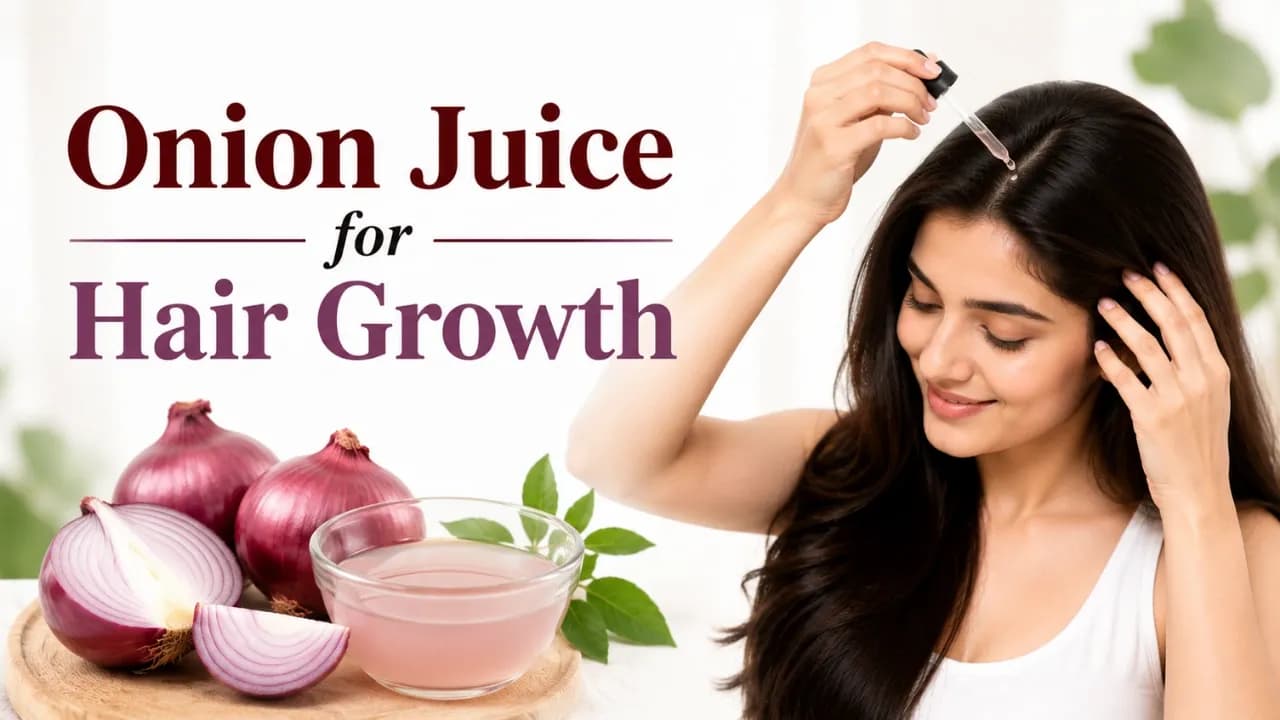
Who This Is For: People considering raw onion juice, onion oil, onion shampoo or onion serum for hair fall; people with patchy alopecia areata who have seen the widely shared 86.9% regrowth statistic; men or women with gradual pattern thinning; people trying to decide whether onion juice can be used daily, overnight or with Minoxidil; and anyone who wants to separate cosmetic scalp effects from clinically proven follicular regrowth.
Onion juice has one small positive human study in patchy alopecia areata, but it is not a proven general treatment for hair growth. The widely repeated evidence comes from a 2002 trial involving 38 people, not from large modern studies in male pattern baldness, female pattern hair loss, telogen effluvium or advanced baldness. The result is worth knowing, but the evidence certainty is low.
Current guidelines are more cautious than social-media claims. The British Association of Dermatologists living guideline for alopecia areata states that evidence is insufficient to recommend allium/onion treatment. That means the old positive study should be interpreted as an interesting signal, not as proof that raw onion juice, onion oil, onion shampoo or onion serum is an established hair-loss therapy.
| Question | Best Evidence-Based Answer |
|---|---|
| Does onion juice regrow hair? | Possibly in some people with patchy alopecia areata, based mainly on one small older study. |
| Does it treat pattern baldness? | There is no strong clinical evidence that it reverses androgen-driven follicle miniaturisation. |
| Is onion oil equally proven? | No. The famous trial used crude fresh onion juice, not packaged onion oil, shampoo or serum. |
| Can it irritate the scalp? | Yes. Burning, redness, itching, irritant or allergic contact dermatitis and eye irritation are practical risks. |
| Should it replace medical treatment? | No. Diagnosis and condition-specific treatment come first. |
What Did the 2002 Onion Juice Study Actually Find?
The study most hair-growth claims trace back to was published in The Journal of Dermatology in 2002. It tested crude onion juice in people with patchy alopecia areata. Twenty-three participants used onion juice and fifteen used tap water, with both groups instructed to apply the assigned liquid twice daily for two months.
Terminal-hair regrowth was reported in 17 of 23 onion-treated participants by week 4 and 20 of 23 by week 6. The tap-water group showed regrowth in 2 of 15 participants by week 8. Those numbers are the origin of the frequently quoted “86.9% regrowth” claim.
What the study proves is much narrower than the headline. It suggests that crude onion juice may have had an effect in a small group with one autoimmune hair-loss condition. It does not prove that onion juice grows hair in the general population, does not compare it with modern standard therapy, does not test pattern hair loss and does not establish long-term relapse prevention.
Why Do Current Alopecia Areata Guidelines Still Not Recommend Onion Treatment?
A positive small trial does not automatically become a recommended therapy. Current alopecia-areata guidance weighs replication, sample size, comparator quality, modern outcome measures, adverse events, long- term response and the broader treatment evidence.
The British Association of Dermatologists living guideline states that there is insufficient evidence to recommend allium/onion treatment for alopecia areata. For scalp AA, current guideline pathways instead prioritise therapies such as potent topical corticosteroids, intralesional corticosteroids in appropriate adults, and licensed systemic treatments such as JAK inhibitors for severe disease when indicated.
This does not mean the 2002 result must be dismissed. It means onion juice belongs in the category of low-certainty complementary evidence, not established first-line care. Read Kibo's guide to alopecia areata regrowth for the condition-specific recovery context.
Five Reasons the 86.9% Statistic Is Easy to Overstate
- Only 23 people received onion juice. A small group can produce unstable percentages.
- The condition was alopecia areata. The result cannot be transferred automatically to hereditary pattern thinning.
- The control was tap water. It was not a comparison with a modern guideline-supported active treatment.
- Follow-up was short. Alopecia areata can relapse, spread or regrow spontaneously, so longer observation matters.
- Large modern replication is missing. Contemporary reviews continue to describe the evidence as limited.
The study also reported a higher apparent response in males than females. That should not be turned into the claim that onion juice works better for men. The male and female subgroups were tiny, and the finding has not been established in large independent trials.
Which Types of Hair Loss Might Onion Juice Help?
| Hair-Loss Situation | Onion-Juice Evidence | Main Limitation |
|---|---|---|
| Patchy alopecia areata | One small positive controlled study | Current guideline still finds evidence insufficient to recommend allium/onion therapy. |
| Male pattern baldness | No strong direct clinical evidence | Does not establish control of DHT- driven miniaturisation. |
| Female pattern hair loss | No strong direct clinical evidence | Women also need evaluation for iron, thyroid, PCOS and other overlapping causes. |
| Telogen effluvium | No established trigger-correcting role | Fever, weight loss, stress, postpartum change, iron or thyroid issues must be addressed. |
| Scarring alopecia | Not appropriate as a regrowth treatment | Destroyed follicles cannot be restored by raw juice. |
| Hair-shaft breakage | No evidence that it biologically repairs fractures | Conditioning effects are not new follicular growth. |
If the type of hair loss is not clear, start with Kibo's overview of hair loss types and causes.
Why Is Onion Juice Believed to Work?
| Popular Mechanism | What Is Plausible | What Is Not Proven |
|---|---|---|
| Sulfur | Onions contain sulfur compounds and hair keratin contains sulfur-rich amino acids. | That topical sulfur from onion is absorbed into follicles in a way that reliably creates new hair. |
| Quercetin / antioxidants | Onions contain flavonoids with antioxidant/anti-inflammatory activity. | That raw onion juice clinically reverses a human hair-loss mechanism through quercetin. |
| Blood flow | Irritation can temporarily increase redness and local blood flow. | That burning or tingling proves follicles are restarting growth. |
| Antimicrobial effect | Onion compounds have laboratory antimicrobial activity. | That raw juice is a proven treatment for dandruff, fungal infection or inflammatory scalp disease. |
Onion Juice for Alopecia Areata: Where Does It Fit?
Alopecia areata is the one condition where onion juice has direct human trial data. But alopecia areata is an autoimmune disease with a variable course. Some patches regrow spontaneously; others recur, enlarge or involve brows, lashes, beard or nails.
For that reason, a home remedy should not be used to decide whether the disease is active, severe or likely to progress. Smooth round patches, eyebrow loss, nail pitting, ophiasis-pattern loss around the scalp margin or rapid spread should prompt clinical assessment. A clinician can decide whether observation, topical/intralesional corticosteroids or systemic treatment is appropriate based on severity and age.
Can Onion Juice Treat Male or Female Pattern Hair Loss?
There is no strong clinical evidence that onion juice reverses androgenetic alopecia. Pattern hair loss is driven by genetically susceptible follicles that gradually miniaturise. In men this often produces temporal recession and crown thinning; in women it more often presents as progressive part widening or diffuse central thinning.
A stronger smell, temporary tingling or less scalp oil does not show that miniaturisation has reversed. Read more about male pattern baldness and hair loss in women before treating gradual thinning as the same condition studied in 2002.
Can Onion Juice Stop Stress, Postpartum or Deficiency-Related Hair Fall?
Onion juice does not correct the main triggers of telogen effluvium. Fever, surgery, major stress, rapid weight loss, postpartum hormonal shifts, thyroid disease, low iron stores and some medicines can move more follicles into the shedding phase.
If the shedding is diffuse and started after a clear trigger, review telogen effluvium. When the history suggests a deficiency or endocrine cause, targeted blood tests for hair fall may be more useful than adding another topical remedy.
Onion Juice vs Onion Oil, Shampoo and Serum: Are They Equivalent?
No. The most-cited clinical study used fresh crude onion juice. A commercial “onion oil” is usually onion extract or fragrance in a carrier oil; an onion shampoo is washed off quickly; a serum may contain multiple actives. Concentration, extraction method, stability, contact time and co-ingredients can all be different.
That means a brand cannot simply inherit the 2002 study by putting “onion” on the label. The carrier oil may reduce hair-shaft friction or dryness, but that is a different endpoint from regrowing an autoimmune bald patch. For a broader evidence audit, see Kibo's review of miracle hair growth oils.
How Often Should Onion Juice Be Applied?
There is no modern dermatology guideline defining an ideal onion-juice frequency for hair growth. The 2002 trial used twice-daily application, but copying the most intensive research schedule is not the same as establishing a safe home routine for the general public.
More frequent use may simply increase exposure to irritant compounds. If an adult chooses to experiment despite the low-certainty evidence, a patch test and limited initial exposure are more defensible than daily or twice-daily application from day one. Stop if redness, burning, swelling, cracking or persistent itch appears.
Should You Leave Onion Juice on the Scalp Overnight?
There is no evidence that overnight contact improves regrowth. Longer exposure increases the time an irritant mixture sits against the skin and may worsen dermatitis, especially on a sensitive, eczematous or recently treated scalp.
“More contact time” is not a proven dose-response relationship for onion juice. Burning is not a sign that the treatment is penetrating better. Wash it off promptly if significant stinging, redness or swelling develops.
Onion Juice Side Effects: What Can Go Wrong?
- Burning or stinging: fresh onion contains reactive sulfur compounds and can irritate skin.
- Redness and itching: repeated application can disrupt a sensitive scalp barrier.
- Irritant or allergic contact dermatitis: persistent inflammation can itself increase scratching and apparent shedding.
- Eye irritation: raw juice can sting severely if it runs into the eyes.
- Dryness or flaking: frequent application and repeated shampooing to remove the smell may worsen dryness.
- Odour: sulfur compounds can remain on hair after washing and reduce adherence.
- Mechanical breakage: vigorous rubbing, scraping or repeated cleansing can damage the shaft even if the follicle is unaffected.
People with a known onion/allium allergy, eczema, psoriasis, active dermatitis, broken skin or a recently treated scalp should be particularly cautious.
Can You Mix Onion Juice With Coconut Oil, Aloe Vera or Lemon?
Coconut oil or aloe vera may make a mixture feel less harsh for some people, but there is no clinical evidence that either mixture regrows more hair than onion juice alone. Coconut oil has separate evidence for reducing hair-shaft protein loss; that is not the same as reversing follicular hair loss.
Lemon is a poor default add-on for a sensitive scalp. Its acidity can increase irritation, especially on broken or inflamed skin. Essential oils add another sensitisation risk if used undiluted. Each extra ingredient makes it harder to know which component caused a reaction.
Can Onion Juice Be Used With Minoxidil?
There is no strong clinical evidence showing that onion juice adds a meaningful regrowth benefit to Minoxidil. Applying both irritating topicals together can also make redness, dryness or dermatitis harder to manage and makes it difficult to identify the cause of a reaction.
If Minoxidil is being used for diagnosed pattern hair loss, do not replace it or reduce adherence because a home remedy is trending. Kibo's Minoxidil vs Redensyl article explains the difference between established drug evidence and lower-certainty cosmetic actives.
Does Onion Juice Treat Dandruff?
Laboratory antimicrobial activity is not enough to call raw onion juice a dandruff treatment. Dandruff and seborrhoeic dermatitis are linked to scalp barrier changes, sebum and Malassezia biology, and established medicated shampoos have a far clearer evidence base.
If flaking is persistent, oily, itchy, inflamed or associated with hair loss, diagnose the scalp condition rather than repeatedly applying an irritant home mixture.
Can Onion Juice Reverse Grey Hair?
There is no good clinical evidence that onion juice reverses established greying. Online explanations often invoke catalase or antioxidant activity, but a biochemical theory is not the same as demonstrating repigmentation in human trials.
If premature greying occurs with other symptoms or nutritional concerns, the useful question is whether an underlying condition exists, not whether a stronger onion mixture will restore pigment.
How Should You Judge Onion-Juice Before-and-After Results?
- Confirm the diagnosis. An alopecia-areata patch can regrow spontaneously; pattern hair loss follows a different biology.
- Check the time interval. Hair cycling makes dramatic changes over a few days biologically implausible.
- Match lighting, angle and hair length. Wetness, part placement and styling can change the appearance of density.
- Ask what else changed. Minoxidil, corticosteroids, supplements, iron correction or resolution of telogen effluvium can confound the result.
- Look for objective scalp density. Cosmetic shine or smoother hair is not the same as more terminal follicles.
Onion Juice vs Better-Studied Hair-Loss Options
| Option | Best-Supported Use | Evidence Position |
|---|---|---|
| Onion juice | Possible complementary use in patchy alopecia areata | One small older positive study; current BAD guideline says evidence is insufficient to recommend allium/onion treatment. |
| Topical/intralesional corticosteroids | Appropriate alopecia areata cases | Guideline-supported based on severity, age and site. |
| Minoxidil | Male and female pattern hair loss; adjunct in some AA plans | Substantially larger clinical evidence base. |
| LLLT | Selected androgenetic alopecia with viable miniaturised follicles | Randomised/meta- analytic device evidence for AGA. |
| PRP | Selected diagnosed non-scarring pattern hair loss | Evidence varies by protocol but is stronger than onion juice for AGA. |
| Hair transplant | Stable permanent pattern loss with adequate donor supply | Surgical redistribution; does not treat active autoimmune disease. |
For suitable pattern-hair-loss cases, adjunctive options may include PRP therapy for hair loss or Low-Level Laser Therapy. These are not automatic upgrades from a home remedy; they are condition-specific options after diagnosis.
When Onion Juice Is Unlikely to Help
- Long-standing smooth bald areas where follicles have been lost
- Scarring alopecia with destruction of follicular units
- Progressive male or female pattern hair loss without appropriate treatment
- Iron, thyroid, nutrition or medication-related shedding until the cause is addressed
- Active bacterial or fungal scalp infection
- Traction alopecia while pulling/tension continues
- Hair-shaft breakage from bleach, heat or mechanical stress
- Severe or rapidly spreading alopecia areata that needs medical assessment
A Practical Decision Rule Before You Try Onion Juice
- Identify the pattern. Round patch, widening part, receding temples and diffuse shedding are different problems.
- Do not use one study as proof for every condition. The onion trial was in patchy alopecia areata.
- Do not transfer the study to packaged onion oil or shampoo. Formulations are not equivalent.
- Protect the scalp barrier. Patch test, avoid broken skin and stop through significant burning or swelling.
- Do not delay better-supported treatment. A home remedy should not consume months while progressive loss continues.
- Measure the outcome objectively. Standardised photographs are more useful than daily mirror checks.
Not sure whether your hair loss is autoimmune, genetic or temporary shedding? Start with the diagnosis before adding another scalp remedy.
Frequently Asked Questions
Does onion juice really regrow hair?
It may support regrowth in some people with patchy alopecia areata, based mainly on one small 2002 study. It is not proven as a general treatment for all hair loss.
Why is the 86.9% onion-juice result misleading?
The percentage came from 20 responders among only 23 onion-treated participants with patchy alopecia areata. It does not represent a general 86.9% success rate for hair loss.
Do dermatology guidelines recommend onion juice for alopecia areata?
Current British Association of Dermatologists guidance states that evidence is insufficient to recommend allium/onion treatment for alopecia areata.
Does onion juice work for male pattern baldness?
There is no strong clinical evidence that onion juice reverses androgen-driven follicle miniaturisation or advanced male pattern baldness.
Can onion juice help female hair thinning?
Evidence is insufficient for female pattern hair loss. Persistent thinning should be assessed for pattern loss, iron deficiency, thyroid disease, PCOS and other causes.
Is onion oil as effective as fresh onion juice?
Not proven. The well-known study used crude fresh onion juice, not packaged onion oil, shampoo or serum. Different formulations cannot automatically inherit the same result.
Can onion juice be used every day?
There is no guideline recommending daily use. More frequent exposure may increase irritation without proven additional benefit.
Can onion juice be left overnight?
There is no evidence that overnight exposure improves regrowth. Longer contact may increase irritation and dermatitis risk.
Can onion juice cause hair fall?
It can indirectly worsen apparent shedding or breakage if it causes dermatitis, scratching or aggressive repeated washing.
Can onion juice and Minoxidil be used together?
There is no strong evidence that combining them improves regrowth. Using multiple irritating topicals can worsen scalp intolerance, so the regimen should be reviewed rather than improvised.
Does onion juice treat dandruff?
Laboratory antimicrobial activity does not prove that raw onion juice is an effective dandruff treatment. Persistent dandruff needs condition-specific scalp care.
Can onion juice reverse grey hair?
There is no good clinical evidence that onion juice reverses established greying. Catalase and antioxidant explanations remain theoretical for human repigmentation.
How long does onion juice take to work?
The small alopecia-areata study reported terminal-hair regrowth beginning within weeks, but that timeline cannot be applied to general hair loss or used as a guarantee.
When should I see a dermatologist instead of trying onion juice?
Seek assessment for sudden smooth patches, rapidly worsening thinning, eyebrow or beard loss, nail changes, scalp pain, pus, scarring or shedding that persists for months.
Bottom Line
Onion juice is not completely evidence-free, but the evidence is far narrower than its reputation. One small older study reported encouraging regrowth in patchy alopecia areata. Modern guidelines still judge allium/onion evidence insufficient for recommendation, and there is no strong proof that onion juice reverses common pattern baldness, telogen effluvium or advanced follicle loss.
If you choose to experiment, protect the scalp barrier and do not let a home remedy delay diagnosis or better-supported treatment. The key question is not whether onion contains sulfur or antioxidants. It is whether the treatment has been shown to improve the specific hair-loss condition you actually have.
Related Articles & Services
Hair Transplant
FUE Hair Transplant | Sapphire FUE Hair Transplant | Direct Hair Transplant (DHT) | Corrective Hair Transplant | Hairline Correction
Hair Regrowth
GFC Therapy | Microneedling for Hair Regrowth | Mesotherapy for Hair Regrowth
Must Read
Alopecia Areata Explained | Iron Deficiency and Hair Thinning | Vitamin D and Hair Follicles | Scalp Psoriasis vs Dandruff | Seborrhoeic Dermatitis
Relevant Blogs
Rice Water for Hair Growth | Castor Oil for Hair Growth | Rosemary Oil for Hair Growth | DHT Blockers for Hair Loss | Non-Surgical Hair Loss Treatments in India
Medical Disclaimer : Information from Kibo Hair Clinics is for educational purposes only. It does not replace diagnosis, trichoscopy, blood test interpretation, prescription treatment, procedure advice, or side-effect counselling from a qualified dermatologist or hair restoration doctor.