
Who This Is For: Anyone watching their hairline move backward who wants to know whether it's genetics, age, a normal mature hairline, stress, styling, or something that needs a dermatologist's attention.
A receding hairline is most often related to pattern hair loss or normal hairline maturation, but it can also result from traction, diffuse shedding, inflammatory or scarring alopecia, infection, or normal variation. An M-shaped hairline alone does not confirm balding. Rapid change, pain, itch, redness, scale, eyebrow loss, patches, or shiny skin without visible follicle openings warrants a dermatologist's assessment.
What Is a Receding Hairline?
A receding hairline is loss or apparent upward movement of hair at the frontal or temporal margin. It's worth saying plainly: a receding or high hairline is a pattern you can observe, not a diagnosis by itself. The temples can also mature naturally over time, moving up slightly without that reflecting a disease process at all.
Dated photographs compared over months or years are genuinely more useful here than a single measurement taken today, since they show you the actual trajectory rather than one snapshot in time.
Common Causes of a Receding Hairline
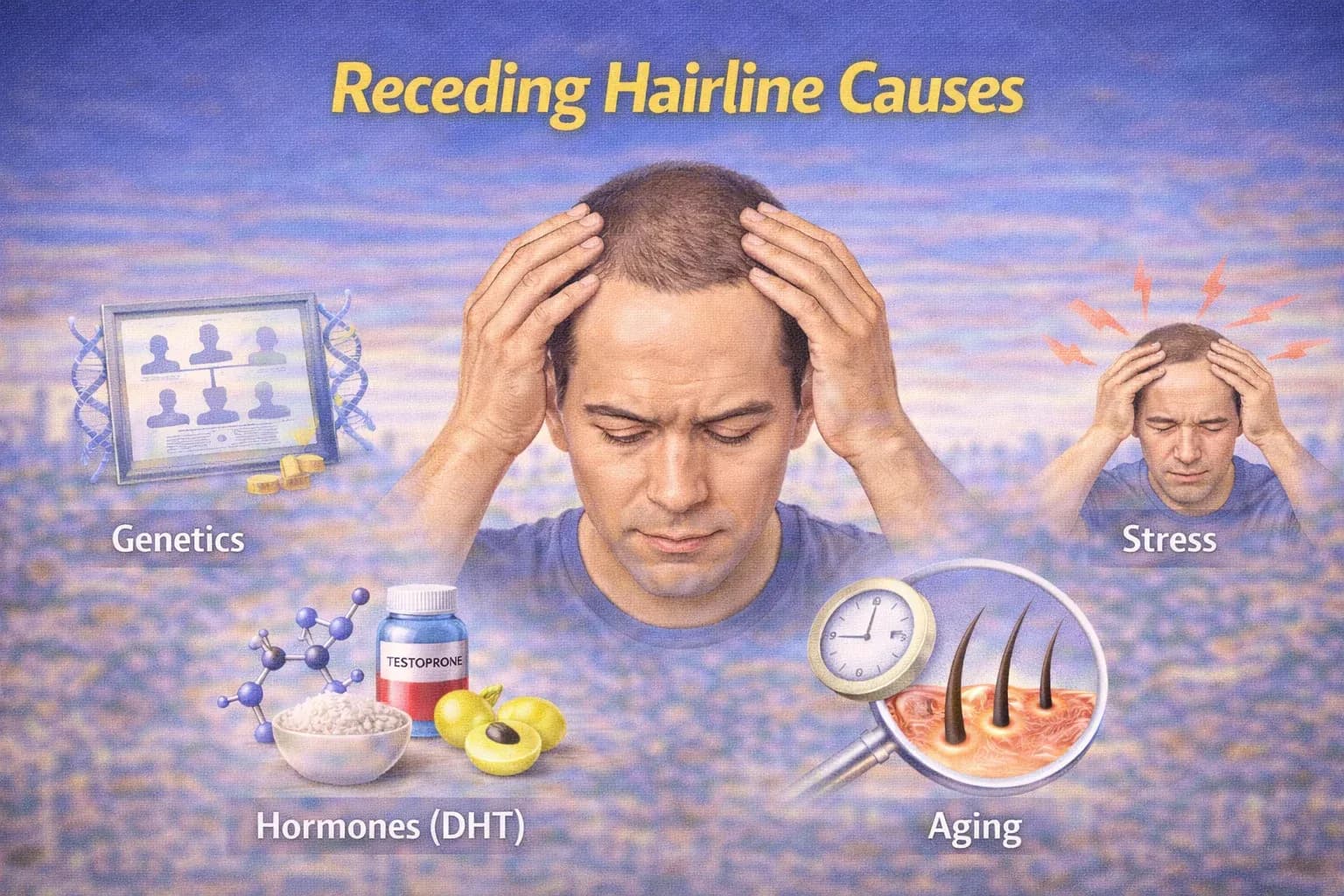
Bilateral temple recession can reflect several different things, and a 2021 review of bitemporal hair loss specifically emphasises that the differential is broad and that prompt diagnosis matters, especially where a scarring condition might be involved. The main possibilities are pattern hair loss, a normal mature hairline, traction alopecia, telogen effluvium unmasking or worsening an existing pattern, female pattern hair loss, frontal fibrosing alopecia, alopecia areata, scalp inflammation, or simple normal variation between individuals.
Receding Hairline in Men vs Women
Cleveland Clinic describes pattern hair loss as progressive, nonscarring loss of terminal hair with miniaturisation to finer vellus fibres, in a distribution that genuinely differs by sex. Men commonly show frontal, temporal, and vertex involvement, the classic male pattern baldness picture that's often mapped using the Norwood scale. Women more often show central or vertex thinning with some bitemporal involvement, rather than a strongly receding frontal edge specifically. That doesn't mean women can't have frontal recession at all. It can still show up through traction, frontal fibrosing alopecia, or other conditions, just less commonly as the classic androgenetic pattern.
Signs That Suggest Pattern Hair Loss
Gradual progression over months or years, visibly miniaturised hairs (finer and shorter than they used to be), a family history of similar loss, a temple or vertex distribution, no pain or scale, and a scalp that otherwise looks healthy all suggest pattern hair loss. Notice the word "suggest," not "proves." These are clues that point a clinician in a direction, not a checklist you can tick off yourself to self-diagnose.
Signs That Suggest Traction or Scarring
Regularly wearing tight hairstyles, pain or stinging at the hairline, broken hairs, hair casts (flakes stuck along the shaft), redness, pustules, eyebrow loss, itch, perifollicular scale, or smooth shiny skin with no visible follicle openings are the signals worth taking seriously. Any of these point away from ordinary pattern loss and toward traction or a genuinely scarring process that needs a dermatologist, not a wait-and-see approach.
How Clinicians Actually Diagnose a Receding Hairline
A proper workup covers your history, comparison photographs over time, an examination of the scalp and eyebrows, hair calibre and how it's distributed across the scalp, trichoscopy (a magnified scalp examination), your medication and medical history, any relevant targeted tests, and a scalp biopsy where a scarring condition is suspected. This is quite a lot more than a quick look at your hairline in a mirror, and that's rather the point: a proper dermatologist or trichologist can distinguish between these categories in a way you genuinely can't from home.
Pattern Hair Loss in Detail
Use the terms "androgenetic alopecia" and "male or female pattern hair loss" accurately here. Androgen-sensitive follicles in pattern hair loss do miniaturise over time, and DHT is part of that biology, especially in men, but circulating testosterone or DHT levels alone don't diagnose the condition on their own. Worth knowing too: most women with female pattern hair loss don't actually have overt androgen excess, so "hormonal imbalance" as a blanket explanation is too broad to be genuinely useful without more specific evaluation.
Mature Hairline
A mature hairline is a normal shift from a lower, more rounded adolescent hairline to a slightly higher, often more angular one, and it can stabilise there. Clinicians judge this by looking at progression, density, miniaturisation, family history, and the rest of the scalp together, not by measuring against some fixed centimetre marker. If your hairline moved up a little in your late teens or twenties and has stayed put since, that's genuinely consistent with normal maturation rather than an active process.
Traction Alopecia in Detail
Traction alopecia is loss caused by constant pulling, most often from tight hairstyles. Causes include tight ponytails, buns, braids, locs, extensions, weaves, clips, head scarves, chemical relaxers, and simply carrying excess hair weight in one style for too long. Early symptoms include itch, soreness, flaking, redness, pustules, and breakage right at the tension points.
A useful patient rule of thumb is that pain means the style is too tight, though it's worth adding that absence of pain doesn't rule the condition out entirely. Early loss can genuinely improve once the tension stops, but long-standing, repeated pulling can permanently destroy the follicles involved, which is exactly why catching this early matters so much more than with ordinary pattern loss.
Telogen Effluvium
Telogen effluvium is usually diffuse rather than presenting as a sharply receding hairline on its own. It can follow illness, fever, childbirth, major stress, rapid weight loss, nutritional deficiency, a medication change, or surgery, typically with a delay of a couple of months before it shows up. It can genuinely make an existing hairline look thinner than it did, but it shouldn't be described as directly producing an M-shaped pattern by itself. If you're seeing both diffuse shedding and hairline change together, that combination is worth mentioning specifically when you see a clinician, since it changes what they're looking for. Our guide to the hair growth cycle covers how this kind of diffuse shedding actually works in more depth.
Frontal Fibrosing Alopecia
Frontal fibrosing alopecia (FFA) is a patterned, scarring form of hair loss along the frontal and temporal margin. It typically shows as a uniform band of recession with shiny or pale skin, absent follicular openings, perifollicular redness or scale, eyebrow loss, itch, pain, and sometimes small facial bumps. It's worth being clear that it isn't only a postmenopausal, fair-skinned condition either. It can affect younger women, men, and people of various ethnic backgrounds, so it shouldn't be dismissed just because someone doesn't fit the most commonly described profile.
Because scarring can permanently destroy the follicles involved, suspected FFA genuinely needs prompt dermatology review rather than a watch-and-wait approach. Trichoscopy, and sometimes a biopsy, helps distinguish it from ordinary pattern loss and from traction.
Other Causes Worth Knowing About
Beyond the main categories above, hairline changes can also come from seborrhoeic dermatitis, tinea capitis, psoriasis, central centrifugal cicatricial alopecia, trichotillomania, thyroid disease, iron deficiency, or certain medications. You don't need to diagnose each of these yourself. What actually matters is that the pattern and scalp findings, not guesswork, are what should guide the evaluation.
Diagnostic Comparison at a Glance
| Clue | Pattern Hair Loss | Mature Hairline | Traction Alopecia | FFA / Scarring Loss | Telogen Effluvium |
|---|---|---|---|---|---|
| Course | Gradual progression | Often stabilises | Related to repeated tension | Progressive if untreated | Delayed, diffuse shedding |
| Distribution | Temples/front/vertex in men; central/bitemporal in women | Slightly higher adult margin | Tension zones, often frontotemporal | Band-like frontal/temporal margin | Diffuse |
| Scalp | Usually healthy | Healthy | Itch, pain, redness, casts possible | Scale, redness, shiny skin, absent openings | Usually healthy |
| Hair | Miniaturisation | Stable calibre | Broken hairs, reduced density | Lonely hairs, loss of openings | Full-length shedding |
| Eyebrows | Usually spared | Spared | May be affected by local traction | Often involved | Usually spared |
| Reversibility | Manageable, not usually fully restored | Normal variant | Early improvement possible; late stage can be permanent | Scarring can be permanent | Often improves after the trigger resolves |
Treatment Depends Entirely on the Cause
A mature hairline usually just needs observation, not treatment. Pattern hair loss may be discussed with clinically appropriate medical options, though these need proper clinician assessment rather than a generic recommendation. Traction alopecia responds best to removing the tension itself, and telogen effluvium generally needs the underlying trigger identified and addressed. Scarring conditions like FFA need anti-inflammatory management from a specialist, and a transplant is only appropriate after diagnosis and stability have been established, not before.
Medical treatment for pattern hair loss generally aims to slow progression and preserve or improve density rather than promising a full reversal. Results take months, and outcomes depend heavily on consistency. Prescription options such as finasteride carry sex-specific, pregnancy-related, and adverse-effect considerations that genuinely need clinician supervision, so it isn't something to reach for as a default recommendation for every patient. PRP is sometimes discussed too, though the evidence and protocols vary enough that it shouldn't be presented as a standard, guaranteed fix.
Is a Hair Transplant the Only Permanent Option?
A hair transplant relocates your own donor follicles. It doesn't diagnose or stop active loss on its own. Offering it as a first response to unstable shedding, active inflammatory disease, or insufficient donor supply genuinely isn't appropriate. For anyone considering the FUE route for hairline recession specifically, long-term planning needs to account for future thinning in the hair that wasn't transplanted, not just the area being treated right now. A graft calculator can give you a rough number to think about, but it genuinely can't diagnose your hairline recession or determine whether you're a suitable candidate. That still needs an actual assessment.
If a prior procedure didn't get you where you wanted, our guide on reasons people seek a corrective transplant covers that situation specifically, and it's worth being aware of the general risks and side effects involved in surgery before deciding it's the right next step for you at all.
Not sure which category your hairline actually falls into? Start with an assessment, not a graft estimate.
Kibo Clinics' Perspective on Receding Hairlines
"Receding hairline" describes what you see, not why it's happening. We genuinely believe the diagnosis has to come before any conversation about treatment, whether that's medication, addressing a styling habit, or eventually considering surgery.
At Kibo Clinics, we'd rather tell you honestly that your hairline is a normal mature pattern than sell you a treatment plan for something that was never actually balding.
If your hairline is changing and you genuinely can't tell why, a Kibo Clinics hair specialist can examine your scalp properly and tell you which of these categories you're actually dealing with.
Frequently Asked Questions
At what age does a hairline recede?
Pattern loss can begin after puberty, including in the late teens or twenties, but age alone does not determine whether a hairline is pathological. A mature hairline can also develop in early adulthood.
Is a mature hairline the same as balding?
No. A mature hairline may rise modestly and then stabilise, while pattern hair loss usually shows progressive miniaturization or density loss over time.
Can helmets cause a receding hairline?
A properly fitted helmet does not automatically cause hair loss. Repeated tight pressure, friction, sweat, or a hairstyle worn tightly underneath may contribute to breakage or traction in susceptible people.
Can oils regrow a receding hairline?
Oils may condition the shaft but are not established treatments for DHT-driven miniaturization, scarring alopecia, or traction-related follicle damage.
Should I get a hair transplant for temple recession?
Only after diagnosis, donor evaluation, stability assessment, and a long-term design plan. A transplant does not stop native hair from thinning and may be inappropriate for active or reversible loss.
Related Articles & Services
Hair Transplant
FUE Hair Transplant | Sapphire FUE Hair Transplant | Real-Time FUE Hair Transplant | Bio FUE Hair Transplant | Unshaven Hair Transplant | Direct Hair Transplant (DHT) | Body Hair Transplant | Corrective Hair Transplant | Hairline Correction
Hair Regrowth
GFC Therapy | Exosomes Therapy | IV Hair Boosters | Low-Level Laser Therapy | Mesotherapy for Hair Regrowth | Microneedling for Hair Regrowth | PDO Threads for Hair Regrowth
Must Read
Hair Loss Types, Symptoms and Causes | DHT Blockers for Hair Loss | DHT-Related Hair Loss | Understanding the Language of a Natural Hairline
Relevant Blogs
PCOS and Hair Thinning | Menopause and Hair Density | Telogen Effluvium Explained | Hair Breakage Causes and Treatments
Medical Disclaimer : Information from Kibo Hair Clinics is for educational purposes only. It does not replace diagnosis, trichoscopy, blood test interpretation, prescription treatment, procedure advice, or side-effect counselling from a qualified dermatologist or hair restoration doctor.