
Who This Is For: People searching for hair plugs, anyone with an old pluggy or doll-like transplant, patients unhappy with a low or unnatural transplanted hairline, and people comparing graft removal, camouflage and corrective hair transplant options.
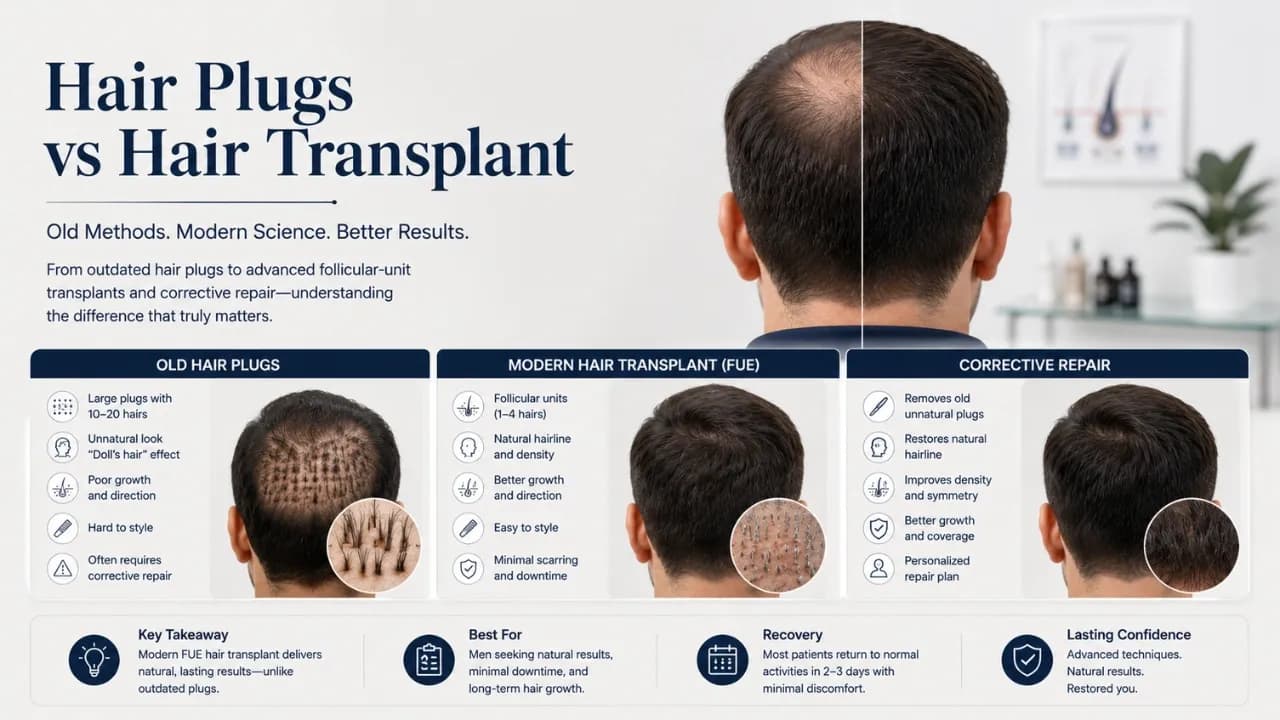
Hair plugs are an outdated form of hair transplantation, not a modern alternative to FUE or FUT. Classic plug procedures moved relatively large round grafts containing many hairs. When these tufts were spaced across a bald scalp, especially at the front, they could create the familiar “doll hair,” “corn row” or pluggy appearance. Modern hair transplantation instead works with naturally occurring follicular units, usually containing one to four hairs, so the surgeon can build a softer single-hair transition and more natural direction.
Old hair plugs can often be improved, but repair is more complex than a first transplant. Options include camouflaging large grafts with finer follicular units, excising or reducing badly placed plugs, redistributing reusable follicles, redesigning the hairline and treating donor or recipient scars. The best plan depends on how low the plugs sit, how much scar tissue is present and how much safe donor hair remains.
| Feature | Old Hair Plugs | Modern Follicular-Unit Transplant |
|---|---|---|
| Graft size | Large round punch grafts, historically several millimetres wide | Individual natural follicular units |
| Hair per graft | Often many hairs in one visible tuft | Usually 1-4 hairs according to the natural follicular unit |
| Hairline | Can look abrupt, evenly spaced or row-like | Single-hair leading edge and irregular transition can be designed |
| Repair | May need removal, division, redistribution or camouflage | Revision usually focuses on density, direction, hairline or donor damage |
What Were Hair Plugs?
The term hair plug usually refers to the older round-punch era of hair transplantation. Large circular grafts of hair-bearing scalp were removed from the donor area and placed into matching recipient holes. Professional hair-restoration history describes punch-and-plug work as an obsolete technique because the large grafts could create obvious islands of hair.
Importantly, a plug was not necessarily “dead” or failed. It could grow perfectly well and still look unnatural. Cosmetic failure came from scale and pattern: a natural frontal hairline contains irregularly spaced fine single hairs, while a plug can present as a thick cluster separated from the next cluster by visible scalp.
Why Did Hair Plugs Create the Doll-Hair Look?
- Large grafts: Too many hairs emerged from one circular island.
- Visible spacing: Grafts were separated by bald scalp to protect blood supply.
- Row-like placement: Repetition made the pattern easy for the eye to detect.
- Wrong hairline transition: Thick multi-hair grafts could sit at the very front instead of fine singles.
- Direction errors: Hair growing too upright or at inconsistent angles looked artificial.
- Progressive native hair loss: The surrounding natural hair could thin later, exposing old plug work that was previously partly hidden.
How Is a Modern Hair Transplant Different?
Modern transplantation is based on the natural follicular unit. FUE and FUT mainly describe how donor follicles are harvested. FUE removes follicular units individually with small punches, while FUT removes a strip that is dissected into individual follicular units. In both, natural grafts are then placed into recipient sites at planned angles and density.
This is why the difference is not simply “old punch versus new machine.” A modern-looking result comes from graft selection, hairline design, angles, density distribution, donor management and physician-led surgical planning. If you want the extraction details, Kibo's FUE hair transplant service explains the individual-graft approach.
Are DHI and FUE the Opposite of Hair Plugs?
Not exactly. FUE and FUT are donor-harvesting methods. “DHI” is commonly used for an implantation workflow using implanter pens, but the follicles still have to be harvested, frequently with FUE. The important modern shift is the use of natural follicular units and precise recipient-site planning rather than the old large plug graft itself.
Can Old Hair Plugs Still Grow Decades Later?
Yes. A plug can remain viable for years. That is why old plug repair is often an aesthetic reconstruction problem rather than a simple regrowth problem. Surgeons may be working with healthy transplanted hairs that are simply too large, too low, too straight, too sparse between clumps or surrounded by scarring.
How Can Hair Plugs Be Repaired?
Kibo's detailed guide to corrective hair transplant covers the broader repair process. For old plug work, the plan commonly uses one or more of the following approaches:
- Camouflage: Add fine single-hair grafts in front of or between large plugs so the eye sees a softer transition.
- Plug excision: Remove selected large or badly positioned grafts, particularly when the hairline is too low or the tuft cannot be hidden.
- Graft reduction or redistribution: Follicles from an excised plug may sometimes be separated and reused in a more natural pattern.
- Hairline reconstruction: Build a new irregular frontal transition with appropriate single-hair grafts and direction.
- Scar camouflage: Place grafts into selected scarred zones where tissue quality and blood supply allow.
- SMP or styling: In donor scars or selected cosmetic gaps, scalp micropigmentation or hairstyle change may reduce contrast without more graft harvesting.
Should Old Plugs Be Removed or Camouflaged?
| Situation | Likely Repair Direction |
|---|---|
| High enough hairline, adequate donor, plugs can be hidden | Camouflage with smaller follicular units may be efficient. |
| Very low or wrong-shaped frontal plugs | Removal/reduction may be needed before redesign. |
| Wrong-angle coarse tufts at the very front | Selective removal plus a new single-hair transition may be preferred. |
| Severely depleted donor area | Conservative camouflage/SMP/styling may preserve the remaining donor. |
What Makes Hair Plug Repair Difficult?
Repair surgery works inside tissue that has already been operated on. Scar tissue can change graft depth and blood supply. Previous large punches can leave circular donor scars. A low hairline may require multiple removal sessions. Most importantly, donor hair is finite. Every follicular unit already used, destroyed or lost through donor overharvesting reduces the material available for reconstruction.
For a pluggy hairline or scarred donor area, a dedicated Corrective Hair Transplant assessment should therefore map donor reserves before promising density.
How Is a Doll-Like Hairline Made More Natural?
Naturalness is not just about adding more grafts. Kibo's guide to hairline design vs graft count explains why distribution and transition matter as much as the total number. The first rows need a broken, irregular outline with fine single-hair grafts, while larger follicular units can sit farther behind for density. Direction should match regional scalp flow and the hairline should be age-appropriate. If the old line is too low, adding even more hair in front can make the problem worse; graft removal and hairline correction may be more logical.
Can a Modern FUE Transplant Still Look Pluggy?
Yes. Large historical plugs are obsolete, but modern surgery can still look unnatural if multi-hair units are placed at the leading edge, recipient sites are too large, angles are wrong, the hairline is too straight or the donor is overharvested. This is why “FUE” on a package is not a quality guarantee. Kibo's failed hair transplant guide covers modern causes of poor results.
How to Choose a Surgeon for Hair Plug Repair
- Ask to see several repair cases, not only first-time transplants.
- Request donor-area photographs, not only front-facing hairline photos.
- Ask what will be removed, what will be kept and why.
- Ask whether removed plug follicles can be reused and how scar tissue changes the plan.
- Confirm who performs diagnosis, donor harvesting, hairline design and recipient-site creation.
- Ask how many stages may be required and what cannot be fully corrected.
- Do not accept a graft promise from photographs alone without donor examination.
Complex revisions are especially dependent on planning and execution. Review Kibo's guide on surgeon experience in hair transplant before choosing a repair clinic.
Have an old pluggy or unnatural transplant? The first goal is to preserve donor options and decide whether removal, camouflage or staged reconstruction gives the safest cosmetic improvement.
Frequently Asked Questions
Are hair plugs the same as a modern hair transplant?
No. Hair plugs were an older transplant approach that moved large round grafts containing many hairs. Modern transplantation generally moves natural follicular units containing one to four hairs, allowing finer control of hairline shape, angle and density.
Why did old hair plugs look like doll hair?
Large tufts were placed with visible spacing or rows, especially near the frontal hairline. That created isolated clumps of hair rather than the irregular single-hair transition seen in a natural hairline.
Do doctors still perform hair plugs?
The classic large punch-and-plug technique is obsolete in modern hair restoration. The word hair plugs is still used casually online, but modern FUE and FUT transplant follicular units rather than large plug grafts.
Can old hair plugs still grow decades later?
Yes. A cosmetically unnatural plug can still contain viable transplanted follicles and continue to grow. The problem may be graft size, spacing, direction, hairline position or surrounding progressive hair loss rather than graft survival.
Can hair plugs be removed?
Selected plugs can sometimes be excised or reduced using punch-based removal, FUE-style excision or other surgical techniques. Some removed follicles may be divided and reused, but scar tissue and graft depth can make repair technically difficult.
Can a pluggy hairline be camouflaged instead of removed?
Sometimes. Carefully placed single-hair and smaller follicular-unit grafts can soften the leading edge and fill gaps. Whether camouflage is enough depends on hairline height, plug position, donor supply, scarring and the density needed.
How many procedures does hair plug repair take?
There is no universal number. Minor pluggy areas may improve in one staged correction, while low hairlines, multiple rows of plugs, scarring or depleted donor areas can require more than one procedure.
Is FUE always better for repairing hair plugs?
No. FUE can be useful for removing or harvesting selected grafts, while FUT can sometimes provide additional donor grafts when scalp laxity and scarring permit. Repair planning is case-specific and may combine approaches.
What is cobblestoning after a hair transplant?
Cobblestoning is an uneven raised recipient-skin texture that can occur when grafts are placed too superficially or tissue heals irregularly. Repair may require graft removal, tissue correction, camouflage or a combination.
Can a very low transplanted hairline be raised?
Sometimes, but it is a complex corrective problem. Poorly positioned grafts may need removal over one or more sessions before a higher, softer hairline can be reconstructed.
What is the biggest limitation in corrective hair transplantation?
Donor hair is finite. If the donor area was overharvested or scarred in previous surgeries, the surgeon may have fewer follicles available for camouflage and reconstruction.
When should I assess a bad modern hair transplant for repair?
Unless there is an urgent medical complication, aesthetic revision is usually judged after the original transplant has matured enough to show its true growth pattern. Many corrective plans are made around the 12-month or later stage, depending on the case.
Bottom Line
Hair plugs belong to an older era of hair transplantation. The transplanted hairs may still grow, but the large graft size, visible spacing, direction and low or abrupt hairline can create a doll-like result. Modern follicular-unit surgery is designed around much smaller natural grafts and better aesthetic planning.
Old plug work is often repairable, but corrective surgery is a donor-management problem as much as a hairline-design problem. A good plan says what should be removed, what can be camouflaged, what donor hair remains and what improvement is realistic before another graft is harvested.
Related Articles & Services
Hair Transplant
Direct Hair Transplant (DHT) | Sapphire FUE Hair Transplant | Real-Time FUE Hair Transplant | Unshaven Hair Transplant | Body Hair Transplant
Hair Regrowth
PRP Therapy | GFC Therapy | Low-Level Laser Therapy | Microneedling for Hair Regrowth
Must Read
Complete Hair Transplant Guide | FUE Hair Transplant Guide | Hair Transplant Safety | Graft Survival Factors | Hair Transplant Procedure Steps
Relevant Blogs
Hair Transplant Side Effects | Hair Transplant Long-Term Maintenance | How to Read Before-and-After Photos | Hair Transplant Results Timeline | Norwood Scale
Medical Disclaimer : Information from Kibo Hair Clinics is for educational purposes only. It does not replace diagnosis, trichoscopy, blood test interpretation, prescription treatment, procedure advice, or side-effect counselling from a qualified dermatologist or hair restoration doctor.